Doña Carmen had never considered herself a suspicious woman. She was the kind of grandmother who kept extra towels folded by the bathroom, soup bones in the freezer, and a spare prayer card tucked behind the kitchen clock.
Alejandro was her only son, and for years she had measured her life by his arrivals. First school uniforms, then scraped knees, then work boots left by the back door whenever he came home tired.
When he married Valeria, Doña Carmen tried to love her with the same patience. She gave the young couple keys to the house, recipes for colic tea, and permission to ask for help before pride swallowed them.
Santi arrived 2 months before that Saturday, small enough to fit in the bend of an elbow. Doña Carmen called him her second sunrise, because his cries woke the whole house and somehow made it brighter.
Valeria seemed exhausted after the birth. Alejandro seemed nervous, though he dressed his nerves as responsibility. He spoke quickly, checked his phone often, and insisted they were managing even when his eyes said otherwise.
Doña Carmen noticed things, but she explained them kindly. New parents looked afraid. New babies cried. A mother-in-law could become a burden if she mistook every tired face for a confession.
That Saturday morning, the house smelled of Fabuloso, wet tile, and coffee brewed dark in a pot. The clock over the sink ticked with the stubborn sound of plastic gears refusing to miss a second.
At exactly 11:23, Alejandro placed Santi in her arms. His smile flashed too quickly. Valeria kissed the baby’s forehead, adjusted the blue blanket, and said they were going to the plaza for “just one hour.”
Doña Carmen remembered the phrase later because it sounded rehearsed. Not false enough to accuse. Not natural enough to forget. Alejandro took the keys, Valeria took her purse, and the door closed behind them.
At first, Santi’s crying seemed ordinary. Doña Carmen warmed the bottle Valeria had left on the counter, tested it against her wrist, and settled into the rocking chair where Alejandro once slept through storms.
The baby turned away from the nipple. Milk slipped down his cheek, and his little mouth opened wider. The sound changed from hunger to panic so quickly that Doña Carmen felt her own breath shorten.
She sang the lullaby she had used with Alejandro, the one about the moon guarding children through the night. Usually, babies softened at rhythm before they understood words. Santi only screamed harder.
At 11:38, Doña Carmen looked at the clock again. Only 15 minutes had passed, but the room felt colder. The mop scent, the coffee, the clean counters, none of it matched the fear in her hands.
Santi arched his back suddenly, fists pressed to his chest. His cry sharpened until it no longer sounded like a complaint. It sounded like a warning coming from a body too small to defend itself.
Any true Mexican mother knows the difference between a cry that asks to be held and a cry that begs for help. Doña Carmen had learned that truth before she ever learned to read a thermometer.
She carried him to the changing table with care so exact it almost resembled calm. Her fingers trembled against the snaps of his onesie. Each click sounded louder than it should have in that clean room.
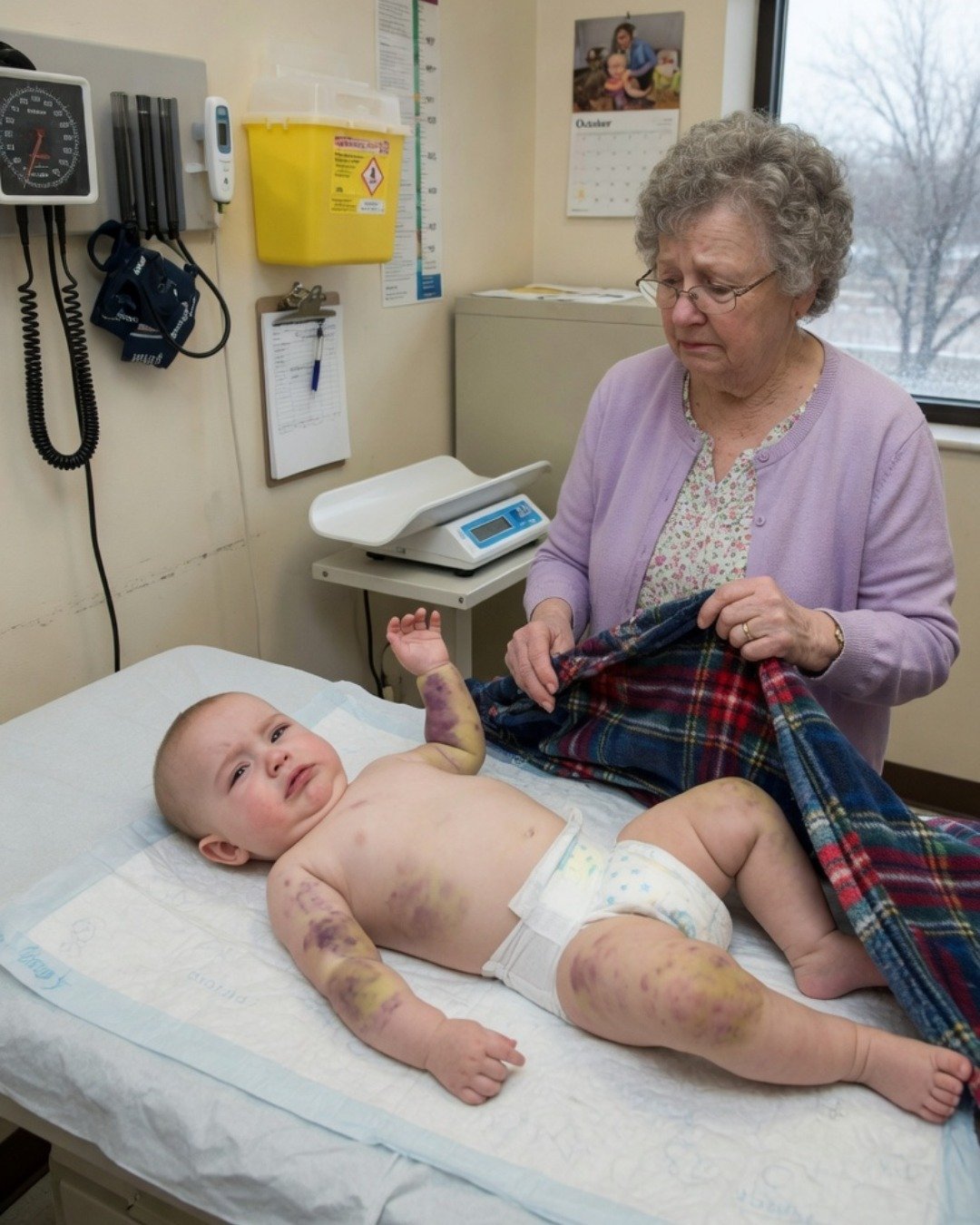
The yellow cloth opened. The diaper edge lifted. Just above the line, on the soft skin of his belly, there was a dark swollen mark shaped like human fingers.
For a moment, Doña Carmen did not understand what her eyes were telling her. Then the curve of four small presses and the heavier shadow of a thumb arranged themselves into a fact.
It was not a rash. It was not an allergy. It was not one of those ordinary red marks babies collect from blankets, seats, and diapers. It was pressure. It was force. It was recent.
She did not call Alejandro. That decision saved the investigation later. Panic often wants a voice, but proof is how panic learns to stand upright, and Doña Carmen chose proof before rage.
She took one clear photograph against the yellow cloth without pressing the skin. Then she wrote Saturday, 11:41 a.m., on the back of an electricity envelope and placed it inside the diaper bag.
Her anger went cold in a way that frightened her. She imagined Alejandro returning with explanations ready. She imagined Valeria crying before anyone accused her. She imagined the entire truth trying to hide behind exhaustion.
Instead, Doña Carmen wrapped Santi in the blue blanket, packed the bottle, the photograph, the envelope, and the diaper bag, then buckled him into the back seat with hands that shook only after the clasp clicked.
The drive to the Municipal Pediatric Emergency Unit felt endless. Every red light felt personal. Every whimper from the back seat made Doña Carmen press one hand to the steering wheel until her knuckles whitened.
When she arrived, the glass doors slid open on bright clinical light. A mother in the waiting room stopped feeding her child. A security guard froze with his pen above a clipboard. Nobody moved.
The nurse behind the desk heard Santi before she saw him. Her face changed in the small professional way that told Doña Carmen the woman had seen enough pain to recognize urgency without asking permission.
“Who was alone with this baby?” the nurse asked.
“His parents,” Doña Carmen answered. “Alejandro and Valeria.” Saying their names inside that emergency room felt like setting them down on a table where nobody could pretend they were only family anymore.
The nurse examined Santi, called for a doctor, and asked Doña Carmen not to call Alejandro yet. Then she opened the diaper bag and found the folded pediatric intake form under the wipes.
Santi’s name was written across the top. Under “reason for visit,” someone had started one sentence in blue ink: “Won’t stop crying since last night.” The time box was blank. The silence after that discovery changed everything.
The doctor documented the bruising, photographed the marks, and ordered a full examination. A hospital social worker joined them. Then the nurse filed a mandatory child safety report before Alejandro and Valeria even returned from the plaza.
Doña Carmen sat beside the exam table, one hand near Santi’s foot, careful not to crowd the doctor. She felt old and young at once, like a mother again and a grandmother for the first real time.
Alejandro called at 12:09. Doña Carmen let it ring. Valeria called next. Then Alejandro texted, asking whether Santi had “settled down yet,” as if the answer could still be ordinary.
By 12:31, a child protection officer and a police investigator arrived at the unit. They reviewed the photograph, the intake form, the bottle, the envelope, and the nurse’s notes before anyone spoke to the parents.
When Alejandro and Valeria walked through the emergency entrance, their calm was gone. Alejandro looked from the officer to his mother, then to the blue blanket. Valeria saw the intake form first and stopped moving.
“What happened?” Alejandro asked, but the question landed wrong. It sounded less like ignorance than a man testing which version of the truth had reached the room before him.
The investigator separated them. Doña Carmen did not hear the interviews, but she watched enough through the glass to understand. Valeria cried quickly. Alejandro sat very still. Neither of them asked to hold Santi first.
That detail stayed with her longer than the shouting that came later. A frightened innocent parent reaches for the baby before defending a story. Alejandro reached for an explanation. Valeria reached for tissues.
The medical report described bruising consistent with gripping pressure. It did not decide guilt in a sentence, because reports do not speak like grandmothers. But every measurement, photograph, and timestamp narrowed the space where lies could stand.
Santi was kept under observation that night. Doña Carmen remained in the chair beside him, refusing a blanket for herself until the nurse brought one and placed it over her shoulders without asking.
By morning, temporary custody had been assigned to Doña Carmen while the investigation continued. Alejandro argued. Valeria cried. The officer repeated the order calmly, and the calm was worse than yelling.
Over the following weeks, the house changed. The rocking chair moved closer to the window. Bottles were labeled. Medical appointments were logged. Doña Carmen became careful with every document because carefulness had saved Santi once.
Alejandro was allowed supervised visits only after the first court review. Valeria was ordered into parenting assessment and counseling. Neither result felt like victory to Doña Carmen. Victory was a word too loud for a baby still healing.
The case moved slowly, as cases do when truth must become paperwork. The pediatric report, the emergency intake form, and Doña Carmen’s 11:41 photograph became the spine of the file.
In court, Alejandro tried to say he had not understood how hard he was holding Santi during a night of crying. Valeria admitted they had considered taking him in earlier but feared questions.
Doña Carmen listened without interrupting. Her jaw stayed locked, her hands folded in her lap. She had imagined anger would burn forever, but by then it had become something steadier and more useful.
The judge ordered continued placement with Doña Carmen, required supervised contact, and set conditions neither parent could avoid. The decision was not a fairy-tale ending. It was a locked door placed between Santi and excuses.
Months later, the bruises were gone. Santi learned to smile at ceiling fans, grab Doña Carmen’s finger, and fall asleep to the old moon lullaby his father had once heard in the same room.
Doña Carmen still kept the blue blanket folded in a drawer. She did not keep it as a shrine to fear. She kept it as a reminder that love without action is only a feeling.
They had left their 2-month-old baby with his grandmother for “just one hour,” but that hour became the line between what a family pretended to be and what a grandmother was brave enough to see.
Near the end, when people asked how she knew, Doña Carmen never described herself as heroic. She only said the same simple truth: proof is how panic learns to stand upright.
And if there was one lesson she wanted every family to remember, it was this. A baby cannot explain pain. Someone who loves him must be willing to listen before the world calls it proof.