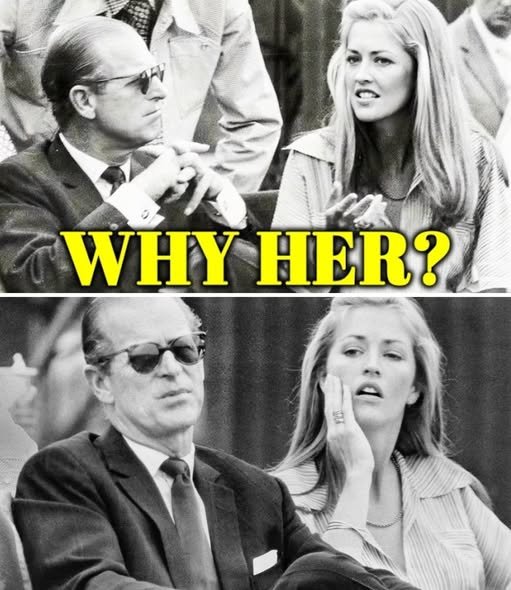
Prince Philip & Penny Were Inseparable—And the Palace Knew
By the time most people noticed her, the royal household had already stopped pretending not to. That is, perhaps, the most delicious part of this tale. It was not that the Duke of Edinburgh simply had a close female friend. Royal men have always had companions, ever since crowns were first fashioned from hammered metal.
What made people stare was the profound ease of it all, the steadiness, and the way Penelope Knatchbull seemed to appear and reappear, year after year. She was never tucked away like a sudden embarrassment, nor explained away as a passing social convenience. She was simply there.
You would see her at carriage driving events, at relaxed country weekends, and at those intimate royal gatherings where seats are never allocated by mere accident. She was not a passing face in the crowd. She had become part of the pattern. And in royal life, the pattern tells you absolutely everything.
It is wonderfully tempting to begin with whispers of scandal. The very premise all but begs for raised eyebrows and lowered, hushed voices. Yet, scandal is only truly satisfying when the people inside it feel real. So, before the palace staff began clocking how often Philip and Penny were together, we must look at the human truth.
Before the world started doing what it always does when observing a man and woman enjoying one another’s company rather too much, there was simply a prince who had spent a lifetime standing next to a crown that would never be his. And there was a younger woman who learned, far too early, that the grandest families in Britain could look immaculately polished in public, whilst still bleeding in private.
Prince Philip had always been a rather strange fit for the supporting role he ended up playing. He was not born to the serene comfort that people like to imagine royalty inhabit. He was born into high rank, certainly, but never into calm.
His early life was dislocated, unstable, and filled with the sort of familial chaos that leaves a person with a gleaming surface and a locked room inside. By the time he married Princess Elizabeth, he was devastatingly handsome, fiercely sharp, and absolutely unsuited to the soft, domestic costume some expected a royal husband to wear.
He was never going to spend his life smiling faintly in the background, feeling eternally grateful for the privilege. He married a woman he loved deeply, and then watched her become something vastly larger than any ordinary marriage can comfortably hold. Once Elizabeth became Queen, Philip had to work out how to be central and secondary at precisely the same time.
He filled his days. He filled the silence with endless projects, with sport, with engineering, with travel, and with relentless movement. He liked people who could keep up. He had very little patience for fuss, flattery, or emotional clutter. Put him in a formal drawing room, and he might look restless and cutting. Put him near horses, engines, or open land, and he suddenly made perfect sense.
Penelope Eastwood was born into new wealth, not into the old Gothic romance of inherited nobility. In Britain, there is a distinct difference, and everyone in the right circles knows it. Yet, Penny learned how to move in high society without looking as if she had studied for it, which is a rare talent in itself.
She was incredibly attractive, wonderfully calm, and socially intelligent. She possessed something far more useful than a desperate need to be noticed; she could be present without ever pushing.
When Penny married Norton Knatchbull, Lord Romsey, in 1979, she stepped into one of the most emotionally complicated dynasties connected to the House of Windsor. Norton was the grandson of Lord Louis Mountbatten, Philip’s adored uncle and mentor.
It was a terrible moment for a wedding. Only weeks prior, Lord Mountbatten had been assassinated, a tragedy that tore through the family with savage force. Among the dead was Norton’s younger brother, Nicholas, only fourteen years old.
The wedding went ahead in an atmosphere thick with grief. Black clothes were barely put away. Guests spoke in those careful, low voices people use when they do not trust joy to hold the room. Penny entered the Mountbatten world not as a decorative addition, but as someone who had to absorb shock quickly and keep moving.
She learned the great house of Broadlands, the habits, the heavy expectations. She made herself quietly indispensable, a skill so often underestimated. There is nothing effortless about becoming essential to a great family; it means enduring without self-pity and understanding that grand households are held together by hidden labour.
Families are bound most tightly not by glamour, but by shared catastrophe. Penny and Norton had three children, and their life from the outside resembled the reassuring image of aristocratic continuity. But family photographs only ever catch the light; they invariably miss the strain.
In 1991, their youngest child, Leonora, died of kidney cancer at the tender age of five. There are losses that merely reorder a life, and then there are losses that crack it open altogether. The death of a small child belongs entirely to the latter.
People who only knew Prince Philip as a sharp-tongued old Duke often missed the fact that he possessed a profound understanding of sorrow. He met pain much like a soldier meets terrible weather. You do what must be done, you stay upright, and you keep the body moving until the mind can bear itself again.
After Leonora’s death, Philip gently encouraged Penny to take up carriage driving. To the uninitiated, it sounds like a quaint hobby for people with too much land. For Philip, it was a fiercely serious pursuit requiring absolute nerve, technical skill, physical courage, and total concentration.
Inviting Penny into that world was not a small gesture. It was time, patience, and a lifeline. Grief traps people in the room where the loss happened; activities that demand the whole body can pry open a window. Philip did not offer Penny a role as a tragic figure to be pitied. He gave her something difficult to master.
That is so often how the deepest attachments begin. Not with grand declarations or thunderbolts of romance, but with usefulness and perfect timing. He taught her, and they trained. They spent hours together outdoors with horses, finding immense relief in talking when they wished to, and remaining silent when they did not.
He was decades older, old enough to be considered absurd if one insisted on reading the story in the most obvious, cynical way. But human relationships stubbornly refuse to arrange themselves merely to flatter public expectations.
Philip was the consort who had spent his life beside history without directing it. Penny was the grieving mother whose life’s ordinary structures had been utterly hollowed out. Around one another, they found a freedom that had nothing to do with seduction, and absolutely everything to do with relief.
Of course, people noticed. Yet, the fascinating detail is how little the royal household did to discourage the friendship. Palaces are absolute experts in frost. If they wish to cool an association, invitations quietly stop. Timetables shift. Distance magically appears.
But Penny kept appearing. She was socially acceptable, supremely discreet, and already embedded in the family’s wider life. She never gave indiscreet interviews or attempted to cash in on her proximity. Good behaviour can buy extraordinary tolerance.
Queen Elizabeth herself understood her husband infinitely better than most. She knew his desperate need for active, undemanding companionship outside the solemn machinery of the monarchy. She knew the crucial difference between a vulgar threat and a settled friendship.
Great marriages, particularly very long ones, often contain practical arrangements that would hopelessly confuse those accustomed to much simpler romantic scripts. The Queen had her role; Philip had his restless nature. Between them existed a bond too old and too useful to be governed by naive expectations.
As the years rolled on, Philip’s calendar increasingly reflected the shape of his true preferences. He liked being in places where he could shed ceremonial stiffness and simply be himself. Sandringham, Windsor, and quiet country estates where the food was plain, the jokes were dry, the dogs were underfoot, and the company was profoundly familiar.
Penny fitted those settings beautifully. She understood the glorious beauty of mud, routine, unpredictable British weather, horses, and long, practical afternoons. She belonged effortlessly in Philip’s chosen kingdom.
By the turn of the new century, the old palace question of what exactly Penny was to Philip had ceased to matter. The plain fact was that she was wonderfully necessary to the texture of his days. If there were events he loved, she was likely nearby.
As Philip entered his nineties, he faced the quiet humiliations that visit men who have always identified with vigour. In that delicate stage of life, when bodies slow and old friends pass away, a trusted companion becomes more precious than any grand public honour.
Penny did not smother him or sentimentalise his age. She treated him as himself, which, for a man in his unique position, was far more intoxicating than any shallow flattery. She offered him the most useful gift of all: continuity. In her presence, he could remain the same fiercely independent man.
Their bond was tested not by melodrama, but by the relentless passage of time. When duty thins, when the public role narrows, and the applause moves on to younger figures, the people who remain are there solely because they actively choose to be.
When Prince Philip finally stepped back from public duties, retreating to the quiet comfort of Wood Farm, Penny was one of the few who remained a constant presence. She had become a keeper of continuity in his twilight years, a friendly, weathered face that made the immense machinery of royal life feel far less mechanical.
The public always prefers neat categories: wife, mistress, friend, or confidant. Yet Philip and Penny hovered in that beautifully inconvenient, deeply human place. It was an attachment too intimate to casually dismiss, too enduring to laugh off, and entirely too layered to explain quickly.
They had built something exquisitely sturdy out of shared grief, mutual respect, and a profound love of the quiet British countryside. In a world utterly obsessed with the noise of scandal, theirs was a silent, enduring truth, a poignant story of two restless souls who simply found their perfect weather in one another.