In the grand, marbled halls of American power, reality has increasingly become an optional elective. For decades, political scientists and historians have warned about the eroding foundation of truth in public discourse, but every so often, a singular moment crystallizes the crisis with such devastating clarity that it stops being a abstract academic debate and becomes a tragicomedy.
That moment arrived in full force during a series of high-stakes congressional hearings, culminating in an extraordinary, viral exchange between Senator (and acting administration surrogate) Marco Rubio and Representative Ted Lieu. It was a confrontation that had everything: geopolitical denialism, a literal videotape of a sleeping commander-in-chief, a brazen denial of physical reality caught on camera, and a stark reminder that in contemporary Washington, the traditional mechanisms of accountability have not just broken down—they have been willfully dismantled.
At its core, this episode is about two distinct but deeply intertwined lies: a macro-level geopolitical lie about an ongoing, volatile conflict involving Iran, and a micro-level, sycophantic lie about the physical state of the President of the United States. Together, they illustrate a political culture where loyalty to a narrative completely supplants loyalty to observable facts, and where “lying to Congress” has transformed from a federal felony into just another Tuesday in the news cycle.
Part I: The Geopolitical Mirage — Declaring Peace Amidst the Smoke
The saga began not with a personal defense, but with a sweeping, breathtakingly inaccurate declaration of geopolitical victory. Speaking before lawmakers, Marco Rubio confidently declared that the ongoing, high-stakes military conflict with Iran was, for all intents and purposes, “over.”
To anyone tracking global intelligence, maritime shipping data, or regional news broadcasts, the statement felt like it belonged to an alternate universe. Even as Rubio was uttering the words, the Middle East was actively smoking from fresh ordnance.
The Reality on the Ground
The disconnect between Rubio’s rhetoric and the reality on the ground was not a matter of nuanced interpretation or strategic forecasting; it was a matter of incoming missiles versus a theoretical peace.
The Kuwait Airport Strike: In the early hours surrounding Rubio’s testimony, Iranian-backed forces launched missile strikes targeting infrastructure in Kuwait, including areas near its critical international airport.
The Bahrain Drone Incursions: Simultaneously, low-flying drone strikes penetrated Bahraini airspace, striking localized targets and sending regional defense systems into high alert. International outlets like France24 and Al Jazeera meticulously documented these kinetic actions in real-time.
The Chokepoint Crisis: Beyond the immediate explosions, the broader strategic landscape directly contradicted the “it’s over” narrative. The Strait of Hormuz—the vital global economic artery through which a massive percentage of the world’s petroleum passes—remained effectively closed or heavily contested to commercial transit.
Troops in Harm’s Way: Thousands of United States service members deployed throughout the region remained locked in defensive postures, regularly intercepting incoming threats and facing immediate, lethal risk.
Why the “Mission Accomplished” Narrative Persists
Rubio’s rush to declare the conflict finished belongs to a long, tragic tradition in American foreign policy: the premature declaration of victory for domestic political consumption. Much like George W. Bush’s infamous “Mission Accomplished” banner aboard the USS Abraham Lincoln in 2003, declaring a conflict “over” is an attempt to retroactively validate a strategy, signal strength, and pivot the domestic news cycle away from an unpopular, grinding reality.
However, when a senior statesman declares a war over while the missiles are still in mid-air, it ceases to be standard political spin. It becomes a dangerous form of gaslighting that undermines the credibility of American foreign policy on the global stage. Allies in Kuwait and Bahrain, looking at the craters in their territory, are left to wonder why their primary security partner is pretending the sky isn’t falling.
Part II: The Micro-Lie — The Myth of the Sleepless Leader
If the declaration of peace in the Middle East was the macro-lie designed to project strategic dominance, what followed in the House Foreign Affairs Committee was the micro-lie designed to protect an fragile executive ego. It was here that the grand strategy dissolved into pure political slapstick.
During a contentious line of questioning regarding executive competence and stamina, Representative Ted Lieu of California confronted Rubio regarding the President’s engagement during critical briefings. Specifically, Lieu pressed Rubio on reports that the commander-in-chief regularly nodded off during high-level Cabinet meetings.
Rubio’s response was absolute, unyielding, and aggressively defensive. With a completely straight face, Rubio asserted to the committee that the President “doesn’t sleep,” painting a picture of an indefatigable leader possessing superhuman stamina, working around the clock without ever succumbing to a moment of physical exhaustion. Furthermore, Rubio asserted that he had never once witnessed the president lose focus, let alone fall asleep, in any meeting they had shared.
It was an assertion rooted not in human biology or observable reality, but in the North Korean-style hagiography that has increasingly come to define the internal culture of modern political factions. Leaders cannot be tired; they cannot be human; they must be flawless.
Enter the Receipts
What Rubio seemingly forgot—or simply chose to disregard—was that modern congressional hearings take place in a room filled with cameras, and that history leaves a digital trail.
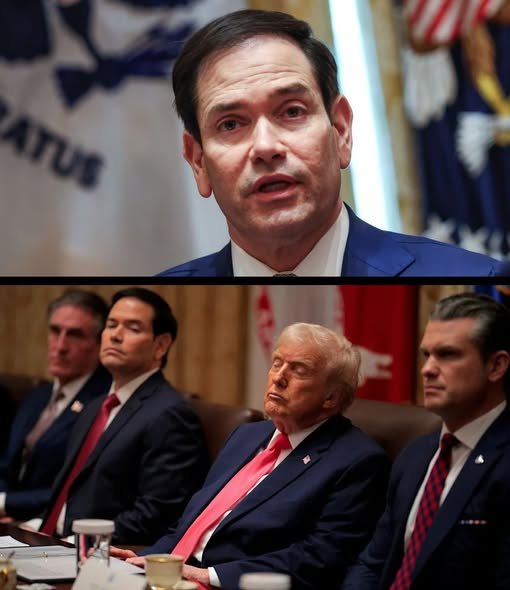
With those words, Lieu cued up a piece of footage that would immediately explode across the internet. The video did not feature an ambiguous angle or a momentary blink. It was a crystal-clear, high-definition recording of a White House Cabinet meeting.
The visual layout of the footage was devastating to Rubio’s testimony:
In the foreground/mid-ground: Marco Rubio himself is sitting at the main table, actively speaking, gesturing, and laying out a policy position.
Directly next to him: The President of the United States is slumped squarely in his leather chair. His eyes are firmly shut. His chin is tilted toward his chest. His posture is relaxed to the point of complete inertia. He is, by any reasonable human definition, fast asleep.
The irony was mathematically perfect. Rubio wasn’t just being accused of hiding the fact that the President slept in a meeting; he was caught on camera denying a moment where the President fell asleep while Rubio himself was speaking directly next to him.
Part III: The Double-Down — The Death of Shame
In a previous era of American politics, being confronted with such ironclad, visual refutation of your testimony would trigger a recognizable sequence of political damage control. There would be a visible flush of embarrassment, a stammered clarification (“What I meant to say was…”), an excuse about jet lag or a grueling schedule, or a quiet retreat behind a wall of staff-issued press releases.
But we no longer live in that political era. We live in the era of the Double-Down.
When the video concluded and the committee room held its collective breath, Rubio did not blink. He did not concede that his previous statement might have been an exaggeration or an oversight. Instead, facing the video evidence in real-time, he flatly denied it again. He insisted that what the video showed wasn’t sleep, that the interpretation was a partisan hit job, and that his original narrative—the myth of the sleepless, omnipresent leader—remained intact.
This reaction is the most illuminating and terrifying part of the entire exchange. It represents a total abandonment of the concept of a shared, objective reality. It relies on a simple, authoritarian premise: Do not believe your lying eyes; believe my political alignment.
The Psychology of Contemporary Political Sycophancy
Why would an experienced, highly educated politician like Marco Rubio degrade his own public credibility by denying a videotaped fact? The answer lies in the harsh mathematics of modern political survival.
In the current ecosystem, the penalty for acknowledging an uncomfortable truth about your own camp is swift, brutal, and politically fatal. To admit that the leader is tired, aging, or detached is to signal disloyalty. Disloyalty invites primary challenges, donor abandonment, and exile to the political wilderness.
Conversely, the reward for a brazen, shameless defense of the indefensible is immense. It signals to the base and to the executive branch that you are willing to sacrifice your own intellectual integrity on the altar of the cause. In that framework, looking directly at a video of a sleeping man and saying “he’s wide awake” isn’t an act of stupidity—it’s an act of supreme political fealty.
Rubio says Cuba leaders must go as US dangles $100 million
Part IV: The Broken Shield — Why 18 U.S.C. § 1001 No Longer Bites
To understand why this happens, one must look at the legal framework that is supposed to prevent it. Under United States federal law, specifically 18 U.S.C. § 1001, making a materially false statement to Congress is a serious crime. It carries a penalty of up to five years in a federal penitentiary. It is the very law that has brought down past political operators, intelligence chiefs, and corporate executives.
Yet, as the dust settles on Rubio’s testimony, there is an overwhelming, cynical consensus across the political spectrum: absolutely nothing will happen.
The enforcement of perjury and false-statement laws within a legislative context relies on a weapon that has been thoroughly dulled: bipartisan institutional self-defense. For Congress to hold someone accountable for lying to it, there must be a collective agreement that the integrity of the institution matters more than the protection of partisan allies. That agreement no longer exists.
If a committee controlled by one party accuses a member of the other party of lying, the accusation is instantly dismissed by half the country as a partisan witch hunt. The Department of Justice, acutely aware of the optics of prosecuting political figures, raises an incredibly high bar for what constitutes a prosecutable lie under these circumstances. A politician can easily claim they “remembered the event differently,” or that their definition of “asleep” requires a clinical EEG reading, creating just enough rhetorical smoke to make a criminal prosecution non-viable.
Part V: The Broader Crisis — The Corrosion of Democracy
The spectacle of Marco Rubio denying both an ongoing war and a sleeping president is a symptom of a deeper, systemic rot that threatens the viability of democratic governance.
Democracy requires a basic, baseline agreement on facts. We can argue passionately about what the top marginal tax rate should be, or how to handle a geopolitical adversary; we cannot have a functioning system if we cannot agree on whether it is raining outside, whether a missile exploded in Kuwait, or whether a person’s eyes are open or closed.
When public officials normalize the outright denial of physical evidence, they aren’t just winning a 24-hour cable news cycle; they are actively eroding the public’s trust in all institutions. If everything is a lie, if every video is a deepfake or a partisan distortion, then the average citizen throws up their hands in exhaustion. They stop trying to discern the truth, retreating into their own echo chambers where they only believe what comforts them.
This exhaustion is the ultimate goal of modern political gaslighting. It is not designed to convince you that the lie is true; it is designed to weary you to the point where you no longer care about the difference between a lie and the truth.
Marco Rubio Is Leading Trump’s Pressure Campaign Against Venezuela – WSJ
Conclusion: A News Cycle in the Wilderness
As the week draws to a close, the cycle moves on. The video of Ted Lieu playing the clip to a stone-faced Marco Rubio will rack up millions of views on social media, accompanied by laughing emojis from one side and angry deflections from the other. It will be carved up into twenty-second clips for late-night television monologues and utilized in fundraising emails for opposing political campaigns.
Meanwhile, the Strait of Hormuz will remain tense, service members will continue to monitor regional radar screens for Iranian-engineered threats, and the halls of Congress will remain filled with individuals willing to look at a camera and deny the very reality it captures.
Marco Rubio’s day in committee was a stark reminder of the current state of play. Lying to Congress used to be a high-stakes gamble that could end a career or land a person in a jumpsuit. Today, protected by the armor of hyper-partisanship and a media ecosystem optimized for outrage rather than accountability, it is simply the price of doing business—a temporary flash in a relentless, unforgiving news cycle that leaves the truth buried beneath the noise.