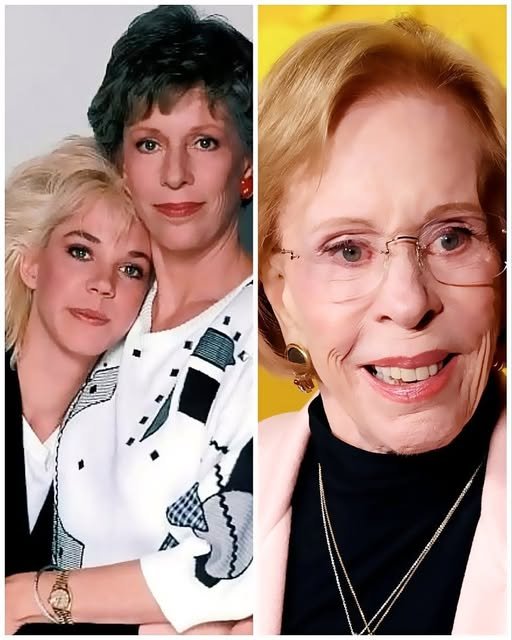
Carol Burnett’s life was a masterclass in contrasts: boundless laughter intertwined with profound sorrow, public triumph shadowed by private grief, and the unyielding commitment of a mother who would face the hardest losses imaginable. On January 20, 2002, Carol experienced the ultimate heartbreak—her daughter Carrie Hamilton died at the age of 38. Carrie’s death did not arrive in isolation; it intersected with decades of surviving hardship, professional pressure, and the enduring scars of a childhood spent in poverty and emotional complexity.
The woman who had once made millions laugh now faced mornings she could barely bear. Carol’s grief was raw, palpable, and unvarnished, yet it was deeply human—a reminder that behind every legendary performer is a lifetime of struggle, love, and sacrifice.
A Childhood Forged in Hardship
Carol was born on April 26, 1933, in San Antonio, Texas, to Joseph Thomas Burnett, a movie theater manager, and Ina Louise Creighton, a publicity writer. Her parents’ marriage was troubled, and after they separated, Carol was mostly raised by her grandmother Mae in a modest Hollywood apartment. The small apartment belied the enormous emotional weight it contained. Poverty and the specter of addiction loomed over her formative years. Her father struggled with alcoholism, and later her mother’s drinking would compound the instability in young Carol’s life.
She remembered poverty plainly. “It meant that we were poor. Every week somebody would show up and give us a chicken to fry, and hand-me-down clothes for me to wear,” she recalled. These early experiences shaped Carol’s resilience and her capacity for empathy, creating a foundation that would serve her through life’s immense challenges.
Mae’s apartment, located down the hall from Carol’s mother, became a space of sanctuary and tension simultaneously. Music and laughter flowed alongside arguments and the unpredictability of adult conflict. In this environment, Carol developed a coping mechanism common to children in turbulent homes: she imagined a “perfect family” of her own, a quiet way of surviving a world in which love was present but safety was never guaranteed.
Early Losses and Growing Responsibility
Tragedy visited Carol early and often. Her father died in 1954 at the age of 47, followed a few years later by her mother at 46, both victims of alcoholism. These deaths coincided with Carol’s nascent career ambitions, adding responsibility for her teenage half-sister, Chrissie, to her already heavy load. At a young age, she understood the duality of life: the joy of personal accomplishment shadowed by grief and duty.
Somehow, Carol navigated these difficulties to reach Broadway, securing a breakthrough in the musical “Once Upon a Mattress” in 1959. The stage became both an escape and a proving ground. Her talent, comedic timing, and ability to connect with audiences distinguished her, laying the groundwork for the groundbreaking television success that would follow.
The Rise of a Television Icon
In 1967, “The Carol Burnett Show” premiered, cementing her status as a household name. Audiences responded to her impeccable comedic timing, the signature ear tug, the iconic Tarzan yell, and the genuine warmth that radiated through the screen. Yet behind the laughter lay an unspoken complexity. Viewers saw humor and effervescence, but few could perceive the pain that informed it—the loss, the instability, and the resilience that defined her life.
Carol’s marriage to producer Joe Hamilton in 1963 introduced new joys and challenges. Together, they had three daughters: Carrie, Jody, and Erin. Carrie, the eldest, displayed immense creativity and drive, a mirror of her mother’s ambition and heart. But adolescence brought turbulence, introducing addiction into the family home. Carol approached these challenges with a difficult, unwavering love.
“I’m happy to say she got off drugs, but during those three years it was hell. At one point I had to throw her into a rehab place before she was 18 and she hated me. She totally hated what I was doing to her,” Carol recalled. This parenting was neither glamorous nor easy; it was the necessary, painful work of love, undertaken with the hope of a future redemption that would one day be realized.
Motherhood and the Bond of Creativity
Carrie emerged from her teenage struggles with resilience and ambition, becoming an accomplished actress, writer, singer, and playwright. Mother and daughter collaborated professionally, most notably on the play “Hollywood Arms” (2002), which drew on Carol’s own childhood experiences and the complex emotional landscapes they shared. Their partnership was more than artistic—it was a testament to the evolution of a mother-daughter bond shaped by hardship, recovery, and love tempered by adversity.
Carrie’s presence was a source of pride and fulfillment for Carol, representing the triumphs of both their lives. Together, they embodied a rare intimacy that intertwined personal history with professional expression, using art as both a reflection and a healing medium.
The Cruel Hand of Illness
In August 2001, this fragile equilibrium was shattered. Carrie was diagnosed with lung cancer, which spread rapidly to her brain. In five months, she succumbed to cancer-related pneumonia, leaving Carol to endure the unbearable task of burying a daughter. The grief was profound, layered atop decades of surviving loss, struggle, and personal demons.
Carol did not attempt to romanticize or sanitize her grief. “Carrie passed away and I… Well, I’m her mom, and I didn’t want to get out of bed. And my husband said, ‘Carol, you owe this not only to Carrie but you owe it to Hal to finish,’” she said, acknowledging the necessity of continuing life amid heartbreak.
She traveled to Chicago for the opening of “Hollywood Arms,” a play Carrie would never see. In her hotel room awaited birds-of-paradise flowers, echoing the tattoo Carrie had carried on her shoulder, alongside champagne labeled with Carrie’s middle name, “Louise,” honoring both mother and daughter. On opening night, the rain seemed to Carol like her daughter’s presence—proof that love and memory endure, even in absence.
Carol Burnett Opens Up About Her Daughter’s Death
Legacy and the Measure of Life
Carol’s reflections on Carrie illustrate a profound understanding of the human legacy: “The legacy is really the lives we touch, the inspiration we give, altering someone’s plan, if even for a moment, and getting them to think, rage or cry, laugh, argue, walk around the block dazed.” The mark we leave on the world, she realized, is less about fame, wealth, or accolades, and more about the depth of connection and impact on those around us.
Even after such loss, Carol’s laughter remained—a deliberate, vital act. Some hearts continue to laugh not because they have moved past sorrow, but because to stop would be unbearable. Humor became her shield, her channel, and her homage to a life and a daughter she could never forget.
Survival, Art, and Enduring Love
Carol Burnett’s life is an intricate tapestry of triumph and tragedy, each thread colored by the challenges of her early years, the intensity of her career, and the raw realities of motherhood. Her experience with Carrie embodies the paradoxical coexistence of joy and grief. While the world saw only the public persona—the laughter, the applause, the polished performance—her private life revealed the endurance of the human spirit in its most demanding forms.
Through her artistry, Carol translated pain into laughter, tragedy into reflection, and love into performance. In her daughter, she saw both vulnerability and brilliance, a reminder that life is measured not in years but in depth, connection, and resilience. The interplay between their lives highlights a timeless truth: love, even when fraught with sorrow, remains the most powerful and enduring force.
Laughter as a Testament
Carol Burnett’s journey illuminates the profound intersections of personal loss and public triumph. Her life exemplifies the capacity of humans to endure hardship, to transform suffering into expression, and to cultivate joy even in the shadow of grief. The death of Carrie Hamilton was a loss of unimaginable magnitude, yet it also underscored the transformative power of memory, legacy, and maternal love.
For Carol, laughter was never mere entertainment—it was survival, homage, and witness. Some hearts keep laughing not because life has been easy, but because stopping would leave a void too vast to endure. In the laughter of Carol Burnett, the world witnesses not only a comedian but a mother, a survivor, and a woman who understood that love’s depth is measured in both joy and sorrow.
Carol’s story, entwined with Carrie’s, remains an enduring meditation on life, grief, and the human capacity to persevere. It is a narrative that reminds readers that behind every smile lies a history of struggle, and behind every act of courage, the quiet resilience of the heart.