My Daughter Never Came Home from Summer Camp
At forty-one, I learned that a missing child does not really leave your house.
She stays in the second toothbrush beside the sink.
She stays in the empty chair at breakfast.
She stays in the purple hoodie you keep washing over and over because you are terrified the last trace of lake water, sunscreen, and summer grass will disappear.
My daughter Maya had been missing for one year.
One full year of police calls, search parties, posters, false sightings, sleepless nights, and people lowering their voices when I walked into a room.
One year of strangers telling me to “stay strong,” as if strength was something you could put on in the morning like a coat.
But the hardest part was not the silence from the world.
It was the silence inside my own house.
Because Maya had a twin sister.
Sophie.
And Sophie came home from summer camp with Maya’s duffel bag clutched against her chest, her eyes hollow, and a secret buried somewhere so deep inside her that I did not know how to reach it.
The Last Morning
The morning I put them on the camp bus, Maya was wearing her purple hoodie, denim shorts, and the bright yellow friendship bracelet Sophie had made for her.
“Save me the top bunk,” Maya told Sophie, bumping her shoulder.
Sophie rolled her eyes.
“You always take it.”
“That’s because I’m older.”
“By seven minutes.”
“Still counts.”
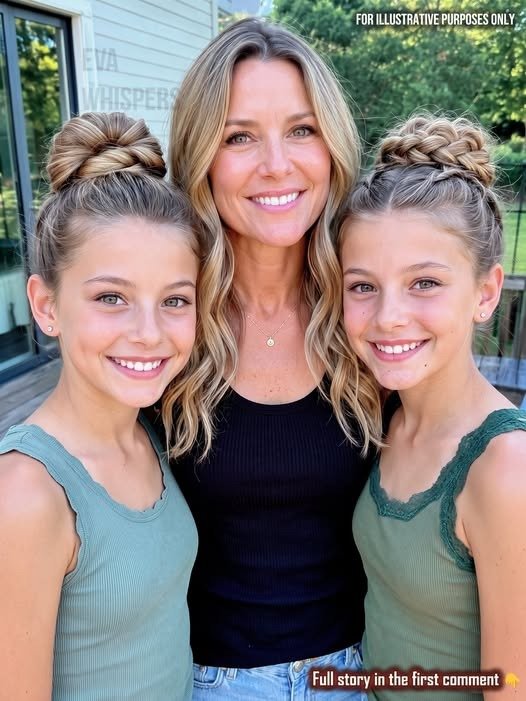
They were twelve, with matching braids and completely different hearts. Maya was sunlight—bold, loud, curious, always running toward the next adventure. Sophie was quieter, thoughtful, the kind of girl who watched the room before entering it.
They fought over the window seat on the bus.
I remember laughing and telling them, “Girls, it’s only two weeks.”
Only two weeks.
Those words haunted me later.
Because three days after they arrived at Camp Willow Creek, the phone rang.
The camp director, Mr. Powell, told me Maya was gone.
Not injured.
Not sick.
Gone.
He said she must have wandered from the cabins before dawn. He said the woods were thick. He said children sometimes got homesick and did strange things.
Then he said something I never forgot.
“Twins sometimes need space from each other.”
I gripped the phone so hard my palm hurt.
“What does that mean?”
He cleared his throat.
“Only that girls can have complicated emotions at that age.”
My child was missing, and already they were trying to make it sound like a mood.
The Search
By the time I reached the camp, police cars lined the gravel road.
Volunteers were moving through the woods in bright vests. Dogs were brought in. Boats searched the lake. Helicopters circled overhead.
I walked through Maya’s cabin with a police officer beside me.
Her backpack was still there.
Her hairbrush was still on the windowsill.
Her favorite purple hoodie was gone.
That detail nearly broke me.
“She would not go anywhere without Sophie,” I told the officer. “She would not just walk into the woods.”
They asked Sophie questions for hours.
She sat in a folding chair with a blanket around her shoulders, staring at the floor.
“Did Maya say anything before bed?”
Sophie shook her head.
“Were you fighting?”
A pause.
Then another shake of her head.
“Did she seem upset?”
Sophie whispered, “No.”
But her hands were shaking.
When we came home days later without Maya, Sophie carried Maya’s duffel bag into their shared bedroom and closed the door.
I stood in the hallway, listening to her cry into a pillow.
I wanted to go in.
I wanted to ask her everything.
But fear made me useless.
I was terrified that if I pushed too hard, I would lose the only daughter I still had at home.
For illustrative purposes only
The Year After
The months that followed turned our house into a museum of grief.
Maya’s room stayed exactly as it was.
Technically, it was still both girls’ room, but Sophie stopped sleeping in there. She dragged her blankets into the small guest room and said she liked it better.
I knew that was not true.
She could not look at the empty top bunk.
Neither could I.
Every week, I called the detective assigned to Maya’s case. Every week, the answer was the same.
No new leads.
No confirmed sightings.
No evidence of where she had gone.
Mr. Powell gave interviews saying the camp had followed every safety rule. He looked sad on camera. He spoke gently. Parents believed him.
But something in me never did.
Because mothers know the difference between an accident and a story rehearsed too many times.
Sophie changed after Maya disappeared.
She stopped wearing yellow.
She stopped swimming.
She stopped saying her sister’s name.
Once, I found her sitting on the floor beside Maya’s bed, holding one of Maya’s sneakers.
When she saw me, she shoved it away and said, “I was just cleaning.”
But she was not cleaning.
She was remembering.
Or hiding.
I hated myself for thinking that.
The Shoebox
Two weeks after the anniversary of Maya’s disappearance, Sophie came home from school pale and exhausted.
She said she had lost her math workbook.
I searched the kitchen, the laundry room, her backpack, the couch cushions. Then I went into the bedroom she no longer used.
Dust had gathered beneath the twin beds.
I knelt down and reached under Sophie’s old bed, expecting to find pencils, socks, maybe the missing workbook.
Instead, my fingers hit cardboard.
I pulled it out slowly.
It was Maya’s old sneaker box.
The one her blue running shoes had come in the spring before camp.
The lid was taped shut.
My breath caught.
For a moment, I told myself not to open it. I told myself it belonged to Sophie. I told myself a mother should respect her living daughter’s privacy.
Then I saw Maya’s handwriting on the side.
Three words.
For Mom. Later.
My hands began to shake.
I peeled back the tape.
Inside was a folded camp map, a yellow friendship bracelet, a small silver whistle, a disposable camera, and a note written on the back of a camp schedule.
The paper was wrinkled, as if it had been held tightly in someone’s fist.
I unfolded it.
Maya’s handwriting stared back at me.
Mom, if I don’t come back, I didn’t run away. Someone is using the old lake house. Sophie knows about the whistle. Please don’t let them say I got lost.
For three seconds, I could not understand what I was seeing.
Then my body understood before my mind did.
I reached for my phone with the box open beside me and called 911.
By the time the dispatcher answered, I could barely speak.
Sophie’s Truth
The police came that evening.
So did Detective Harris, the same woman who had held my hand at the camp a year earlier and promised she would not stop looking.
She read Maya’s note twice.
Then she looked at Sophie, who stood in the doorway with her face white as paper.
“Sophie,” Detective Harris said gently, “do you know what this is?”
Sophie began to cry before she answered.
“I didn’t mean to hide it forever.”
I felt the floor tilt beneath me.
“What do you mean?”
Sophie covered her mouth.
“I was scared.”
Detective Harris pulled out a chair.
“Sit down, sweetheart. Start wherever you can.”
For a long time, Sophie said nothing.
Then the truth came out in broken pieces.
On the second night at camp, Maya had woken Sophie and told her she had seen someone near the old lake house beyond the restricted trail. A girl from another cabin had mentioned hearing crying there, but the counselors brushed it off.
Maya, being Maya, wanted to investigate.
Sophie begged her not to.
They argued.
That was the fight Sophie had denied for a year.
Maya had taken the silver whistle their grandfather gave them and promised she would blow it if anything went wrong.
“She said she’d only be gone ten minutes,” Sophie whispered. “She told me to stay in bed because if we both got caught, we’d both be in trouble.”
“Did she come back?” Detective Harris asked.
Sophie shook her head, tears sliding down her cheeks.
“Not at first. But later, before sunrise, I heard the whistle.”
My heart stopped.
“One short sound,” Sophie said. “Then nothing.”
She had climbed out of bed and gone toward the trail. Near the maintenance shed, she saw a camp van. A young counselor named Jenna was standing beside it, arguing with someone Sophie could not see.
Then Sophie saw Maya.
She was getting into the van.
“I thought maybe Jenna was helping her,” Sophie cried. “Maya looked scared, but she saw me. She dropped the shoebox near the woodpile. I think she wanted me to find it.”
Sophie had grabbed the box and run back to the cabin.
Later, when she tried to tell Mr. Powell that Maya had not gone into the woods, he told her she was confused, tired, and frightened.
“He said if I kept saying things I didn’t understand, people would blame me for letting her go,” Sophie whispered. “He said Mom might never forgive me.”
I closed my eyes.
That was how they had silenced my child.
Not with force.
With guilt.
With fear.
With the one thing Sophie could not survive hearing.
That I might blame her.
I pulled her into my arms.
“Sophie, listen to me,” I said, my voice breaking. “You were twelve. You were scared. This was never your fault.”
She collapsed against me like she had been holding up a mountain for a year.
The Camera
The disposable camera from the shoebox was developed that night through the police department.
Most of the photos were ordinary camp pictures.
Maya making a silly face.
Sophie reading on the cabin steps.
The lake glittering in the sun.
Then came the last three frames.
The first showed a white camp van parked behind the maintenance shed.
The second showed a young woman in a counselor shirt. Jenna.
The third was blurry, taken from behind trees, but clear enough to show part of the license plate.
Detective Harris stared at the photo for a long time.
“This van was never listed in the camp’s vehicle report,” she said.
The next morning, police searched records from Camp Willow Creek again.
Jenna Parker had worked there for only one week.
She had left the day after Maya disappeared.
Her address was fake.
Her references were fake.
And the emergency contact she had given belonged to a woman named Elise Parker, who had died three years earlier.
But the partial license plate led them somewhere.
A rural property two states away.
Owned by a man named Carl Benton.
A former maintenance contractor for Camp Willow Creek.
The Raid
Police did not let me go with them.
I wanted to scream. I wanted to drive there myself. I wanted to tear open every door in the world until I found my child.
Instead, Detective Harris made me promise to stay home.
“If Maya is there,” she said, “we need to bring her back safely.”
If Maya is there.
Those four words kept me alive for the next six hours.
Sophie sat beside me on the couch, holding my hand so tightly our fingers went numb.
Neither of us spoke much.
At 4:17 in the afternoon, my phone rang.
Detective Harris.
I answered but could not make a sound.
Her voice was quiet.
“We found her.”
The room disappeared.
I dropped to my knees.
Sophie screamed, “Mom?”
Detective Harris continued, her voice thick with emotion.
“She’s alive.”
Alive.
The word entered my body like sunlight after a year underground.
I sobbed so hard I could not breathe.
Sophie fell beside me, crying into my shoulder.
Maya was alive.
For illustrative purposes only
What Happened to Maya
The full truth came later, in careful pieces.
Jenna Parker had not been Jenna Parker at all.
Her real name was Claire Benton, Carl Benton’s niece. She had gotten the camp job using false documents. Carl had worked near the old lake house and had been using it without permission.
Maya had seen something she was not supposed to see—not something dramatic like in movies, but enough to frighten people who were already doing wrong. Storage boxes. Stolen camp equipment. Records. Things that could expose them.
When Maya tried to tell someone, Claire convinced her that the camp director already knew and that Maya needed to come with her “just for a minute.”
Maya was brave.
Too brave for a twelve-year-old.
She had hidden the shoebox with her note, camera, bracelet, and whistle because she knew Sophie would understand.
Carl and Claire had kept Maya hidden under a false name, moving her between small rental houses. They told her we had stopped looking. They told her Sophie had said terrible things. They told her if she ran, we would be in danger.
Lies can become walls when a child hears them long enough.
But Maya never stopped trying to leave signs.
A librarian remembered her asking for newspapers from our town.
A neighbor remembered hearing her say her real name once.
And when the police arrived, Maya told them, “My mom knew I didn’t run away.”
She was right.
I had known.
I had always known.
The Reunion
They brought Maya home three days later after doctors and counselors made sure she was ready.
I stood outside the family services building with Sophie beside me.
A police car pulled up.
The door opened.
And there she was.
Thirteen now.
Taller.
Thinner.
Her hair shorter.
Wearing a gray sweatshirt that did not belong to her.
But her eyes were Maya’s.
My Maya.
For one second, she just looked at me.
Then her face crumpled.
“Mom?”
I ran to her.
I do not remember crossing the pavement. I only remember holding her and feeling her hands clutch the back of my shirt.
“I knew you’d come,” she sobbed.
“I never stopped,” I said. “Not for one second.”
Sophie stood a few feet away, trembling.
Maya looked over my shoulder.
The sisters stared at each other.
A year of guilt, fear, silence, and stolen childhood stood between them.
Then Sophie whispered, “I’m sorry.”
Maya pulled away from me and reached for her.
“No,” Maya said, crying. “You found the box.”
Sophie shook her head.
“I hid it.”
“You kept it safe,” Maya said.
And then my daughters held each other.
Not like twins fighting over a bunk bed.
Not like children arguing over a window seat.
Like two halves of one heart finally beating in the same room again.
The Truth Comes Out
The investigation that followed shook the entire county.
Camp Willow Creek was closed.
Mr. Powell was charged for lying to investigators and ignoring reports about the old lake house. Carl and Claire were arrested. Other adults who had looked away were held accountable.
For the first time in a year, people stopped asking why Maya had wandered off.
They started asking why no one had listened sooner.
But I did not spend my days thinking about revenge.
I had too much healing to do.
Maya had nightmares.
Sophie had guilt.
I had anger that sometimes felt too large for my chest.
So we went to therapy.
We ate dinner together even when nobody had much appetite.
We painted Maya’s room a soft yellow because she said she was tired of purple for now.
We bought new toothbrushes.
Three of them.
One for me.
One for Sophie.
One for Maya.
The first morning Maya came home, I found her standing in the kitchen, staring at her empty chair.
“Is it still mine?” she asked quietly.
I nearly broke all over again.
“It was always yours,” I told her.
She sat down.
Sophie placed a bowl of cereal in front of her and said, “I saved you the top bunk too.”
Maya smiled for the first time.
A small smile.
A wounded smile.
But real.
“You always hated the top bunk,” she said.
Sophie shrugged.
“I was saving it anyway.”
One Year Later
Healing did not happen like a movie.
There was no single hug that fixed everything.
Some days Maya laughed like nothing had changed.
Some days she could not leave the house.
Some days Sophie apologized for the hundredth time.
Some days I sat in the laundry room holding that old purple hoodie and cried until the dryer stopped.
But slowly, our home changed.
The silence became softer.
The girls started sharing secrets again.
They argued over music.
They stole each other’s socks.
They left cups all over the house.
Every ordinary annoyance became a miracle.
On the second anniversary of the day Maya disappeared, we did not go to the lake. We did not light candles in sadness.
Instead, we planted a small dogwood tree in the backyard.
Maya placed the silver whistle in a little wooden box beneath the roots.
Sophie placed the yellow bracelet beside it.
I placed a copy of Maya’s note there too—not the original, which stayed safely with the case file, but a copy.
Then Maya covered it with soil and said, “I don’t want this to be where the story ended.”
Sophie looked at her.
“What should it be?”
Maya thought for a moment.
“Where it started again.”
So that is what we called the tree.
The Starting Again Tree.
What I Know Now
People sometimes ask me how I survived that year.
The truth is, I did not survive it gracefully.
I was afraid.
I was angry.
I made mistakes.
I was so focused on the daughter who was missing that I almost missed the daughter who was silently breaking in front of me.
But love, real love, does not have to be perfect to find its way back.
It only has to keep reaching.
Maya never should have been taken.
Sophie never should have been made to carry that secret.
And I never should have doubted the quiet voice inside me that kept saying, Something is wrong.
Because sometimes a mother’s heart hears the truth before the world is ready to admit it.
My daughter did not run away.
She did not vanish into the woods.
She left a shoebox.
A note.
A whistle.
A trail of courage only her twin sister could understand.
And one year later, under a bed covered in dust and grief, I found the first real clue that brought my child home.
Now, every morning, there are three chairs at my kitchen table.
Three toothbrushes by the sink.
Two sisters arguing over toast, socks, and who used whose shampoo.
And sometimes, when sunlight moves across the backyard, it touches the little dogwood tree we planted together.
The Starting Again Tree.
Its branches are still thin.
Its leaves still tremble in the wind.
But it is growing.
So are we.
Note: This story is a work of fiction inspired by real events. Names, characters, and details have been altered. Any resemblance is coincidental. The author and publisher disclaim accuracy, liability, and responsibility for interpretations or reliance. All images are for illustration purposes only.
Post Views: 1,911