The community center was packed, buzzing with a cruel kind of excitement. At the center of it all sat sixteen-year-old Embry Callister, facing a disciplinary hearing that had morphed into a public spectacle. The cause was her college admissions essay, in which she claimed her mother was a Navy SEAL. Superintendent Hargrove held the paper aloft as if it were evidence of a crime, his voice dripping with condescension as he addressed the crowded room. The audience whispered and sneered, labeling the quiet girl a pathological liar.
Embry maintained a soldier’s posture, her chin parallel to the floor despite the tremor in her hands. She found strength in the steady gaze of her grandfather, a retired Colonel, sitting in the back row. He gave her a subtle, almost invisible nod—a silent command to hold the line. As her English teacher was forced to read excerpts from the essay aloud, the room erupted in mocking laughter. The idea that her mother, Zephyr, was a classified operator was too fantastical for them to believe.
The officials presented what they called irrefutable proof: a service record obtained through the Freedom of Information Act that listed Zephyr as an administrative specialist. A town psychiatrist diagnosed Embry with a “compensatory fantasy,” suggesting she invented a heroic mother to cope with abandonment. Embry insisted the record was a cover, but her explanations were drowned out by more derision. For over an hour, she endured the public flaying, her truth met with escalating scorn.
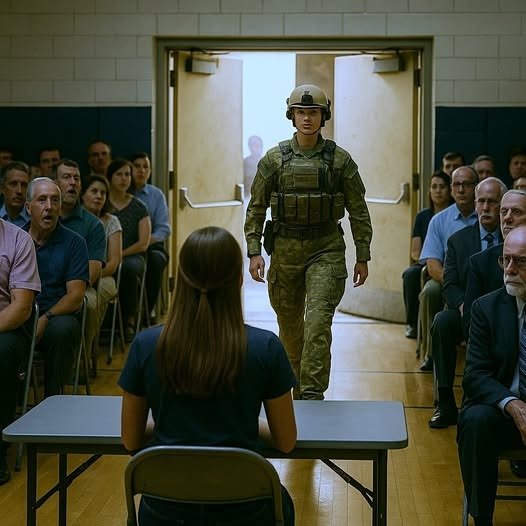
Just as the superintendent reached the peak of his moral grandstanding, demanding to know where this “phantom SEAL mother” was, the double doors burst open. The laughter died in every throat. Six figures in naval combat uniforms entered in a precise formation, their boots striking the floor in unison. In the center was Commander Zephyr Callister. Her uniform bore insignia that silenced the room, and the naval trident on her chest gleamed under the lights. She walked directly to the superintendent’s desk and dropped a folder of newly declassified documents in front of him.
The transformation in the room was absolute. The man who had led the mockery was now speechless. A Vietnam veteran in a wheelchair, who had earlier questioned Embry, snapped a crisp salute. Zephyr’s voice, quiet yet commanding, explained that her service had been classified for fifteen years. She turned to the crowd and declared that her daughter had shown more courage that afternoon than most people display in a lifetime. The collective shame of the room was palpable as the Callister family walked out, leaving a town forever changed by the weight of a truth they had refused to believe.