Chapter 1: The Splintered Reflection
The city breathed with a slick, neon-soaked rhythm. It was a metropolis that thrived on perpetual motion, a relentless hum of combustion engines and rushing footsteps against the rain-slicked pavement. I was a part of that rhythm, a high-functioning cog in a machine built on aggressive corporate litigation and absolute detachment. As a senior partner at Vance & Sterling, my world was constructed of billable hours, ironclad contracts, and the deliberate severing of messy human entanglements.
My name is Eleanor Vance. I wore my armor well—a flawlessly tailored, slate-gray trench coat over a designer suit, paired with the kind of impenetrable, icy demeanor that made opposing counsel sweat before a word was spoken. I navigated the world believing that vulnerability was a structural flaw, a weakness to be exploited.
I was entirely wrong. The structure of my life wasn’t flawed; it was built on a fault line of my own making, and the earth was about to violently give way.
It was a miserable, driving downpour on a Tuesday evening in November. I was sitting in the back of my idling black sedan, the tinted windows blurring the aggressive neon signs of the Garment District. My driver, Thomas, was attempting to navigate the congested, chaotic street, inching the heavy vehicle through the throngs of pedestrians who moved like hurried, anonymous ghosts under their umbrellas.
I was reviewing a deposition transcript on my glowing tablet when the world outside abruptly halted.
A violent, sickening thud echoed against the reinforced steel of the passenger-side door.
Thomas slammed on the brakes, the sudden deceleration throwing me hard against the leather seatbelt. A chaotic spray of filthy, oil-slicked gutter water erupted across the shining black surface of the window beside me.
I dropped the tablet, my pulse instantly spiking. A cold spike of adrenaline—not fear, but pure, unfiltered rage—flooded my system. Outside the window, the sea of anonymous pedestrians had suddenly frozen. Dozens of smartphones were already raised, their pale, rectangular lights capturing the scene like a swarm of mechanical fireflies. A collective, theatrical gasp rippled through the gathered crowd.
I shoved the heavy car door open and stepped out into the freezing deluge.
“What is the meaning of this?” I snapped, my voice cutting through the ambient noise of the street with practiced, courtroom authority.
And then, I saw him.
Standing directly in the path of the vehicle, illuminated by the harsh glare of the headlights, was a small boy. He couldn’t have been older than ten. His clothes were a tragic mosaic of torn denim and an oversized, soaked flannel shirt that clung to his shivering frame. His face was streaked with grime and rainwater, but as my eyes adjusted to the glare, I realized his cheeks were wet with something far deeper and more agonizing than the storm.
He wasn’t crying. He was vibrating with a fierce, absolute fury.
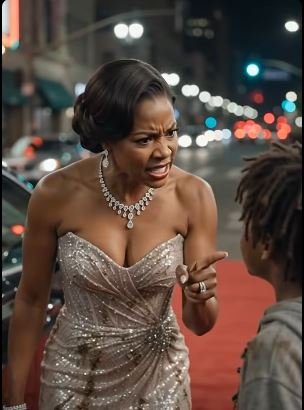
“YOU DID THIS TO ME!” the boy screamed, pointing a trembling, dirt-caked finger directly at my chest. “THIS IS YOUR FAULT!”
His voice broke through the oppressive drone of the city like a shattered pane of glass, raw and jagged. It was the sound of a cornered animal, a desperate accusation hurled into the indifferent void of the street.
I stared at him, my initial anger mutating into a profound, aristocratic indignation. I was untouchable, insulated by wealth and status, and this filthy street urchin had the audacity to accuse me of some imagined slight.
“Are you completely insane?” I fired back, stepping forward, my expensive heels splashing into the filthy puddle. “You threw yourself at my car! You little idiot, you could have been killed!”
The crowd leaned in closer, a circle of voyeurs hungry for the spectacle. The murmurs grew louder, anticipating the destruction of the ragged boy by the wealthy woman.
But the boy didn’t flinch. He didn’t cower, and he certainly didn’t run.
Instead, he took a deliberate step toward me.
It was a defiant, terrifyingly mature movement. He stepped into my personal space, closer than any opposing attorney had ever dared. His small hands were clenched into fists, shaking violently at his sides, but his eyes—dark, wide, and burning with a terrifying, ancient recognition—locked onto mine with absolute certainty.
“You left us,” he whispered, his voice dropping from a scream to a ragged, devastating rasp that somehow carried over the roar of the rain. “You drove away. You didn’t even look back.”
The words slammed into my chest with the kinetic force of a physical blow.
Something shifted deep within the carefully curated architecture of my mind. It was a microscopic tremor, a sudden, inexplicable disruption of the narrative I had ruthlessly enforced for a decade. My anger faltered. A cold, suffocating confusion flickered behind my eyes, like a suppressed memory clawing its way toward the surface of a frozen lake.
I opened my mouth to dismiss him, to threaten to call the authorities, but the words withered and died in my throat.
The boy maintained his fierce, burning eye contact as he reached one trembling hand deep into the inner pocket of his soaked, oversized jacket.
Chapter 2: The Ghost in the Frame
He pulled out an object. It was small, rectangular, and entirely unremarkable at first glance. A photograph, its edges curled and worn soft from years of being handled by desperate, searching hands.
The crowd pressed tighter. The glowing lenses of the smartphones zoomed in, capturing the rain dripping steadily from the faded, glossy paper.
The boy held it up, presenting it to me like a piece of irrefutable, damning evidence in a trial I didn’t know I was standing.
“Look at it,” he demanded, his voice cracking.
I didn’t want to look. Every self-preservation instinct in my highly trained, analytical brain screamed at me to get back in the car, to order Thomas to drive over the curb if necessary, to escape this impossible, horrifying confrontation. But my eyes, betraying my will, dragged themselves down to the image in his hand.
And in that fraction of a second, the entire, meticulously constructed universe I inhabited violently collapsed.
It was me.
It was a younger version of me, perhaps twenty-two or twenty-three. The severe, styled hair was replaced by loose, untamed curls. The expensive silk was replaced by a faded, comfortable sweater. I was sitting on a worn, floral-patterned sofa that I recognized with a sickening, visceral clarity.
And I was holding a baby.
A swaddled, dark-haired infant, resting securely against my chest, my face buried in the crown of his head in a gesture of profound, consuming love.
“My mom said…” the boy whispered, the fierce anger finally fracturing, revealing the agonizing, desperate vulnerability beneath. He choked on a sob, his chest heaving. “…she said you were my mother.”
Silence struck the street.
It was not a gradual quieting, nor a soft, respectful hush. It was a total, absolute vacuum of sound. It was the kind of heavy, suffocating silence that swallows entire cities whole. The hum of the engines, the patter of the rain, the murmurs of the crowd—all of it ceased to exist.
I stared at the photograph, the rain blurring the image of my own face.
My mind violently rejected the visual data. The shock hit first—a cold, numbing wave that paralyzed my vocal cords. Then came the desperate, frantic denial, the legalistic urge to dismantle the claim, to find the logical fallacy, the photoshop manipulation, the grifter’s trick.
But underneath the shock and the denial, something far more terrifying began to stir. Something ancient, buried beneath a decade of ambition and ruthless forward momentum.
My manicured hand slowly dropped to my side, hanging uselessly in the rain. My breathing turned shallow, rapid, inadequate.
“…that’s not possible,” I whispered to the empty air, the words barely audible. “That… I don’t…”
But as I looked from the photograph up into the boy’s dark, tear-streaked eyes, my own eyes betrayed the lie I had spoken. I saw the distinct, sharp arch of his brow. The slight, uneven curve of his lower lip. They were not the features of a stranger. They were a reflection. They were mine.
The boy watched the recognition dawn on my face. He watched the absolute, devastating destruction of my denial.
And then, he stepped back.
Just a few inches, but the movement was final. It was the physical manifestation of a profound, irrevocable resignation. He looked at me not with anger anymore, but with the hollow, exhausted stare of someone who had spoken their ultimate truth and found the universe entirely indifferent.
It was as if he had waited his entire, short life for this exact, agonizing moment of confrontation—and now that it had arrived, he realized it changed absolutely nothing.
“I waited,” the boy whispered, the words carrying the crushing weight of a thousand empty evenings. “Every day.”
The words didn’t echo. They didn’t need to. They bypassed the ears entirely and settled directly into the marrow of everyone standing on that street. The voyeuristic crowd didn’t move. They didn’t speak. They didn’t even dare to draw a breath, trapped in the gravitational pull of a tragedy they couldn’t comprehend.
And in that frozen, impossible moment—suspended precariously between absolute truth and desperate denial, between the ghost of a past I couldn’t remember and the brutal reality of the present I couldn’t escape—I felt the very foundation of my sanity begin to splinter.
Everything was about to violently, irrevocably break.
And then… darkness.
Chapter 3: The Architecture of Amnesia
I awoke not to the aggressive neon of the city, but to the sterile, oppressive white light of a hospital room.
My head throbbed with a dull, rhythmic ache. I tried to sit up, but a firm, gentle hand pressed against my shoulder, guiding me back against the crisp pillows.
“Lie still, Eleanor,” a familiar, soothing voice commanded.
I blinked, the blurry shapes coalescing into the concerned, handsome face of Julian, my husband of eight years, and the managing partner of the firm. He looked immaculate, as always, his silver hair perfectly coiffed, his bespoke suit unwrinkled despite the late hour.
“Julian?” I rasped, my throat feeling like sandpaper. “What… what happened? The boy… where is the boy?”
Julian’s expression tightened into a mask of practiced, professional empathy. He glanced toward the door, where a uniformed police officer stood with his arms crossed.
“You had a severe vasovagal syncope, darling,” Julian explained, his tone smooth and reassuring. “You fainted on the street. Thomas caught you before you hit the pavement and brought you straight here.”
“But the boy,” I insisted, the panic rising in my chest, the image of the faded photograph burning behind my eyelids. “Julian, he had a picture of me. He said… he said I was his mother.”
Julian offered a soft, patronizing smile. He reached out and stroked the hair back from my forehead, a gesture that suddenly felt incredibly cold and performative.
“Eleanor, you’ve been working ninety-hour weeks on the Sterling acquisition. You’re exhausted. You suffered a stress-induced hallucination.”
I stared at him, the legal instincts I relied on daily screaming that the narrative was flawed. “It wasn’t a hallucination. I saw the photograph. He had my eyes. I felt it, Julian. It was real.”
Julian’s smile vanished, replaced by a hard, calculating glint that I had only ever seen him use during hostile cross-examinations. He leaned closer, his voice dropping to a harsh, conspiratorial whisper.
“Listen to me very carefully, Eleanor. There was no boy. The police reviewed the dashcam footage from Thomas’s car. A vagrant threw a piece of debris at the vehicle. You stepped out, shouted at empty air, and collapsed. You are suffering from severe exhaustion, and if this gets out to the board, they will question your competence to handle the merger.”
I lay there, the sterile smell of antiseptic filling my nose, staring into the eyes of the man I had trusted with my life. He was lying. The certainty of it settled into my gut like a lead weight. I had spent ten years reading micro-expressions, dissecting testimony, and uncovering perjury. My husband was perjuring himself, right now, in my hospital room.
“I want to see the footage,” I demanded, my voice cold and steady.
Julian sighed, a theatrical display of patience. “I’ll have Thomas send it over when you’re discharged tomorrow. But right now, you need to rest.”
He kissed my forehead, a dry, perfunctory pressure, and left the room, speaking in hushed, urgent tones with the police officer in the hallway.
I waited until the heavy door clicked shut.
I didn’t believe the hallucination narrative for a second. The physical sensation of the rain, the exact timbre of the boy’s voice, the specific, terrifying detail of the floral sofa in the photograph—it was too visceral, too deeply entrenched in reality to be a product of fatigue.
If the boy was real, and if Julian was lying to protect me from the truth, it meant the architecture of my life wasn’t just built on a fault line; it was built on a deliberate, orchestrated deception.
I slowly slid out of the hospital bed, my bare feet hitting the cold linoleum floor. My head spun, but the adrenaline overrode the dizziness. I needed to find the truth, and I knew exactly where the first piece of evidence was hidden.
I didn’t wait for Thomas or the footage. I needed to find the boy.
Chapter 4: The Truth in the Rain
The following forty-eight hours were a masterclass in clandestine investigation.
I discharged myself against medical advice the moment Julian left for a morning board meeting. I didn’t return to our penthouse; instead, I checked into an anonymous, mid-tier hotel under a pseudonym. I was a senior partner at a top-tier law firm; I knew how to utilize private investigators and forensic data analysts better than the police.
I hired an independent contractor, a man named Kael, who specialized in digital recovery and deep-background checks. I gave him the only lead I had: the intersection in the Garment District where the confrontation had occurred, and the precise time.
“I need traffic cam footage, ATM security feeds, anything that captured that corner,” I instructed Kael over a secure line. “Julian claims it was a vagrant throwing debris. Prove him wrong.”
While Kael scoured the digital landscape, I began to painstakingly dissect my own history.
Ten years ago, before I met Julian, before the law degree and the bespoke suits, there was a gap. A dense, impenetrable fog covered a twelve-month period following a severe car accident that had left me in a coma for three weeks. I had awakened in a private clinic, my medical bills mysteriously paid, with Julian—then a junior partner handling my personal injury claim—sitting by my bedside. He had told me I was alone, that my parents had passed away years prior, and that the trauma had caused severe retrograde amnesia.
He had built my new life from the ground up, molding me into the ruthless, successful woman I was today. I had trusted his narrative implicitly, grateful for the anchor in the storm of my missing memories.
My phone buzzed. It was Kael.
“I have something, Eleanor,” Kael’s voice was grim. “Julian was right about the dashcam. It was wiped clean, replaced with a looped segment of the street prior to the incident. But he didn’t account for the bodega on the corner.”
A heavy, encrypted video file arrived in my inbox.
I opened it, my heart hammering against my ribs. The footage was grainy, shot from a high angle through a dirty window, but it was undeniable.
It showed my black sedan stopping. It showed me stepping out into the rain. And it showed the boy.
He was standing exactly where I remembered, holding up the photograph. The confrontation, the boy stepping back, my collapse—it was all there, captured in stark, digital reality.
Julian had lied.
But the video showed something else.
Immediately after I fainted, Thomas, my trusted driver, didn’t rush to my side. He moved swiftly toward the boy. He grabbed the child by the arm, his posture aggressive, threatening. The boy struggled, dropping the photograph onto the wet pavement before turning and sprinting into the labyrinth of the Garment District alleys. Thomas picked up the photo, shoved it into his pocket, and then finally turned to assist me.
The betrayal was absolute. My husband and my employee were complicit in erasing the most crucial moment of my existence.
“Kael,” I said, my voice eerily calm as I watched the boy disappear into the dark alley on the screen. “Track that child. Find him. Whatever it costs.”
It took Kael less than twelve hours.
“His name is Leo,” Kael reported later that evening. “He’s ten years old. He’s been living in the foster system, bouncing between group homes in the lower wards. He ran away from a facility three days ago.”
Kael gave me an address—an abandoned, condemned apartment complex slated for demolition, a frequent squat for runaway youth.
I didn’t call the police. I didn’t call Julian. I changed into dark, unassuming clothes, grabbed a heavy flashlight, and walked out into the night.
The building was a decaying monument to urban neglect. The air smelled of mold and stale urine. I navigated the dark, debris-filled hallways, my flashlight beam cutting through the gloom, following Kael’s precise directions to a specific unit on the third floor.
I pushed the rotting door open.
The room was barely illuminated by the ambient street light filtering through a broken window. In the corner, huddled beneath a filthy, discarded moving blanket, was a small shape.
“Leo?” I whispered, my voice trembling with a terrifying, overwhelming emotion.
The shape stiffened. The blanket was slowly lowered.
It was him.
He looked even smaller in the dim light, his eyes wide and terrified, anticipating the harsh authority of a social worker or the brutal hand of a street enforcer.
When he recognized me, his eyes widened further. He scrambled backward, pressing himself against the peeling wallpaper.
“Stay away from me!” he shouted, his voice cracking with fear. “The man in the car said he’d kill me if I ever came near you again!”
The monstrous reality of Thomas’s threat slammed into me. I dropped the flashlight, letting it roll across the floor, and slowly sank to my knees, making myself as small and non-threatening as possible.
“Leo, please,” I pleaded, holding my hands out, palms up, showing I was unarmed. “I didn’t know. They lied to me. They told me I imagined you.”
He watched me, his small chest heaving, the suspicion warring with a desperate, buried hope.
“You really didn’t know?” he whispered, his voice incredibly small.
“I lost my memory in an accident ten years ago,” I confessed, the tears finally breaking free, carving hot tracks down my cheeks. “I didn’t even know I had a child. Please, Leo. Tell me the truth. Tell me about the photograph.”
Leo hesitated for a long, agonizing moment. Then, with trembling hands, he reached under his shirt and pulled out a small, waterproof pouch worn on a string around his neck. He opened it and carefully extracted the faded photograph—the exact same image Thomas had supposedly confiscated.
“He took the copy,” Leo said quietly, holding the real photograph out to me. “My foster mom… she died last year. Before she got sick, she told me the truth. She said she was my aunt. She said my real mother was in a bad accident, and a rich man took her away while she was asleep. She said she didn’t have the money to fight him in court, so she hid me.”
He looked down at the floor, his voice breaking. “She gave me the picture. She said if I ever found you, I should show it to you. She said you loved me.”
I reached out and gently took the photograph. I looked at my younger self, holding the infant Leo, the fierce, unconditional love radiating from the image. It wasn’t a memory, but it was a profound, undeniable truth that resonated in the deepest, untouched corners of my soul.
Julian had found me vulnerable, alone, and injured. He had erased my past, stolen my child, and sculpted me into the perfect corporate weapon for his firm, ensuring I had no emotional ties to distract me from his ambition. He had built his empire on the grave of my motherhood.
I looked up from the photograph, my tears falling freely now, landing on the dusty floorboards.
“She was right,” I whispered fiercely, crawling forward until I was close enough to reach him. “I did love you. And I love you now.”
I didn’t wait for him to move. I reached out and pulled the small, shivering, filthy boy into my arms. He stiffened for a second, the defensive instincts of a street survivor kicking in, but then, with a choked, agonizing sob, he buried his face in my shoulder, his small hands clutching the fabric of my coat with desperate, crushing strength.
I held my son, the phantom ache in my chest finally, irrevocably healed.
The architecture of the lie was completely demolished. The ruthless, detached senior partner of Vance & Sterling was dead, buried under the weight of a ten-year deception.
I held him tighter, feeling the steady, reassuring beat of his heart against my own.
“We have to go,” I whispered against his hair, a cold, surgical determination replacing the sorrow. “We’re going to disappear tonight. But first, I’m going to tear his empire down to the bedrock.”
I had spent a decade destroying people legally for Julian’s benefit. Now, he was about to learn that you should never teach a mother how to be a monster, and then steal her child.
If you want more stories like this, or if you’d like to share your thoughts about what you would have done in my situation, I’d love to hear from you. Your perspective helps these stories reach more people, so don’t be shy about commenting or sharing.