Chapter 1: The Copper Toll
The air inside Rosie’s Diner always smelled reliably of scorched coffee, heavy grease, and the faint, stinging scent of ammonia used to wipe down the cracked vinyl booths. It was a Tuesday evening in November, the kind of wet, bone-chilling night that drove the desperate indoors. The rain slashed against the large front window, blurring the neon glow of the streetlamps into smeary streaks of harsh orange light.
I was working the late shift. Again. At twenty-four, my life was a relentless cycle of balancing trays, dodging the creeping hands of late-night drunks, and pretending my paycheck would magically cover both rent and my mother’s escalating medical bills. I was exhausted, the kind of deep, cellular fatigue that settles into your marrow.
The bell above the door chimed, a weak, tinny sound.
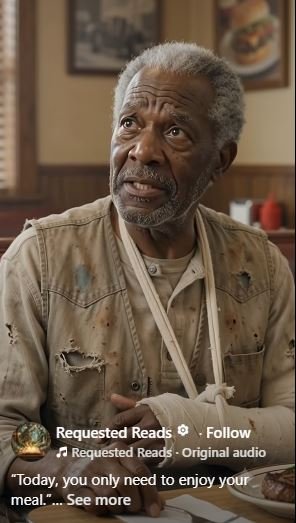
An elderly man shuffled over the threshold. He moved with a fragile, agonizing slowness, his posture permanently bowed by a gravity only he could feel. His frayed, oversized trench coat was dark with rain, clinging to a frame that looked more skeleton than flesh. He didn’t look up. He didn’t seek eye contact. He simply navigated to the furthest, darkest booth in the back corner and slid onto the cracked red vinyl, making himself as small as physically possible.
I grabbed a damp rag and a menu, suppressing a sigh. The owner, Mr. Henderson, had a strict policy about loiterers, and I didn’t have the energy to play enforcer tonight.
“Evening,” I said, approaching the table.
The man flinched slightly, pulling his coat tighter around his throat. Up close, I could see the pale, translucent quality of his skin and the deep, hollow bruises beneath his eyes. He possessed the specific, terrifying look of someone who had recently plummeted from a great height and was still waiting for the impact to kill him.
“Just a glass of tap water, please,” he murmured, his voice a dry, rasping whisper that barely carried over the hum of the ancient refrigerator.
I looked at him. I looked at the rain lashing against the glass. I thought of my own mother, lying in a sterile hospital bed across town, terrified of the bills piling up on her nightstand.
I didn’t bring him water.
I walked back to the kitchen line. The cook, a massive, silent man named Sal, raised an eyebrow as I grabbed a heavy porcelain bowl and began ladling a massive portion of our thick, homemade chicken and rice soup.
“Henderson’s gonna dock your pay for that, Mia,” Sal grunted, wiping a smear of grease from his apron.
“Let him,” I replied flatly, adding a generous handful of saltine crackers to the side of the plate.
I carried the steaming bowl back to the dark corner booth and gently placed it on the Formica table directly in front of the old man. The rich, savory steam rose, curling around his weathered face.
He froze. He stared at the bowl as if it were an explosive device.
Slowly, his trembling hands reached deep into the pockets of his wet coat. He fumbled for a long, agonizing moment before finally withdrawing a closed fist. He placed his hand on the table and slowly uncurled his fingers.
Resting on the cracked Formica were three tiny, tarnished copper pennies.
“I’m sorry,” he whispered, a hot, shameful flush creeping up his pale neck. His voice cracked, shattering into a thousand jagged pieces. “I… I don’t have enough.”
A physical ache bloomed in the center of my chest. The utter devastation in his tone was unbearable.
I reached out and gently covered his trembling, frozen hand with my own.
“You don’t have to pay for this,” I said, offering him a soft, entirely genuine smile. “It’s on the house tonight.”
The old man’s chin quivered. His storm-gray eyes instantly filled with thick, blinding tears that he didn’t try to stop. He looked up at me, the rigid, protective walls of his pride finally collapsing.
“Thank you,” he wept, the words tumbling out in a ragged, breathless rush.
I squeezed his hand once more and walked away, giving him the dignity of eating in private. When my shift ended three hours later, the booth was empty. The bowl was scraped clean, and the three copper pennies were stacked neatly on a paper napkin.
I pocketed the coins, assuming I would never see him again. I had no idea that a simple bowl of soup had just triggered a chain reaction that would completely dismantle the life I knew.
Chapter 2: The Elegant Ghost
The following afternoon, the diner was unusually packed. The lunch rush was a chaotic symphony of clinking silverware, shouting cooks, and the aggressive hiss of the espresso machine. I was balancing three plates of meatloaf when the bell chimed.
An elegant woman stepped through the doors. She immediately silenced the room.
She wore a sharply tailored, expensive tan trench coat, cinched tightly at the waist, and a pair of tortoiseshell sunglasses pushed back into her impeccably styled dark hair. She exuded an aura of wealth and authority that was entirely alien to Rosie’s Diner. She surveyed the sticky floors and the cracked booths with a fleeting look of confusion before her eyes locked onto me.
She bypassed the “Please Wait to Be Seated” sign and walked directly to my station at the counter.
“Are you Mia?” she asked, her voice cultured and precise, carrying the distinct cadence of old money.
I carefully set the meatloaf plates down, wiping my hands on my stained apron. A cold spike of anxiety pierced my stomach. Wealthy people rarely entered this diner unless they were lost or looking to buy the property to bulldoze it.
I nodded nervously. “Yes, ma’am. How can I help you? Did something happen?”
The woman reached up and removed her sunglasses. The harsh diner lighting revealed eyes that were red-rimmed and bloodshot, swimming with unshed tears. The veneer of untouchable elegance cracked.
She offered a watery, fragile smile. “I want to talk to you about the old man you fed yesterday evening.”
My breath hitched. Had he stolen something? Had he collapsed in the alley?
She unclasped a heavy leather purse and reached inside. She withdrew an old, slightly faded Polaroid photograph and placed it face-up on the sticky counter between us.
I looked down. The photograph showed a much younger, vibrant version of the broken man from the corner booth. He was standing in front of a sprawling, magnificent estate, wearing a bespoke suit, his arm wrapped around a beautiful woman holding a baby. He radiated power and absolute confidence.
“He is my father,” the woman said softly, tracing the edge of the photograph with a manicured fingernail. “His name is Arthur Vance.”
The name hit me like a physical blow. Vance. The Vance shipping empire. The family that had dominated the city’s industry for three decades before a catastrophic series of bad investments and hostile takeovers had publicly, brutally ruined them five years ago. The newspapers had covered the bankruptcy for months. Arthur Vance had vanished entirely from the public eye.
“After losing everything… the company, the house, my mother…” she swallowed hard, her voice trembling. “He was simply too ashamed to ask anyone for help. He pushed us all away. He preferred to starve in the shadows rather than admit he couldn’t rebuild his empire. We’ve been looking for him for weeks.”
She reached back into her purse and pulled out a thick, sealed white envelope. She pushed it across the counter toward me.
“Your kindness gave him hope again, Mia,” she whispered, a tear finally escaping and tracking down her immaculate cheek. “He called me this morning. For the first time in three years, he asked to come home. Please, accept this… and thank you for treating him with dignity when he believed the entire world had forgotten him.”
I stared at the thick white envelope resting on the counter. It was heavy. Too heavy.
“I…” I stammered, my mouth suddenly dry as ash.
Before I could form the words to refuse, Mr. Henderson, who had been eavesdropping from the kitchen pass, shoved his way through the swinging doors. His eyes were locked on the envelope with a predatory, greedy gleam.
“Mia,” Henderson barked, his voice loud enough to turn heads in the dining room. “If the lady is offering a gratuity, you take it. And remember, all tips are pooled and split with management. Hand it over.”
Chapter 3: The Secret Ingredient
I looked at Henderson, his face flushed with unearned entitlement. Then, I looked down at the envelope. My hands, still smelling of grease and cheap soap, trembled as I reached out.
But I didn’t pick up the envelope. I pushed it firmly back across the counter toward the elegant woman.
“I can’t accept this,” I stated, my voice shaking but resolute. I glanced at Henderson, refusing to back down. “I didn’t feed your father for a reward. I fed him because he was hungry. Soup doesn’t come with a ransom.”
Henderson’s face contorted in rage. “You stupid girl, you take that—”
The elegant woman silenced him with a single, sharp glare. It was the look of a woman who had grown up commanding boardrooms. Henderson physically flinched, snapping his mouth shut and retreating a step backward.
She turned her attention back to me. The watery smile returned, warmer and significantly more profound this time.
“Then, Mia,” she said softly, “if you won’t accept money, please accept something else.”
She reached into her heavy leather purse one final time. She bypassed her wallet and withdrew a small, folded index card. She carefully placed it on the counter, right where the envelope had been.
The paper was ancient, yellowed by time, its corners worn soft and frayed from being handled a thousand times.
I looked at it. Across the top, written in faded, looping blue ink, were three simple words.
Dad’s Favorite Soup.
I frowned, genuine confusion knotting my brow. “Why are you giving me this?”
The woman’s eyes filled with fresh tears. “Because he explicitly asked me to.”
She leaned closer over the counter, the scent of expensive jasmine perfume cutting through the grease of the diner.
“He said that if I ever found the young waitress who looked at a ruined man and treated him like family…” her voice cracked, the emotion finally overwhelming her composure, “…he said she should have this.”
I slowly picked up the worn index card. The paper felt fragile beneath my fingertips. I unfolded it.
It wasn’t a recipe.
On the back of the card, written in fresh, shaky, jagged handwriting—the unmistakable script of a man whose hands trembled—was another message.
Mia,
You didn’t just feed my stomach last night. You fed my hope. Thank you for reminding an old ghost that he is still visible. – Arthur.
A hot tear rolled down my cheek, splashing onto the sticky Formica counter. Then another. The sheer, overwhelming weight of the human connection in that simple gesture shattered the protective armor I wore to survive this job.
The elegant woman reached out and gently squeezed my arm. “He made one more request, Mia.”
I looked up, rapidly wiping my eyes with the back of my wrist. “What was it?”
She glanced around the noisy, chaotic diner, her eyes sweeping over the worn booths and the tired faces of the patrons. Then, she raised her hand and pointed directly toward the dark, shadowed back corner. The exact booth where her father had sat the night before.
“He wanted one seat in this diner,” she said, her voice carrying a quiet, undeniable authority, “to always be reserved for anyone who is hungry and cannot afford a meal. And he has secured a fund to ensure it is paid for, in perpetuity.”
The diner, which had been buzzing with lunchtime energy, fell completely silent. The clinking stopped. The shouting ceased.
I looked past her, toward the empty red vinyl booth in the corner. The shadows seemed less oppressive now. I looked back at the woman, and then quietly, firmly, nodded my head.
“Consider it done,” I whispered.
Chapter 4: The Architecture of Grace
The very next morning, before the sun even crested the city skyline, I arrived at Rosie’s Diner an hour early.
I didn’t immediately turn on the coffee urns or begin prepping the grill. I walked to the back storage room and found a small, polished block of oak wood. I spent twenty minutes carefully etching a message into the surface with a heavy black marker.
I carried the wooden block out into the dining room and placed it squarely in the center of the dark corner booth.
The sign read: “If you are hungry, this seat is already paid for.”
When the morning rush began, the change in the atmosphere was immediate and palpable. Customers, regulars who had been coming here for years, stopped dead in their tracks to read the wooden sign.
A heavy-set construction worker, a man who usually complained loudly about his eggs, paused by the booth. He stared at the sign for a long moment, his jaw tightening. Without saying a word, he reached into his wallet, pulled out a crisp twenty-dollar bill, and tucked it under the wooden block before walking out the door.
He wasn’t the last.
Throughout the day, people quietly left money behind. A stressed young mother paid for a meal she would never eat. An elderly couple dropped a handful of silver coins onto the table. It was a silent, spontaneous communion of strangers, an unspoken agreement to participate in an architecture of grace.
And then, just as the evening rain began to fall against the glass doors, the bell chimed.
A young boy, perhaps fourteen, stepped inside. He was shivering, his clothes thin and inadequate for the November chill. He looked around the diner with the same terrified, hunted expression Arthur Vance had worn two nights ago.
He saw the sign.
He hesitated, his eyes darting toward me behind the counter. I didn’t glare at him. I simply offered him a warm, genuine smile and nodded toward the booth.
He slowly walked over, sliding into the cracked red vinyl seat.
I didn’t wait for him to ask. I grabbed a heavy porcelain bowl, ladled a massive portion of thick chicken and rice soup, and carried it over to him.
And every single day after that, the pattern held.
Someone in need sat at that booth. A runaway teenager. A mother fleeing a bad situation. An old man who had lost his pension. They sat in the warmth, eating hot food, shielded from the brutal reality of the city streets for an hour.
They never knew the name of the old, broken billionaire who had inspired the sanctuary. They never knew the story of the three copper pennies.
But as they ate, the terror slowly leaving their eyes, they always felt the undeniable, lingering kindness he had left behind. And in a world that so often feels cold and transactional, I finally understood that true wealth isn’t measured by the size of your empire, but by the space you create at the table for someone else.
If you want more stories like this, or if you’d like to share your thoughts about what you would have done in my situation, I’d love to hear from you. Your perspective helps these stories reach more people, so don’t be shy about commenting or sharing.