PART 1: THE GOLDEN CLOCK THAT RETURNED WITH A BOY
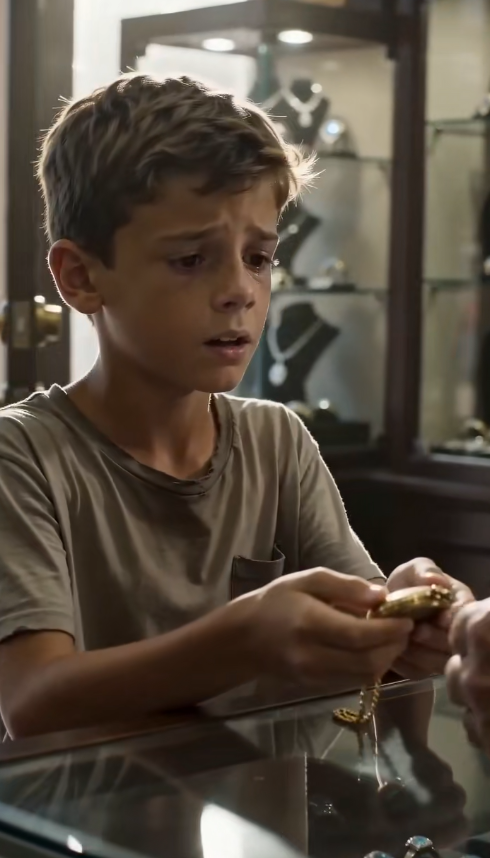
—My mom is sick. She needs medicine. She told me to sell this.
The boy had to stand on his tiptoes to reach the glass counter.
He held an antique gold pocket watch in both hands.
She didn’t look older than seven.
He wore a coat that was too thin for the cold, worn-out trousers, and shoes covered in dried mud. His cheeks were pale. Under his eyes was the weariness of someone who hadn’t slept well for several nights.
However, the most unsettling thing was not his appearance.
It was the way he tried to stay strong.
As if she knew she couldn’t afford to cry until she had gotten the money.
Henry Whitmore looked up from the small table where he was repairing a ring.
At seventy years old, he had been working at that jewelry store for more than four decades.
The shop was located on an old street in the city center, between a bookstore and a hat shop that had closed years before.
It wasn’t a luxury store.
The display cases were worn out.
The exterior sign had lost some of its paint.
And the doorbell rang with a small metallic tremor.
But everything inside was arranged with almost obsessive care.
Antique clocks.
Silver chains.
Family brooches.
Wedding rings that had been passed down through several generations.
Henry knew the value of each piece.
He also knew that some objects were worth much more for the history they held than for the metal they were made of.
He adjusted his glasses.
—Let me see it.
The boy hesitated before handing over the watch.
—I don’t want him to break it.
Henry gave a gentle smile.
—It’s hard to scare an old watchmaker.
The little boy placed the piece on his palm.
Henry first looked at the casing.
It was a golden age.
It had suffered years of use.
It had scratches along the edge and a small dent near the hinge.
It didn’t appear to have been recently stolen.
Someone had carried it with them for a long time.
“What’s your name?” he asked.
—Noah Reed.
—And your mother?
—Emma.
Henry nodded as he searched for the small side tab.
—Did she ask you to come alone?
Noah looked down.
—He said he couldn’t get out of bed.
Henry pressed the mechanism.
The clock opened.
And the world stopped moving.
Inside the lid was a tiny photograph.
A young man appeared next to a dark-haired girl.
They were both smiling in front of a garden.
Henry barely glanced at the man.
His eyes were fixed on the woman.
The shape of her smile.
The slight tilt of the head.
The light eyes that seemed to light up even within an aged photograph.
Henry felt the air disappear from the room.
I knew that face.
I had tried to forget it.
I had prayed to see him again.
And she had ended up accepting that it would never happen.
“Sir?” Noah asked.
Henry’s hands began to tremble.
—Where did your mother get this watch?
—He’s always had it.
-You’re sure?
—He keeps it inside a wooden box. He never let me touch it.
Henry closed his fingers around the piece.
—This watch belonged to my daughter.
Noah frowned.
—My mom says she has no family.
That phrase hurt him more than any accusation.
Henry looked up.
—What did you say his name was?
—Emma Reed.
The old man had to lean on the counter.
Her daughter’s name was Emily Whitmore.
He had disappeared twenty-two years earlier.
She was nineteen when she left home after a terrible argument.
She was in love with Daniel Reed, a young man whom Henry considered impulsive, poor, and without a future.
Emily wanted to get married.
Henry refused to give his consent.
He told her things he’d been trying to forgive himself for decades.
That he was destroying his life.
That Daniel was not worthy of her.
That if he crossed that door, he shouldn’t return expecting everything to continue as before.
Emily walked through the door.
And he never returned.
Henry searched for her for years.
He hired researchers.
He asked at hospitals.
She visited cities where someone claimed to have seen her.
He wrote to Daniel.
The letters returned unanswered.
Until, five years after the disappearance, she received an envelope with no return address.
Inside was a short letter.
Emily had died abroad after an illness.
Daniel had also died.
There was no address.
There was no certificate.
There was no grave.
But Henry was exhausted.
His wife had already died, consumed by guilt and sadness.
And he ended up accepting that news because continuing to wait had become unbearable.
Now a child with Emily’s eyes stood before him.
And she was wearing the watch that Henry had given her for her eighteenth birthday.
“Noah,” he said with difficulty, “how old is your mother?”
-Forty one.
Henry closed his eyes.
Their ages matched.
—Do you have a small scar under your chin?
The boy was surprised.
-Yeah.
—And when she’s nervous, does she bite the inside of her lip?
Noah nodded slowly.
—How do you know that?
Henry opened his mouth.
He was unable to respond.
The doorbell rang.
A tall man entered the jewelry store.
He was wearing a perfectly tailored black coat.
Dark gloves.
Hair combed back.
And a calm smile that didn’t reach her eyes.
Noah stopped breathing.
He backed up until he hit the counter.
“There you are,” said the stranger. “Your mother is very worried.”
The boy positioned himself behind Henry.
-No.
The man bowed his head.
—Noah, don’t make this any harder.
—Mom said to run if you found me.
The smile disappeared.
Henry closed the watch and discreetly put it in his waistcoat pocket.
-Who are you?
—Victor Voss.
—Are you related to the child?
—I am an authorized person to take him back.
—That doesn’t answer my question.
Voss looked at Henry impatiently.
—The child took an object that does not belong to him.
—His mother gave it to him.
—Your mother is sick and confused.
Noah held the back of Henry’s coat.
“He came last night,” she whispered. “He told Mom that if she didn’t hand over the watch, they would stop bringing her medicine.”
Henry felt his blood begin to boil.
Voss extended a gloved hand.
—Give me the watch and the child.
-No.
The man looked at him as if he hadn’t heard correctly.
-Excuse me?
—I said no.
—Mr. Whitmore, you don’t understand the situation.
Henry remained motionless.
—How does he know my name?
For the first time, Voss made a mistake.
It was just a pause.
A fraction of a second.
But Henry saw her.
—It’s written on the shop window—he replied later.
Henry didn’t take his eyes off him.
Noah gently tugged on his sleeve.
—Mom gave me something else.
Voss turned his head.
The boy put a hand inside the lining of his jacket.
He took out a folded piece of paper that had been sewn with thick thread.
Voss’s eyes hardened.
—Give it to me.
Noah stepped back.
Voss lunged towards him.
Henry grabbed a heavy silver candlestick from the counter and hit the man’s wrist.
Voss let out a curse.
Noah ducked down.
Henry took the paper and opened it.
The writing was faint.
Insecure.
But he recognized her immediately.
I had seen those letters in school notebooks.
On birthday cards.
In notes left on the kitchen table.
Father:
If this letter reaches you, I’m still alive.
For years I was told that you had rejected me and that you didn’t want to see me again.
I believed it.
Daniel died.
Noah is our son.
The people from Harrow House are coming for him.
Don’t trust Victor Voss.
Forgive me for taking so long.
Emily.
The words became blurred.
Henry felt something break inside his chest.
His daughter was alive.
She had lived for more than two decades believing that her father had abandoned her.
The bell rang again.
A police officer entered.
Henry had reached for the silent button under the counter when Voss lunged at Noah.
The stranger’s expression changed immediately.
“Thank God,” he said. “This man is holding a minor against his will and refusing to release him to his legal guardian.”
The agent looked at Henry.
Then to Noah, who was trembling behind the counter.
—Sir, keep your hands visible.
Voss smiled.
-Of course.
Noah pointed at the man.
—He threatened my mom.
“The child is confused,” Voss replied. “His mother is not fit to care for him.”
Henry held the letter.
—Her mother is my daughter.
The agent took a step toward Voss.
—I need your identification.
The man looked at Noah.
Her voice lost all softness.
—You should have obeyed your mother.
Noah clenched his fists.
—She said not to trust you.
Voss reached into his coat.
The policeman brought his gun to his.
But Voss pulled out a small cylinder.
He threw him to the ground.
A cloud of gray smoke filled the room.
Henry heard glass breaking.
A blow.
The bell.
Then, silence.
When the smoke began to clear, Voss had disappeared.
The back door of the store remained open.
Henry put a hand in his pocket.
The clock was gone.
“He took it,” he said.
Noah remained crouched behind the counter.
In one hand he held a piece of paper torn from Voss’s pocket during the struggle.
There was only one address written on it.
Harrow House.
The officer called for backup.
He told Henry that he had to wait.
That he couldn’t leave.
They needed to confirm Emily’s identity and obtain a warrant.
Henry tried to listen.
He tried for three minutes.
Then he looked at Noah.
—Do you know where your mother is?
The boy pointed in the direction.
-Over there.
—Have you been here before?
—Once. When I was little. Mom said I shouldn’t remember it.
Henry took his coat.
-Come on.
The officer tried to stop him.
—Mr. Whitmore, you can’t take the child.
—He’s my grandson.
—That’s not confirmed yet.
Henry showed the letter.
“My daughter has been waiting for someone to believe her for twenty-two years. I’m not going to make her wait another night.”
Noah got into Henry’s old car.
During the journey, he held the letter to his chest.
The city was left behind.
Then came the fields.
The roads became narrow.
Tall trees covered the road.
“Is it true that you are my grandfather?” the boy asked.
Henry kept his hands on the steering wheel.
—It seems so.
—Mom never talked much about you.
—Did he say I was a bad person?
Noah thought before answering.
—She said you didn’t love her.
Henry felt guilt close his throat.
—I loved her more than anyone else.
—Then why didn’t he look for her?
The question was fair.
Painful.
Impossible to answer without admitting failure.
—I looked for her for a long time. Then I received a letter saying she had died.
—And did she believe it?
Henry looked at the road.
-Yeah.
—Mom says lies work best when they say exactly what you’re most afraid to hear.
The old man turned his head towards him.
That child should never have heard such a phrase.
Did anyone hurt you at Harrow House?
Noah lowered his eyes.
—Not so much for me.
—And your mother?
The boy clutched the letter.
—She was always tired. Sometimes she couldn’t remember where she was. They gave her pills that made her sleep.
Henry accelerated.
Harrow House appeared at the end of the road.
It was a huge stone building erected on a hill.
The windows were narrow.
The light-colored walls looked clean from a distance.
An iron fence surrounded the entire property.
A blue medical van was waiting next to a side entrance.
Henry parked behind a line of trees.
They approached on foot.
Noah walked quickly despite his short legs.
Upon reaching a ground floor window, he stopped.
-There.
Henry looked through the glass.
A woman lay on a narrow bed.
She was extremely thin.
Her skin looked almost transparent.
The dark hair lay spread out on the pillow.
She had a strap around one wrist.
Henry ran out of strength.
Time had changed her face.
But not the way to close your eyes.
Not that small scar under the chin.
—Emily.
Noah placed both hands against the glass.
-Mother.
The woman did not react.
Henry tried to open the window.
It was insured.
The bedroom door opened.
Victor Voss entered.
He was holding the gold watch.
He opened it.
He put the small photograph aside.
Behind it was a compartment that Henry had never seen before.
Voss pulled out a tiny key.
Emily opened her eyes.
Her face filled with fear.
Voss leaned towards her and said something they couldn’t hear.
Noah started to cry.
—We have to get her out.
Henry looked towards the van.
Two employees were loading boxes and medical equipment.
“They’re moving her,” Noah said. “They do that when someone gets too close.”
Voss turned towards the window.
Their eyes met Henry’s.
She smiled.
The garden lights all came on at the same time.
Dogs began to bark.
The gate slammed shut with a metallic clang.
A voice came from the loudspeakers installed on top of the building.
—Welcome home, Mr. Whitmore.
Henry took Noah’s hand.
-Runs.
They went into the hedges.
A searchlight crossed the garden.
Guards left through the main entrance.
The dogs were barking closer and closer.
Noah pulled Henry towards an ivy-covered wall.
-Here.
Beneath the plants was an old basement door.
It had been painted black, but underneath the peeling paint a dark red color could be seen.
—Mom said that if I ever came back, I should look for the red door.
Henry bumped the zipper with his shoulder.
He did not give in.
He did it again.
The rusted metal broke.
They went in and closed the door behind them.
The interior smelled of dampness, bleach, and old stone.
Noah moved forward through a narrow corridor.
He didn’t seem to consciously remember the way.
But her body did.
It turned twice.
He went down a few steps.
Finally, they heard voices.
Henry recognized Voss.
The other voice was weak.
But it was her daughter’s.
“My father will find us,” Emily said.
Voss let out a laugh.
—Your father accepted your death because we gave him a letter and a tomb that he never dared to open.
Henry closed his eyes.
Every word was a blade.
“I wrote to him,” Emily continued. “For years.”
—And we keep every letter.
—You told him he hated me.
—It was easier to remain obedient if you believed you had nowhere to return to.
Henry clenched his fists.
Voss opened the clock.
—Your father never discovered that this piece contained the final key to the Whitmore trust.
Emily turned her face away.
—The money doesn’t belong to you.
—Money belongs to whoever can control it.
—Noah doesn’t belong to you either.
—Your son is the heir to two fortunes. Whitmore through you. Reed through his father.
Voss stroked the small key.
—We need all three of them. The key. The heiress. And the child.
Henry pushed the door.
Emily raised her head.
For a moment, father and daughter looked at each other across twenty-two years of lies.
Henry saw the girl leave his house.
Emily saw the man she had thought was lost.
—Emily—he whispered.
Her lips trembled.
-Dad?
Voss raised a pistol.
—She should have stayed in her jewelry store.
Henry stood in front of Noah.
—Let them go.
—You ceased to have the right to give orders when you allowed your daughter to disappear.
The phrase achieved its purpose.
Henry did not back down.
Noah looked at the wall.
Next to a series of jars was a red switch protected by glass.
He grabbed a bottle.
She threw it.
The glass shattered.
The bottle hit the switch.
The alarms began to sound.
The sprinklers were activated.
Several automatic locks opened in the corridors.
Voices and shouts filled the building.
Henry ran towards Emily.
Voss pointed out.
A gunshot rang out.
Noah screamed.
But it was Voss who fell.
The bullet had hit his shoulder.
Behind him appeared the jewelry store police officer accompanied by other officers.
—Drop the weapon.
Voss fell to his knees.
Henry untied Emily’s wrist.
She could barely stand up.
When he saw the clock on the floor, he reached out a hand.
—The key.
Henry picked up the piece.
—What does it open?
The iron door had no handle.
Nor a keyboard.
There was only a tiny golden hole in the center.
Henry opened the hidden compartment of the watch.
He took out the key.
Throughout his life he had repaired complicated mechanisms.
He had opened safes.
Watches with secret clasps.
Jewels built to hide messages.
But I had never felt so much fear when putting a key into a lock.
Turn.
At first nothing happened.
Then a click was heard.
The door opened slowly.
Henry was hoping to find beds.
Chains.
Perhaps a confinement room.
Instead, a file appeared.
Entire rows of bookshelves covered the walls.
There were numbered boxes.
Children’s photographs.
Birth certificates.
Medical reports.
Adoption documents.
Declarations of incapacity.
Cards.
Wills.
And hundreds of files with names crossed out and replaced by others.
On one of the walls hung portraits of children identified only by numbers.
Noah took a few steps in.
—Where are they?
Emily leaned against Henry.
—Some were taken away.
—And the others?
She closed her eyes.
-Don’t know.
The police started photographing everything.
An officer requested immediate backup.
That room did not contain only evidence against Harrow House.
It was the map of an organization that had been destroying families for decades.
Noah found a box on one of the lower shelves.
It had written on it:
EMILY WHITMORE.
He took her to her mother.
Letters appeared inside.
Hundreds of letters.
Henry recognized his own envelopes.
She had written one every month for the first five years.
Then one every birthday.
Then one every Christmas.
Some were stained.
Others had never been opened.
Emily took one of them.
Her fingers were trembling.
—You wrote to me.
—Every month.
—Voss said you burned them without reading them.
Henry felt his legs give way beneath him.
—I never received a single response.
Emily opened another box.
Inside were copies of letters she had sent to Henry.
They were there too.
Detained.
Classified.
They have become instruments to keep them apart.
In one of them, Emily had written after Noah’s birth:
Father:
I know you might not want to know anything about me, but you have a grandson.
He looks like Daniel when he gets angry.
And what about you when you look at a clock?
I want you to meet him.
Henry covered his mouth.
-Forgive me.
Emily looked up.
-Because?
—For letting you go that night.
—I left too.
—You were nineteen years old.
—And she was angry.
—I was your father. I should have followed you.
She clutched the letter.
—You tried.
—Not enough.
Emily did not respond.
I couldn’t forgive him in a few minutes.
Nor did he want to turn twenty-two years of suffering into a simple scene of reconciliation.
But when Henry reached out his hand, she did not move away.
Noah found another file.
—Mom, here’s Dad.
The name Daniel Reed appeared on a thick folder.
Emily sat down.
For years they had been told that Daniel had died in an industrial accident.
The file contained photographs of him entering and leaving Harrow House.
Surveillance reports.
Call logs.
And a document signed by Victor Voss.
Daniel had discovered that the institution was falsifying diagnoses to seize inheritances.
He tried to get Emily out.
He also looked for Henry.
He couldn’t reach him.
A final note stated:
“SUBJECT REED NEUTRALIZED DURING TRANSFER.”
Emily dropped the document.
—They killed him.
Henry put his arm around his daughter’s shoulders.
-I’m sorry.
—He died trying to find you.
Noah looked at his father’s folder.
She didn’t cry immediately.
He remained still.
Then he asked:
—Was he brave?
Emily knelt in front of him.
-A lot.
—Did he try to save us?
—Until the end.
The boy nodded.
He pressed the folder to his chest.
For the first time since she had entered the jewelry store, she allowed the tears to fall.
The investigation continued throughout the night.
Harrow House had begun decades earlier as a private center for young women from wealthy families.
Some arrived after unwanted pregnancies.
Others due to emotional crises.
Or because of relationships that their parents disapproved of.
The institution promised discreet treatment.
In reality, its directors discovered that they could earn much more money by manipulating identities, assets, and custody arrangements.
Healthy women were declared unfit.
Their letters were being intercepted.
Their families received false reports.
The children were registered with different names.
Some were given up for adoption illegally.
Others were used to control family trusts.
When a victim tried to speak, they increased the medication.
If he persisted, his complaint was described as delusional.
Victor Voss was not the creator of the network.
He was in charge of keeping her invisible.
There were lawyers.
Doctors.
Officials.
Bank managers.
Notaries.
And members of powerful families who preferred to erase their own children rather than accept a scandal.
The small key on the clock did not directly open the money.
It provided access to the file capable of proving who had stolen each inheritance.
Henry understood why he never knew the key existed.
The watch had originally belonged to his father.
His wife gave it to Emily before she died.
Unbeknownst to Henry, his grandfather had investigated Harrow House many years before.
He discovered part of the network.
He hid a copy of the key inside the watch and left instructions that it could only be opened along with certain Whitmore trust documents.
But he died before revealing the whole truth.
The staff at Harrow House believed that Emily knew the secret.
That’s why they detained her.
During the first few months after her disappearance, they tried to convince her to hand over the watch.
Emily had hidden it.
Daniel managed to recover it during one of his escape attempts.
Years later, before he died, he managed to return it to her.
Emily kept it for more than two decades.
Until she realized that she could no longer protect Noah.
Then he sent the boy to get money for medicine.
But I was also expecting something more.
I knew that Henry continued working at the same jewelry store.
I had seen the name of the place in an old newspaper.
He couldn’t tell if his father was still alive.
I couldn’t know if I would receive it.
All I knew was that, upon opening the watch, I would recognize the photograph.
Before dawn, Emily was taken to a hospital.
Henry wanted to accompany her in the ambulance.
But she asked that Noah go first.
The boy sat down next to the stretcher and held her hand.
—I told you I would come back.
Emily stroked his face.
—You were very brave.
—I was afraid.
—Courage doesn’t disappear just because you’re afraid.
Henry watched them from the other side.
For twenty-two years he had imagined hundreds of times what it would be like to find his daughter.
In none of those fantasies was she so weak.
Even her grandson didn’t seem so used to protecting her.
Guilt accompanied him the whole way.
Emily remained hospitalized for three weeks.
She suffered from malnutrition.
Liver damage from years of medication.
Muscle weakness.
And episodes of disorientation caused by treatments he had never needed before.
Doctors warned that his recovery would be slow.
Henry did not try to rush her.
He visited every day.
At first he sat far from the bed.
He didn’t ask questions.
He didn’t constantly apologize to her.
He didn’t expect her to console him for his guilt.
She brought food that she knew he liked when he was young.
Books.
Family photographs.
And the recovered letters.
One afternoon, Emily found a picture of her mother.
She held it for a long time.
—When did he die?
Henry lowered his head.
—Two years after you left.
—Did I know you were looking for me?
—We did it together.
Emily closed her eyes.
—Voss said she was happy that he had disappeared.
Henry felt like breaking something.
But he didn’t want his anger to fill the room.
—Your mother never stopped waiting.
-Me neither.
Tears streamed down Emily’s face.
—But there came a time when I no longer knew if the memories were real.
Henry got up slowly.
—Can I hug you?
She took a while to answer.
Then he nodded.
The embrace was fragile.
Almost clumsy.
He did not repair twenty-two years.
But it opened a place where they could begin.
Noah visited every day.
At first he was inseparable from the watch.
The police had returned it after copying and documenting the mechanism.
The boy slept with the piece inside his backpack.
She was afraid someone would rob her again.
Henry managed to convince him to take it to the jewelry store to have it repaired.
“I don’t want it to look new,” Noah warned.
-Because?
—Because Mom protected her while she was scratched.
Henry nodded.
He cleaned the mechanism.
He changed a damaged wheel.
He repaired the hinge.
But it left the marks on the casing intact.
Every scratch was a test of survival.
Victor Voss survived the shooting.
He was accused of kidnapping, fraud, conspiracy, unlawful deprivation of liberty, homicide related to the death of Daniel, and manipulation of numerous assets.
During the interrogation, he tried to present himself as an employee.
He claimed that he was only obeying orders.
The files showed that he had directed transfers, destroyed evidence, and threatened victims for years.
Other arrests began shortly after.
The medical director of Harrow House.
Three lawyers.
Two officials.
A bank manager.
Several former employees.
The investigation extended to other cities.
Dozens of families received calls.
Some found daughters or grandchildren they had believed to be dead.
Others discovered much more painful truths.
Not all of the missing survived.
But their names were recovered.
And the lies that had erased them began to crumble.
During the trial, Henry had to testify.
Voss’s lawyer tried to hold him responsible for Emily’s disappearance.
—You kicked your daughter out of the house.
Henry held her gaze.
-Yeah.
—And now he intends to blame others for what happened?
—I made a terrible mistake.
The room fell silent.
—I spoke to her with pride when I should have spoken to her with love. I let her go because I thought she would come back when she understood that I was right.
He looked at Emily.
—I spent twenty-two years wishing I had run after her.
The lawyer approached.
—So Harrow House didn’t break up a perfect family. It found a family that was already broken.
Henry took a deep breath.
—A crack does not give anyone the right to turn it into a prison.
Emily testified in a secure room.
She recounted how Voss appeared after she and Daniel fled.
He claimed that Henry had reported Daniel for kidnapping.
He promised to help her communicate with her family.
Then he took her to Harrow House.
There they showed him fake letters.
They told her that her father had disinherited her.
That her mother didn’t want to see her.
That Daniel had fled.
When she insisted on leaving, they medicated her.
Daniel managed to find her years later.
They escaped for a brief period.
Then Noah was born.
But Voss located them again.
Daniel was murdered.
Emily and the child returned to the institution under false identities.
“Why didn’t he try to flee earlier?” the prosecutor asked.
Emily looked at Noah.
—I tried many times.
—What was stopping him?
—They told me that if I escaped, he would disappear.
Noah lowered his head.
Emily continued:
—A person can endure many things when they believe punishment will befall them. When your child is threatened, even breathing seems like a dangerous decision.
Voss was found guilty.
He received a sentence that guaranteed he would spend the rest of his life in prison.
Harrow House was closed.
Part of the building ended up being converted into a support center for victims of confinement and family fraud.
Emily didn’t want to return for a long time.
When she finally did, she entered accompanied by Henry and Noah.
The red door was still in the basement.
They had kept it as evidence.
Emily stopped in front of her.
—I thought I would die here.
Henry took her hand.
—You don’t have to come in.
-Yeah.
She breathed.
—But this time I’ll decide when to leave.
He crossed the threshold.
He walked to the old room.
The straps had been removed.
The walls were empty.
Noah placed a photograph of Daniel on the table.
“So that he also knows that we’re back,” he said.
Emily wrapped her arms around her son.
Months later, she returned to the jewelry store for the first time.
Henry closed the shop to avoid onlookers.
Emily stood in front of the door for several minutes.
“I used to come here after school,” he said.
—You would sit behind the counter and change the price tags.
-Only once.
—For three weeks.
Noah ran behind the counter.
—Can I learn to repair watches?
Henry smiled.
—First you’ll have to learn not to lose your screws.
—I won’t lose them.
—Everyone says that.
Emily watched her father and son.
A strange emotion crossed his face.
Happiness.
Pain.
And the sadness of knowing that Daniel would never see that scene.
Henry opened a small box.
Inside was the golden clock.
I had placed it on dark velvet.
The photograph continued under the lid.
Emily and Daniel.
Youths.
Smiling before the world tried to tear them apart.
“It’s yours,” said Henry.
Emily denied it.
—From Noah.
The boy took the watch.
—I don’t plan to sell it.
Henry laughed through his tears.
-I hope so.
They placed the piece inside a display case.
Not to sell it.
But to keep it visible.
Next to it was a small plaque:
NOT FOR SALE.
Noah asked to add another sentence.
Henry handed him a piece of paper.
The child wrote in irregular handwriting:
SOME THINGS DON’T STAND BY TIME.
THEY GUARD THE WAY BACK.
One afternoon, when the shop had already closed, Noah asked:
—Mom, why did you send me with the watch?
Emily was sitting by the window.
—Because we needed the medicines.
—But you knew that Grandpa worked here.
She nodded.
—I was hoping he was still alive.
—What if he didn’t recognize you?
Emily looked at Henry.
—I knew he would recognize the watch.
-Because?
His mother smiled weakly.
—Because some people remember the pain first.
He extended a hand towards Henry.
—But your grandfather always remembered love a little faster.
Henry took her hand.
Years ago I had let her go next to a door.
This time he didn’t.
Noah opened the clock.
The mechanism began to beat.
Tic.
Tac.
Tic.
Tac.
For twenty-two years, that sound had continued inside a hidden box.
I had crossed through closed rooms.
Hospitals.
Roads.
And hands that tried to steal it.
I couldn’t bring back the lost time.
He could not resurrect Daniel.
Nor can she erase the nights when Emily believed no one was looking for her.
But he had done something that seemed equally impossible.
He had guided a child to his grandfather.
He had opened a door built never to be opened.
And he had given a family back the chance to get to know each other before it was too late.
Because the golden clock had never contained only one key.
I kept a photograph.
A name.
A truth.