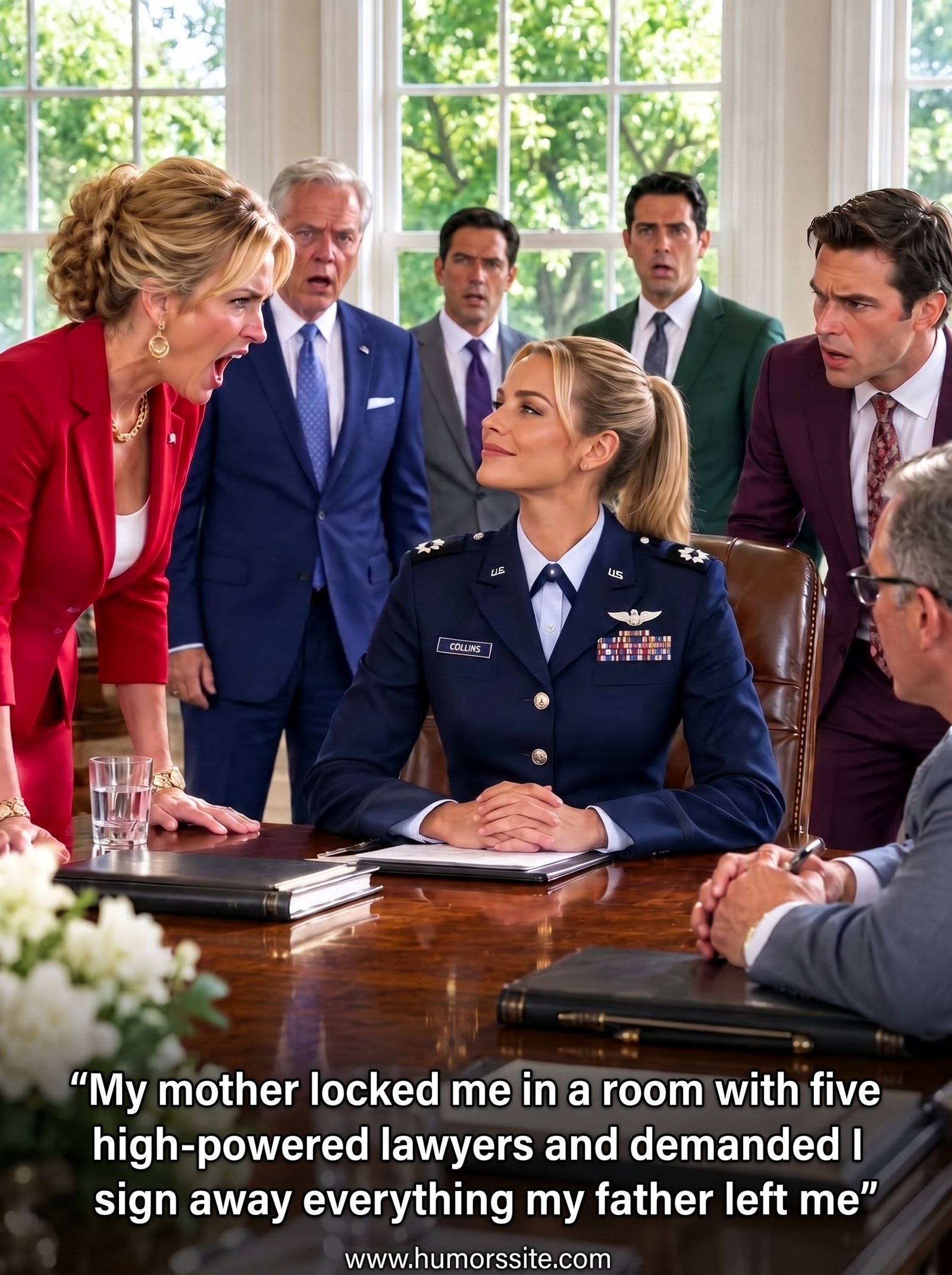
My mother locked me in a room with five high-powered lawyers and demanded I sign away everything my father left me—including a $25 million estate. “Stop pretending you deserve more,” she said. My family thought I was just an ordinary government employee they could intimidate. They had no idea I commanded a military intelligence unit—or why I kept counting the lawyers around the table as one of them quietly reached for a sealed envelope.
Part 1: The Signature They Expected Me to Surrender
My mother had five lawyers waiting when she tried to make me give away my father’s estate.
“Sign the papers, Naomi,” she said, pushing a folder toward me. “Stop pretending your father intended you to have more than the rest of us.”
Three weeks had passed since my father’s funeral. I had come directly from Washington, still carrying the exhaustion of a long briefing and the grief I had postponed because work had required me to function. I expected a tense conversation about probate. I did not expect to walk into my childhood home and find strangers arranged around the dining table like a tribunal.
My mother, Celeste, stood at the head of the table in a pale gray suit. Beside her was her husband, Grant, watching the doorway. My younger half-brother, Owen, sat with his phone in his hand, refusing to meet my eyes.
The folder in front of me was labeled: RELINQUISHMENT OF INHERITANCE AND ESTATE CLAIMS.
I did not sit down.
“What exactly am I being asked to sign?” I asked.
Celeste gave an impatient sigh. “Your father’s will was unfair. Owen is trying to expand his business. You have a secure government job and no need for property or investment accounts.”
My father, Daniel Hart, had spent forty years building a construction company. He had also left behind commercial buildings, a historic house in Philadelphia, company shares, and investments worth far more than anyone in that room wanted to acknowledge.
“Owen’s business is not my responsibility,” I said.
“It is family,” Grant replied.
“So was Dad.”
The room went quiet.
For most of my life, my family had treated my career as an inconvenience they could not explain at dinner parties. They knew I worked for the government. They knew I traveled often. They knew I wore a uniform on formal occasions.
But they had never asked enough questions to understand that I was Colonel Naomi Hart, commander of a military intelligence unit. They did not know that I had spent years assessing people who believed confidence could replace evidence.
They thought five attorneys would intimidate me.
Instead, I counted them.
One had opened the folder but never touched it again. Another kept looking at my mother before answering even simple questions. A third appeared uncomfortable enough that he had already packed his legal pad away.
Then the oldest attorney stood.
“Colonel Hart,” he said carefully. “Perhaps you should review the documents.”
My mother’s smile tightened at the sound of my rank. “She is not here as a colonel. She is here as my daughter.”
“No,” I said. “I’m here as the person you asked to sign away her father’s property.”
I opened the folder. It offered me $300,000 in exchange for every right my father had left me. The Philadelphia house. His shares in Hartson Construction. Two office buildings. Several accounts.
The estate was worth more than $25 million.
Owen finally looked up. “You don’t even care about money.”
“That is usually what people say when they want mine.”
I turned another page and noticed a yellow divider tucked near the back. In the lower corner, someone had handwritten four numbers: 1022.
My father’s birthday.
He used those digits only for one thing: the indexing system for his private records.
I looked at the older attorney. “Where did this come from?”
Before he could answer, my mother said, “From your father’s files. It is none of your concern.”
But the attorney had already given her away. His expression changed for less than a second.
Fear.
Then he removed his glasses and looked directly at me.
“Your father asked me to be present if this meeting ever happened,” he said.
Grant shifted near the doorway. Owen lowered his phone.
My mother’s voice became dangerously quiet. “Martin, do not make this complicated.”
The attorney reached into his briefcase and placed a sealed envelope on the table.
My name was written across the front in my father’s unmistakable handwriting.
For the first time that night, my anger gave way to grief.
Then Martin said the words that changed everything.
“Your father believed someone was trying to take control of his estate before he di:ed.”
Part 1: The Signature They Expected Me to Surrender
My mother had five lawyers waiting when she tried to make me give away my father’s estate.
“Sign the papers, Naomi,” she said, pushing a folder toward me. “Stop pretending your father intended you to have more than the rest of us.”
Three weeks had passed since my father’s funeral. I had come directly from Washington, still carrying the exhaustion of a long briefing and the grief I had postponed because work had required me to function. I expected a tense conversation about probate. I did not expect to walk into my childhood home and find strangers arranged around the dining table like a tribunal.
My mother, Celeste, stood at the head of the table in a pale gray suit. Beside her was her husband, Grant, watching the doorway. My younger half-brother, Owen, sat with his phone in his hand, refusing to meet my eyes.
The folder in front of me was labeled: RELINQUISHMENT OF INHERITANCE AND ESTATE CLAIMS.
I did not sit down.
“What exactly am I being asked to sign?” I asked.
Celeste gave an impatient sigh. “Your father’s will was unfair. Owen is trying to expand his business. You have a secure government job and no need for property or investment accounts.”
My father, Daniel Hart, had spent forty years building a construction company. He had also left behind commercial buildings, a historic house in Philadelphia, company shares, and investments worth far more than anyone in that room wanted to acknowledge.
“Owen’s business is not my responsibility,” I said.
“It is family,” Grant replied.
“So was Dad.”
The room went quiet.
For most of my life, my family had treated my career as an inconvenience they could not explain at dinner parties. They knew I worked for the government. They knew I traveled often. They knew I wore a uniform on formal occasions.
But they had never asked enough questions to understand that I was Colonel Naomi Hart, commander of a military intelligence unit. They did not know that I had spent years assessing people who believed confidence could replace evidence.
They thought five attorneys would intimidate me.
Instead, I counted them.
One had opened the folder but never touched it again. Another kept looking at my mother before answering even simple questions. A third appeared uncomfortable enough that he had already packed his legal pad away.
Then the oldest attorney stood.
“Colonel Hart,” he said carefully. “Perhaps you should review the documents.”
My mother’s smile tightened at the sound of my rank. “She is not here as a colonel. She is here as my daughter.”
“No,” I said. “I’m here as the person you asked to sign away her father’s property.”
I opened the folder. It offered me $300,000 in exchange for every right my father had left me. The Philadelphia house. His shares in Hartson Construction. Two office buildings. Several accounts.
The estate was worth more than $25 million.
Owen finally looked up. “You don’t even care about money.”
“That is usually what people say when they want mine.”
I turned another page and noticed a yellow divider tucked near the back. In the lower corner, someone had handwritten four numbers: 1022.
My father’s birthday.
He used those digits only for one thing: the indexing system for his private records.
I looked at the older attorney. “Where did this come from?”
Before he could answer, my mother said, “From your father’s files. It is none of your concern.”
But the attorney had already given her away. His expression changed for less than a second.
Fear.
Then he removed his glasses and looked directly at me.
“Your father asked me to be present if this meeting ever happened,” he said.
Grant shifted near the doorway. Owen lowered his phone.
My mother’s voice became dangerously quiet. “Martin, do not make this complicated.”
The attorney reached into his briefcase and placed a sealed envelope on the table.
My name was written across the front in my father’s unmistakable handwriting.
For the first time that night, my anger gave way to grief.
Then Martin said the words that changed everything.
“Your father believed someone was trying to take control of his estate before he died.”
Part 2: The Letter My Father Left Behind
I picked up the envelope slowly, but my mother reached for it before I could break the seal.
“No,” Celeste said. “That was not meant for you.”
Martin Hale, the older attorney, rose from his chair. “Mrs. Hart, the envelope is addressed to Colonel Naomi Hart and was placed in my custody by her father. You have no authority to withhold it.”
Grant moved away from the doorway, and Owen finally put his phone down. My mother looked around the room as if she had just realized that the five lawyers she had assembled were not all there to protect her.
I opened the envelope. Inside was a letter written on my father’s cream stationery, the handwriting shaky but familiar.
Naomi, if you are reading this while someone is urging you to give up what I left you, then I was right to be concerned. Do not sign anything concerning my estate until Martin Hale has completed the review I asked him to conduct.
My throat tightened as I read the next paragraph. Dad had anticipated every argument waiting for me: that Owen needed support, that my career made me independent, that I should prove my love for the family by giving away something I had never requested.
Owen stood abruptly. “What review?”
My mother answered before Martin could. “Your father was ill. He became suspicious of everyone and started inventing problems.”
Martin’s expression remained calm. “Daniel Hart was not inventing anything. He contacted my firm ten months ago after noticing activity in accounts he had not authorized.”
Grant’s face hardened. “You are discussing confidential business matters in front of the family.”
“The family is exactly why Mr. Hart was worried,” Martin replied.
I kept reading Dad’s letter. He wrote that Celeste had asked him to transfer the Philadelphia house to Owen, and that Grant had proposed using one of the commercial buildings as security for a private loan. Dad had refused both requests.
After that, he wrote, financial documents began appearing with signatures and instructions he had never approved.
Owen looked directly at our mother. “What is he talking about?”
Celeste’s eyes stayed fixed on me. “Your father favored you. He always did. This is one more way for him to punish the rest of us.”
For years, she had used that accusation whenever Dad showed me affection. When he attended my military graduation, I was selfish. When he called me during deployments, I was taking him away from the family. She had turned every act of love into proof that I had done something wrong.
But the letter in my hands told a different story. Dad had not been choosing a favorite child. He had been trying to protect his work from people he no longer trusted.
Martin reached into his briefcase and placed several pages in front of me. “Your father wanted you to see these if anyone attempted to challenge the will.”
The documents were emails from a luxury real-estate broker. Seven months earlier, someone had requested a valuation for the Philadelphia house, then prepared a draft purchase agreement.
The seller listed on the document was my father.
The person claiming authority to act for him was my mother.
I looked at Celeste. “You tried to sell Grandma’s house.”
“It was only an evaluation,” she said too quickly.
An evaluation does not include a buyer’s offer.”
Her own attorney picked up the pages and began reading. The color drained from his face.
Owen leaned over his shoulder. “Mom, tell me this isn’t real.”
She did not answer. Instead, she looked at Grant.
That was all the answer any of us needed.
Martin opened another file. “There is also the matter of a power of attorney your father revoked years ago.”
My stomach tightened. “Was it used after he revoked it?”
Martin met my eyes.
“We have identified nearly three million dollars in transactions that require an explanation.”
Part 3: The Money They Said Was for Family
No one spoke after Martin named the amount.
Nearly three million dollars had vanished from accounts connected to my father’s estate and company, and my mother stood at the far end of the table as if outrage alone could erase the documents in front of her.
“That money was used for the family,” Celeste said. “Daniel understood that families sometimes need help.”
Martin folded his hands. “Some accounts were personal. Others belonged to Hartson Construction. The issue is whether the transfers were authorized.”
Grant stepped forward. “You are making accusations based on incomplete records.”
“Then complete them,” I said. “Explain the transfers.”
He stared at me for a moment, clearly expecting the daughter he remembered—the one who let family arguments end when everyone became loud enough. But I had learned that silence could be useful when it gave people room to reveal the thing they were trying hardest to hide.
Martin slid one spreadsheet across the table. “Six hundred thousand dollars was transferred from Hartson Construction to a consulting firm created under your name, Mr. Reed.”
Grant did not touch the paper.
Owen looked between us. “What consulting firm?”
“It was a business expense,” Grant said.
“For what service?” Martin asked.
Grant’s jaw tightened. “Strategic planning.”
Martin opened a second file. “The company had no employees, no verified clients, and no documented work product. It was created eleven days before the first transfer.”
My mother moved quickly toward Owen. “Your father always wanted you to have the opportunity he never had. This was meant to help you.”
Owen looked sick. “Help me how?”
Martin answered gently. “We found money from the consulting company entering accounts associated with your restaurant group.”
Owen sank back into his chair. “Mom told me Dad approved an investment.”
Celeste’s expression broke for a fraction of a second. “He intended to.”
“That is not what I asked,” Owen said.
For the first time in years, I saw him without the arrogance that had always irritated me. He looked less like the brother who believed every setback deserved rescuing and more like someone who had realized his success might rest on money he had never earned.
Martin opened a third folder. “There is an additional concern. Mrs. Hart appears to have used a power of attorney after it was formally revoked.”
My mother gave a short, angry laugh. “Daniel told me I could still handle things.”
“Did he put that in writing?” I asked.
“No. He was my husband.”
“That is not legal authorization.”
Grant walked toward the doorway. He was not rushing, but his posture had changed. He no longer looked like a man overseeing a meeting; he looked like a man calculating the quickest way out of it.
“Don’t leave yet,” I said.
He stopped. “Why would I take orders from you?”
“Because Dad documented everything, and Martin’s firm has been reviewing it for months.”
Martin nodded toward the laptop at the center of the table. “Your father maintained original ledgers in a separate location. An associate is accessing them now.”
My mother went pale.
“You said those records were destroyed,” Grant murmured.
She turned sharply toward him. “I never said that.”
But she had said enough.
On the laptop screen, a live video feed appeared from Dad’s old office downtown. A young legal assistant stood beside the drafting table he had used when I was a child, while a security officer watched from the hall.
Martin held up a brass key. “Your father left this for Naomi.”
I recognized it immediately. The lower drawer in Dad’s filing cabinet had always been locked, even when I was little.
The assistant opened the drawer, removed the false bottom, and revealed a narrow metal compartment underneath. Inside were handwritten ledgers, a flash drive, a sealed affidavit, and a digital recorder.
My mother whispered, “No.”
Then the assistant opened the first ledger to a red-marked page.
Beside a transfer date, my father had written one line in blue ink:
Celeste requested release. I refused. Verify account activity Monday.
Part 4: The Story They Built Around My Father
The ledger held more than a few suspicious transfers.
Page after page contained my father’s notes: invoices from vendors that did not exist, requests my mother had made and he had rejected, money moved through Grant’s consulting company, and references to Owen’s restaurant group. Dad had written everything down because, by the end, he understood that memory alone would not protect anyone.
Martin opened the sealed affidavit next. “Your father prepared this after he discovered someone was using an old power of attorney to gain access to company funds.”
Celeste’s face twisted. “He was becoming confused.”
I looked up from the screen. “Was that the story you planned to tell?”
She did not answer. Grant did.
“Daniel had health problems. We were concerned about him.”
“Concerned enough to claim he could not manage his own affairs?” I asked.
Martin placed several printed messages on the table. They were between Celeste and Grant, dated almost a year before my father died. The first mentioned getting “supporting language” from Dad’s physician. The second discussed restructuring assets before I returned from an overseas assignment.
The third line was only four words.
Naomi is never here.
For a moment, I could not speak. My deployments, the work I had accepted, the distance I had always hated—they had viewed all of it as an opportunity.
“You were going to use my absence,” I said.
Celeste looked down at the floor. “We were trying to save the family.”
“From what?”
Grant finally stopped pretending. “I made investments that went badly.”
Owen stared at him. “How badly?”
Grant’s voice was low. “A few million.”
My mother closed her eyes, and the truth filled the room even before she said another word. Grant had lost money. She had believed my father’s assets could repair the damage. The Philadelphia house would cover a large part of it, and the company transfers had been meant to buy them time.
“You called that saving the family?” I asked.
Celeste’s eyes filled with tears. “I was desperate.”
“No,” I said. “You were methodical.”
Desperation did not create false companies, draft property contracts, revive revoked authority, and build a narrative about a man’s incapacity. Those things took planning. They took choices made again and again.
Owen walked away from her side of the table. “You told me Dad wanted to support my restaurants.”
“I wanted to support you,” she said.
“With stolen money?”
Her hand lifted as if she meant to touch his face, but he stepped back before she could. The movement was small, but it seemed to break something in her expression.
Martin’s laptop chimed. His associate had found an audio recording in the hidden compartment and sent it securely to him.
“Do not play that,” Celeste said.
Martin looked at me. “Your father authorized its release if there was a dispute over the affidavit.”
I nodded once.
Dad’s voice filled the dining room. He sounded tired, but steady.
“Celeste, did you authorize the transfer to Grant’s company?”
Her recorded answer came after a pause. “It was temporary.”
“You used an authority I revoked.”
“You never let anyone help Owen.”
“The money belongs to the company and its shareholders.”
Then Grant’s voice entered the recording. “Daniel, you are making this worse than it needs to be.”
My father answered, “You are asking me to risk employees’ jobs to solve debts you created.”
The audio ended.
Owen stood motionless, and my mother stared at the laptop as if it had turned against her. In the silence, Martin explained that Dad had quietly created a separate trust to protect Hartson Construction’s payroll, vendors, and employee pensions while the missing funds were traced.
My father had not left that trust to me or Owen.
He had left it to the people who would suffer if our family’s damage reached them.
Then a car door closed outside.
Grant turned toward the front windows as two vehicles pulled into the driveway. Martin closed his briefcase and spoke with the same calm voice he had used all evening.
“Outside counsel and financial investigators are here to secure the records.”
My mother gripped the back of her chair.
“You arranged this,” she whispered.
I looked at the unsigned waiver still lying on the table.
“No. Dad did. He just needed us to make the final mistake.”
Part 5: What My Father Actually Left Me
Three months after that meeting, my father’s estate entered independent administration.
The investigators traced the disputed transfers, and Hartson Construction continued operating because Dad’s contingency trust protected payroll, vendor contracts, and employee benefits while the review proceeded. He had understood that the people most harmed by a family’s dishonesty are often the people who never knew there was a problem.
Grant’s consulting company became part of the financial investigation. My mother challenged several provisions of the estate plan, which she had every right to do, but she had to make her arguments in court with documents and testimony instead of pressure and intimidation.
Owen separated his restaurant business from every account connected to the disputed money. He cooperated with the review, returned what he could, and accepted that being misled did not erase his responsibility to face the truth.
One afternoon, he called me.
“I should have asked questions sooner,” he said.
“Yes,” I replied.
He was silent for a while. “Do you think Dad hated me?”
I looked out my office window before answering. “No. He wanted you to become someone who could stand on his own. That is not the same as hating you.”
My mother never gave me the apology I had imagined when I was younger. At first, that disappointed me more than I expected. I had spent so much of my life hoping that one day she would see me as her daughter instead of a threat to the version of the family she wanted to control.
Eventually, I understood that her approval was not something I needed to earn.
I kept the Philadelphia house, but not because I felt obligated to preserve every piece of my father’s past. I kept it because I wanted a place where I could remember him without arguments, lawyers, or people insisting I should be smaller to make them comfortable.
The first weekend after the estate hearing, I drove there alone. The house smelled like old wood, dust, and the faint trace of coffee my grandmother used to make before anyone else was awake.
Dad had mentioned one loose floorboard in the upstairs study. When I found it, I laughed quietly because it still creaked in the same spot it had when I was nine years old.
Back then, I had hidden bad report cards beneath it, convinced no one would ever find them. Dad had never confronted me about it, but he had always known.
Under the floorboard was a small metal box.
Inside, I found a photograph of the two of us. I was missing a front tooth and trying to hide a report card behind my back, while Dad sat beside me with the patient expression of a man pretending not to notice what his child was doing.
On the back, he had written: Naomi always thinks the secret is what she hides. It never is.
Beneath the photograph was a final note.
The real question is whether you can face the truth when it finally finds you.
I sat on the floor for a long time, holding those words in my hands.
My mother had believed power meant surrounding me with lawyers, blocking the door, and persuading me that I had no right to resist. She had mistaken pressure for strength.
But I had spent my life learning something different. Power was not controlling a room. It was being prepared enough to remain calm when someone else tried to control it.
That night, my mother saw five lawyers and believed she had built an army.
I saw five witnesses.
And when the truth finally reached the table, the only signature that mattered was my father’s.