My husband brought an elderly homeless man into our home and ordered me, “You bathe him. I don’t want the staff touching him.” I reluctantly put on gloves and began helping. Then I spotted a crescent-shaped birthmark on his shoulder and froze. I dropped the sponge, pulled out a locket I had hidden for 20 years, and compared the two. Seconds later, I broke down in tears …
“I want you to help him bathe in our tub, and don’t hand the job to the staff. You’re going to do it yourself.”
For several seconds, I honestly wondered whether my husband had completely lost his mind. My name is Mariana, I was thirty-six, and after fifteen years of marriage I thought I understood Julian well enough to know what he might do next, but that afternoon proved otherwise.
Julian owned several successful commercial construction companies across Chicago, so money had never been a serious concern in our marriage. What occasionally tested my patience was his tendency to become completely absorbed in whatever charitable cause had recently captured his attention.
That week, his latest mission was volunteering at a soup kitchen near the downtown bus terminal. He told me he was tired of donating large checks from behind a desk and wanted to meet the people those donations were actually supposed to help.
I was far less enthusiastic about the idea.
“Some people really do need help, but plenty of others choose to live that way.”
I had said it casually over breakfast while sitting inside our perfectly climate-controlled home, with our cook preparing my meal and a private driver waiting outside. Looking back, I can barely tolerate the arrogance in my own words.
That afternoon, I returned from lunch with friends and found Julian standing in our foyer beside an elderly man I had never seen before. The stranger looked as though years of living on the streets had settled into every part of him, from his badly tangled hair and dirt-covered skin to the worn coat that seemed barely capable of keeping out the cold.
The smell reached me before I was close enough to speak, and I instinctively covered my nose and stepped backward.
“What is he doing in our house?”
The elderly man immediately lowered his eyes, looking embarrassed simply for standing inside my home. Julian, however, remained maddeningly calm.
“His name is Lucas.”
I stared at him in disbelief.
“Is that really his name, or did you just decide to call him that?”
“He doesn’t remember his real name, Mariana.”
At first, I assumed Julian was exaggerating, but Lucas quietly explained that he had spent roughly twenty years moving between bus stations, parks, shelters, and abandoned buildings without knowing who he had been before. His earliest memory was waking near the remains of a construction site two decades earlier, with no recollection of his family, surname, address, or anything that could reconnect him to his former life.
Julian had met him while serving meals earlier that afternoon and had apparently made a decision before bringing him home.
“I’m going to help him replace his documents and find out who he is. Until then, he’ll stay in the guest suite.”
I felt my temper rise almost immediately.
“In this house?”
“Yes.”
“What’s next? Are we turning the entire place into a shelter?”
Lucas shifted uneasily toward the front door, clearly uncomfortable with becoming the reason for an argument between us.
“I don’t want to cause trouble. I can leave.”
Julian gently stopped him before turning back toward me.
“You’re not going anywhere.”
Then his attention settled entirely on me.
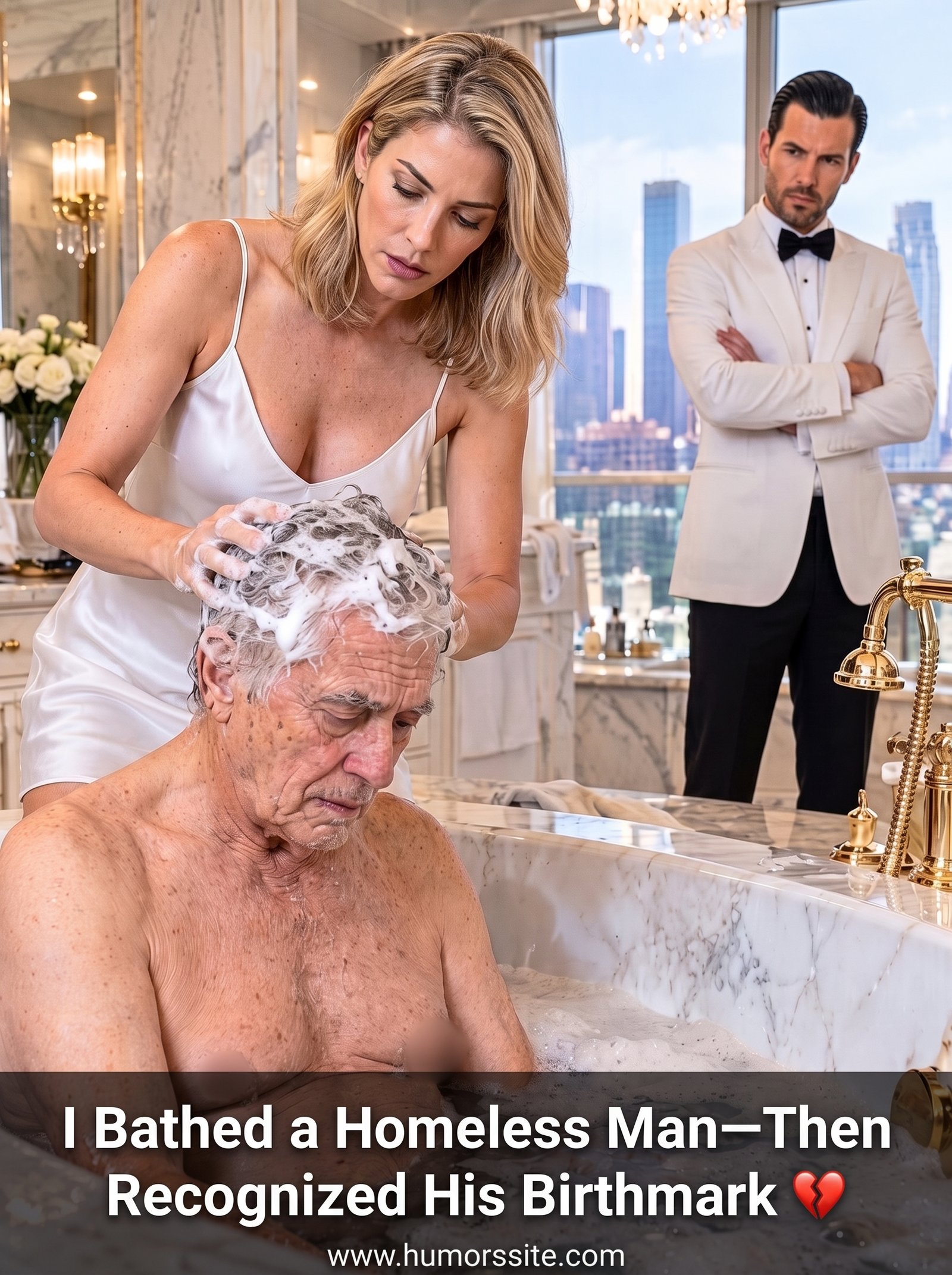
“I filled the garden tub upstairs. Mariana, take him up and help him get cleaned up.”
I could hardly believe what I was hearing.
“Me?”
“Yes.”
“We have an entire household staff, Julian.”
His expression hardened as he answered.
“Exactly. If you really believe people deserve help, start by treating him like a human being instead of something unpleasant you can hand off to an employee.”
The remark hurt because I knew exactly why he had aimed it at me. Still angry and embarrassed, I led Lucas upstairs to the master bathroom and pulled on a pair of thick rubber gloves before going anywhere near him.
“Put those clothes directly into the trash bag. None of them are staying in this house.”
Lucas answered with a level of politeness I had not deserved.
“I can wash myself, ma’am.”
“I’d rather make sure you don’t damage the marble.”
Even now, remembering those words makes me ashamed. Lucas never answered my cruelty with anger, and somehow his quiet dignity makes the way I treated him feel even worse in hindsight.
He carefully lowered himself into the warm bath, and within minutes the clear water had become cloudy from years of accumulated dirt. I picked up a soft sponge and began washing his right shoulder, focusing on the task and trying to ignore how uncomfortable the entire situation made me.
As the grime came away, something small appeared on his skin. It was a tiny crescent-shaped birthmark.
My hand stopped immediately, and the sponge slipped from my fingers into the bathwater. I stared at the mark while a memory I had buried for years suddenly forced its way back into my mind.
My chest tightened so sharply that breathing became difficult.
Because I had seen that exact birthmark before..
Part 1: The Stranger in My Bathtub
My husband told me he wanted me to bathe the elderly homeless man he had just brought into our house, and for several seconds, I honestly believed he had lost his mind. My name is Mariana, I was thirty-six, and after fifteen years of marriage, I thought I understood Julian better than anyone.
Julian owned several large construction companies throughout Chicago and had more money than we could ever reasonably spend. He was also the kind of man who threw himself completely into whatever charitable cause had captured his attention, and that week he had started volunteering at a soup kitchen near the downtown bus terminal.
He told me he was tired of simply writing large corporate checks and wanted to meet the people receiving help face-to-face. I was less impressed by his sudden enthusiasm.
“Some people genuinely need help, but plenty of others choose to live that way.”
Those words had come easily while I sat inside a climate-controlled mansion with a cook preparing breakfast and a driver waiting outside. At the time, I had no idea how arrogant I sounded.
Later that afternoon, I returned from lunch with friends and found Julian standing in our grand foyer beside an elderly man who looked as though he had spent years surviving on the streets. His hair was badly tangled, his coat was worn almost beyond repair, and the smell surrounding him made me instinctively step backward.
“What is he doing in our house?”
The man immediately lowered his eyes, but Julian remained calm.
“His name is Lucas.”
I frowned.
“Is that really his name, or did you give it to him?”
“He doesn’t remember his real name.”
Lucas quietly explained that he remembered waking up nearly twenty years earlier near the remains of a construction site. Since then, he had moved between parks, transit stations, abandoned buildings, and shelters without knowing his surname, his family, or where he had originally lived.
Julian had met him while serving food that afternoon and had already decided he would help recover his identification and search for information about his past. Until then, he intended to let Lucas stay in one of our guest rooms.
“In our house?”
Julian nodded.
“Yes.”
Lucas immediately stepped toward the entrance.
“I don’t want to cause trouble. I can leave.”
Julian gently stopped him before turning back toward me.
“You’re not going anywhere.”
Then he told me the bath upstairs was ready and asked me to help Lucas clean up. I stared at him in disbelief because we employed a full household staff, and I could not understand why he insisted I do it myself.
“We have people for that.”
Julian’s expression sharpened.
“If you think helping people matters, start by treating him like a human being instead of something unpleasant you can hand off to someone else.”
His words irritated me because I knew exactly what he was accusing me of. Still muttering under my breath, I led Lucas upstairs, put on thick rubber gloves, and helped him into the warm bath.
I spoke to him more coldly than I am proud to admit, telling him his clothes would be thrown away and warning him not to damage the marble. Lucas remained polite through all of it, which somehow made my behavior feel even worse in hindsight.
As I began washing years of grime from his right shoulder, something underneath the dirt caught my attention. A small crescent-shaped birthmark appeared against his skin, and my entire body went still.
The sponge slipped from my hand into the water.
“Turn around.”
Lucas looked confused.
“Is something wrong?”
I grabbed a wet cloth and began wiping his face more carefully. Beneath the dirt and exhaustion, an older version of a face I had not seen in twenty years slowly emerged.
My hands started shaking so badly that I could barely move. I rushed to my vanity, opened a drawer, and pulled out the tarnished gold locket I had hidden there for two decades.
Inside was a faded photograph of a young man smiling with his arms around a ten-year-old girl. I held the picture beside Lucas’s face and looked again at the crescent-shaped mark on his shoulder.
“This man was my father.”
My voice broke as tears filled my eyes.
“He had the exact same birthmark.”
Lucas stared at the photograph for several seconds before raising his eyes toward the bathroom mirror. I looked at the exhausted man sitting in front of me and finally spoke the name I had not dared to say aloud in twenty years.
“Dad… your name is Lucas.”
Part 2: The Memory That Wouldn’t Return
Lucas did not suddenly recognize me or throw his arms around me. He simply sat in the bath holding the gold locket with trembling hands, staring at the photograph as though he were looking at someone else’s life.
“I’m so sorry. I don’t remember that little girl.”
The words cut deeper than I expected. For twenty years, I had believed my father died in a devastating house fire, and now he was sitting only a few feet away from me, alive but unable to remember who I was.
I had been ten when the fire destroyed our old home. Firefighters never found a body, but the building was reduced to ruins, and everyone around me eventually accepted that my father could not have survived.
Afterward, an aunt raised me, and years later I met Julian. Even after building a new life, however, I never stopped wondering what had really happened that night.
When Lucas and I went downstairs, Julian was waiting in the living room. I walked straight toward him with tears still running down my face.
“You knew, didn’t you? You brought him here on purpose.”
Julian shook his head.
“I wasn’t completely sure.”
He explained that two details had caught his attention at the soup kitchen. Lucas appeared to be the right age, and a long uneven burn scar stretched across his left wrist, matching a childhood injury I had once described to Julian.
“I thought it might be a coincidence. I needed you to see him before I gave you false hope.”
The next morning, we took Lucas to a private neurologist downtown. After brain scans and cognitive testing, the doctor explained that the trauma he had suffered twenty years earlier had likely caused severe psychogenic amnesia.
“Do not force the memories. Familiar places, photographs, smells, music, and other sensory triggers may help, but let the process happen naturally.”
For the next several weeks, I tried everything I could think of. I filled the house with old photographs, baked the cinnamon rolls my father used to make on Sunday mornings, played his favorite jazz records, and drove him to the park where he had once bought me ice cream after school.
Nothing worked.
Lucas always smiled politely, but there was never any flicker of recognition. One afternoon, he noticed an old black-and-white photograph on the fireplace mantle showing a young version of him standing beside my mother.
“Who is she?”
My throat tightened.
“That’s my mother. Eleanor.”
He looked at me carefully.
“Where is she?”
I turned the photograph facedown.
“That can wait, Dad.”
I could not bring myself to tell him because I had spent twenty years believing my mother died because of me. That guilt had become so deeply woven into my life that I was not ready to reopen it while my father was still struggling to remember himself.
A week later, I drove Lucas back to the street where our home had once stood. The old property was gone, replaced by a pharmacy and a strip mall, and he stared through the car window without recognition.
“I’m sorry, sweetheart. I don’t remember any of this.”
I forced a smile.
“It’s okay, Dad.”
We got out and walked toward a nearby park. Without warning, a truck horn exploded behind us, followed by the violent screech of tires.
A pickup had jumped the curb and was heading directly toward us. I froze, but Lucas reacted instantly and shoved me out of the way before the truck slammed into a utility pole farther down the street.
When I pushed myself up from the pavement, Lucas was kneeling nearby and trembling violently. Then he looked at me with an intensity I had not seen since childhood.
“Marianita…”
My heart seemed to stop. No one had called me that in twenty years.
Lucas pressed both hands against his temples as tears ran down his face.
“I remember.”
He looked at me again.
“I remember what happened to your mother.”
Part 3: The Truth About the Night Everything Changed
My father looked at me as though twenty years of fog had suddenly cleared from his mind. His hands were still trembling from the near accident, but his eyes were no longer distant or confused.
“Your mother didn’t die because of you, Marianita.”
The words broke something open inside me. For two decades, I had carried the belief that one reckless decision I made as a child had somehow caused my mother’s death, and I had never been able to forgive myself.
Lucas took my face gently between his hands.
“You were ten years old. You were just a little girl.”
Still sitting near the curb, he told me what had really happened.
Twenty years earlier, my mother Eleanor had picked me up from school. I had seen my father waiting across a busy avenue near the grocery store and rushed toward the crosswalk the moment the pedestrian signal changed.
A speeding driver ran the red light.
My mother saw the car before I did and threw herself toward me, pushing me out of its path. She was struck instead and hit her head against the curb.
She died before the ambulance arrived.
Lucas had witnessed everything from across the street.
I covered my face as years of guilt crashed into a completely different truth. My mother had not died because I had been a bad child.
She had died saving me.
“Your mother chose to protect you because you were her whole world. She would never have wanted you to spend the rest of your life using her sacrifice to punish yourself.”
I cried against my father’s shoulder until I could barely breathe. When I finally calmed down, there was one more question I needed answered.
“What happened after that? How did you disappear?”
Lucas closed his eyes and let the rest of the memories return.
After Eleanor’s death, he sank into a severe depression but continued working because he still had me to support. On the night our house burned, I was staying with my aunt while he worked a late shift at a bakery.
When Lucas returned home early, smoke was already pouring from the kitchen. He rushed inside to retrieve a metal box containing our identification papers, photographs, and the few belongings we still had from my mother.
Then the gas exploded.
The blast threw him against a wall, and he escaped through a broken rear window badly injured and disoriented. In shock, he wandered several miles before a truck driver found him unconscious near an interstate rest stop and took him to a small rural clinic.
Lucas had no identification when he woke up.
Worse, he could not remember his own name.
What followed was twenty years of shelters, temporary jobs, freezing nights, exploitation, and endless movement from one state to another. Without documents or memories, he had no way to return to the life he had lost.
Eventually, something he could not explain drew him back toward Chicago.
“Something inside me must have known you were here.”
When Julian saw us return home holding hands, he rushed into the driveway with alarm.
“What happened?”
I smiled through my tears.
“He came back.”
Julian looked between us.
“Who?”
Lucas gave him a warm smile.
“Lucas came back.”
Over the following months, pieces of my father continued returning. He remembered that I hated cilantro, the lullaby he used to sing when I had a fever, and the coffee can where he saved coins to buy me new school shoes every autumn.
As Lucas remembered who he had been, I was forced to confront who I had become.
Only weeks earlier, I had recoiled from a homeless stranger in my own foyer. Now I understood that my father had survived for twenty years among the very people I had judged so casually.
One morning, I asked Julian to take me back to the soup kitchen.
I wore simple clothes, brought no cameras, and told no one where I was going. Then I tied on an apron and started serving meals.
When a tired man in a torn coat approached the counter, I remembered the disgust I had shown Lucas on the day he entered my home.
“Would you like some extra stew?”
The man looked up in surprise.
“Yes, ma’am. If it isn’t too much trouble.”
I filled his bowl twice.
Across the room, Julian caught my eye and smiled.
He did not need to say anything.
For the first time, I understood exactly what he had been trying to teach me from the beginning.
Part 4: The Man Who Shared His Last Piece of Bread
As my father recovered more of his memories, he also began talking about the people who had helped him survive during the years when he did not know who he was. One evening over dinner, he placed his spoon down and told Julian and me there was someone he needed to find.
“His name is Marcus.”
For the previous three years, Marcus had worked overnight cleaning restrooms at Chicago’s central bus terminal. He earned very little and lived in a damp basement apartment, yet he had repeatedly shared what little he had with the homeless man everyone knew only as Lucas.
Marcus saved leftover bread for him, brought him hot coffee, and sometimes allowed him to sleep inside a warm supply closet during freezing winter nights. More importantly, Marcus was the person who had told my father about Julian’s soup kitchen.
“If Marcus hadn’t pushed me to go get a hot meal that day, I never would have met your husband. I might still be sleeping on a park bench.”
Julian immediately put down his fork.
“Then we’re going to find him.”
The next afternoon, we drove to the bus terminal. Lucas walked through the tiled corridors until he spotted an older man with graying hair pushing a heavy mop bucket near the restrooms.
“Marcus!”
The man turned and stared at my father without recognition. Lucas was now clean, neatly dressed, and healthier than the exhausted man Marcus had known on the streets.
My father laughed.
“What, you don’t recognize the old rag-man who used to beg you for coffee?”
Marcus dropped the mop handle.
“Lucas?”
They embraced in the middle of the terminal while commuters moved around them. Marcus admitted he had searched for Lucas after he suddenly disappeared and feared something terrible had happened.
My father smiled through tears.
“Something incredible happened. I found my daughter.”
Marcus looked toward me and then at Julian, slowly realizing who we were. When Julian thanked him for caring for his father-in-law, Marcus immediately waved the gratitude away.
“I didn’t do anything special. I just did what anyone should do.”
Julian had already learned that Marcus had once been a talented tailor who repaired clothes for neighbors. He had never earned enough to buy professional equipment or rent a proper storefront, and years of financial hardship had eventually pushed him into janitorial work.
Julian did not simply hand him money. Instead, he leased a small storefront in a busy neighborhood, equipped it with commercial sewing machines, arranged a contract for school-uniform alterations, and covered the first year of rent on a clean apartment nearby.
When Marcus saw the shop, he broke down crying.
“I can’t accept this. I didn’t do enough to deserve something like this.”
Lucas embraced him.
“You shared your bread with me when you barely had enough for yourself. Let me share what I have now.”
Watching them changed something permanent inside me.
For most of my life, I had assumed homelessness was largely the result of irresponsible decisions. My own father had now taught me how easily one accident, illness, trauma, or terrible night could erase a person’s identity and push them into years of survival.
Julian and I eventually created a nonprofit focused on helping unhoused people recover identification, locate missing relatives, access medical care, and rebuild basic stability. My father insisted that the organization should never treat anyone like a charity case.
He understood too well how much dignity mattered.
When I tried buying him designer clothes and expensive watches to compensate for everything he had lost, he gently asked me to stop.
“I don’t need twenty years of luxury to make up for twenty years on the street.”
I smiled sadly.
“I just want to spoil you.”
“Then sit down and have breakfast with me.”
That simple request humbled me more than any expensive gift ever could. My father did not want a replacement for the twenty years we had lost; he wanted whatever ordinary time we still had left together.
Part 5: The Place Where We Both Came Home
One year later, my father and I returned to the same street corner where the speeding truck had nearly taken him from me again. We stood beside the curb holding hands, looking at the ordinary intersection that had somehow become the place where twenty years of missing memories finally ended.
“This is where I finally woke up.”
I squeezed his hand.
“And where I almost lost you again.”
Lucas smiled and turned toward me.
“No, Marianita. This is where we both came home.”
By then, our lives had changed in ways I never could have imagined on the afternoon Julian first brought him into our foyer. My father had continued recovering pieces of his past, while I had spent the year confronting the assumptions I once carried about poverty, homelessness, and people whose lives looked nothing like mine.
Julian and I expanded the nonprofit we had created together. It helped unhoused people replace lost identification, reconnect with relatives, receive medical treatment, and access temporary housing without being treated as though hardship had erased their dignity.
My father remained involved, but he never wanted to become a symbol of tragedy or a wealthy family’s inspirational project. He preferred talking directly with people who had lived through the same cold nights, uncertainty, and invisibility he had endured.
He also refused almost every luxury I tried to give him. Designer clothes, expensive watches, and lavish vacations meant very little to a man who believed the most valuable thing he had recovered was ordinary time with his daughter.
“I don’t need twenty years of luxury to compensate for twenty years on the street.”
I would usually protest.
“I’m allowed to spoil my father.”
He would smile.
“Then have breakfast with me.”
So that became our ritual.
Sunday mornings were cinnamon rolls, coffee, and stories. Lucas asked about the years he had missed, including my first day of high school, how I met Julian, the mistakes I made in college, and all the ordinary memories no amount of money could recreate.
Marcus became part of our lives too. His tailoring shop grew steadily after Julian helped him get started, and within a year he had hired two assistants and earned enough to support himself comfortably.
Whenever Marcus tried thanking us, my father corrected him.
“You kept me alive long enough to find my daughter. We’re even.”
Standing at that intersection a year later, I thought about how strangely all our lives had collided. My mother had died protecting me, my father had lost himself while surviving a terrible accident, Marcus had shared what little food he had, and Julian had walked into a soup kitchen because he wanted his charity to mean more than writing checks.
And I had met my own father while recoiling from him because he was dirty.
Before we returned to the car, Lucas glanced at me with a mischievous smile.
“Marianita, do you remember the first time you gave me a bath?”
I covered my face.
“Dad, please don’t start.”
He laughed.
“You wore rubber gloves.”
“I’ve apologized a hundred times.”
“A hundred and one wouldn’t hurt.”
By the time we reached Julian, both of us were laughing.
Julian shook his head.
“What did I miss?”
Lucas grinned.
“Your wife remembering that the homeless stranger she didn’t want to touch was the same man who used to carry her on his shoulders.”
I felt my face grow warm, but this time I laughed through the tears.
My father had taught me that people rarely arrive in our lives carrying explanations for how they got there. Sometimes beneath worn clothes, exhaustion, or years of neglect is a history nobody bothered to ask about.
Whenever I now pass someone sleeping on a bench or wearing shoes held together by tape, I remember Lucas. I remind myself that I cannot see the accident, illness, grief, or chain of circumstances that may have brought them there.
The man who entered my home that afternoon had never needed my disgust or even my pity.
He needed someone to look closely enough to recognize that he was still a person worth finding.
And sometimes, a warm meal, an open door, or a tub filled with clean water is enough to help a life everyone else has overlooked begin finding its way home.