My husband tried to take our seven-year-old daughter from me by telling the judge I was faking every blackout. His mother pointed across the courtroom and said, “She is pretending.” Then I collapsed beside the witness stand, and my husband laughed, “She always does this.” A military doctor in the gallery checked my pulse, ordered emergency care, and the monitor revealed the heart condition they had spent a year denying.
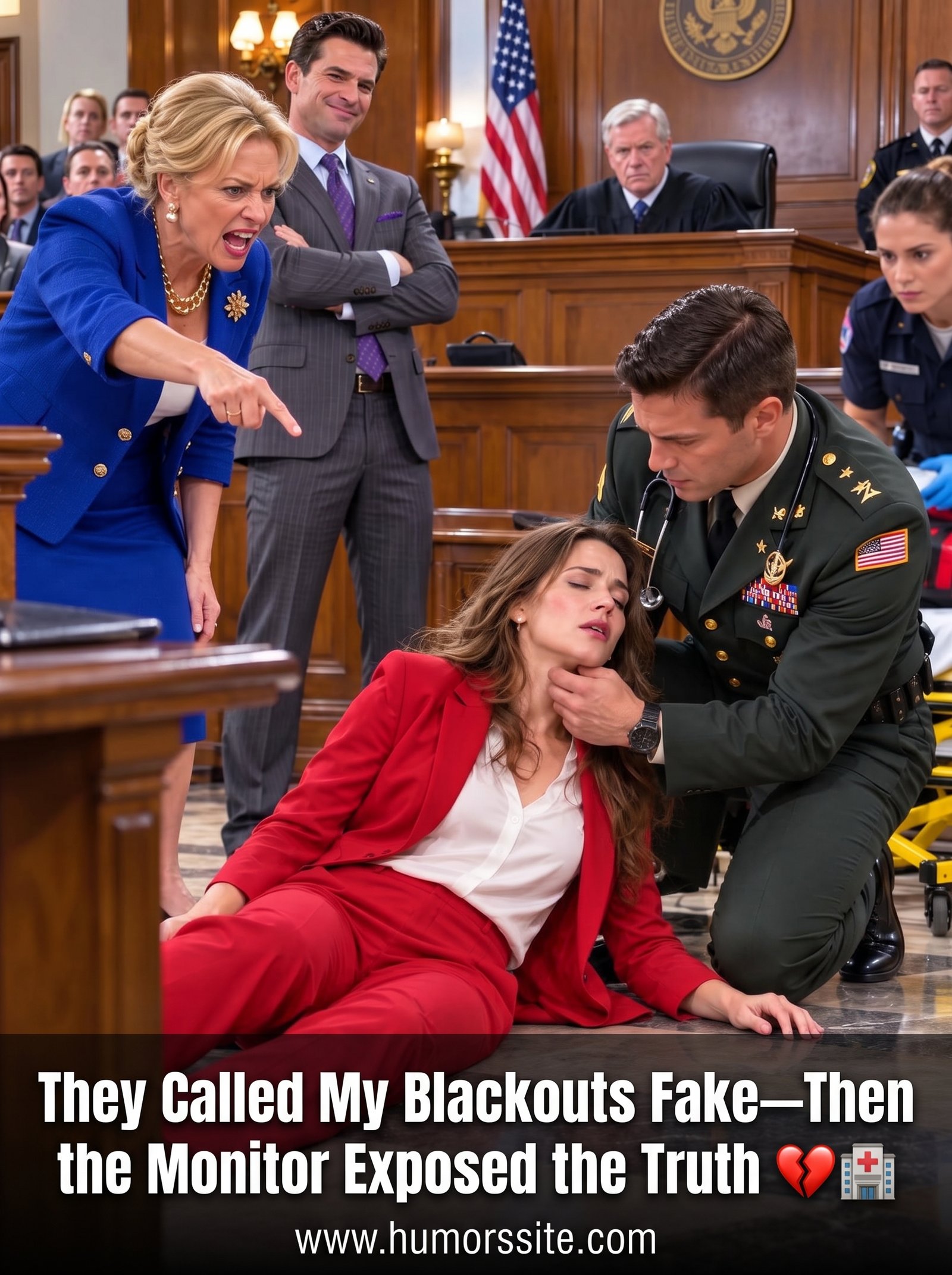
My mother-in-law pointed at me across the courtroom and said, “She is pretending.”
My husband sat beside his attorney and gave the judge a small, satisfied smile. “She does this whenever things don’t go her way,” he said.
Less than a minute later, I collapsed.
I had been holding the rail beside the witness stand because the room would not stop moving. The lights above me buzzed too loudly, my vision kept narrowing at the edges, and my heart felt wrong—too fast one moment, frighteningly slow the next.
But Evan had spent months using my symptoms against me.
For nearly a year, I had been living with dizziness, sudden exhaustion, near-blackouts, and strange episodes where sound seemed to fade far away. Some emergency-room tests had come back normal because nothing happened while I was connected to the machines.
Evan turned that uncertainty into a weapon.
He told people I was anxious. His mother, Celeste, said I loved attention. When we separated, Evan filed for more custody of our seven-year-old daughter, Sophie, and claimed my health made me incapable of caring for her.
That morning, I came to court alone.
My lawyer had withdrawn after Evan drained our joint account and I could no longer afford the retainer. I had spent hours trying to explain why Sophie cried on the nights before she went to Evan’s home, why she hid her school bag, and why she had started asking whether I was “really sick.”
Every time I tried to speak, Evan’s attorney objected.
“You have no confirmed diagnosis,” he said.
No diagnosis. As though the absence of an answer meant the absence of pain.
Judge Marshall asked whether I could continue. I wanted to say yes, because I knew Evan was watching for weakness. I knew Celeste was waiting for another chance to call me dramatic.
Then the floor seemed to tilt beneath my feet.
“Your Honor,” I whispered, “I need a moment.”
Evan laughed quietly.
Celeste leaned toward the gallery and said, “There it is again.”
I tried to grip the railing, but my fingers would not close around it. The courtroom split into shadows, and then my shoulder struck the floor.
For a few seconds, I could not understand why voices sounded so far away. Chairs scraped. Someone said my name. Evan stood nearby, but he did not come toward me.
“She’s fine,” he said. “She always does this.”
Then a man I had never seen before pushed through the benches and dropped to his knees beside me. He wore a dark green military uniform, and his name tag read WATKINS.
He placed two fingers against my neck.
The calm left his face immediately.
“Ma’am, can you hear me?” he asked.
I tried to answer, but my mouth would not cooperate.
Behind him, Celeste said, “She just wants sympathy.”
The man looked over his shoulder, his voice suddenly hard enough to silence the room.
“I’m Colonel Samuel Watkins, U.S. Army Medical Corps,” he said. “And this woman needs emergency care.”
He checked my pulse again, then looked toward the bailiff.
“Call 911. Now.”
The paramedics arrived minutes later. They placed oxygen beneath my nose, connected wires to my chest, and stared at the monitor.
“One reading shows thirty-four,” one paramedic said.
Another repeated my blood pressure, and even through the fog in my mind, I knew it was dangerously low.
Evan finally stepped closer. “Is she actually—”
Colonel Watkins turned toward him.
“Sir,” he said, “she is not pretending.”
Those words hurt more than the fall.
For a year, I had asked doctors, family, and even myself to believe that something real was happening inside me. A stranger who had known me for less than five minutes was the first person to say it plainly.
The judge immediately suspended the custody hearing. Evan protested, but Judge Marshall cut him off.
“Custody will not be decided while the mother is experiencing a medical emergency,” he said.
At the hospital, I woke with wires across my chest and a cardiologist sitting beside my bed.
Dr. Meera Joshi asked me about the blackouts, the muffled hearing, and the way my heartbeat seemed to change without warning. Then she turned the monitor toward me.
“Your earlier tests may have missed it because the problem is intermittent,” she said. “But we caught it tonight.”
I was afraid to ask.
Dr. Joshi took a breath.
“Your heart is periodically slowing to a dangerous rate,” she said. “And we need to determine why.”
For the first time, my symptoms had become more than something Evan could dismiss.
They had become evidence.
Part 1: The Day They Called Me a Liar in Court
My mother-in-law pointed at me across the courtroom and said, “She is pretending.”
My husband sat beside his attorney and gave the judge a small, satisfied smile. “She does this whenever things don’t go her way,” he said.
Less than a minute later, I collapsed.
I had been holding the rail beside the witness stand because the room would not stop moving. The lights above me buzzed too loudly, my vision kept narrowing at the edges, and my heart felt wrong—too fast one moment, frighteningly slow the next.
But Evan had spent months using my symptoms against me.
For nearly a year, I had been living with dizziness, sudden exhaustion, near-blackouts, and strange episodes where sound seemed to fade far away. Some emergency-room tests had come back normal because nothing happened while I was connected to the machines.
Evan turned that uncertainty into a weapon.
He told people I was anxious. His mother, Celeste, said I loved attention. When we separated, Evan filed for more custody of our seven-year-old daughter, Sophie, and claimed my health made me incapable of caring for her.
That morning, I came to court alone.
My lawyer had withdrawn after Evan drained our joint account and I could no longer afford the retainer. I had spent hours trying to explain why Sophie cried on the nights before she went to Evan’s home, why she hid her school bag, and why she had started asking whether I was “really sick.”
Every time I tried to speak, Evan’s attorney objected.
“You have no confirmed diagnosis,” he said.
No diagnosis. As though the absence of an answer meant the absence of pain.
Judge Marshall asked whether I could continue. I wanted to say yes, because I knew Evan was watching for weakness. I knew Celeste was waiting for another chance to call me dramatic.
Then the floor seemed to tilt beneath my feet.
“Your Honor,” I whispered, “I need a moment.”
Evan laughed quietly.
Celeste leaned toward the gallery and said, “There it is again.”
I tried to grip the railing, but my fingers would not close around it. The courtroom split into shadows, and then my shoulder struck the floor.
For a few seconds, I could not understand why voices sounded so far away. Chairs scraped. Someone said my name. Evan stood nearby, but he did not come toward me.
“She’s fine,” he said. “She always does this.”
Then a man I had never seen before pushed through the benches and dropped to his knees beside me. He wore a dark green military uniform, and his name tag read WATKINS.
He placed two fingers against my neck.
The calm left his face immediately.
“Ma’am, can you hear me?” he asked.
I tried to answer, but my mouth would not cooperate.
Behind him, Celeste said, “She just wants sympathy.”
The man looked over his shoulder, his voice suddenly hard enough to silence the room.
“I’m Colonel Samuel Watkins, U.S. Army Medical Corps,” he said. “And this woman needs emergency care.”
He checked my pulse again, then looked toward the bailiff.
“Call 911. Now.”
The paramedics arrived minutes later. They placed oxygen beneath my nose, connected wires to my chest, and stared at the monitor.
“One reading shows thirty-four,” one paramedic said.
Another repeated my blood pressure, and even through the fog in my mind, I knew it was dangerously low.
Evan finally stepped closer. “Is she actually—”
Colonel Watkins turned toward him.
“Sir,” he said, “she is not pretending.”
Those words hurt more than the fall.
For a year, I had asked doctors, family, and even myself to believe that something real was happening inside me. A stranger who had known me for less than five minutes was the first person to say it plainly.
The judge immediately suspended the custody hearing. Evan protested, but Judge Marshall cut him off.
“Custody will not be decided while the mother is experiencing a medical emergency,” he said.
At the hospital, I woke with wires across my chest and a cardiologist sitting beside my bed.
Dr. Meera Joshi asked me about the blackouts, the muffled hearing, and the way my heartbeat seemed to change without warning. Then she turned the monitor toward me.
“Your earlier tests may have missed it because the problem is intermittent,” she said. “But we caught it tonight.”
I was afraid to ask.
Dr. Joshi took a breath.
“Your heart is periodically slowing to a dangerous rate,” she said. “And we need to determine why.”
For the first time, my symptoms had become more than something Evan could dismiss.
They had become evidence.
Part 2: The Monitor That Finally Told the Truth
I stared at Dr. Joshi because I had heard so many versions of “nothing is wrong” that the truth felt harder to accept than the doubt.
She explained that the electrical signals in my heart were not moving consistently. At times, the rhythm slowed so much that my brain was not receiving enough blood flow, which explained the blackouts, fading sound, and sudden weakness.
“Stress can make symptoms feel worse,” she said gently. “But stress cannot create the rhythm pattern we captured on this monitor.”
For the first time, my illness was not an argument.
It was numbers on a screen.
My phone arrived from the courthouse with missed calls from Evan and Celeste. His first message asked what the doctors had found, but the last one read, Your little episode delayed the hearing.
Celeste’s message was colder: You frightened everyone. Let us know when you are ready to act reasonably about Sophie.
I took screenshots before I could talk myself into deleting them.
That had been my habit for years. Evan would say something cruel, apologize later, and I would erase the evidence because I wanted to believe the apology mattered more than the words that came before it.
Lying in that hospital bed, I realized I had spent too long helping him tidy up the record of how he treated me.
I created a folder on my phone and saved everything.
Later that afternoon, a court clerk called to tell me that Judge Marshall had postponed the custody hearing until I was medically cleared. The court also ordered both sides to preserve all medical records used in the case.
The word all stayed with me.
Evan’s attorney had shown the judge selected notes from my emergency-room visits. They highlighted the fact that I had been sent home stable and suggested that no doctor had ever found anything concerning.
But that was not the whole story.
I logged into my patient portal and searched through months of records. In a note from May, a physician had written that my recurring near-fainting episodes required follow-up with cardiology.
The doctor had specifically recommended an ambulatory heart monitor.
He had also noted that an intermittent rhythm problem could not be ruled out.
Evan had been sitting beside me when that doctor explained it.
In court, though, his attorney had never mentioned the recommendation. He had taken one sentence—discharged in stable condition—and used it to make the judge believe every medical question had already been answered.
The truth had not disappeared.
It had been cut down until it served Evan’s version of me.
That night, the monitor beside my hospital bed sounded an alarm while I was asleep. There was no courtroom, no argument, no audience, and no one for me to convince.
My heart rate had fallen into the thirties again.
By morning, Dr. Joshi was no longer discussing possibilities.
“You need a pacemaker,” she said.
The word terrified me. I was only thirty-four. I asked whether anxiety could somehow be responsible, because even then a part of me still wanted permission to trust my own body.
Dr. Joshi shook her head. “Fear did not create what we recorded. And being frightened does not mean you imagined the cause.”
Before I went in for the procedure, I downloaded every record I could find. I saved the May report, the earlier emergency visits, the message recommending cardiac monitoring, and every text Evan and Celeste had sent after I collapsed.
Then I received one more notification.
It was from the court-appointed child advocate assigned to speak with Sophie.
Her name was Margaret Ellis.
The email was short:
Ms. Turner, I need to discuss something your daughter told me about your medical condition.
Part 3: The Thing Sophie Was Told to Believe
The pacemaker procedure left a small bandage beneath my collarbone. The morning after it was done, I stood beside my hospital bed and waited for the familiar rush of darkness.
It did not come.
I took a few slow steps down the hallway without touching the wall. Then I cried, not because I was in pain, but because my body had finally stopped abandoning me without warning.
Evan arrived that afternoon carrying flowers and a careful expression.
“You really needed a pacemaker?” he asked.
I looked at him. “You were in court when the monitor showed my pulse.”
“I only believed what the earlier tests said.”
“Do you remember the cardiology recommendation from May?”
His eyes shifted away for a fraction of a second.
The doctor had told us that an intermittent heart-rhythm issue needed to be ruled out. Evan had heard every word, yet his attorney later stood in court and treated the lack of a final diagnosis as proof that I was unstable.
“Doctors write things like that to cover themselves,” he said.
The answer came too quickly.
That was when I stopped asking whether Evan had simply misunderstood my illness. He may not have known the final diagnosis, but he knew someone had warned us there could be a medical reason.
Still, he chose the explanation that made me easier to dismiss.
The court appointed Margaret Ellis as Sophie’s advocate. Her role was to look after our daughter’s interests, not mine or Evan’s.
That frightened me more than another test or another hearing.
Margaret met with each of us separately, then spent time with Sophie. When she called me later, her voice was professional but gentle.
“Sophie has heard adults discussing whether your symptoms are real,” she said. “That is putting her in a position no child should have to manage.”
I sat in the quiet hospital room with my hand against the new bandage.
“What did she say?”
“I cannot share every detail over the phone,” Margaret replied. “But I can tell you that Sophie feels responsible for noticing whether you are tired, sick, or ‘acting.’ She thinks she has to figure out who is telling the truth.”
My chest hurt in a way no monitor could explain.
Sophie was seven. She should have been worrying about spelling tests, cartoons, and whether she could wear glitter shoes to school.
Instead, she thought my health was a mystery she had to solve for the adults around her.
Margaret’s report arrived the following day. It said Sophie loved both parents and enjoyed time with Evan, but she felt anxious before transitions. She worried that saying she missed me would upset her father.
Then I reached a sentence that made my hands shake.
Sophie reported hearing her grandmother say that Mommy gets sick when she wants people to feel sorry for her.
Celeste had not kept her contempt inside the courtroom. She had placed it inside my daughter.
After I came home from the hospital, I found Sophie arranging plastic animals across the living-room rug. She looked up immediately.
“Is your heart okay now?” she asked.
“It has a helper now,” I said. “The doctors found the problem, and they fixed what they could.”
She studied the small bandage beneath my collarbone. “I knew you weren’t pretending.”
I sat beside her and pulled her into my arms.
“You never had to prove that,” I said. “It was never your job.”
That night, I built a timeline. I gathered every emergency visit, the May cardiology note, the courtroom collapse, the monitor readings, the pacemaker report, the texts from Evan and Celeste, and Margaret’s findings.
When I put the dates in order, the truth became painfully clear.
My story had never lacked evidence.
It had been edited.
The next hearing was scheduled for three weeks later. The night before, Sophie climbed into my bed with her stuffed rabbit under one arm.
“Are you going to fall down again at court?” she whispered.
“No,” I told her. “The doctors know what is wrong now.”
She rested her head against my shoulder.
Then she said something so quietly I almost missed it.
“Grandma told Daddy not to let you bring the hospital papers.”
I went still.
“What hospital papers, sweetheart?”
Sophie looked worried that she had said something wrong.
“The ones Daddy put in the black folder,” she said. “Grandma said they would make people think you were sick.”
The next morning, I called Margaret Ellis.
And for the first time, the evidence I was bringing to court was not only about my heart.
It was about what Evan and Celeste had tried to hide.
Part 4: The Records They Tried to Keep From the Judge
The courthouse looked different when I returned. The first time, I had stood near the witness box trying not to fall; now I walked in slowly, steadily, with medical records organized in a binder and my heart keeping the rhythm it had once forgotten.
Evan sat beside his attorney. Celeste was in the gallery, her posture rigid and her expression carefully blank.
Colonel Watkins sat near the aisle.
Judge Marshall began by confirming that I had been medically cleared to participate. Evan’s attorney stood and tried to soften the past.
“We never intended to suggest that Ms. Turner’s diagnosed heart condition was fabricated,” he said.
The judge looked at him over his glasses. “Counsel, I was present when she collapsed.”
Nothing else needed to be said.
Colonel Watkins testified first. Evan’s attorney pointed out that he had never treated me before the day of the collapse.
“That is correct,” the colonel said calmly. “I can only speak to what I observed.”
“And what did you observe?”
“A woman in a genuine medical emergency while multiple people around her claimed she was pretending.”
Evan stopped looking at him after that.
When it was my turn, I asked Colonel Watkins whether I had known he would be in the courtroom that morning. He said no.
I asked whether we had ever met before that day. Again, no.
Then I asked whether a person could simply decide to make their pulse drop into the thirties.
“No,” he replied. “Not by deciding to.”
The medical records came next.
Judge Marshall read the May note aloud: a recommendation for cardiac monitoring and a warning that an intermittent rhythm disorder had not been ruled out. He asked Evan’s attorney whether the document had been available before the earlier hearing.
“Yes, Your Honor,” the attorney admitted.
“Then presenting selected lines from the medical file as proof that no physical concern existed was misleading,” the judge said.
Evan testified that he never intended to deceive anyone. He said he thought my symptoms were caused by anxiety because that was what they looked like to him.
I showed the court his text calling my collapse a stunt.
“I was angry because the hearing was delayed,” he said.
“Why did my medical emergency make you angry?” I asked.
He could not answer.
Then Margaret Ellis took the stand. She explained that Sophie loved both parents and needed relationships with both of us, but she had been exposed to adult discussions about my illness.
“She believes she must decide whether her mother is genuinely sick,” Margaret said. “That is an unacceptable loyalty burden for a seven-year-old.”
She read Sophie’s statement about Celeste saying I became ill to gain sympathy. I watched my mother-in-law look down at her hands for the first time.
Margaret also told the court about Sophie mentioning a black folder of hospital papers Evan had kept at his home.
Judge Marshall ordered the folder produced.
Evan’s attorney objected, but the judge overruled him. A court officer returned twenty minutes later carrying the folder from Evan’s car, where he had apparently kept it during the hearing.
Inside were copies of my medical records.
The May cardiology recommendation was missing.
But there was more.
Tucked behind the emergency-room summaries was an email from Evan to his attorney, dated two months before the first hearing.
Use only the visits where she was sent home. The cardiac follow-up language could confuse the court.
The courtroom went silent.
Evan’s face drained of color.
I stared at the screen as the email was displayed, realizing my husband had not merely dismissed my illness. He had helped shape a legal version of me that left out anything that might prove I needed help.
Judge Marshall closed the folder and looked at Evan.
“This court will take a recess,” he said. “When we return, I will issue temporary orders regarding custody, medical communication, and contact between Ms. Turner’s daughter and the paternal grandmother.”
I placed my hand over the small device beneath my collarbone.
For the first time since the case began, I did not feel afraid of what the judge might say next.
Part 5: The Heartbeat They Could Not Deny
When the court returned from recess, Judge Marshall spoke without raising his voice.
“The evidence presented today raises serious concerns about the father’s judgment, his handling of medical information, and the extent to which the paternal grandmother’s comments have affected this child.”
Evan stared down at the table. Celeste sat rigidly behind him, silent for once.
The judge awarded me temporary primary custody of Sophie. Evan’s parenting time would continue, but it would be supervised for ninety days while he completed counseling focused on co-parenting and medical emergencies.
Celeste was not allowed unsupervised contact with Sophie until she completed a court-approved program and the child advocate confirmed that Sophie was no longer being exposed to comments about whether I was “faking” illness.
“A grandmother may have opinions,” Judge Marshall said. “She may not teach a child to distrust her own mother’s body.”
I felt my eyes fill.
The judge also ordered Evan to provide complete medical information in the future and prohibited either side from discussing adult accusations with Sophie. The email and hidden records would remain part of the case file for the final custody review.
Outside the courtroom, Evan approached me before I reached the elevator.
“You made me look terrible,” he said.
I looked at him calmly. “I asked questions. The truth did the rest.”
For the next three months, life did not transform overnight. Supervised visits were awkward at first, and Sophie still woke sometimes asking whether my heart would “do the bad thing again.”
I explained that the pacemaker was a small helper beneath my skin, always ready to remind my heart what to do.
“So your heart has a friend now?” she asked one night, tracing the edge of my scar with one finger.
“Yes,” I said. “Exactly.”
Evan’s counseling began slowly. His first reports showed resistance, but he kept attending.
One afternoon during a pickup, he stood beside his car for a long moment before speaking.
“When you were on the courtroom floor,” he said, “I heard Colonel Watkins say your pulse was low. I still told myself you were making it bigger than it was.”
I waited.
“I was wrong,” he said. “I don’t expect you to forgive me. But I need to stop acting like it did not happen.”
It was not enough to erase the damage. But it was the first honest thing he had said in a long time.
Celeste’s progress was slower. Her supervised contact continued after she completed the required classes because Margaret reported that Celeste could repeat the right words in formal settings without fully accepting what she had done.
I did not celebrate that. I only felt relief that Sophie finally had adults whose job was to protect her from the conflict.
At the ninety-day review, Margaret told the judge that Sophie had stopped repeating cruel statements about my health. She spoke more freely about both homes, and she no longer believed she had to decide which parent was telling the truth.
Judge Marshall lifted supervision for Evan’s visits but kept safeguards around communication and extended Celeste’s restrictions.
Then he looked directly at me.
“The absence of an immediate diagnosis,” he said, “is not evidence of dishonesty. Sometimes it means we have not yet looked hard enough.”
I had not expected those words to matter so much. But they settled something inside me that had been unsteady since the day I first began doubting my own body.
A year later, my cardiology appointment showed months of steady readings. Dr. Joshi smiled as she reviewed the data.
“Boring,” she said. “The best kind of report.”
Sophie was waiting in the car afterward, eager to tell me about a science project involving vinegar and baking soda. We drove home with the windows down, sunlight across the dashboard, and my heart beating steadily beneath my skin.
I no longer needed the court to tell me I had been telling the truth.
I had a daughter who no longer had to question it. I had doctors who listened. And I had an ordinary, reliable heartbeat carrying us into a life where no one could use my pain as a weapon again.