Part 1: The Bowl at 7:14
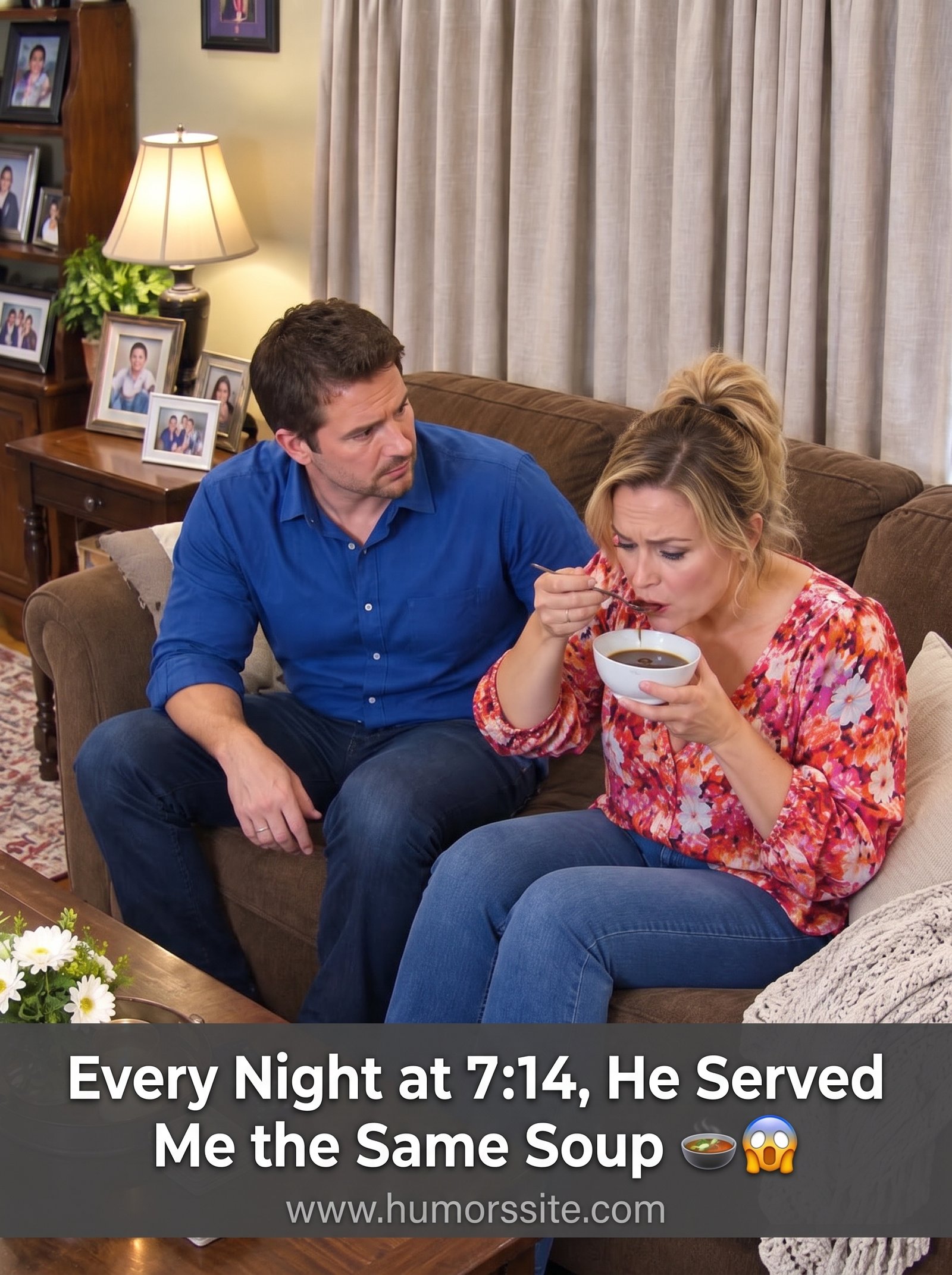
Every evening at exactly 7:14, my husband closed the living room curtains and brought me a bowl of soup. He watched until I finished it. After two months, I stopped wondering why he cared whether I ate dinner and started wondering what he needed me to swallow.
It began so quietly that I almost missed the change. Daniel would rise from the couch, draw each curtain, and return from the kitchen carrying the same small white bowl. The soup was thick and dark, with a smell I could never identify.
“You need to finish all of it,” he said the first night.
I laughed. “I’m not a child. I’ll eat if I’m hungry.”
Daniel sat across from me without smiling. He stayed there until I took the last spoonful, then collected the bowl. I thought he was going through an odd phase, perhaps worrying that I wasn’t eating enough.
But the routine continued the next night, and the next. The time never changed. Neither did the curtains, the soup, or the way he watched me eat.
Sometimes Daniel held the empty bowl up to the light and checked its bottom. I noticed that he did it even when I had eaten almost everything. Whatever his reason, a little soup left behind seemed to bother him.
I asked what he was making. He gave vague answers and told me it was good for me. When I pressed him, he changed the subject. I could have refused the soup altogether, but I still wanted to believe there was a harmless explanation he hadn’t managed to tell me.
One evening, I decided to see what would happen if I didn’t finish it. While Daniel’s back was turned, I poured some down the sink. He glanced into the pot a moment later and noticed there was more left than he expected.
Without raising his voice, he filled a second bowl and placed it in front of me.
“Please don’t argue with me tonight,” he said. “Just trust me.”
“Then tell me what’s in it.”
He paused. “What your body needs.”
That answer followed me upstairs. I lay beside him that night trying to decide why he had hesitated, and why he could tell me to trust him without naming a single ingredient.
After that, I began noticing other changes. Daniel took certain calls away from me, lowering his voice or stepping into another room. He spent longer periods in the garage and started locking its door. When I found a receipt from a medical center in his jacket pocket, I realized he had never mentioned going there.
None of it proved he was hiding something dangerous. He might have had an appointment he wanted to keep private. The garage might have been locked for an ordinary reason. Yet each detail brought me back to the bowl and the way he inspected it after I ate.
I noticed, too, how tired I had become. Getting through a normal day took more effort than it used to. I blamed my poor sleep; I had been lying awake beside Daniel, listening for any sign that he was still up.
Then, one night, I woke and saw him standing next to our bed. The room was dark, but I could make out his face turned toward me. He wasn’t reaching for his phone or getting ready to leave.
“What are you doing?” I whispered.
“Nothing. Go back to sleep.”
He got into bed. I kept my eyes closed until his breathing slowed, but I was fully awake. I had seen where he was looking: at my chest, as if he needed to know whether it was still rising and falling.
By morning, I had made a decision. The next time Daniel brought me that soup, I would keep some of it—and find out what was inside.
Part 2: The Jar in My Purse
At 7:14 the next evening, Daniel stood up and closed the curtains. I watched him pull the last one across the window before he went into the kitchen.
He returned with the white bowl and set it in front of me. I stirred the soup as though I were waiting for it to cool. Its dark surface gave away nothing.
Daniel stayed nearby while I began to eat. I counted the spoonfuls, wondering how much I would need to save for a laboratory to test. I had put a small glass jar in my purse, but getting the soup into it without him seeing felt impossible.
Then he stepped away from the kitchen for a few minutes. I took the jar out, poured in some of the soup, and sealed the lid. By the time Daniel returned, it was back in my purse.
I ate what remained in the bowl. He watched me, and I tried to keep my face still each time I raised the spoon. When I finished, he took the bowl and tilted it toward the light as he always did.
I thought he might notice there was less soup than he had served. He said nothing. I carried my purse upstairs with the jar hidden inside it.
The next day, I went to a private laboratory. I waited at the counter with the jar in my hand, suddenly conscious of how strange my story might sound to someone who had never met Daniel.
“I think something may have been added to my food,” I told the employee.
She listened, then asked, “Do you believe someone may be poisoning you?”
I couldn’t bring myself to say yes. Daniel was my husband, and I had no proof that the soup contained anything harmful. But I remembered him replacing the portion I had poured away and watching me at night.
I nodded. The employee accepted the jar and told me the results would take three days.
On the drive home, I kept thinking about what I would do if the test found nothing. I would still have to live with the questions Daniel refused to answer. I would still know he had insisted on the same soup at the same time each night.
The first evening of the wait, 7:14 seemed to arrive before I was ready. Daniel closed the curtains and brought me the bowl. I looked at it for so long that he asked if I felt all right.
“I’m tired,” I said.
“You should eat. It’ll help.”
I ate while he sat across from me. When he checked the bowl afterward, I wondered whether he could tell how hard it had been to finish.
The following day, I examined every explanation I could think of. Maybe Daniel had become fixated on something he believed was healthy. Maybe the receipt from the medical center was his own business. Maybe the locked garage had nothing to do with the soup.
But I could not forget his refusal to tell me what was in it. I had asked him directly, and he had answered only that it was what my body needed. That uncertainty made me dread going home each evening.
On the third day, I kept my phone beside me. I checked it while making coffee, while trying to work, and again when I heard a sound from another room that I mistook for its ringtone.
When the laboratory finally called, I answered immediately.
“Mrs. Carter? We need to discuss the sample you brought us in person. Can you come in today?”
I asked whether they could tell me what they had found. The caller said a doctor would go through the results with me when I arrived.
After the call, I sat with my keys in my hand. I had wanted someone other than Daniel to give me an answer. Now that the answer was waiting, I was afraid to hear it.
Part 3: The Questions the Doctor Asked
The doctor led me into a small office at the laboratory. Several pages lay on his desk, but he did not hand them to me. He asked me to sit and tell him how the soup had become part of our evenings.
“About two months ago,” I said. “Daniel started making it every night.”
“How often do you eat it?”
“Every evening.”
When he asked what time, I felt foolish giving such a precise answer. “At 7:14. He closes all the curtains first.”
The doctor looked up from his notes. I had noticed the exact minute because Daniel never treated it as an ordinary dinnertime. He could be reading or sitting beside me on the couch; when the clock reached 7:14, he got up and began the same routine.
“What happens after he brings you the bowl?” the doctor asked.
“He watches me eat.”
I told him how Daniel remained across from me until I finished and sometimes lifted the empty bowl to check its bottom. I explained what happened when I poured part of the soup down the sink: Daniel saw there was more left in the pot and served me another bowl.
The doctor asked whether we had argued. I said Daniel had told me to trust him. When I asked what was in the soup, his answer had been, “What your body needs.”
Saying the words aloud made me uneasy all over again. At home, I had turned them over so many times that I was no longer sure whether they sounded threatening to anyone but me. The doctor wrote them down without commenting.
“Did he tell you who advised him to make it?” he asked.
“No. I don’t know where he got the recipe.”
I mentioned the medical center receipt, although I had no reason to think it was connected. I told him about the private phone calls and the garage Daniel now kept locked. His internet history was regularly cleared as well.
“I know those things don’t tell you what’s in the jar,” I said.
“They give me context,” the doctor replied. “What concerns you most about his behavior?”
I thought of the bowl in Daniel’s hands, held toward the light. I had seen him do it so often that I could picture the movement without looking at him.
“He needs me to finish every bit,” I said. “I don’t know why.”
The doctor asked whether I had noticed any change in my health. I told him I was tired almost all the time. I had blamed the sleepless nights, but I could not say when the exhaustion began or whether it followed the soup. I wished I had kept a record.
He asked a few more questions about the sample and when I had collected it. I answered as carefully as I could. I wanted him to tell me whether I was safe, yet I understood he needed to know exactly what the laboratory had tested.
There was one thing I had not mentioned. I had avoided it because it sounded like an accusation I could not prove.
“One night I woke up,” I said. “Daniel was standing beside our bed.”
“What was he doing?”
“Looking at me.”
The doctor waited.
“I think he was watching my chest to see whether I was breathing. When I asked him about it, he told me to go back to sleep.”
The doctor added that to his notes. He didn’t offer an explanation, and I felt no relief from finally saying it.
He turned to the report on his desk. From where I sat, I could see rows of figures but could not read the words. He drew one page from the stack, then paused.
“Before we discuss the sample,” he said, “I need to be certain of one thing. Did Daniel give you this soup again after you asked what was in it?”
“Yes,” I said. “Every night.”
The doctor lowered his eyes to a line marked in blue on the next page.
Part 4: The Line Marked in Blue
“Yes,” I repeated. “He gave me the soup every evening, even after I asked what was in it.”
The doctor glanced at the report again. I wanted to ask him to stop looking at the pages and simply tell me whether the sample was dangerous, but I waited while he checked his notes.
“After you tried to leave some behind,” he said, “he served you another bowl?”
“He did.”
I remembered standing at the sink, hoping Daniel would not notice what I had poured away. When he filled the second bowl, he had sounded tired of arguing, almost hurt that I didn’t trust him. For a while, that expression had made me doubt my own fear.
The doctor asked whether I had eaten the soup during the three days I waited for the results. I told him I had. Each night, Daniel had closed the curtains at 7:14 and sat with me until the bowl was empty.
“Why did you keep eating it?” he asked.
I looked at my hands. “I didn’t know what it contained. I was afraid he would realize I had taken a sample.”
The doctor listened without judging me. I explained that Daniel and I still lived together. Until two months ago, I had trusted him; I could not suddenly behave as though I knew he meant to hurt me when I didn’t even know whether the soup was responsible for my exhaustion.
He made another note. I had gone to the laboratory because I wanted evidence, yet sitting there reminded me that the result might answer only one question. If the soup was ordinary, I would still need to ask Daniel why he had hidden its ingredients and checked every empty bowl. If it wasn’t, I would have to face what that meant about my husband.
The doctor lifted the top sheet and handed it to me. My name appeared above a reference to the sample I had brought in. Below it were columns and abbreviations I could not interpret.
I read the page twice without understanding it. It reminded me of the receipt I had found in Daniel’s jacket pocket: a piece of paper that might matter greatly, if only I knew what it meant.
“I need you to explain this,” I said.
“I will.” The doctor waited while I put the first sheet down. “I want to make sure you understand what was tested and what the report can tell us.”
My eyes went to the remaining pages. One line on the second sheet was underlined in blue. The doctor had looked at it several times since I entered the office.
Outside this room, I had spent three days inventing possible answers. I had imagined finding something harmful in the soup. I had imagined being told it was harmless and returning home with no way to explain Daniel’s behavior. I hadn’t prepared for the sight of a result I could not read.
The doctor drew the second page from the stack. He turned it toward me and placed his finger beneath the underlined entry.
I leaned forward. Whatever the laboratory had identified was printed in a single line.
Then I saw the doctor’s handwritten note beside it—and realized he had marked a second question about the sample.
Part 5: What the Report Could Tell Me
I looked again at the mark beside the underlined line. It was a brief notation about the test, but I couldn’t tell from it what the finding meant. I needed the doctor to explain the report aloud.
He took back the first page and placed it beside the second. I watched his hand move between them while I tried to hold on to the facts I knew: I had brought him a sample of Daniel’s soup, I had eaten that soup every evening for two months, and lately I had been exhausted.
Everything else was still a question.
I thought of the first night Daniel brought me the bowl. I had laughed and said I wasn’t hungry. He had waited until I ate anyway. I thought of the night I poured some away, when he immediately served me more and asked me to trust him without telling me the ingredients.
Then I remembered waking to find him beside our bed. He had been looking at my chest, and I had believed he was checking whether I was breathing. I had carried that memory into the laboratory because I could no longer dismiss it on my own.
The doctor had asked about each of those details. Now the result was in front of me, but I still could not interpret the marked line. My hands shook as I moved the page closer.
“Please,” I said. “Tell me what you found in the soup.”
He rested one finger beneath the blue underline and began to answer.
The supplied story ends at this point, before the doctor reveals the result. A specific finding or ending would have to be newly written rather than paraphrased from the original.