Part 1: They Thought I Was the One Who No Longer Belonged
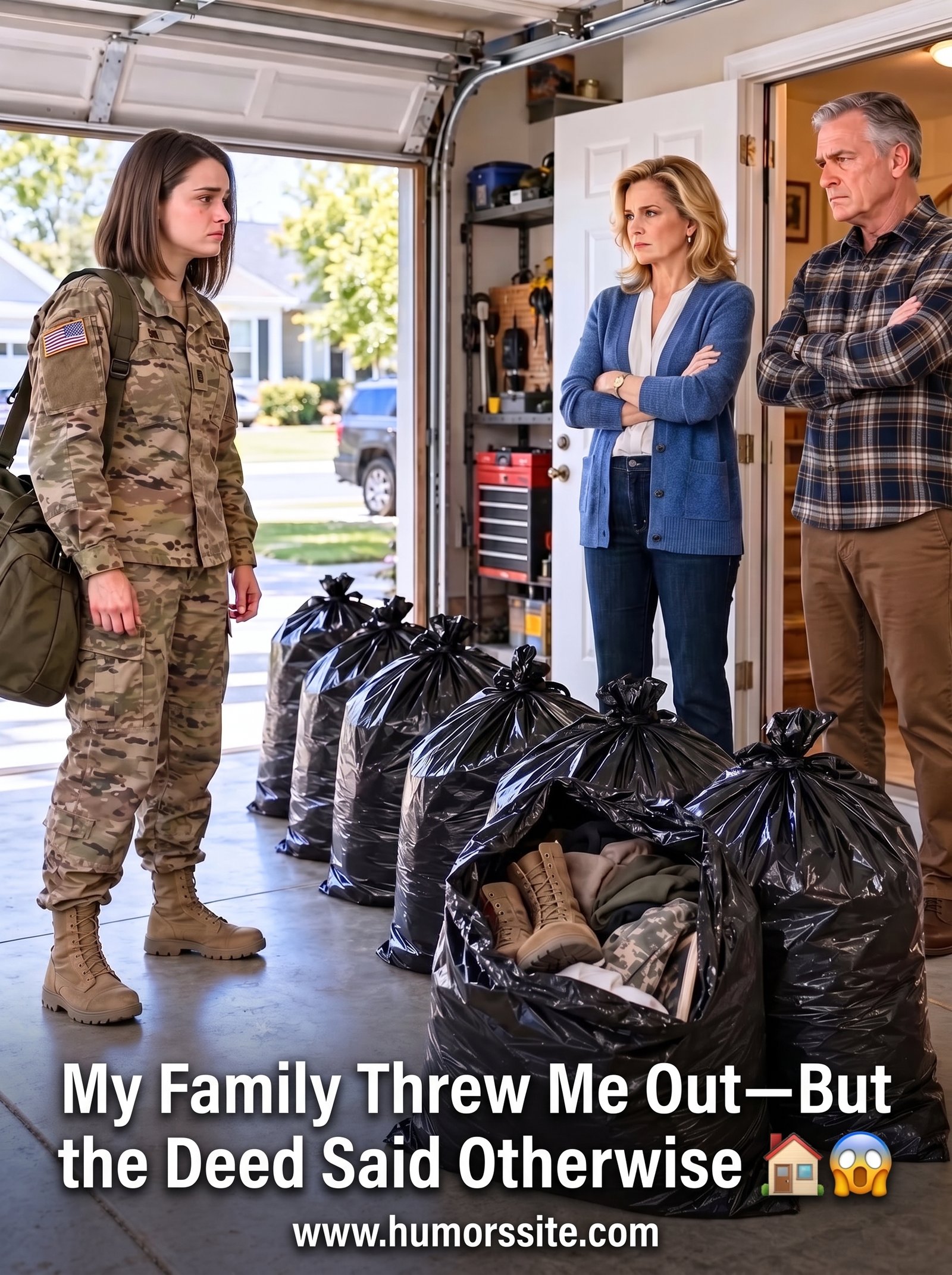
After returning from a nine-month deployment, I came home to find nearly everything I owned stuffed into black garbage bags inside my own house. My mother, Evelyn, stood nearby in her usual pressed blouse, while my father, Richard, watched from behind her with his arms crossed, still carrying himself like the colonel he had once been.
“You’re back earlier than we expected,” Evelyn said.
“I told you my return date.”
She dismissed my answer with a casual wave, as though deployment schedules and time zones were minor details that could simply be ignored. Neither of my parents seemed remotely uncomfortable about what I had just walked into.
“Well, things changed.”
I lifted one of the garbage bags and glanced toward the living room. The furniture had been rearranged, unfamiliar decorations had appeared, and several things that belonged to me had been replaced by items I had never seen before.
“Yeah. I can see that. Where’s Chloe?”
“Oh, she’s upstairs resting.”
“And Vance?”
“Moved in.”
My duffel bag was still sitting on the porch behind me, but apparently my younger sister and her husband had already settled comfortably into my home. When I asked what had happened to my bedroom, Evelyn tilted her head as though the answer should have been obvious.
“Chloe needed the master suite. She’s been under a lot of stress. You know how sensitive she is.”
“So where am I sleeping?”
“The basement is available,” Richard said. “Or you can head back to the barracks on base. Might be easier with your schedule anyway.”
I stared at him, realizing those were genuinely the choices they believed I should accept after nine months overseas. I could sleep in an unfinished basement with concrete floors and half-installed drywall, or return to base as though my deployment had never ended.
Evelyn stepped closer and lowered her voice into the gentle tone she always used when presenting a decision she had already made for someone else. There was no guilt in her expression, only certainty that I would eventually adjust like I always had.
“You’re single. You’re gone half the time. You don’t need all this space. Be a good sister for once.”
That sentence told me exactly what role they still expected me to play. I had always been the reliable daughter, the one who adapted, solved problems, and sacrificed whatever was necessary to keep everyone else comfortable.
They expected an argument, but I gave them nothing. Instead, I walked past them, crossed the kitchen, and headed downstairs to the unfinished basement.
Behind several storage bins was a floor panel that looked slightly different from the others. I lifted it carefully and found the small safe exactly where I had left it, untouched and showing no sign that anyone had discovered it.
I entered the code and opened the waterproof folder inside. The original deed was still there, confirming what my family apparently had never bothered to investigate: the house had been transferred to me years earlier through a trust established by my grandfather.
The property wasn’t Richard’s, Chloe’s, or part of some shared family estate. It legally belonged to me, and my grandfather had structured the ownership carefully enough that my parents clearly had no idea what they were dealing with.
I could hear laughter upstairs as I sat on the basement floor with the deed in my hands. They believed they had taken control of my home and reduced me to a guest, yet they had never even checked whether they owned the property they were claiming.
I pulled my laptop from my duffel because if they had been willing to take over my house while I was deployed, I needed to know what else had happened during those nine months. The moment I logged into my military banking portal and saw the balance, I knew the house was only the beginning.
My hazardous-duty pay and deployment bonuses were gone, not delayed or pending, but completely missing. I opened the transaction history and found multiple carefully structured transfers made while I had been overseas with limited ability to monitor my accounts.
I documented every date, amount, and transaction number before tracing the destination accounts. Eventually, one of the transfers led directly to an account belonging to Evelyn, and the login history showed repeated access from my house while I had been halfway around the world.
Then I discovered a document uploaded three months earlier that made the missing money look almost secondary. It was a power of attorney naming Evelyn as my authorized agent, complete with a witness signature, a notary stamp, and what appeared to be my signature at the bottom.
The problem was simple: I had never signed it. The signature resembled mine closely enough to fool someone unfamiliar with my handwriting, but I could immediately see that it had been copied rather than written naturally.
I followed the financial trail further and totaled the missing transfers twice. Forty-five thousand dollars had been removed from my accounts, but the records showed that my mother hadn’t taken the money simply for herself.
The trail eventually led to Vance, Chloe’s husband and an active-duty lieutenant. He had accumulated serious gambling debt, the kind of financial problem that could threaten his security clearance and potentially destroy his military career.
Everything suddenly made sense. Evelyn had forged paperwork and taken my deployment money to protect Vance, preserving Chloe’s comfortable life while expecting me to absorb the loss without ever discovering what they had done.
This was no longer a family disagreement about who deserved the master bedroom. I was looking at forged authorization, identity theft, suspicious financial transfers, and an active-duty officer whose debts had apparently been concealed using money taken from me.
I began documenting everything, including screenshots, transaction histories, IP records, login information, and copies of the forged power of attorney. I duplicated every file before printing the most important records and arranging them inside the tactical folder I normally used for deployment briefings.
Upstairs, my family was still laughing and behaving as though the biggest problem waiting for them was whether I would complain about sleeping in the basement. They had no idea that while they were settling into my house, I was downstairs assembling evidence that could threaten far more than their living arrangements.
Part 2: They Tried to Sell What Was Mine
After organizing the evidence, I went back upstairs and immediately smelled barbecue coming from the backyard. Less than twelve hours after I had returned from deployment, my parents were hosting a party at my house, complete with string lights, folding tables, food, drinks, and enough military officers to make it look like an unofficial command event.
Evelyn moved effortlessly through the crowd, smiling and greeting everyone while Richard socialized with several officers. Vance stood near the grill networking like his career depended on it, while Chloe remained beside him wearing a new dress and an expensive designer watch.
“Harper,” Evelyn called loudly enough for several people to turn. “We’re so proud of you.”
“Didn’t know I was getting a welcome party.”
Her smile tightened because we both knew the gathering had nothing to do with welcoming me home. When Major Collins approached and mentioned hearing that I had endured a difficult deployment, Evelyn immediately inserted herself into the conversation.
“She’s being modest. It’s been difficult. She’s had a lot of stress, so we’re trying to give her space to adjust.”
“I’m fine.”
“Of course you are, honey. We all just want what’s best for you.”
I understood exactly what she was doing. Instead of directly accusing me of being unstable, Evelyn was quietly planting the idea that deployment had changed me, ensuring that anything I said later could be interpreted through the story she had already created.
As I moved through the party, I heard similar comments from Richard about combat zones changing people and how fortunate I was to have family supporting me. They were preparing an audience before I had even accused them of anything.
Eventually, I stopped near Vance. He greeted me casually, but the confidence in his expression shifted when I held his gaze longer than necessary.
“Nothing like being back home, right?” he asked.
“Depends on the home.”
Chloe moved closer to him and slipped her arm through his before mentioning how nicely they had arranged my former bedroom. She even assured me that I would like the basement once they finished renovating it, making it obvious that they had no intention of leaving anytime soon.
Before I could respond, Richard caught my attention and motioned toward the side of the house. I followed him away from the other guests, and the moment we were alone, he dropped the family pleasantries.
“You need to handle something tomorrow.”
“What kind of something?”
“A transfer. Paperwork. Simple.”
“Transfer of what?”
“The house.”
There it was. Richard explained that Chloe needed stability and claimed I wasn’t home often enough to justify keeping such a large property, so he expected me to visit an office the following morning and formally transfer ownership.
“I’m here now.”
“You’ll go down to the office tomorrow and sign the documents. Make it official.”
“And if I don’t?”
Richard’s tone changed immediately. He reminded me that despite being retired, he still had connections throughout the military and knew people who respected what he had accomplished during his career.
“You’re up for major soon. It would be a shame if something complicated that process.”
That was when any remaining illusion of a family disagreement disappeared. My father was threatening my career to pressure me into surrendering property he didn’t own, and he still believed his old rank gave him enough authority to make me obey.
“I’ll make sure the paperwork is handled exactly as it should be, Dad.”
Satisfied, Richard returned to the party without realizing we had interpreted that sentence very differently. The following morning, I carried my evidence folder into the JAG office and sat across from Captain Morales.
She examined the bank statements, login records, transfers, and forged power of attorney without interrupting me. Her expression changed when she reached my falsified signature and confirmed that $45,000 had been transferred while I was deployed, with an active-duty lieutenant connected to the money.
“This is already bad.”
Because the situation also involved civilian property law, Morales brought in a real-estate attorney named Mr. Dalton. He reviewed the documents, searched preliminary property filings, and suddenly stopped when he discovered something I hadn’t seen.
A purchase agreement had been submitted the previous week for my address. The buyer was a private development company, and the agreed sale price was $650,000.
The listed seller was Richard, with Evelyn as co-signer. Attached to the agreement was another deed bearing my name and another forged version of my signature.
“They don’t own this property,” Dalton said.
“I do.”
When I explained that my grandfather had transferred the house through a private revocable trust, Dalton immediately understood what had happened. My parents apparently assumed the property still belonged to the family estate and believed they could sell it without ever discovering the ownership structure my grandfather had created.
Morales leaned forward as the full picture became clear. My parents had allegedly used forged documents to sell property they didn’t legally own while another forged authorization had been used to remove $45,000 from my accounts, with some of that money connected to an active-duty officer.
“That’s not a mistake,” Dalton said. “That’s a pattern.”
“What’s the fastest way to stop the sale?”
“Lis pendens.”
Dalton explained that filing a formal notice of legal dispute against the property would immediately poison the transaction because the developer could no longer receive clean title. He also recommended publicly recording the trust documentation, eliminating any plausible claim that Richard owned the house.
“Do it.”
The next morning, Dalton and I were waiting when the county clerk’s office opened. We filed the lis pendens and recorded the trust, turning the private ownership structure my family had ignored into an official public record.
By late afternoon, Richard called me in a rage. The developer had discovered the title problem, the sale had stopped, and words like fraud and breach of contract were suddenly being directed at him.
“What did you do?”
“I handled the paperwork.”
“What paperwork?”
“The kind that reflects reality.”
Richard insisted he knew what he had signed, but that was exactly the problem. He had signed documents to sell a $650,000 house he had never owned, and now the paper trail existed for everyone else to see.
“I’ll deal with this. Just stay out of it.”
“Too late.”
I ended the call knowing Richard would never accept losing control quietly. He would escalate, and this time, I intended to let him.
Part 3: Seven Days to Leave
That evening, I returned to the house and found Richard, Evelyn, Chloe, and Vance waiting for me in the living room. Richard paced near the center of the room with his jacket off, while Vance stood rigidly near the window and Chloe looked close to tears.
“What did you do?” Richard demanded.
“We were trying to make a practical decision for the family.”
“For the family?”
Chloe immediately accused me of destroying everything over a house, deliberately reducing forged documents and a fraudulent $650,000 sale to a petty disagreement over property. Then Evelyn calmly presented their solution: I should use my deployment savings to cover the financial gap with the developer, after which the house could still be transferred to Chloe.
“We can resolve this cleanly. You cover the financial gap, we finalize the transfer to Chloe, and everyone moves on.”
“You want me to pay for your fraud and then give Chloe the house?”
“Everything has to be about you,” Evelyn replied.
Vance finally joined the conversation, insisting the situation could still be handled quietly. I looked directly at him and asked the question that immediately changed his expression.
“You mean before your command finds out?”
Richard stepped toward me and ordered me to fix the problem, reminding me again that I was part of the family. When I refused to accept responsibility for decisions they had made without me, Evelyn abandoned her gentle tone and delivered what she apparently considered their final threat.
“Then you are no longer our daughter.”
I looked at all four of them before raising my phone. They had been so focused on pressuring me that nobody had noticed I was recording the conversation.
“Twenty minutes. Everything you just said.”
Vance immediately demanded that I delete the recording, but I ignored him. Instead, I informed them that they had exactly seven days to leave my property, after which they would be trespassing.
“This is my house,” Richard insisted.
“No. It’s not.”
I reminded them that they had forged documents, taken my money, and attempted to sell property they didn’t own. There was nothing left to negotiate, and for the first time, Chloe looked toward our parents for a solution they couldn’t provide.
“You have seven days.”
I left the house and checked into a hotel, then blocked all four of their numbers. Once I was alone, I reviewed the remaining financial connections I had maintained for the family and realized how many expenses I had been quietly covering for years.
Their four vehicles were still connected to a family insurance policy paid through my account, so I removed my payment information. Their four phone lines, including unlimited service and international coverage, were also being charged to my card, so I canceled those automatic payments as well.
My goal wasn’t to create chaos. I simply stopped financing adults who had stolen from me and tried to take my home.
The following morning, I returned to Captain Morales and formally signed the report covering identity theft, fraud, and financial misconduct involving Vance. She explained that his command would be notified and his security clearance suspended while the investigation proceeded.
Two days later, Chloe left a voicemail saying their cards were being declined. The next day, Richard complained that their insurance coverage was being reviewed, still speaking as though I were responsible for repairing every inconvenience in their lives.
I deleted both messages.
On the fifth day, I was on base when I saw an officer approach Vance during formation. After a brief conversation, Vance stiffened and was ordered to step away before following the officer from the area.
Later that afternoon, confirmation arrived through official channels. His security clearance had been suspended effective immediately while the investigation continued.
At two the following morning, Chloe managed to reach me from a blocked number. She was no longer pretending to be calm.
“He’s being investigated! They pulled him out of formation. They’re talking about court-martial. Do you understand that?”
She blamed me for their financial problems, Vance’s investigation, the failing cards, and everything else unraveling around them. Then she demanded that I call whoever I had contacted and make the entire process disappear.
“You should have stayed out of my bedroom.”
The silence on the other end was immediate. I ended the call and went back to sleep.
By the sixth day, I knew Evelyn would realize private pressure had failed. When she couldn’t control the situation itself, she always tried to control the story surrounding it.
There was one place where reputation mattered more than anywhere else, and nearly every senior officer who mattered would be gathered there.
The brigade ball.
When I entered the ballroom in my dress uniform, the base commander personally greeted me and invited me to join his table. Conversation remained professional, but I knew awareness of the investigation was already spreading quietly through command.
Then hurried footsteps crossed the ballroom behind me.
I turned and saw Evelyn approaching in formal clothes with Richard beside her. Chloe followed with red eyes, while Vance walked behind them in uniform, visibly tense.
They were heading directly toward the commander’s table.
Evelyn stopped in front of us and raised her voice loudly enough for everyone nearby to hear.
“You need to explain yourself.”
Part 4: The Story Collapsed in Public
The commander’s table went silent as Evelyn stopped in front of me. She turned slightly toward the senior officers nearby, her voice trembling just enough to sound distressed rather than angry.
“I’m sorry to bring this here, but I don’t know what else to do. She’s trying to throw her own family out on the street. My daughter is pregnant, and she’s being evicted from her home.”
Chloe began crying while Evelyn continued, claiming I had taken their money, cut them off financially, and abandoned my family after returning from deployment. It was exactly the strategy I had expected: create a public scene, portray me as unstable and vindictive, then pressure me into surrendering before people whose opinions mattered to my career.
I remained seated and allowed her to finish. When the commander finally turned toward me, his voice remained calm.
“Captain Harper, is there something you’d like to address?”
I stood, opened my clutch, and removed the plain folder I had brought with me. Instead of arguing with my mother, I placed it in front of the commander and let the documents answer for me.
He reviewed the bank statements, transaction records, forged power of attorney, falsified deed, property filings, and documentation from the active JAG investigation. The longer he read, the quieter the people around us became.
Finally, he looked past me toward Richard.
“Colonel, retired or not, you attempted to sell property you do not legally own using falsified documentation.”
Richard automatically straightened at the sound of his former rank. The commander continued, explaining that the records also appeared to connect the family to financial misconduct involving an active-duty service member under his command.
Vance’s face lost its color.
“MP.”
Two military police officers immediately approached the table. Chloe grabbed Vance’s arm when they told him he needed to accompany them, but he didn’t resist as they escorted him across the ballroom in front of hundreds of officers and spouses.
“What’s happening?” Chloe cried.
No one answered her. Evelyn’s carefully controlled expression finally cracked, while Richard stood silently as the public narrative they had tried to create collapsed under the weight of documented evidence.
“This is not the place for this,” the commander said. “But it will be handled.”
Staff members escorted my family from the ballroom, and I returned to my seat without following them. I hadn’t needed to raise my voice or defend myself emotionally because every accusation they made had been answered by records they couldn’t explain away.
The seventh day arrived the following morning. I returned home before sunrise, and six sealed black garbage bags were waiting neatly on the lawn, filled with their clothes, shoes, and personal belongings.
Two military police officers stood near the driveway alongside a county sheriff. Everything had been handled legally, and when Richard’s car finally pulled in, he stepped out with Evelyn and Chloe, but Vance was nowhere with them.
Chloe froze when she saw the bags. Richard immediately headed toward the house.
“What did you do?”
The sheriff stepped between him and the front door.
“Sir, I’m going to need you to stop right there.”
“I’m not stopping on my own property.”
“Actually, you are.”
The sheriff handed him the official paperwork. Richard read the eviction notice silently before passing it to Evelyn, whose confidence disappeared when she saw the accompanying documents connected to the property dispute and fraud investigation.
“This is ridiculous. There’s been a misunderstanding.”
“No, ma’am. There hasn’t.”
Chloe stepped forward angrily, insisting they lived there and couldn’t simply be thrown out. For the first time that morning, I answered her directly.
“No. You don’t.”
Richard warned me that the situation wasn’t over, while Evelyn changed tactics and quietly pleaded for another chance. She reminded me that they were still my family, apparently hoping the same argument that had controlled me for years would work one final time.
“We made mistakes, Harper. But this is too far. We’re still your family.”
“I gave you seven days.”
Chloe’s tears became real as she asked where they were supposed to go. I didn’t answer because solving that problem was no longer my responsibility.
The sheriff instructed them to collect their belongings and leave immediately. Evelyn searched my face for hesitation, but when she found none, I stepped inside and closed the door.
I didn’t watch them leave. I went into the kitchen, made coffee, and sat in my living room while morning sunlight filled a house that was finally quiet again.
The consequences continued afterward. Vance lost his security clearance as the military proceedings advanced, Richard’s reputation deteriorated once the allegations became known, and Evelyn lost the carefully maintained image she had relied on for years.
Chloe lost the house and financial safety net she had assumed would always exist. For the first time, she had to find ordinary work and support herself without expecting me to rescue her.
I didn’t celebrate any of it, and I didn’t interfere. I simply stopped protecting them from the consequences of decisions they had made themselves.
For years, I had believed being reliable meant fixing every crisis my family created. Only after I stopped did I understand the difference between being valued and merely being useful.
The house had always belonged to me.
The harder truth was realizing that my life did too.
Part 5: I Finally Stopped Saving Them
Once the house became quiet again, I expected to feel victorious. Instead, sitting alone in the same living room where my family had tried to take control of my life, I felt something much simpler: clarity.
For years, I had believed my role was to be the dependable one. I covered expenses, solved emergencies, overlooked disrespect, and adjusted whenever someone else needed something because keeping the peace always seemed easier than creating conflict.
What I hadn’t understood was that every exception taught my family something. They learned that no matter what happened, I would absorb the consequences, repair the damage, and continue showing up.
That wasn’t loyalty anymore. It had become a system, and I was the resource keeping it alive.
The betrayal hadn’t started when I came home and discovered my belongings in garbage bags. It had developed slowly through favors that became expectations, boundaries I allowed them to cross, and problems I repeatedly solved because confronting the pattern seemed harder than tolerating it.
By the time they took $45,000, forged my signature, and attempted to sell my house, their behavior didn’t even seem unreasonable to them. My money had become “family money,” Chloe’s problems were automatically emergencies, and my property was treated as something that could be reassigned whenever someone else supposedly needed it more.
That realization hurt more than the money. They depended on me, but dependence had never guaranteed respect.
The only part of that relationship I could truly control was my participation in it. I couldn’t force them to value me differently, but I could decide what access they had to my money, property, time, and life.
That was why the most important thing I did wasn’t confronting them. I simply stopped.
I stopped paying their bills, explaining myself, fixing their mistakes, and protecting them from consequences. Once I stepped away, the system collapsed because they had spent years assuming I would always prevent that collapse.
My military training had helped me understand how to respond when I first saw those garbage bags. Instead of reacting emotionally, I assessed the situation, verified the deed, examined my accounts, documented the transfers, and preserved every piece of evidence I could find.
That distinction changed everything. If I had confronted them immediately, they would have known what I had discovered and had time to change their story, conceal records, or destroy evidence.
Instead, I let documentation speak for me. Bank records proved where the money went, login records showed where my accounts had been accessed, the forged documents established the pattern, and the attempted property sale created another paper trail.
I also stopped waiting for a confession. I didn’t need Evelyn to admit she had forged my signature or Richard to acknowledge that he had tried to sell something he didn’t own.
The facts existed whether they accepted them or not. Once I understood that, everything became procedural: file the report, record the trust, protect the property, submit the evidence, and allow the appropriate systems to handle what followed.
The hardest part was allowing consequences to happen without rescuing anyone. For years, whenever my family faced a financial or personal crisis, I stepped in before the full cost reached them.
This time, I didn’t.
Their lives didn’t unravel because I created their problems. They unraveled because I finally stopped preventing those problems from reaching the people who had created them.
When everything was over, I realized I hadn’t lost my family in seven days. I had simply stopped pretending I had the kind of family I wanted to believe I had.
Trust was gone, and so was respect. Without either of those things, what remained wasn’t a healthy family bond but a habit built around obligation.
Walking away didn’t mean I stopped caring about them. It meant I finally included myself among the people I was willing to protect.
The house became quieter afterward, but the silence no longer felt empty. It gave me space to recognize that boundaries don’t necessarily destroy healthy relationships; sometimes they simply reveal which relationships depended on you having none.
When I think about those garbage bags now, I no longer see them as the beginning of what happened. They were simply the moment when a pattern that had existed for years became impossible to ignore.
For too long, I had been the one who adjusted, fixed, paid, and made everything work. My family had become so accustomed to what I provided that they confused access to me with ownership of what was mine.
They were wrong.
The house was mine. The money was mine. The decision to walk away was mine.
And finally, so was my life.