Part 1 — The Woman My Son Called Mom
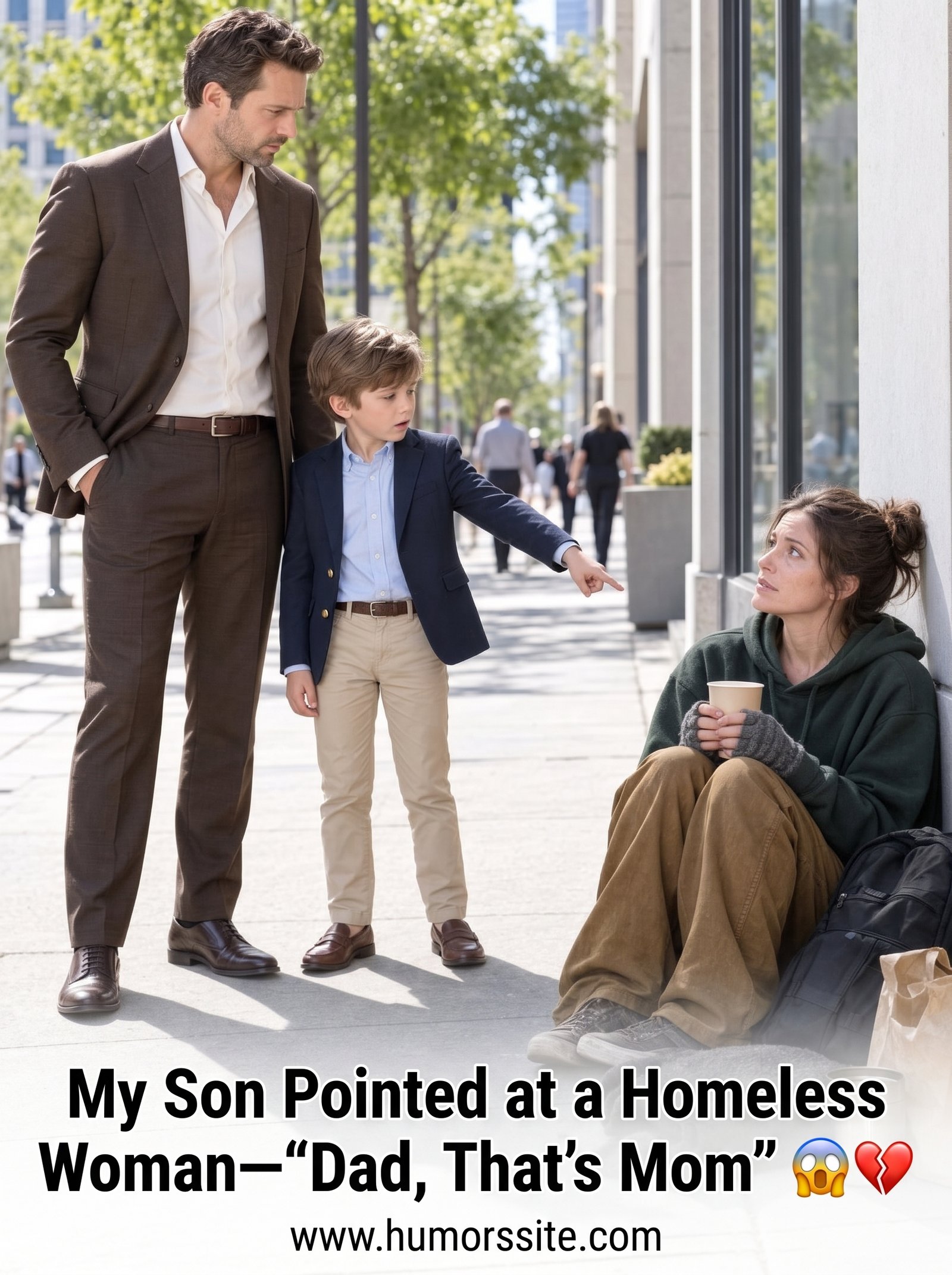
I never knew an ordinary Saturday with my eight-year-old son could make me question the funeral I had attended three years earlier. Ethan and I were walking outside Chelsea Market when he suddenly stopped, squeezed my hand, and pointed toward a woman sitting against a building.
“Dad… that’s Mom.”
I followed his finger. A thin woman in an oversized gray coat sat on a piece of cardboard, her tangled hair falling across a tired face as she held a paper cup between both hands.
“That’s not Mom, buddy,” I said gently. “You know Mom is gone.”
Ethan shook his head, already fighting tears. I understood why he wanted to believe otherwise, but I had buried my wife, Sarah, three years earlier and spent every day since teaching our son how to live without her.
Then the woman lifted her face.
My chest tightened. She was painfully thin and looked years older, but her eyes were unmistakably familiar.
Ethan pulled away from me and ran toward her.
“Mom!”
He dropped beside the woman before I could stop him. She initially recoiled, but when she looked into Ethan’s face, the paper cup slipped from her fingers.
“Ethan?” she whispered.
I froze. Before I could make sense of how a stranger knew his name, she raised a trembling hand toward his cheek.
“My little moon.”
I stopped breathing.
Sarah had called Ethan that since the night he was born. It was a private nickname, one I had barely been able to say after her death.
I stepped closer.
The small scar beside her eyebrow was there. So was the faint mark beneath her chin from an accident Sarah had as a teenager.
“Sarah?”
She looked directly at me.
“Michael.”
Her knees buckled when she tried to stand, and I caught her before she fell. Ethan clung to her arm while I stared at the woman I had spent three years mourning.
“Where have you been?”
Fear immediately crossed her face.
“Not here.”
Someone nearby called an ambulance. At the hospital, doctors told me Sarah was severely dehydrated and malnourished but stable, while Ethan sat beside me asking the one question I couldn’t answer.
“Dad, if Mommy is alive… who did we bury?”
Hours later, Sarah finally began explaining.
Her memories of the period surrounding her disappearance were fragmented. She remembered an argument, leaving in panic and later waking injured and confused, but she had spent months without identification before drifting between shelters and eventually the streets.
Only recently had pieces of her old life begun returning.
I struggled to understand how the woman I loved could have been alive in the same city while Ethan and I mourned her.
Then I asked the question that had been haunting me since the sidewalk.
“If you’re Sarah, who was buried in your grave?”
Her expression changed.
“Rachel.”
I stared at her.
Rachel was Sarah’s identical twin sister, a woman whose unstable life had included periods when she disappeared without contacting anyone. She had vanished around the same time Sarah supposedly died, but nobody had connected the two events.
“How could they mistake Rachel for you?”
“I don’t know everything yet,” Sarah whispered. “But the identification wasn’t as simple as you were told.”
Then she reached for my hand.
“And Michael… someone knew there was a problem.”
“Who?”
Sarah hesitated before saying the name.
“Daniel.”
My business partner. My closest friend. The man who had stood beside Ethan and me at Sarah’s funeral.
And suddenly I remembered one detail I had ignored for three years.
Daniel had been the last person who claimed he saw my wife alive.
Part 2 — The Detail Daniel Never Told Me
I barely slept that night. Ethan stayed at the hospital with Sarah, refusing to let go of her hand, while I went home and opened the box containing every document I had received after her supposed death.
Three years earlier, I had been too devastated to question anything. Now I read every page slowly and noticed something I should have seen from the beginning: the identification had relied heavily on personal belongings and circumstances because the remains had been badly damaged.
Sarah’s wedding ring had been recovered. So had a jacket with her initials inside.
But Sarah and Rachel were identical twins.
The next morning, I returned to the hospital with copies of the records. Sarah stared at the photograph of the jacket for several seconds before shaking her head.
“That was mine,” she said. “But Rachel borrowed my clothes all the time.”
“What about your ring?”
Sarah looked down at her bare hand.
“I remember taking it off that night.”
Her next memory was fragmented. Rachel had arrived unexpectedly, frightened and desperate, saying she had gotten herself into serious trouble and needed somewhere to stay.
Sarah remembered arguing with her in the kitchen. Then Daniel arrived.
“Why was Daniel there?” I asked.
“I think Rachel called him.”
That immediately bothered me.
Daniel had told police that he happened to see Sarah leaving our neighborhood later that evening. His statement had helped establish the timeline investigators eventually gave me.
Sarah pressed her fingers against her temple.
“I remember Daniel shouting at Rachel. I remember going outside. After that, everything becomes pieces.”
She remembered headlights, falling, and waking somewhere unfamiliar with a severe headache. She had no purse, phone, or identification, and for weeks she could not clearly remember her surname or address.
A hospital social worker later confirmed something important. Sarah had apparently passed through shelters under different versions of her first name, and there were records that might help reconstruct where she had been.
That made her disappearance tragic, but possible.
It did not explain Daniel.
I called him that afternoon.
“Michael!” he answered cheerfully. “How’s Ethan?”
I kept my voice normal.
“I was going through some old paperwork about Sarah. Do you remember the night she disappeared?”
The silence lasted only a second.
“Of course.”
“You told police you saw her.”
“Yeah. Near your street.”
“What was she wearing?”
Another pause.
“I don’t remember, Mike. It was three years ago.”
I looked at Sarah sitting across the hospital room.
“Did you see her face?”
Daniel laughed nervously.
“What kind of question is that?”
“A simple one.”
This time he didn’t answer immediately.
Then his tone changed.
“You’ve spent three years trying to move forward. Don’t start tearing yourself apart over details that won’t change anything.”
I ended the call without telling him Sarah was alive.
For the first time, I wasn’t grieving. I was suspicious.
That evening, Sarah remembered something else. She asked me to retrieve an old blue suitcase from the top shelf of our bedroom closet, one I hadn’t opened since her disappearance.
Inside, beneath winter scarves and old photographs, I found an envelope addressed in Rachel’s handwriting.
There was no letter inside.
Only a storage-locker receipt dated the morning before the supposed accident.
And across the bottom, Rachel had written six words:
“If anything happens, don’t trust Daniel.”
Part 3 — What Rachel Left Behind
The storage facility was less than twenty minutes from Rachel’s old apartment. I went there the next morning with a copy of the receipt and an attorney, because after finding her warning, I no longer wanted to handle anything connected to Daniel alone.
The manager confirmed that the unit had been rented under Rachel’s name three years earlier. After the paperwork was resolved, he unlocked a narrow metal door and left us standing before several dusty boxes.
Most contained ordinary things: clothes, photographs, unpaid bills, and old notebooks. Then I found a small plastic folder hidden inside a winter boot.
Inside were printed emails between Rachel and Daniel.
At first, they looked personal. Daniel had been secretly lending Rachel money for months, apparently helping her cover gambling debts Sarah and I knew nothing about.
Then the tone changed.
Rachel had begun accusing Daniel of moving company money through accounts she didn’t recognize. One email from her read:
“I know what I saw. If Michael finds out, you’re finished.”
Daniel’s response was shorter.
“Stop digging into things you don’t understand.”
I felt sick.
This wasn’t proof that Daniel had caused Rachel’s death or Sarah’s disappearance, but it proved he had lied to me. For three years, he had acted as though Rachel barely mattered to him.
I photographed everything and took the originals directly to my attorney.
When I returned to the hospital, Sarah was sitting beside Ethan, helping him finish a bowl of soup. For a moment, watching them together felt so ordinary that I almost forgot how impossible the last two days had been.
Then Sarah saw my face.
“You found something.”
I showed her the emails.
She read them twice before closing her eyes.
“I remember them arguing about money,” she whispered.
Another fragment had returned.
On the night she disappeared, Sarah had found Rachel in the kitchen with Daniel. Rachel was furious and waving something in her hand while Daniel repeatedly told her to calm down.
“What was she holding?” I asked.
Sarah struggled for several seconds.
“A flash drive. I think.”
That changed everything.
Instead of confronting Daniel, we contacted the detective reviewing the original case. He agreed that the mistaken identification and Rachel’s newly discovered connection to Daniel justified taking another look at the evidence.
Daniel still didn’t know Sarah was alive.
At least, we thought he didn’t.
That evening, Ethan and I finally left the hospital together. As we reached my car, he stopped beside the passenger door.
“Dad, that man has been watching us.”
Across the parking lot sat a dark sedan.
The driver immediately pulled away.
I couldn’t see his face, but I recognized the car.
Daniel had driven the same model for years.
My phone rang before we even reached home.
His name appeared on the screen.
I answered without speaking.
For several seconds, neither did he.
Then Daniel said quietly:
“Michael, I heard something strange today.”
I tightened my grip on the phone.
“What did you hear?”
Another pause.
Then came the question that confirmed our secret was already gone.
“Is Sarah really alive?”
Part 4 — The Lie Daniel Couldn’t Explain
I didn’t answer Daniel’s question immediately. Ethan was beside me, watching my face, so I forced my voice to remain calm.
“Why would you ask me that?”
Daniel hesitated.
“Someone from the hospital mentioned seeing a woman who looked like Sarah. I figured it was probably a mistake.”
That explanation made no sense. Sarah had been admitted under restricted visitor instructions, and only a handful of people knew who she was.
“You seem worried,” I said.
“I’m worried about you, Michael. You lost Sarah once. I don’t want some confused stranger reopening that wound.”
I ended the call.
The next morning, the detective handling the reopened case met Sarah at the hospital. Instead of pushing her to remember everything at once, he walked her carefully through the timeline while comparing her fragmented memories with Rachel’s emails and the original investigation.
One detail finally connected them.
Sarah remembered following Rachel outside after the argument. Rachel had taken Sarah’s coat because she was cold, and Sarah had removed her wedding ring earlier while washing dishes.
Rachel had apparently taken the ring too.
“She used to borrow it,” Sarah whispered. “She liked pretending her life was mine.”
Sarah then remembered stepping into the street after Rachel and being struck by the side of a passing vehicle. The impact had left her confused and disoriented.
Daniel had seen it happen.
But he had never told me.
The detective pulled Daniel’s original statement. Daniel claimed he had seen “Sarah” walking away alone shortly before midnight, wearing the same coat later recovered with the remains.
He hadn’t seen Sarah.
He had seen Rachel.
And he knew there had been two women outside that night.
That afternoon, investigators obtained traffic-camera footage preserved as part of an unrelated accident report. The image quality was poor, but it showed an ambulance leaving the area shortly after midnight.
Hospital archives provided the missing piece.
An unidentified woman matching Sarah’s approximate age had been brought into an emergency department that night with a head injury and severe confusion. She had no identification and gave only the first name “Sara.”
Somehow, that record had never been connected to my missing wife.
For three years, I had believed Sarah was dead because no one had looked beyond the easiest explanation.
But Daniel had known enough to question it.
I wanted to confront him immediately. The detective stopped me.
“Don’t tell him what we found.”
So I waited.
Two days later, Daniel requested to meet me at our office. When I entered the conference room, he looked exhausted.
“I can explain,” he said.
“Then explain why you never told police there were two sisters outside my house.”
His face changed.
Daniel looked toward the closed door before answering.
“Because Rachel begged me not to.”
“Rachel died that night.”
“I know.”
“Then why did you identify her as Sarah?”
Daniel stared at the table.
“I didn’t.”
That answer caught me off guard.
He slowly raised his eyes.
“Michael, I lied about a lot of things. But I wasn’t the person who confirmed that body was your wife.”
My anger suddenly gave way to confusion.
“Then who did?”
Daniel swallowed.
And when he gave me the answer, I realized the mistake surrounding Sarah’s funeral had started inside my own family.
Part 5 — The Woman We Buried
Daniel’s answer was a name I hadn’t expected.
“Your mother.”
For several seconds, I simply stared at him. My mother, Margaret, had been the person who helped me choose Sarah’s funeral flowers, stayed with Ethan when I couldn’t get out of bed, and reminded me repeatedly that accepting Sarah’s death was the only way our family could heal.
“That’s impossible.”
Daniel lowered his voice.
“Rachel owed me money, Michael. That’s why we were arguing that night. She had also found irregular transfers in company accounts and threatened to expose them because she thought she could use them against me.”
He admitted hiding those transactions because they would have cost him his career. But when Sarah was injured outside the house, Daniel panicked and left instead of calling for help, terrified that police involvement would expose everything.
Rachel disappeared shortly afterward.
Days later, when badly damaged remains were discovered after an accident at an abandoned building, investigators found Sarah’s coat and wedding ring. Margaret was asked whether the belongings belonged to her daughter-in-law.
She said yes.
The identification moved forward from there.
“But you knew Rachel had Sarah’s things,” I said.
Daniel looked away.
“I suspected.”
“And you said nothing.”
“I was protecting myself.”
That sentence destroyed whatever remained of our friendship.
Investigators eventually found no evidence that Daniel had caused Rachel’s death or deliberately arranged the mistaken identification. What they did find were financial crimes, false statements, and proof that he had withheld information that could have changed the investigation three years earlier.
My mother’s part was more painful.
When I confronted her, she broke down almost immediately. She admitted she had known Sarah and Rachel occasionally exchanged clothes, but after seeing the ring and coat, she convinced herself the remains had to be Sarah’s.
“I saw what losing her was doing to you,” she cried. “I thought certainty would help you survive.”
Instead, certainty had buried the wrong woman.
The following weeks were complicated. Rachel’s remains were formally reidentified, her records corrected, and Sarah began the slow process of rebuilding a legal identity that had effectively disappeared with her.
There was no miraculous return to normal.
Sarah needed medical care, counseling, proper housing, and time. Ethan wanted his mother back exactly as he remembered her, while Sarah sometimes struggled with memories that returned without warning.
So we started small.
Breakfast together.
Short walks.
School pickup.
One evening, I found Ethan asleep beside Sarah on the couch, his head resting against her shoulder. She looked at me and smiled through tears.
“My little moon,” she whispered.
This time, those words didn’t frighten me.
Months later, we visited Rachel’s corrected grave together. Sarah placed flowers beneath her sister’s name while Ethan stood quietly between us.
For three years, I thought that grave represented the worst thing my family had ever lost.
I was wrong.
The greatest tragedy wasn’t only that Rachel had been buried under her sister’s name. It was that fear, selfishness, assumptions, and silence had allowed a living woman to disappear while everyone who loved her believed there was nothing left to search for.
As we walked away, Ethan slipped one hand into mine and the other into his mother’s.
Three years earlier, I had taught my son how to say goodbye to her.
Now he looked up at us and smiled.
“Can Mom come home with us?”
Sarah squeezed his hand.
She didn’t promise that everything would immediately become the way it had been.
She simply answered:
“I already am.”