
Part 1: The Wedding Morning That Changed Everything
I woke up on my wedding morning expecting to become Mrs. Carter Whitmore, but instead discovered that someone had shaved every strand of hair from my head while I slept. A handwritten note rested on my pillow, and I immediately recognized my fiancé’s handwriting when I read the cruel message.
“Now you look as ridiculous as you really are.”
For several minutes, I stared at my reflection, struggling to comprehend what Carter had done to me. Then, unexpectedly, I began laughing because he had chosen the worst possible day to humiliate the woman he believed he could control.
“Oh, sweetheart, you really picked the perfect day.”
At eight that morning, we were supposed to begin preparing for a lavish wedding at the Grand Bellmont Hotel, where two hundred guests would watch us exchange vows. Carter had no idea that immediately after our marriage, I intended to transfer fifteen million dollars from my late grandfather’s trust into a shared investment account as a wedding gift.
He knew I’d inherited money, but I’d never disclosed the full extent of my wealth. I had allowed him to believe I was merely financially comfortable, while he frequently joked that marrying me was practically an act of charity.
His mother, Diane, had been equally dismissive throughout our engagement, openly suggesting that her son deserved someone more impressive. I usually responded with a polite smile, although I remembered every insult and increasingly questioned why Carter never defended me.
My phone vibrated with a message from him while I was still examining my scalp. Instead of expressing concern or regret, he demanded that I wear a wig and warned me against embarrassing him during the ceremony.
Moments later, his sister Vanessa sent another message that revealed something even more disturbing. She confirmed that Diane had known about the plan and believed I deserved punishment for refusing to surrender control of my inheritance.
I suddenly remembered the champagne Carter had repeatedly encouraged me to drink two nights earlier. After becoming unusually dizzy, I’d fallen asleep much earlier than expected, and he had helped me into bed while pretending to be affectionate.
The possibility that he’d deliberately drugged me made the situation far more serious than a cruel prank. I saved both messages before calling Margaret Sloan, my grandfather’s longtime attorney and the executor responsible for managing his trust.
“Margaret, I need you at the Bellmont by ten. Bring the fifteen-million-dollar transfer documents and the prenuptial amendment Carter’s attorney sent yesterday.”
Margaret immediately warned me that the proposed amendment would give Carter extensive control over investments made during our marriage. I assured her that I hadn’t signed anything and asked her to bring every relevant document because I intended to review his financial demands before the ceremony.
By midmorning, my bridal suite was filled with horrified bridesmaids who couldn’t believe what Carter had done. My cousin Emily began crying when she saw my missing hair, but I refused to let anyone cover it with the wig he’d ordered me to wear.
Instead, I asked the stylist to transform the uneven shave into a neat, deliberate buzz cut. After putting on my grandmother’s diamond earrings and the silk wedding gown I’d chosen months earlier, I looked in the mirror and realized that my appearance was no longer what frightened me.
Margaret arrived shortly afterward carrying a black leather case filled with documents. She explained that she’d uncovered several troubling communications between Carter, his attorney, and a financial adviser concerning the inheritance he expected to control after our wedding.
One email estimated my trust at approximately five million dollars, which almost made me laugh. My grandfather’s commercial real estate investments had actually left me close to forty-two million, and the fifteen-million-dollar transfer was only the wedding present I’d planned to give my future husband.
Then Margaret showed me where Carter intended to move the money. His proposed amendment would give him management authority over our shared investments, allowing him to redirect the funds into Whitmore Development, his family’s supposedly successful business.
I looked up when Margaret revealed what her investigation had uncovered.
“Rachel, Whitmore Development is nearly insolvent. Carter isn’t marrying you because he needs a wife. He’s marrying you because he needs your money.”
For the first time that morning, my laughter disappeared. I finally understood that shaving my head hadn’t been an impulsive act of cruelty but part of a calculated attempt to frighten me into surrendering financial control.
And Carter still believed I would walk down the aisle and give him everything he wanted.
Part 2: The Secret Behind His Fifteen-Million-Dollar Wedding
After Margaret revealed the financial problems threatening Whitmore Development, I began reconsidering every conversation Carter and I had shared about my inheritance. His repeated demands for financial transparency, which he’d disguised as concern for our future, suddenly appeared to be part of a calculated attempt to gain control of my grandfather’s fortune.
Margaret explained that the company faced serious debts, overdue payments to contractors, and approaching loan deadlines that could threaten its survival. Carter had apparently been counting on our marriage to provide the money necessary to rescue his family’s failing business without revealing its true financial condition.
The proposed prenuptial amendment would have given him authority over investments transferred into our marital accounts. If I’d signed it and completed my planned wedding gift, he could have redirected millions into Whitmore Development while presenting the transaction as an ordinary business decision.
I realized that Carter had never needed me to understand the company’s financial problems because his plan depended on keeping me uninformed. His cruel treatment now made sense as another attempt to convince me that challenging him would only bring humiliation.
While Margaret continued examining the documents, my phone rang, and Carter’s name appeared on the screen. I answered calmly, determined to discover whether he would admit what he’d done without realizing that my attorney was listening.
“Rachel, where are you? You’re wearing the wig, right?”
I told him I was getting ready but had no intention of covering my head. His irritation immediately became obvious, and he warned me not to create unnecessary trouble on the most important day of his life.
“You shaved my head while I was sleeping, Carter. Do you really expect me to pretend nothing happened?”
“You were being stubborn about the money. My mother was right that you needed to understand how marriage works.”
I activated the recording function as he continued explaining that a husband should lead and that I would eventually learn to respect his decisions. Rather than expressing remorse, Carter spoke as though humiliating me had been a reasonable response to my refusal to surrender financial control.
I then asked whether Diane had known about his plan before he entered my room. His answer confirmed that the cruelty hadn’t been a private decision made without his family’s knowledge.
“Of course she knew. My mother held the flashlight while I shaved your head.”
Margaret exchanged a stunned look with my bridesmaids, who had gathered nearby and heard every word. I ended the conversation after assuring Carter that I’d see him downstairs, allowing him to believe he’d successfully intimidated me into attending the ceremony.
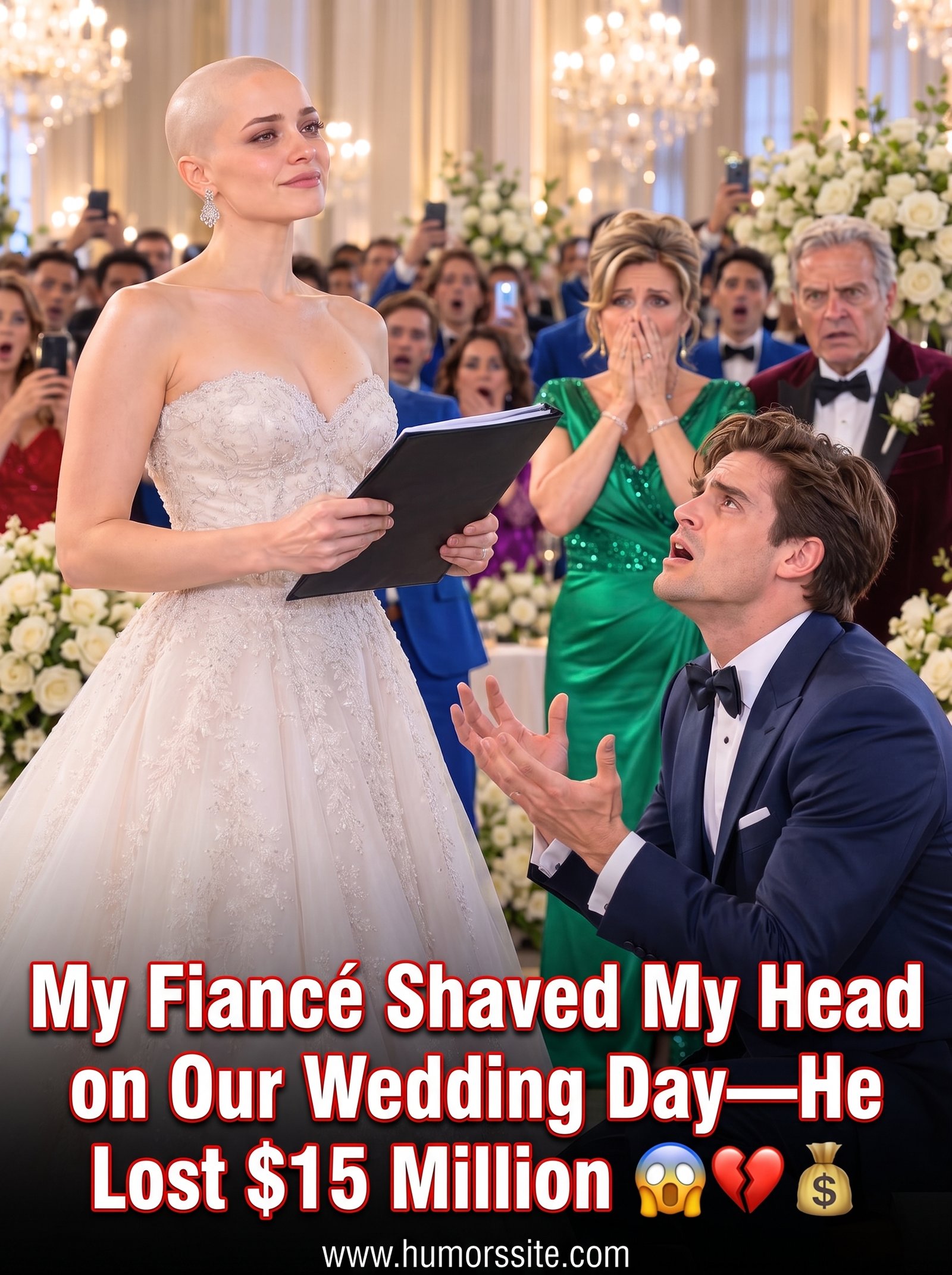
By eleven forty, the Grand Bellmont ballroom was filled with two hundred guests, elaborate white floral arrangements, and expensive decorations selected by Diane. As the doors opened, I stepped inside wearing my wedding gown, grandmother’s diamond earrings, and the short haircut I’d deliberately chosen instead of the wig Carter demanded.
Whispers spread through the room as guests noticed my shaved head, but I continued toward the altar without lowering my eyes. Carter initially looked alarmed before recovering his confident smile, apparently interpreting my arrival as proof that I intended to forgive him.
“You actually came,” he whispered when I reached him.
“I wouldn’t have missed this for anything.”
Diane sat proudly in the front row wearing cream silk and pearls, smiling as though the entire event had unfolded according to her expectations. Her expression changed slightly when she noticed Margaret seated beside my grandfather’s longtime accountant, both carrying folders rather than wedding gifts.
The officiant began the ceremony, but I politely interrupted before he could continue. I explained that I’d prepared a special wedding present and wanted everyone present to understand exactly what I had intended to give Carter.
My fiancé immediately relaxed, while Diane began applauding and announcing that she’d known I would eventually make the right decision. Margaret approached the altar and handed me a black folder containing the documents we’d spent the morning reviewing.
I turned toward our guests and revealed that Carter believed the folder contained arrangements for a fifteen-million-dollar transfer. The ballroom fell silent as people began realizing that my supposedly modest inheritance was considerably larger than anyone had imagined.
“I was planning to give Carter fifteen million dollars today, immediately after our marriage. But after what happened this morning, I’ve changed my mind.”
Carter’s smile vanished, and he grabbed my arm while demanding that I stop speaking. I pulled away and raised the handwritten note he’d left on my pillow, preparing to explain exactly why our wedding would not proceed as planned.
Then I looked directly at Diane and asked whether she wanted the guests to hear what her son had admitted about the flashlight.
Part 3: The Wedding Ceremony That Exposed His Betrayal
The entire ballroom fell silent when I held up the handwritten note Carter had left on my pillow that morning. Standing before two hundred guests in my wedding gown, I explained that my fiancé had shaved my head while I was unconscious because I’d refused to give him control over my inheritance.
Diane immediately stood from her seat and accused me of inventing the story to embarrass her family. Carter attempted to interrupt as well, but I reminded them that I had evidence of what had happened and wasn’t afraid to share it.
“Would you like everyone to hear Carter explain who held the flashlight, Diane?”
Her expression changed instantly, and several guests turned toward her with obvious suspicion. I handed the microphone to the hotel’s audio technician, who played the recording I’d made during my earlier conversation with Carter.
His voice filled the ballroom as he explained that marriage required a husband to lead and that I needed to learn obedience. Moments later, the recording captured his admission that Diane had held the flashlight while he shaved my head.
Guests reacted with disbelief, while Carter’s sister Vanessa abruptly stood and demanded to know what her brother had been thinking. Carter rushed toward the audio booth, but two hotel security officers prevented him from interfering with the recording.
“You recorded me? How could you do something like that to me?”
I watched him struggle to contain his anger, astonished that he still considered himself the injured party. When he began shouting insults, I waited until the room quieted before explaining that his cruelty was connected to something much larger than our relationship.
I told the guests that Carter had been planning to use my inheritance to rescue Whitmore Development, the family business everyone believed was thriving. Margaret distributed copies of relevant financial correspondence to Carter’s father and several senior employees who were attending the wedding.
Their expressions changed as they examined the documents revealing overdue obligations, unpaid contractors, and approaching loan deadlines. I explained that Carter’s proposed prenuptial amendment would have granted him management authority over our shared investments, allowing him to redirect my fifteen-million-dollar wedding gift into his family’s struggling company.
Carter’s father looked at the papers before turning toward his son with growing anger. He had apparently been assured that Whitmore Development’s financial problems were already being addressed through legitimate financing arrangements.
“You told me the financing was secured, Carter. Were you planning to use Rachel’s inheritance?”
Carter attempted to defend himself by insisting that the money would have saved the company and eventually benefited everyone. However, his explanation only confirmed that he’d intended to rely on funds I hadn’t agreed to invest in his family’s business.
Diane interrupted again, accusing me of publicly humiliating the Whitmores and destroying their reputation. I reminded her that she had willingly participated in an assault intended to intimidate me into surrendering millions of dollars.
Then I opened the final envelope Margaret had brought to the ceremony. Its contents concerned a financial arrangement Carter knew nothing about, one that my grandfather’s investment firm had completed six months earlier.
I explained that the firm had discreetly purchased Whitmore Development’s defaulted senior debt from its bank. The acquisition meant that my trust now controlled a substantial loan secured by the company’s headquarters, equipment, and several important properties.
Margaret confirmed that the debt had fallen into breach the previous day, giving the creditor significant contractual rights. Carter stared at her in disbelief as he began to understand that the woman he’d planned to exploit had a far stronger financial position than he’d imagined.
“That’s impossible. You can’t possibly control our company’s debt.”
“Actually, Carter, my grandfather’s investment firm purchased it six months ago. Your company now owes money to a trust you were planning to deceive.”
His confidence disappeared as Margaret explained that the creditor could pursue enforcement remedies under the loan documents. I had already instructed her to prepare an alternative that would protect employees and legitimate creditors while preventing Carter from continuing to manage the business.
The proposal required Whitmore Development’s board to remove Carter from management and approve an independent restructuring plan. If those conditions weren’t accepted, the trust would consider exercising its contractual remedies against the company’s secured assets.
Carter moved closer, suddenly abandoning the arrogance he’d displayed throughout our engagement. He begged me to reconsider, insisting that we could still marry and resolve everything privately.
“Rachel, please. I can fix this. You don’t have to destroy everything.”
I looked at the man who’d humiliated me while I slept and then expected me to reward him with fifteen million dollars. For the first time, he seemed to understand that my silence had never meant I was powerless.
Before I could answer, his father finished reviewing the documents and rose from his chair. He looked directly at Carter, his expression hardened by the realization that his son’s deception had placed the family business in even greater danger.
“You’re fired, Carter. Effective immediately.”
Carter stared at his father, apparently unable to comprehend what he’d heard. The wedding he’d expected to turn into his greatest financial victory had become the moment his carefully constructed life began collapsing around him.
Part 4: The Fifteen-Million-Dollar Wedding That Never Happened
Carter stood motionless after his father announced that he was fired, seemingly unable to accept that his position at Whitmore Development had disappeared in front of two hundred wedding guests. Only minutes earlier, he’d expected to marry a wealthy woman, gain access to her inheritance, and rescue his family’s failing company without admitting how desperate its financial situation had become.
“Dad, you can’t do this. I’m your son, and I was trying to save the company!”
His father continued examining the financial documents Margaret had provided, his expression revealing more disappointment than sympathy. Carter had apparently concealed the company’s difficulties from him while presenting my inheritance as a financing arrangement that was already secured.
“You lied to me about the money, Carter. You lied to the board, and you tried to manipulate Rachel into paying for your mistakes. You’re finished.”
Diane rushed toward her husband and demanded that he reconsider, insisting that the family needed to remain united. However, her concern seemed focused entirely on the company’s reputation and financial survival rather than the fact that she’d helped her son humiliate an unconscious woman.
I watched the argument unfold without interrupting because the truth had finally reached the people Carter had spent months deceiving. His father understood that the business couldn’t survive by depending on money obtained through intimidation, especially when the actual creditor had already prepared a lawful restructuring proposal.
Margaret explained that my trust wasn’t demanding the immediate destruction of Whitmore Development. Instead, we were offering the board an opportunity to preserve the company by removing Carter from management and allowing independent professionals to examine its finances.
The proposed restructuring would prioritize legitimate creditors, outstanding obligations to contractors, and the employees whose livelihoods depended on the business. I had no intention of punishing hundreds of innocent people for decisions made by Carter and his mother.
Carter approached me again, his voice considerably softer than it had been during our earlier telephone conversation. He appeared to believe that if he could persuade me to forgive him, the financial consequences might somehow disappear.
“Rachel, please. We were supposed to get married today. You know I love you.”
I looked at the man standing before me and remembered how casually he’d mocked my intelligence, criticized my appearance, and demanded control over money my grandfather had spent a lifetime building. His sudden tenderness couldn’t erase the handwritten insult he’d left beside me after shaving my head.
“You weren’t planning to marry me, Carter. You were planning to acquire me.”
Several guests lowered their eyes as the meaning of my words settled over the room. I removed my engagement ring and placed it on the altar beside the flowers we’d chosen together months earlier.
“Deal canceled.”
Carter stared at the ring as though it represented the final piece of his collapsing future. I turned away before he could offer another explanation, leaving Margaret to handle the financial documents and the proposed restructuring arrangements.
Behind me, Diane began crying while her husband spoke quietly with several company representatives. Carter continued protesting that everyone had misunderstood his intentions, but the recording, financial correspondence, and proposed amendment made his position increasingly difficult to defend.
As I walked toward the ballroom doors, I felt the weight of the morning beginning to settle over me. I had entered the hotel expecting to become someone’s wife, only to discover that the man I’d loved had treated my trust and independence as obstacles to overcome.
Emily met me outside the ballroom and wrapped her arms around me, careful not to disturb my earrings or wedding gown. Her eyes filled with tears again, although this time she seemed relieved rather than frightened.
“Rachel, are you okay? You just walked away from your entire wedding.”
I glanced back toward the closed doors, where the celebration I’d spent months planning had transformed into an argument over debt, deception, and responsibility. The wedding was over, but I knew that exposing Carter publicly wouldn’t be enough to address what he’d done while I was unconscious.
“I walked away from Carter, Emily. That’s not the same as losing my future.”
Margaret joined us shortly afterward and assured me that the trust’s financial position remained protected. She also recommended that I preserve Carter’s note, the threatening messages, and the recorded admission because his conduct warranted more than a broken engagement.
I agreed to cooperate with a formal investigation, understanding that Carter’s actions couldn’t be dismissed as an ordinary relationship dispute. The possibility that he’d drugged me before shaving my head raised serious questions that required medical evidence and independent examination.
By the time I left the Grand Bellmont, the fifteen-million-dollar transfer had been canceled, my engagement was over, and Carter had lost his management position. Yet the most important consequences were still ahead, because investigators would soon begin examining exactly how he’d rendered me unconscious on the night of the assault.
Part 5: The Freedom He Never Expected Me to Find
Seven months after I walked away from Carter Whitmore at the altar, my hair had grown into a short chestnut pixie cut. I could have let it grow long again, but I discovered that I liked the new style because it reminded me of the morning I stopped allowing someone else’s cruelty to determine my choices.
The weeks following our canceled wedding had been exhausting, particularly when the investigation into Carter’s actions began. Although his family initially tried to portray the incident as an unfortunate misunderstanding, the evidence made it increasingly difficult for them to dismiss what had happened.
Investigators reviewed hotel security footage and examined the circumstances surrounding the night Carter had encouraged me to drink champagne. Toxicology results supported my report that I’d been drugged before the assault, while his handwritten note and recorded admission helped establish the deliberate nature of his actions.
I cooperated with the investigation and provided the messages Vanessa had sent on my wedding morning. Those messages were particularly important because they showed that Carter’s family had known about his plan and regarded the humiliation as punishment for my refusal to surrender financial control.
Margaret remained beside me throughout the legal proceedings, ensuring that every relevant document was preserved. She also made certain that Carter’s attorneys couldn’t use the abandoned wedding or our former relationship to pressure me into withdrawing my complaint.
Carter eventually pleaded guilty to reduced charges rather than continuing to contest the evidence. He was ordered to pay damages and received probation that required treatment and community service.
When Margaret informed me of the outcome, I didn’t experience the overwhelming satisfaction I’d once imagined. I was relieved that his actions had been formally acknowledged, but I also understood that no legal judgment could completely erase the betrayal of someone I’d intended to marry.
Whitmore Development faced its own difficult recovery after Carter’s dismissal. The board accepted independent oversight and began restructuring the company’s obligations, allowing it to address its financial problems without relying on the fifteen million dollars Carter had expected to obtain through our marriage.
My trust’s position as a secured creditor gave Margaret an important role in those negotiations. Rather than demanding an outcome that would destroy the company, we supported arrangements designed to protect legitimate creditors, preserve valuable assets, and keep employees working.
The restructuring required difficult decisions, but Whitmore Development eventually stabilized under new management. Carter no longer held authority within the business, and the employees who’d had nothing to do with his misconduct were able to retain their jobs.
That outcome mattered more to me than watching the Whitmore family lose everything. My grandfather had always believed that responsible investing required considering the people affected by financial decisions, and I wanted to honor that principle even after Carter’s betrayal.
My inheritance remained protected, and the fifteen-million-dollar wedding gift was never transferred. I also retained control over the rest of my trust, which was worth far more than Carter had ever suspected.
Occasionally, I thought about how differently my life might have unfolded if I’d signed the prenuptial amendment without questioning its terms. Carter could have gained influence over millions of dollars while continuing to treat me as someone whose opinions didn’t matter.
Instead, his attempt to intimidate me had exposed the very deception he hoped to conceal. The moment he’d believed would make me obedient became the beginning of his downfall.
I eventually returned to the Grand Bellmont Hotel for an unrelated business meeting, several months after the disastrous wedding. Walking through the familiar entrance brought back memories of white roses, shocked guests, and the engagement ring I’d left on the altar.
For a moment, I remembered how frightened I’d been when I first discovered my shaved head. Then I realized that the fear belonged to a version of myself who hadn’t yet understood how much power she possessed.
I had once believed that keeping a relationship meant being patient with insults, forgiving disrespect, and avoiding confrontations that might upset the person I loved. Carter had exploited that patience until he became convinced I would tolerate anything rather than walk away.
But he’d been wrong about me, just as he’d been wrong about my inheritance and the financial future of his family’s company. He’d mistaken kindness for weakness and assumed that humiliating me would make me surrender.
As I passed a mirror in the hotel lobby, I stopped briefly to examine my reflection. My short chestnut hair framed my face, and I smiled because I no longer saw the frightened bride Carter had expected to control.
I saw a woman who had protected her future, defended her independence, and refused to let revenge destroy innocent people’s livelihoods. The wedding I’d once dreamed about had never happened, but losing Carter had given me something far more valuable than the marriage he’d offered.
For the first time in years, my happiness belonged entirely to me.
And whenever someone asked why I’d decided to keep my hair short, I simply smiled and answered:
“Because it reminds me that losing something doesn’t always mean you’ve lost.”