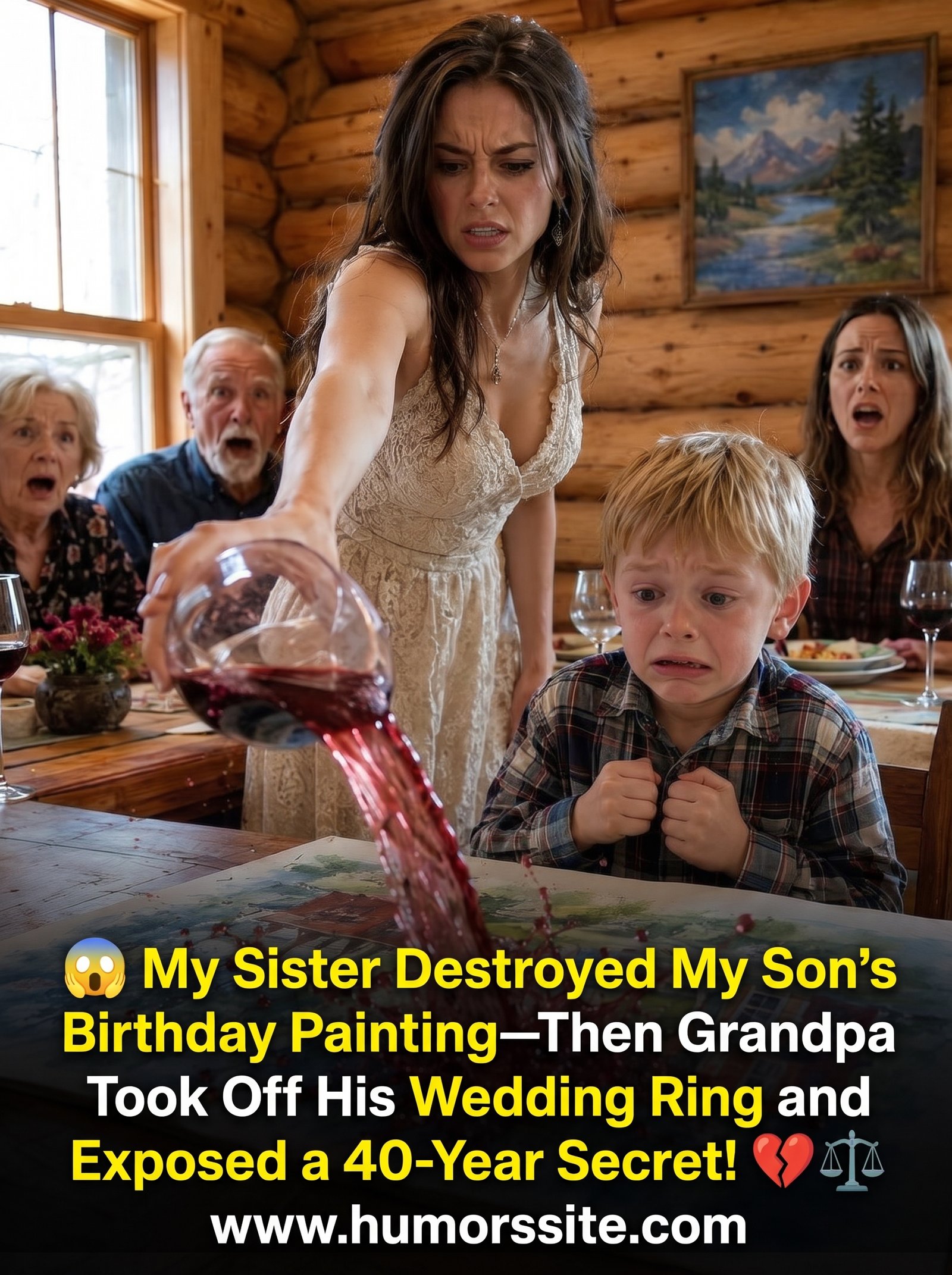
Brooke laughed as she pushed the empty wineglass aside.
“Honestly, someone should teach that boy not to leave his mess everywhere.”
Caleb stared at his ruined painting. His lower lip trembled, but he tried desperately not to cry. He was six years old, and he had spent three days painting the river he loved—the same river where Grandpa Arthur had taught him to skip stones.
“Mom?” he whispered.
My mother, Margaret, rushed forward—not to comfort her grandson, but to save the expensive tablecloth.
“Caleb, move! Look what you’ve done to the table!”
My stomach twisted.
Brooke smirked. “See? Even Mom knows what matters.”
Nobody spoke up.
Nobody defended my son.
Then Grandpa Arthur slowly pushed his chair back.
The scrape of its wooden legs against the floor silenced the room.
He looked at the painting, then at Caleb’s trembling hands. Finally, he turned toward Brooke.
“Did you pour that wine on his painting deliberately?”
Brooke rolled her eyes. “Oh, Arthur. Don’t be dramatic. It’s just a child’s painting.”
Grandpa nodded once.
“Interesting.”
He reached for his wedding ring and slipped it off.
My grandmother had been gone for eleven years, but Arthur had never removed that ring—not once. He had worn it through surgeries, storms, and even the day he buried his beloved wife.
Now he dropped it into the spreading pool of red wine.
Clink.
Brooke’s smile disappeared.
“Dad, what are you doing?” my mother demanded.
Arthur didn’t answer. Instead, he reached beneath his chair and pulled out a battered leather notebook.
I had seen that notebook only once before, when I was a teenager. Grandpa had caught me peeking at it and told me, “One day, you’ll understand why some things need to stay hidden until the right moment.”
He opened it to a page marked with a faded photograph.
“Brooke,” he said calmly, “do you remember the summer you turned eighteen?”
She frowned. “What does that have to do with anything?”
“Everything.”
He turned the notebook around.
Inside was a photograph of a young Brooke standing beside a wooden easel. Behind her was a watercolor painting of the Ozarks river.
My breath caught.
It was nearly identical to Caleb’s painting.
Grandpa continued. “Your grandmother painted that picture. She spent months capturing the river before her hands became too weak to hold a brush. She wanted it displayed in this house so the family would remember where we came from.”
He looked at the ruined painting.
“Caleb did something remarkable. Without ever seeing her original, he painted the river the way she remembered it.”
Brooke scoffed, but the sound was weak.
“So what? It’s still just paint.”
Arthur’s expression hardened.
“No. The painting is not the issue. The issue is that you deliberately humiliated a six-year-old child, then expected everyone to laugh with you.”
He turned another page.
“Forty years ago, your grandmother and I established a family trust. The money was never intended to reward the loudest, richest, or most successful person in this room. It was meant to support the family members who showed kindness when nobody was watching.”
My mother went pale.
“Arthur, please,” she whispered.
He kept reading.
“Every year, I have observed how this family treats others, especially children and those who cannot defend themselves. I never announced the rules because I wanted to see who you really were when you thought nobody important was paying attention.”
Brooke suddenly stood.
“You can’t do this! I’m your daughter!”
“And Caleb is your family, too.”
Arthur closed the notebook.
“Ten minutes ago, I intended to announce the next beneficiary of the trust. I was going to give you a chance to help manage the river house and preserve your grandmother’s legacy.”
Brooke’s eyes widened.
The river house was worth millions.
But Arthur wasn’t finished.
“I have changed my decision.”
“Because of a stupid painting?” Brooke shouted.
“No,” he replied. “Because of what you revealed about yourself when you thought a little boy’s feelings didn’t matter.”
He took a sealed envelope from the notebook and placed it beside Caleb.
“Your grandmother left a separate instruction. She asked that the first child in the family who recreated her river painting be given something she treasured.”
Caleb looked up through his tears.
“Me?”
Arthur smiled gently.
“Yes, sweetheart. You.”
Inside the envelope was a handwritten letter from Grandma Eleanor, along with a small key.
The letter explained that she had hidden her original painting in a locked cabinet in the upstairs library. Behind it was a collection of family letters, photographs, and her personal art journals—everything she had hoped would be passed down to someone who understood why the river mattered.
Caleb wiped his cheeks.
“But my painting is ruined.”
Arthur knelt beside him.
“The paper is ruined, son. Your talent isn’t. And no one can pour enough wine into the world to destroy what you carry in your heart.”
For the first time that afternoon, Caleb smiled.
Brooke looked around the table, waiting for someone to defend her.
Nobody did.
My mother reached for Arthur’s arm. “Surely we can discuss this privately.”
“We’ve had forty years of private discussions,” he replied. “That’s how we ended up pretending cruelty was harmless as long as it came from family.”
He stood, picked up his wedding ring from the wine puddle, and slipped it into his pocket.
Then he faced Brooke.
“You owe Caleb an apology. Not because it will restore the painting, and not because it will change my decision. You owe him one because he deserved better.”
Brooke’s face flushed.
For a long moment, I thought she would refuse.
Instead, she muttered, “I’m sorry.”
Arthur shook his head.
“Look at him when you say it.”
Brooke finally met Caleb’s eyes.
“I’m sorry I ruined your painting.”
Caleb studied her quietly.
“Grandpa says we should be kind to people, even when they aren’t kind to us,” he said. “I forgive you.”
Those words seemed to hurt Brooke more than any punishment could have.
Because a six-year-old boy had shown more grace in one sentence than she had shown in her entire performance that afternoon.
Later that evening, Arthur helped Caleb open the cabinet in the library. Inside, wrapped in protective cloth, was Eleanor’s original watercolor.
Caleb stood before it in awe.
The river curved between the trees exactly as he had painted it. Even the little wooden house near the bend was there.
On the back of the frame, Eleanor had written:
“For the one who sees beauty even when the world tells him it doesn’t matter.”
Arthur placed a hand on Caleb’s shoulder.
“Your grandmother would have loved you.”
I watched my son smile at the painting, and I finally understood what Grandpa had been trying to teach us.
Family isn’t proven by blood, money, or a shared last name.
It’s proven in the moments when someone vulnerable is hurting—and you have the choice to laugh, look away, or stand beside them.
That night, Caleb’s ruined painting was placed carefully in a frame of its own. Arthur refused to throw it away.
“Let it remind us,” he said, “that the worst thing someone does to you doesn’t have to become the best thing about you.”
Brooke left the river house before breakfast the next morning.
And for the first time in years, our family stopped pretending that cruelty was just another form of humor.
The wine eventually washed off the table.
But nobody at that table ever forgot the sound of Grandpa’s wedding ring hitting the glass.