After losing Samuel, I struggled to part with the things that reminded me of our thirty-six years together in our little home. Selling his old sofa felt like a small step forward, even if my heart protested the entire time.
I never imagined that quiet decision would uncover a secret he had kept hidden for years, one that reached directly into our family’s most painful memories.
The young father who had purchased the couch returned to my porch the very next morning holding a package bound with yellowed tape.
“I think you should have your money back, Mrs. Cooper,” he said while looking at me with gentle concern.
“Did that old wooden frame break already?” I asked him, worried that the worn springs had finally given out.
“No, ma’am, nothing broke,” he answered quickly. “I came back because I found something tucked deep inside the upholstery.”
He held out the heavy parcel toward me across the open doorway.
My name was written across the brown wrapping in Samuel’s familiar, steady handwriting.
My husband had been gone for six months, and seeing his penmanship again made my breath catch in my throat.
“What on earth is that?” I asked while staring at the bundle in disbelief.
“I was honestly hoping you could tell me,” he replied softly.
Whatever Samuel had hidden away inside our living room couch, he had never mentioned a single word about it to me while he was alive.
When I finally took the parcel inside and opened it, I understood the tender reason behind his silence.
For twenty long years, I had constantly begged Samuel to replace that awful brown tweed couch.
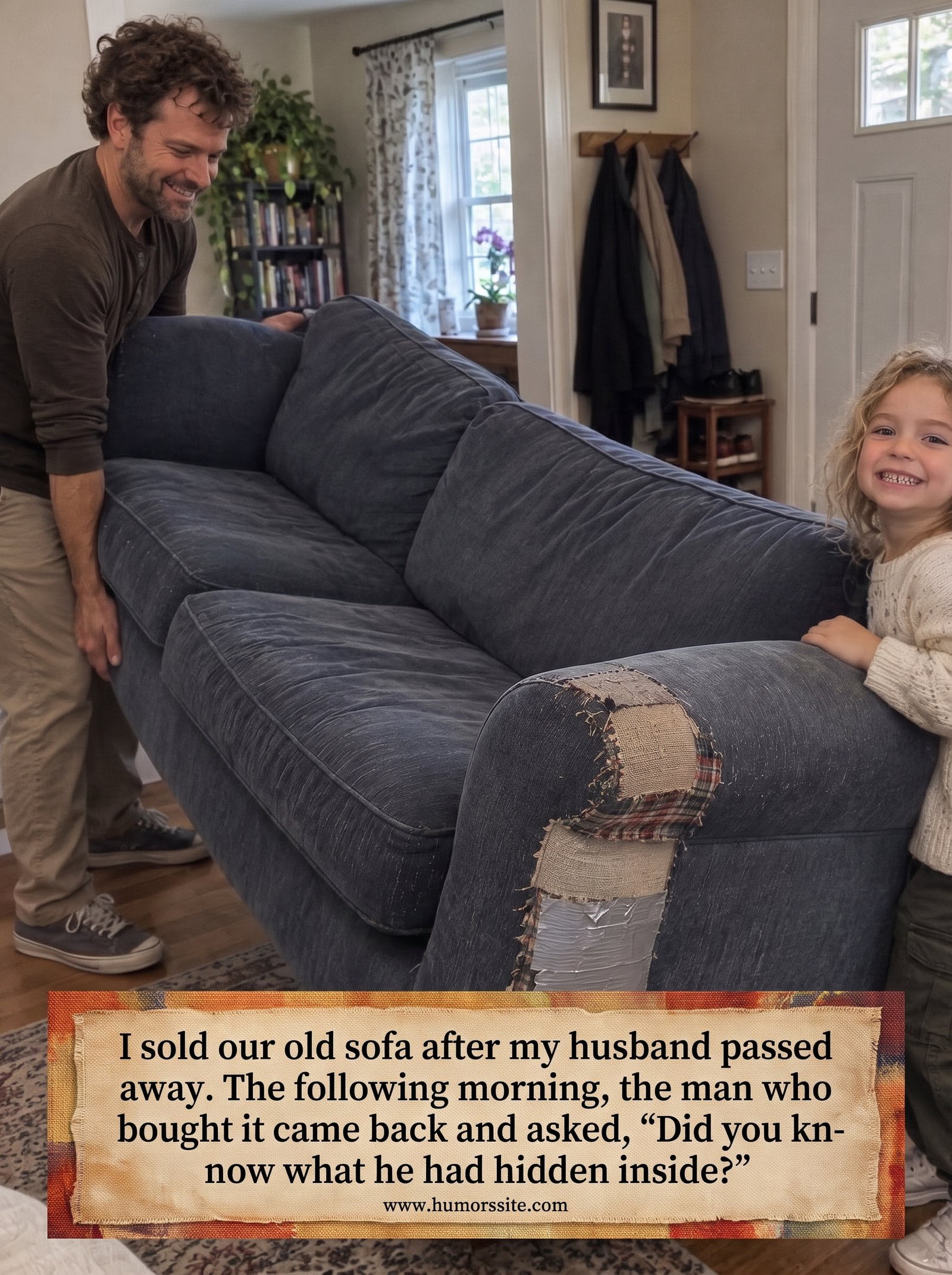
The middle cushion sagged terribly, the left armrest had three different fabric patches sewn on, and getting up required a rocking motion that made me feel twice my age.
“Samuel, we are buying a brand-new sofa this weekend,” I would announce while rubbing my sore lower back.
He would simply pat the worn cushion right beside him with that easy grin of his.
“This one makes you sit closer to me, Shirley,” he always answered.
“That is only because the broken springs are actively trying to swallow us whole,” I retorted with an affectionate roll of my eyes.
Samuel would chuckle warmly, wrapping his arm around my shoulders to pull me down against his chest.
Samuel had been my husband for thirty-six wonderful years, ever since we first met at a county fair.
He had a remarkable gift for fixing lawn mowers and leaky faucets, but unfortunately, he also believed absolutely everything in the world deserved fixing instead of throwing away.
Then Samuel died on an ordinary Tuesday morning from a sudden heart failure.
Suddenly, the lumpy brown couch I had hated for decades became the only place where I could actually fall asleep.
I would curl up on his favorite side beneath his wool blanket, leaving the television playing low murmurs until the morning light crept in.
Our daughter, Cassidy, finally came over with groceries and decided to speak her mind.
“Mom, you cannot keep sleeping out here in the living room every single night,” Cassidy said gently.
“I am perfectly comfortable right here, honey,” I lied, smoothing the fringe on the blanket.
“You complained about that awful couch for half of my childhood, so do not try to fool me now,” she said.
“Well, people are allowed to change their minds when the world changes around them,” I replied softly.
Cassidy was twenty-nine years old, blessed with her father’s dry humor and my stubborn streak.
She sat down right beside me, sinking immediately into the familiar indentation Samuel had left behind.
“Dad would never want you sleeping out here with the plastic remote control digging into your spine,” she said.
A faint smile touched my lips despite the heavy grief lingering over the quiet house.
She reached over and squeezed my fingers with both of her warm hands.
“You really do not have to keep every single item in this house exactly as he left it, Mom,” she whispered.
That very evening, I took three clear photographs and listed the brown sofa online for forty dollars.
I nearly deleted the marketplace listing three different times before going to sleep, doubting my own resolve.
The next afternoon, a polite young man named Wyatt arrived in an old pickup truck accompanied by his friend Mason and his five-year-old daughter, Chloe.
Chloe scampered inside right away, climbed onto the worn cushions, and bounced with pure delight.
“Daddy, look at this, we both fit together with room to spare!” the little girl giggled happily.
Wyatt smiled warmly, wiping his dusty hands on his denim jeans.
“I have been slowly furnishing our little apartment since my divorce, and Chloe and I have been watching cartoons on the bare floor for months,” he explained.
He reached into his pocket and handed me two crisp twenty-dollar bills.
I looked at the sweet girl kicking her sneakers happily, and I promptly pushed one of the twenty-dollar bills right back into his hand.
“Please take this back and buy her something sweet, young man, because every child deserves a special treat on her new couch,” I insisted.
“Are you completely sure about that, Mrs. Cooper?” Wyatt asked, looking pleasantly surprised.
“Take it before I change my mind and decide to hoard my furniture forever,” I told him with a soft laugh.
Mason helped Wyatt lift the heavy piece through the front door, maneuvering carefully around the porch railing.
I almost opened my mouth to call them back and cancel the whole transaction on the spot.
Instead, I stood silently on the front walkway, watching Samuel’s favorite resting spot drive down the road.
That night, for the very first time in six months, I climbed into our master bed and slept through until dawn.
Now Wyatt stood inside my bright kitchen, looking visibly uneasy while holding that taped parcel.
“Chloe dropped a yellow pencil between the cushions last night during dinner,” Wyatt explained carefully. “When I turned the couch over to reach inside, I noticed the black dust cover fabric underneath had been sewn shut by thick hand stitches.”
“Samuel repaired that furniture constantly whenever the springs drifted out of place,” I said, remembering his heavy toolbox.
“That is exactly what I figured at first, ma’am, but one of the seam lines looked much newer than the others,” Wyatt said.
He carefully set the heavy bundle down on top of my wooden kitchen table.
“Did you know he had hidden something wrapped up inside there?” Wyatt asked.
“I had no idea whatsoever,” I answered honestly, shaking my head in complete disbelief.
“I cut the tape open on one corner,” Wyatt admitted sheepishly while looking at the floor. “I read the first few sentences before realizing it was private family history, and I am so sorry for prying.”
“You did nothing wrong at all, Wyatt,” I assured him gently.
He reached into his jacket pocket and pushed the remaining twenty-dollar bill across the tabletop toward me.
“Chloe loves the couch dearly, but if you want it back in your home, Mason and I will load it up and bring it right over this afternoon,” he offered.
I glanced down at Samuel’s neat, familiar script written across the package.
“You keep that sofa, Wyatt, because your sweet girl needs a cozy place to sit while watching her morning cartoons,” I told him.
After he waved goodbye and drove away, I fetched a pair of sharp kitchen scissors from the drawer.
Inside the yellowed tape and heavy cardboard rested a thick stack of handwritten lined paper, held tightly together with thick rubber bands.
A handwritten personal letter rested right on top of the pile.
The very first thing my eyes landed on was a handwritten date at the top of the white page.
June 14.
That was Daisy’s birthday.
Our first little girl would have turned thirty-three this summer, but she had lived for only eight fragile months before an illness took her from us.
Directly beneath that painful date, Samuel had penned a single sentence.
“I could not tell you this while I was alive.”
PART 2
I sat down heavily in the kitchen chair, feeling my knees tremble underneath me.
“Samuel, what on earth did you do?” I whispered to the empty room.
I turned over the cover letter to reveal the first bound page, which had a carefully penned title.
The Life We Did Not Get.
Directly below that bold title, Samuel had written another neat heading in black ink.
Daisy’s Fifth Birthday.
The opening chapter described an energetic little girl with sandy curls who stubbornly refused to wear matching socks to preschool.
“Nobody can even see them inside my red sneakers, Daddy,” little Daisy argued in Samuel’s story.
“The teacher will definitely know, young lady,” her mother replied patiently from the stove.
“Then she really shouldn’t be looking at my feet during reading time,” the little girl retorted.
A startled laugh escaped my lips before I could stop myself.
Samuel had given our lost baby girl my exact brand of stubbornness.
In his story, Daisy desperately wanted a rich chocolate birthday cake, but Samuel had accidentally bought one decorated with fresh raspberries, which she completely despised.
The fictional Daisy crossed her small arms and refused to eat a single bite until her father painstakingly picked off every single red berry.
Then I reached a paragraph near the bottom of the page that made my chest tighten sharply.
“Shirley watched our little girl blow out five bright candles, and for once in our lives, my wife did not have to wonder what this birthday might have looked like,” Samuel had written.
I lowered the heavy stack of papers onto my lap, closing my eyes against a sudden wave of grief.
Samuel and I had spent three long decades trying to survive the silent birthdays that Daisy never lived to celebrate.
Yet all those years, while sitting on that broken couch, he had quietly imagined every single milestone for her.
At age eight, she stubbornly learned how to balance on a two-wheel bicycle without any training wheels.
At twelve, she declared that she was going to become a large-animal veterinarian on an open cattle ranch.
At sixteen, she brought home a gangly high school boy whom Samuel disliked immediately simply because the boy greeted him by calling him buddy.
I chuckled through my tears, resting my fingers over the neat cursive lines.
Samuel absolutely despised being called buddy by anyone younger than fifty.
“Oh, Samuel, you stubborn romantic man,” I murmured aloud.
Yet the further I read into the stack of pages, the more unsettled and conflicted my heart became.
He had fabricated an entire parallel lifetime for our deceased infant daughter.
There were middle school dances, messy teenage arguments over curfew, quiet Christmas mornings, and even her moving into her very first college apartment in Topeka.
Samuel had even written an elaborate chapter describing Daisy walking down the aisle in a white wedding gown.
How many lonely hours had my husband spent sitting in the living room writing all these private scenes?
And why in the world had he kept such an enormous part of his heart completely hidden from me?
I carried the thick manuscript down the hallway and into our master bedroom, where the curtains let in the morning sun.
Samuel’s old oak desk stood silently beside the window, an area I had barely touched since the funeral service ended.
“All right, mister, let us see what other secrets you tucked away in this room,” I said to the quiet air.
The top wooden drawer contained his usual collection of dead batteries, pocketknives, and stray paperclips.
In the bottom drawer, hidden beneath old tax forms, I found three spiral notebooks filled with twelve years of detailed handwriting notes.
There were short bullet points: Daisy learns how to swim at the public pool, Daisy gets a terrible bowl haircut, Shirley teaches Daisy how to drive on the backroads.
Near the back of the second spiral notebook, Samuel had scribbled a brief note to himself: “Hid manuscript inside the sofa lining today. Still need the courage to show Shirley.”
Right beneath that confession, my husband had underlined four words with a heavy red pen.
“Do not make her perfect.”
Samuel had not crafted a saintly ghost who never threw tantrums or made poor choices in his story.
He had given our lost daughter a living personality filled with flaws, humor, and vibrant spirit.
I flipped the manuscript back to the wedding chapter, where Daisy stood nervously before a tall dressing mirror while I adjusted the lace on her dress.
“Mom, you are making that face again,” the fictional Daisy complained playfully.
“What face would that be, sweetheart?” the story version of myself asked innocently.
“The funny pinched face you make whenever you are trying your hardest not to cry in front of people,” Daisy replied.
I pressed my hand against my cheek, realizing that Samuel had noticed that exact habit of mine for thirty years.
All those countless evenings while I thought he was simply dozing off to sports games, he had been dreaming up our daughter’s missing life.
A sharp pang of guilt struck my chest as I suddenly thought of Cassidy.
Our living daughter had grown up right before our eyes, yet here was an entire book dedicated to the baby who had died.
I grabbed my car keys from the counter, slipped the heavy bundle into my canvas tote bag, and hurried out to my car.
I needed to see Cassidy immediately because I could not carry the weight of this discovery all by myself.
Cassidy answered the door to her brick apartment wearing an oversized gray sweatshirt and reading glasses.
“Mom, what is going on?” Cassidy asked with immediate concern in her brown eyes. “Are you feeling sick?”
“Your father wrote something incredible and terrifying, and I never knew a single word about it until an hour ago,” I gasped breathlessly.
She stepped back into the entryway and opened the door wide for me.
“Please come inside and sit down while I make us a pot of fresh coffee,” she urged.
“Just do not brew that dark roast you bought me last Thanksgiving,” I warned, trying to ease the tension in my chest.
“That was perfectly normal Columbian coffee, Mom,” she said with a dry chuckle from the kitchen counter.
“It tasted like burnt fireplace toast to me,” I called back while setting the heavy manuscript squarely on her wooden dining table.
Cassidy walked out carrying two ceramic mugs and stopped in her tracks when she noticed the title page.
“Dad actually wrote this whole manuscript?” Cassidy asked, setting the mugs down carefully.
“Every single word of it,” I answered, watching her face closely.
She pulled out a chair, sat down, and began turning the typed and handwritten pages slowly.
“This is all about Daisy, isn’t it?” Cassidy asked in a quiet, measured voice.
“It is about what her life could have looked like if she had stayed with us,” I explained softly.
Cassidy read the first three pages in absolute silence, her hazel eyes darting across her father’s familiar script before she finally looked up at me.
“I really wish he had felt comfortable enough to show this to me while he was still alive,” Cassidy whispered.
“Why do you say that, honey?” I asked, surprised by her reaction.
“Because I always wanted to know more about my big sister, but nobody in our house ever wanted to talk about her,” she confessed.
I reached across the table and touched her forearm with a worried expression.
“Cassidy, Daisy passed away years before you were born, and we simply did not want our old sorrow to cast a shadow over your childhood,” I explained.
“I understand that you were grieving, Mom, but I was not asking you to change the past,” Cassidy said, closing the manuscript with a dull thud.
“Then what are you trying to say to me right now?” I asked, feeling my defenses rising.
“I am asking why it was always so completely forbidden to mention her name when I was growing up,” Cassidy replied steadily.
I frowned, feeling a sting of unfairness in her accusation.
“That is not true, Cassidy, because we spoke about your sister whenever you asked us,” I insisted.
“No, Mom, we really did not,” Cassidy countered firmly without raising her voice.
“I remember things differently,” I murmured.
“When I was six years old, I found Daisy’s baby photograph tucked away in the back of Dad’s sock drawer, remember?” Cassidy asked me directly.
The memory rushed back into my mind with sudden, vivid clarity.
In that faded photograph, Daisy was wearing a pastel yellow onesie patterned with tiny ducks, gripping Samuel’s thick thumb with her tiny fist.
“You sat me down on the carpet and told me she was my older sister who went to heaven,” Cassidy continued quietly. “And then you immediately slipped the picture back into the envelope and locked the drawer shut.”
“I did that because I did not want to confuse or frighten a six-year-old child,” I argued gently.
“I was not frightened, Mom, I was just curious to know whether she had my nose or my smile,” Cassidy said with a sad look in her eyes.
“Your father and I did the very best we knew how to do back then,” I said, feeling defensive tears prickling my eyes.
“I know you did your best, Mom, but right now I am trying to tell you how that silence felt to a little girl, and you keep justifying your choices,” Cassidy said softly.
I looked away from her honest gaze, feeling overwhelmed by the weight of her words, and pushed my chair back from the table.
“I think I should probably go home now,” I said stiffly while reaching for my handbag.
“Mom, please do not just walk away simply because an honest conversation feels uncomfortable,” Cassidy pleaded from the table.
I could not help myself, so I picked up my purse and hurried out the front door into the brisk afternoon air.
Halfway back to my empty house, I pulled my car into an empty church parking lot and rested my forehead against the steering wheel.
I vividly remembered Cassidy at six years old, clutching that yellow-duck photograph with wide, questioning eyes.
“Would Daisy have played tea party with me on the porch, Mommy?” she had asked that afternoon.
“Probably, sweetheart, but let us go play outside right now,” I had answered, quickly hiding the grief that threatened to tear me apart.
I had hidden behind silence for nearly thirty years, foolishly believing that silence was the same thing as emotional protection.
I reached into my bag, pulled out my mobile phone, and dialed Cassidy’s number with trembling fingers.
“Mom?” Cassidy answered instantly on the first ring.
“I behaved poorly by walking out on you just now, and I am calling to say that I am deeply sorry,” I admitted with a cracking voice.
The line remained completely quiet for a few moments while she took a breath.
“It hurt my pride to hear that Samuel and I made you feel shut out in your own home,” I confessed into the receiver.
“I was never trying to hurt your feelings, Mom, I promise,” Cassidy said gently.
“I know that now, and I would truly like to hear the rest of what you have to say about growing up with us,” I told her.
“Are you sure you are ready for that conversation?” she asked carefully.
“Come over to the house for dinner tomorrow evening so we can sit down and talk like adults,” I suggested.
“I would really love that, Mom,” Cassidy agreed.
I hung up the phone and looked down at Samuel’s thick manuscript resting quietly on the passenger seat next to my purse.
I had barely scratched the surface of what my husband had spent decades writing in secret.
I could no longer keep obsessing over his hidden words while completely ignoring the feelings of our living child.
The following evening, the doorbell rang promptly at five o’clock, and Cassidy stepped inside carrying a covered glass dish.
“I stopped by the bakery on Orchard Street and brought an apple pie,” Cassidy announced with an apologetic smile.
“That is wonderful because I made a roasted herb chicken with mashed potatoes,” I replied, taking her warm jacket.
“Good, because I was genuinely terrified you were going to serve Dad’s old manuscript on a dinner plate,” she teased gently.
We both laughed together, and the heavy tension that had lingered between us finally dissolved into warmth.
Over our meal, I set down my fork on the rim of my plate and looked directly across the dining table into Cassidy’s eyes.
“Tell me honestly what you remember about growing up in this house regarding your sister,” I said.
Cassidy paused, resting her fork beside her plate while searching my expression.
“Do you really want the absolute truth?” she asked.
“I want the absolute truth, especially if it is difficult for me to hear,” I nodded firmly.
She looked down at her plate, turning her water glass slowly between her fingers before speaking.
“I remember that Dad always turned completely silent for the entire week of June fourteenth,” Cassidy said softly. “And I remember that you always avoided looking at the photo albums whenever we pulled out the family boxes.”
I nodded slowly, feeling the familiar ache behind my ribs.
“I could not look at those baby pictures without feeling like I was drowning, Cassidy,” I admitted honestly.
“I figured that out on my own once I became a teenager, Mom,” she said.
“What did your little mind think when you were just a small child?” I asked her.
Cassidy moved a forkful of potatoes across her plate before answering with a quiet hesitation.
“Sometimes I honestly wondered if you and Dad secretly wished that our family had turned out differently,” she whispered.
I immediately reached across the table and grasped her hand tightly in mine.
“Cassidy, look at me right now,” I said firmly. “Your father and I never once wished you away, not for a single fraction of a second.”
“I believe you with all my heart, Mom, but that is simply what it felt like when the ghost of another sister was always floating in the corners of every room,” she replied gently.
“Why didn’t you ever say anything to us about feeling like that?” I asked, wishing I could turn back the clock.
“Because whenever I mentioned Daisy’s name, you looked so utterly shattered that I felt guilty for asking,” Cassidy confessed. “I even drew a crayon picture of the four of us standing in front of our house once when I was seven, but I threw it in the trash can before you could see it because I didn’t want to make you cry.”
Tears spilled over my eyelids as I realized the tragic irony of our family life.
I had stayed completely silent for decades to protect my daughter, while my daughter had swallowed her own grief to protect me.
“I am so terribly sorry, my sweet girl,” I whispered, squeezing her fingers.
Cassidy squeezed my hand right back, offering me a tender, forgiving smile.
“I just wish we had spoken about her out loud, so she could feel like a real sister instead of a forbidden mystery,” Cassidy said.
I turned my head toward the living room credenza where Samuel’s heavy manuscript rested under the lamp.
“There is still something that puzzles me deeply about your father’s writing,” I said thoughtfully.
“What puzzles you, Mom?” Cassidy asked.
“Why he spent twelve long years writing hundreds of pages about a life that Daisy never got to experience on this earth,” I wondered aloud.
Cassidy looked over at the pages, tilting her head thoughtfully.
“Maybe Dad just needed a safe place to get to know her too,” Cassidy suggested softly. “And maybe writing down those imaginary memories was the only way his heart could heal from losing his first baby.”
Her words hung in the warm air of the dining room, opening a brand-new window into my husband’s private soul.
After finishing our dessert, I walked Cassidy out to the front porch beneath the yellow porch light.
“Can I come back and read the rest of the manuscript once you have finished going through it?” Cassidy asked.
“Of course you can, sweetheart, whenever you are ready,” I promised.
She stepped down onto the first walkway step, paused, and looked back over her shoulder at me.
“And Mom?” Cassidy said softly.
“Yes, honey?” I answered.
“I never needed you to be a flawless mother with every answer figured out,” she said.
I wrapped my arms around her shoulders and held her tight against the cool evening breeze.
“That is very fortunate, my dear, because I seem to be running rather short on answers lately,” I murmured against her hair.
Later that evening, after the house grew quiet, I sat down at Samuel’s old oak desk with a cup of chamomile tea.
I opened the manuscript where I had left off, reading about Daisy packing her trunk for college and accidentally shrinking her woolen sweaters in the dormitory laundromat.
I smiled at Samuel’s dry descriptions of her teenage dramatic complaints over the telephone.
Then my fingers turned another heavy page, and I froze in place.
The bold black heading at the top of the lined paper had changed completely.
Cassidy’s First Bicycle.
My breath caught in my throat, and I leaned closer to the desk lamp with a puzzled frown.
This chapter had nothing whatsoever to do with the imaginary life he had constructed for Daisy.
I began reading Samuel’s handwriting, tracing every single curve of his familiar lettering.
“Cassidy was seven years old when Shirley decided our little girl was finally ready to conquer the sidewalk without any training wheels,” Samuel had written.
The vivid memory rushed through my mind, sweeping away decades of dust.
Samuel had argued stubbornly that we should wait until spring because the gravel on our driveway was too rough for a beginner.
I had stood my ground, insisting that our determined little girl possessed the balance and grit to manage just fine.
“Cassidy tumbled onto the grass twice before she found her momentum and raced down the asphalt,” the page read.
Samuel described me sprinting alongside the handlebars in my faded sneakers, shouting encouragement until my voice cracked.
Then Samuel recorded the exact moment Cassidy pulled the handbrakes, balanced with one foot on the curb, and looked back over her shoulder.
“Did you see me flying, Daddy?” she had shouted across the yard.
“I saw every single second of it, my brave girl,” Samuel had written in the margin. “And more than anything, I saw Shirley laughing with pure, unfiltered joy as she ran after our child.”
I turned the page with trembling hands, eager to see what came next.
The Birthday Cake Catastrophe.
Cassidy had been ten years old that autumn when she decided to surprise her father by baking him a yellow birthday cake from scratch.
She had accidentally swapped the white granulated sugar for coarse sea salt while reading my handwritten recipe card.
Samuel had dutifully swallowed two enormous bites of that salty disaster with a straight face before admitting that something tasted slightly oceanic.
I laughed out loud in the empty room until hot tears streamed down my cheeks, remembering the look of sheepish horror on Cassidy’s face.
The very next chapter heading was titled: The Afternoon Shirley Sang Again.
Samuel wrote about a rainy Tuesday when Cassidy was twelve, making up ridiculous nonsense lyrics to a radio pop song while scrubbing dishes in the kitchen sink.
I had walked into the room to dry the pans and joined right in with her silly performance without even thinking about my sadness.
Samuel had quietly stood in the hallway shadows, leaning his shoulder against the doorframe to listen to us singing together.
“I had forgotten how much I desperately missed hearing my Shirley sing around our home,” Samuel had penned in blue ink.
I lowered the lined paper to my chest, letting the realization wash over my racing heart.
The first half of the thick manuscript was Samuel’s loving tribute to the daughter we had lost too soon.
The entire second half was a breathtaking, detailed chronicle of the wonderful life we had actually lived together as a family.
Samuel had never forgotten about Cassidy for a single second.
My husband had loved and cherished both of his daughters with every fiber of his quiet being.
Tucked into the very back of the stack, nestled inside a plain white envelope, was a final letter addressed to me.
“My dearest Shirley,
I was always terrified that if you found these pages, you would think I was longing for an imaginary life instead of our real one.
I never wanted any other reality than the one I shared with you.
I deeply wanted Daisy to grow up, to listen to her argue about schoolwork, and to hear her complain about my dry barbecue cooking.
Yet I never once looked at Cassidy and wished for a different child to take her place.
From the very second Cassidy drew her first breath in that hospital room, I loved her purely for who she was, not as a replacement for the baby who slipped away.
I wrote about Daisy because my heart needed a gentle way to imagine the precious moments we had missed out on.
I wrote about Cassidy because I never wanted to forget the countless miracles and everyday joys we were blessed to hold in our hands.
And above all else, Shirley, I wrote about you because even when our grief made it hard for us to talk, you were the greatest love of my existence.
I only wish I had possessed the simple courage to hand this book to you while I was still sitting beside you on that lumpy sofa.”
I reached out and touched his final signature with my thumb, feeling the faint indentation his pen had left in the thick paper.
“You foolish, wonderful, stubborn man,” I whispered into the quiet night. “You should have trusted me enough to show me.”
I remembered walking out of Cassidy’s apartment yesterday when the conversation turned painful, realizing how easily fear can build walls between people who love each other.
I picked up my phone from the desktop and dialed Cassidy’s number right away.
“Mom, is everything all right over there?” Cassidy answered with concern in her voice.
“Everything is more than all right, sweetheart, but there is something truly extraordinary in your father’s manuscript that belongs to you,” I explained.
“Did you find another hidden note?” she asked curiously.
“I found hundreds of pages written about us, about you, and about the beautiful life we built together,” I told her warmly.
Cassidy fell quiet on the line for several seconds, absorbing my words.
“Then I am coming over right after my lunch break tomorrow,” she said softly.
The next afternoon, the bright autumn sunlight poured across the kitchen table as Cassidy sat in her father’s favorite oak chair.
I handed her the second half of the manuscript, watching her face soften as she read through the memories of her childhood.
She laughed out loud at the memory of the salt cake, shook her head over her bicycle scrape, and dabbed her eyes when she read about the kitchen singing.
When she finally finished reading Samuel’s final letter, two distinct tracks of tears ran down her flushed cheeks.
“He remembered every single detail of those little days, didn’t he?” Cassidy whispered in wonder.
“Your father paid far more attention to our lives than either of us ever gave him credit for,” I said with a tender smile.
She looked at me, a lingering trace of vulnerability surfacing in her eyes.
“Mom, do you think deep down in his heart he secretly wished Daisy was the one sitting here grown up instead of me?” she asked.
I scooted my chair closer until our knees were touching, taking both of her trembling hands into mine.
“Not for a single heartbeat, my sweet girl,” I answered with absolute certainty. “Your father simply loved both of his girls with everything he had, and he wanted the whole world to know it.”
Cassidy rested her forehead gently against my shoulder, letting out a long, contented breath that felt like the lifting of an ancient weight.
I smoothed her hair, feeling the heavy burden of thirty years of unspoken sorrow finally drifting away from our home.
I reached across the table and opened the manuscript back up to the transition page between the two halves of the book.
“There is still one chapter right in the middle that I saved so we could read it together,” I told her gently.
Cassidy lifted her head, wiping her wet cheeks with the back of her sleeve, and peered at the bold heading on the white paper.
The Day Cassidy Came Home to Des Moines.
“Do you really think Dad remembered the chaotic day I was born as clearly as he wrote here?” she asked with a wet chuckle.
“Well, he completely forgot where he parked our station wagon in the hospital parking lot that morning,” I teased, smiling through my own tears.
Cassidy laughed, the sound bright and ringing through the sunlit kitchen.
I turned the page carefully, holding the corner down with my thumb so we could both read Samuel’s words at the exact same time.
“He definitely forgot about the car, my dear, but he remembered every single detail of the miracle of having you.”
THE END.