Morning sunlight filtered through the large classroom windows, casting a soft golden glow over the children’s drawings covering the walls.
It was time for “Show and Tell,” a weekly ritual in Miss Carter’s third-grade class. The students sat in a semicircle on a bright, colorful rug, eagerly waiting for their turn.
Each child was excited to talk about their personal heroes: their parents.
Little Lily, with her blonde pigtails, proudly shared that her mom was a veterinarian who saved kittens. Ethan, the loudest kid in the class, bragged that his dad was a firefighter who drove a huge red truck. One after another, the stories blended together into a colorful tapestry of admirable professions.
Then it was Marcus’s turn.
Marcus was a boy with large, thoughtful eyes that seemed older than his eight years. His clothes were clean but worn, slightly too big for him, as if they had once belonged to an unseen older brother. He stood up with a quiet dignity that didn’t quite match his age.
At first, his voice was barely a whisper, but it soon became steady.
“My dad,” he said, “works at the Pentagon.”
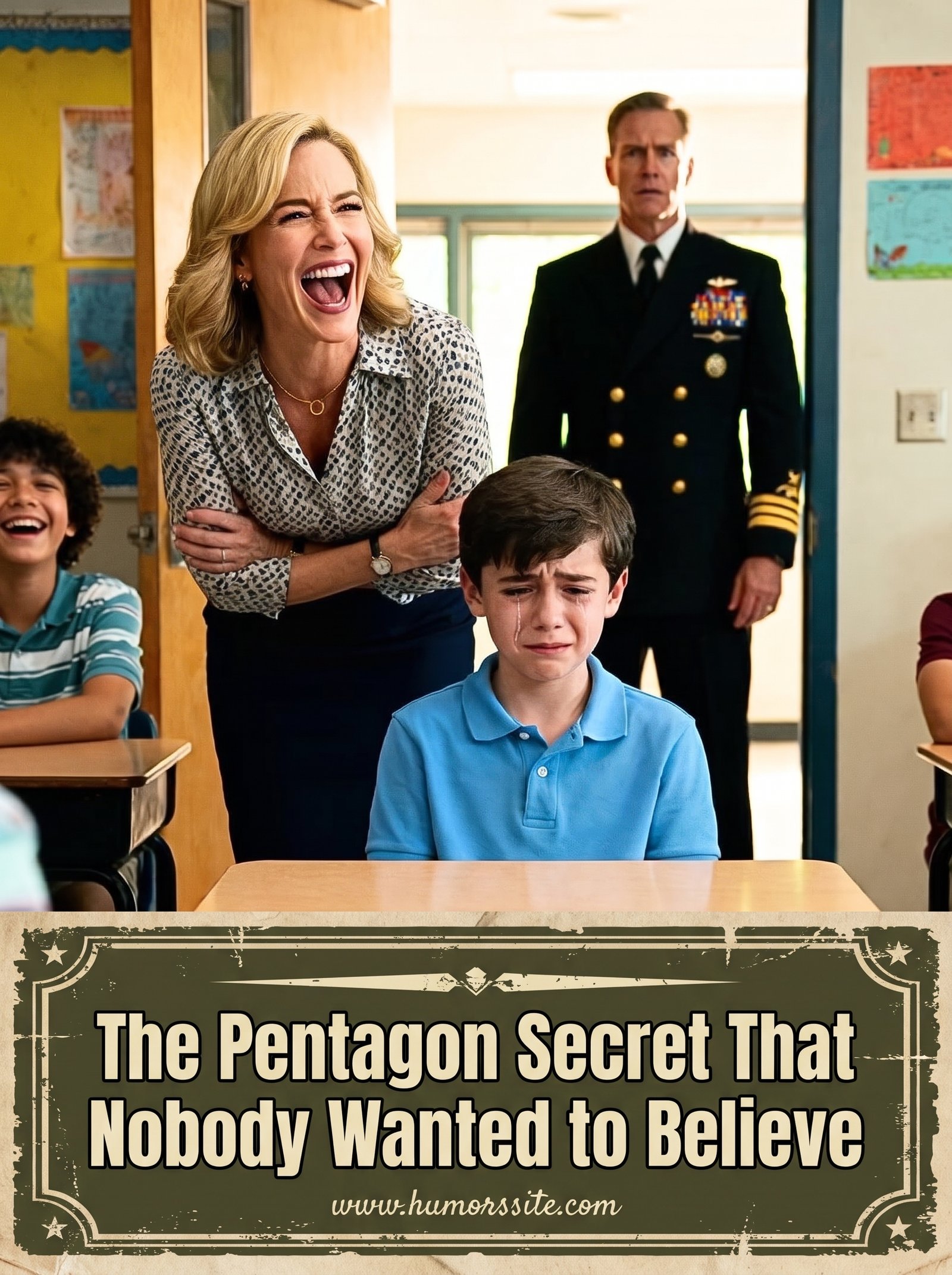
An awkward silence filled the room. It wasn’t the silence of curiosity, but one of disbelief, mixed with a hint of restrained laughter. Miss Carter, a woman in her forties who always kept her hair neatly tied in a bun and rarely strayed from a stern expression, frowned.
She had already had “conversations” with Marcus about what she believed were his “fantasies.”
“Marcus,” she said, her voice carrying a barely hidden condescension. “We’ve talked about this before. You know that’s not true. No one in your family lives near Washington, D.C., and certainly not working somewhere as important as the Pentagon.”
A few giggles began to ripple through the room.
A boy sitting in the front row, Tyler, muttered loudly enough for everyone to hear, “Marcus always lies! His dad doesn’t work at the Pentagon. He’s probably just a janitor!”
The other children, encouraged by the teacher’s authority and Tyler’s boldness, joined the teasing.
“Liar!” one girl shouted.
“You’re making it up!” another added.
Marcus felt a cold sting in his chest. His small hands trembled as he held a wrinkled drawing of a man in uniform. Shame and injustice tightened around him like a knot.
“But it’s true…” he whispered, his voice barely audible. Tears threatened to spill. “My dad told me.”
Miss Carter sighed, her patience wearing thin. In her mind, Marcus was a troubled child who invented stories for attention. This was simply another attempt.
“Marcus, that’s enough,” she said firmly. “This is not the time for your fantasies. Go back to your seat. We need honesty in this classroom.”
Heat rose up Marcus’s neck as humiliation washed over him. He lowered his head, his small world collapsing under the accusing looks of his classmates and the disbelief of his teacher. He was about to return quietly to his desk when a sound interrupted the tense silence.
The classroom door opened.
Everyone turned toward the entrance.
Standing in the doorway, framed by the light of the hallway, was a tall man with a commanding presence. He wore a perfectly pressed dark blue military uniform that seemed to absorb the light. Gold insignia gleamed on his shoulders, and the cap in his hand revealed neatly combed gray hair.
His face was serious, marked with lines of experience, but his warm amber eyes radiated calm.
A different kind of silence fell over the room—one filled with awe.
Miss Carter felt the blood drain from her face. She recognized the uniform and the insignia. This was no costume. The man carried undeniable authority.
Her eyes darted from the man to Marcus and back again.
Marcus, seeing the figure in the doorway, instantly forgot his tears. A bright smile spread across his face.
“Dad!” he shouted, running toward the man.
The man knelt down and opened his arms, embracing his son warmly. He ruffled Marcus’s hair, kissed his forehead, and then stood again with one hand resting on the boy’s shoulder. His eyes met Miss Carter’s.
He gave a brief, precise military salute.
Miss Carter stood frozen, mouth slightly open, unable to process what she was seeing. The child she had just called a liar was now hugging a high-ranking officer.
The other children stared in stunned silence, their eyes moving between Marcus and his father.
The man stepped forward with Marcus holding onto his leg. His gaze was sharp but calm.
“Sorry for the interruption,” he said in a deep, steady voice. “I’m Colonel Daniel Brooks. I’m here to pick up my son, Marcus.”
Miss Carter could only nod. Her authority had evaporated, replaced by paralyzing embarrassment.
The classroom air grew heavy with tension. Everyone sensed that this moment meant more than a simple school pickup.
Colonel Brooks looked briefly at the children before turning back to the teacher, who was now trembling slightly.
The silence was thick enough to feel.
“Miss Carter,” the colonel began calmly, “I understand that appearances can be misleading. And children do sometimes have vivid imaginations.”
He paused, and the teacher felt a flicker of hope that he might let the matter go.
But it vanished instantly.
“However,” he continued, “trust and respect are the foundation of any relationship—especially between a teacher and her students. A child should never feel ashamed for telling the truth or for speaking proudly about their parents.”
His words, delivered quietly, struck harder than any angry outburst.
Miss Carter lowered her gaze, crushed by the weight of her mistake.
Marcus clung to his father’s leg, watching the teacher with innocent curiosity.
“My work at the Pentagon,” the colonel explained, briefly addressing the class, “is complicated. I can’t discuss many details, but it involves strategic cybersecurity planning for national defense. It’s a job that requires dedication, sacrifice, and sometimes staying out of the spotlight.”
The children listened in fascination. Words like “cybersecurity” and “national defense” gave Marcus’s earlier claim an entirely new meaning.
“Marcus,” the colonel said gently, looking down at his son, “I’ve always told you to tell the truth, haven’t I?”
“Yes, Dad,” Marcus said proudly.
“And you should always be proud of your father, no matter what anyone else thinks,” he said, squeezing the boy’s shoulder. “The truth always finds its way out.”
Miss Carter felt her face burn with shame as the children’s eyes shifted toward her.
“Miss Carter,” the colonel continued formally, “educators have the responsibility to verify facts and create an environment of respect—especially when a child’s integrity is involved.”
Finally, the teacher found her voice.
“Colonel Brooks… I’m deeply sorry,” she said shakily. “I let my assumptions guide me.”
“Assumptions are dangerous,” the colonel replied calmly. “They can destroy trust and damage a child’s self-esteem. What happened here today was not acceptable.”
At that moment the classroom door opened again.
Principal Harris stepped inside, looking concerned after hearing about the unusual visitor.
“Colonel Brooks, welcome,” he said nervously, extending his hand. “I’m Principal Harris. Is there a problem?”
The colonel shook his hand firmly.
“Yes,” he said. “There is. My son was humiliated and called a liar for telling the truth about my profession. I believe this situation requires a private discussion—and a formal apology.”
Principal Harris’s face reddened immediately.
“Of course,” he said. “Please come to my office.”
The colonel gave Marcus another quick hug before leaving with the principal.
The next day, the atmosphere in the classroom felt different.
Miss Carter stood before her students with a humbled expression.
“Class,” she began, her voice steady but emotional, “I want to apologize—especially to Marcus. Yesterday I made a serious mistake. I doubted him and allowed him to be disrespected. That was wrong.”
She turned toward him.
“Marcus, I’m truly sorry. Your father is an admirable man, and you have every right to be proud of him.”
Marcus nodded shyly. “It’s okay, Miss Carter.”
During recess, Tyler approached Marcus.
“Hey… I’m sorry for what I said,” he admitted. “Your dad is awesome.”
Marcus smiled, feeling accepted for the first time in a long while.
Colonel Daniel Brooks had done more than defend his son. He had taught the entire school a powerful lesson.
His work protecting the nation through cybersecurity might remain largely invisible, but his actions that day revealed something far more important.
True authority isn’t found in rank or uniform.
It lies in integrity—and in the courage to admit when we are wrong.