The fluorescent lights in the South Side Chicago police precinct buzz overhead like angry wasps, flickering every few seconds like they’re as tired as the officers on duty. It’s two in the morning, and I can taste metal in my mouth from biting the inside of my cheek during the drive here.
Chicago in January is a different planet. The kind where the wind doesn’t just sting your skin; it goes straight through your bones and settles there. My hair is still damp from the snow that blew into my car every time I hit a red light and had to wipe the windshield with a spare grocery receipt because the wipers are overdue for replacement—like everything else in my life that isn’t strictly necessary to keep moving.
When Sergeant Miller called, his voice was careful, measured, the way doctors talk when test results aren’t simple. “Ms. Baker, we have your niece and nephew here. They’re safe, but we need you to come down.”
Safe. I clung to that word the entire way from Lincoln Park to the South Side, hands welded to the steering wheel, knuckles white, driving through the kind of lake-effect snow that swallows headlights and makes the world dissolve into gray. I kept repeating it under my breath at every slick intersection.
They’re safe. They’re safe. They’re safe.
Now, inside the precinct, the air smells like burned coffee and wet wool. A TV in the corner of the waiting area plays muted footage of some late-night news anchor talking about the storm warning sweeping across the Midwest. A few people in heavy coats doze on plastic chairs, their faces etched with the kind of exhaustion that belongs in emergency rooms and bus stations and places like this.
“Ms. Baker?”
I look up. The man walking toward me is in his late forties, tall, with a tired face and steady eyes. The name tag over his badge reads MILLER.
“Yes,” I say, rushing to meet him. “I’m Wren. You called about my niece and nephew. Cooper and Piper. Are they—”
“They’re here,” he says. “They’re warm. They’ve been seen by paramedics. We’re monitoring them.”
My lungs finally remember how to work. I exhale so hard my shoulders sag.
“Can I see them?” I ask.
“Soon,” he says. But he doesn’t turn toward the waiting area, toward the silver blankets I’ve already spotted in my peripheral vision. His hand settles on my elbow, firm, steering me toward a corridor that leads deeper into the station.
“First, I need to ask you some questions.”
The corridor is narrow, lined with bulletin boards full of flyers about neighborhood meetings, missing persons, and a faded poster about winter safety that feels like a cruel joke. He leads me into a small interview room with cinderblock walls painted a tired beige and a metal table bolted to the floor.
The door closes behind us with a click that sounds too final.
Miller drops a plastic evidence bag onto the table between us. Inside is a crumpled note, and even through the cloudy plastic, I can see my name scrawled across it in Sloan’s handwriting. She writes my name like she always has, the loop in the R too big, the N trailing off like she got bored halfway through.
“Ms. Baker,” Miller says, and his voice has lost the warmth it had in the waiting room. “Can you explain why a well-off Lincoln Park architect would send two small children to a frozen industrial area on the South Side in the middle of a blizzard?”
The words don’t just land—they slam into my stomach like a fist.
“What?” My voice comes out as a croak. “I didn’t—”
“Children being dropped off without a responsible adult is serious,” he says evenly. “It’s our job to figure out how it happened. I need to understand your involvement tonight.”
My hands start to shake. I lace my fingers together in my lap to hide it.
“This isn’t real,” I say, but it sounds like I’m talking to myself more than to him. “There’s been a mistake.” I force myself to focus. “I live at 2400 North Clark, in Lincoln Park. The children… where were they found?”
Miller’s eyes don’t leave my face.
“2400 South Clark Street,” he says. “An old industrial lot. During a blizzard warning. They were in light clothing meant for warm weather.”
The difference hits me like ice water.
North versus South. One letter. Two entirely different worlds.
North Clark is tree-lined streets and dog walkers and boutique coffee shops with reclaimed wood tables and pour-over menus. South Clark, at that number, is warehouses with boarded windows, chain-link fences, and streetlights that flicker more than they shine. It’s loading docks and cracked asphalt and the kind of quiet that doesn’t feel safe.
“I never—” My throat closes up. I swallow hard. “I told my sister no. I told her I couldn’t watch them tonight. I sent her an email. I have proof.”
“People send emails for all kinds of reasons,” Miller says, crossing his arms, the movement slow and deliberate. “Sometimes to confirm arrangements. Sometimes to rewrite them after things go wrong.”
“You think I—” My voice snaps, then breaks. “You think I would send my niece and nephew to an empty lot in a storm?”
“I think I need you to walk me through your day,” he replies calmly. “From the time your sister first contacted you about tonight.”
Twelve hours ago, I was in a different universe.
I was at my drafting table in my tiny Lincoln Park apartment, neck cramped, eyes burning from staring at my laptop screen. The city park bid covered every surface—sketches, printouts, color swatches, sticky notes forming constellations across my walls. Three years of work compressed into one presentation due Monday morning. It wasn’t just a work project; it was the thing that could change my entire career.
I’d skipped dinners, weekends, and family events for this. The design wasn’t just a park. It was light and safety and sightlines and places where kids could run without disappearing around blind corners. It was everything I hadn’t had as a kid in this city.
When Sloan called, my hands were stained with graphite and highlighter ink.
“Wren, thank God you answered,” she’d said, her voice coming through my Bluetooth speaker, high and fast. I’d recognized that edge immediately—the mix of excitement and entitlement I grew up orbiting.
I’d stared at the half-finished elevation of the main play structure. “Hey. I’m in the middle of a deadline. Can we make this quick?”
“I need you to watch Cooper and Piper tonight,” she rushed on, like she hadn’t heard me. “Preston surprised me with a trip to Aspen and we’re leaving in two hours. I’m already packing. The nanny’s off, Mom and Dad are heading to a gala, and you know how they are about kids at their place. I’ll Uber the kids over. They’ll have already eaten. You just have to be there.”
I closed my eyes, counted to three.
“I can’t,” I said. “I told you last week I have that deadline. The park presentation is Monday. I’m not going to be home tonight. I’m working at the office.”
“This is important, Wren,” she said, slipping into that tone she used whenever she wanted something. “Family is important.”
Family. In our house, that word was a key that opened every door except the one I needed most: the right to say no.
When we were kids, family meant I sat with Sloan at the table doing her book reports while she painted her nails. Family meant I took the blame for the broken vase because she was starring in the school play and “couldn’t afford a suspension on her record.” Family meant our parents hosted fundraisers and charity balls while I made sure my little sister got home from parties in one piece.
At thirty-two, family apparently still meant my life was a safety net for hers.
“The deadline is important too,” I said, keeping my voice even. “I am not available tonight. I will not be home. Do not bring them to my apartment. I will not answer the door.”
It felt strange, saying the boundary out loud that clearly. Like trying on a coat that might not be my size yet but fits better than I expected.
“You’ll regret this,” Sloan had snapped when it became clear I wasn’t bending. “Don’t say I didn’t ask.”
She’d hung up. I’d stared at my phone, my heart pounding, and then I’d done something I wasn’t raised to do: I backed my words up in writing.
At 3:30 p.m., I sent an email.
I will not be home tonight. Do not bring them. I will not open the door.
Now, in this buzzing little room that smells like old coffee and paper, Miller is watching me like he’s heard a thousand versions of this story and half of them ended badly.
“Do you still have the email?” he asks.
“Yes.” I fumble with my phone, my fingers clumsy and numb. “It’s right here. And I got a read receipt. She opened it at 3:47.”
“That could have been set up after the fact,” he says. “Or you could have changed your mind later and then panicked when they didn’t show up.”
“Can I please see them?” I ask, my voice cracking. “Cooper and Piper. I need to see that they’re okay.”
Something shifts in his expression. Maybe it’s the way my voice sounds, shredded and raw. Maybe it’s the fact that I keep asking about the kids instead of lawyers.
He stands. “Come with me.”
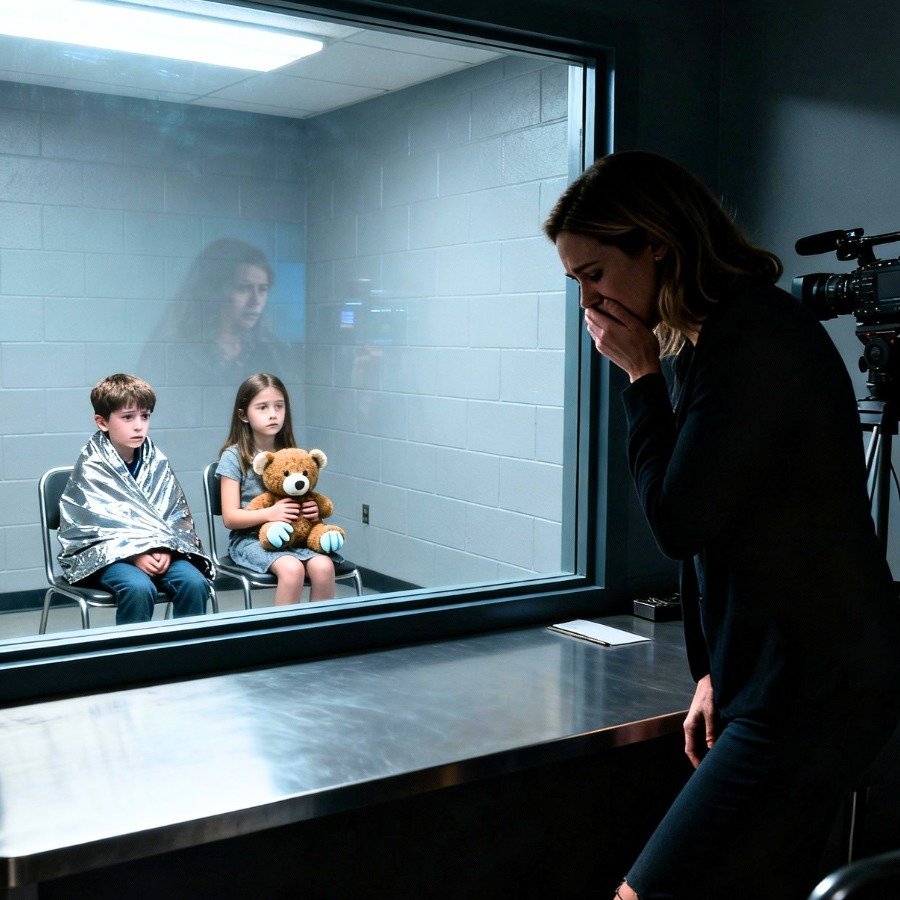
We walk down another hallway, this one darker, lined with closed doors. He turns into a narrow room with a large pane of glass set into the wall. The lights inside the adjoining room are dimmed, but I can see enough.
Cooper is wrapped in one of those metallic emergency blankets, the kind they hand runners at the finish line of the Chicago Marathon. His shoulders shake under it, his whole body trembling in a way that has nothing to do with being nine years old and everything to do with spending too long in the wrong place.
Piper is next to him, her stuffed bear clutched against her chest, her dark hair hanging in stringy, damp clumps. Her eyes are wide and unfocused, staring at something none of us can see.
My knees buckle. I catch myself on the glass, breath fogging the surface.
The old voice rises up, the one that’s been whispering in my ear since childhood.
Fix this. Protect Sloan. Take the blame. You’re the responsible one. That’s your job.
I could do it. I could walk back into that interview room and tell Miller it was all a misunderstanding. I could say I meant to say yes, that the address mix-up was on me, that I must have said “South” by accident. I could let everyone go home with a story that makes sense to them.
Everyone except Cooper and Piper.
“The rideshare driver was told their father was waiting for them,” Miller says quietly behind me. “She dropped them at the curb and drove away.”
I close my eyes.
“You should be grateful for Mr. Henderson,” he continues. “Night security at the industrial park. He heard them banging on his booth and yelling for help. He called it in.”
He lets silence fill the rest. He doesn’t say: If he hadn’t, we’d be having a different kind of conversation tonight. We’d be talking about loss instead of paperwork.
I feel the blood drain from my face.
This wasn’t a misunderstanding. This was deliberate.
Sloan knew I’d said no. She’d opened that email, read every word, and then she’d done this anyway. Punishment for daring to set a boundary. Punishment for choosing my own life over her convenience.
I turn to face Miller. My hands are still shaking, but my voice comes out clearer than I feel.
“I didn’t call that car,” I say. “I didn’t give that destination. I have the email I sent refusing to babysit, with a timestamp and a read receipt. And I have a partner at home who knew I was working tonight.”
I meet his eyes.
“I’m not covering for her this time.”
The sentence feels like stepping off a cliff. Twenty-eight years of being the good daughter, the reliable sister, the one who smooths things over, all standing behind me like a crowd I finally walk away from.
Miller studies my face for a long moment.
“Let’s go back to the table, Ms. Baker,” he says at last. “We’ll start from the beginning.”
Back in the interview room, his phone sits on the table between us like a grenade waiting to be pulled.
“You said you can prove you told her no,” he says. “Let’s see it.”
My fingers fumble over my screen as I pull up the email thread. There it is.
Sent: 3:30 p.m.
Read: 3:47 p.m.
I slide the phone across to him. He reads the email silently, lips moving just slightly over the words I typed when I still believed that boundaries and proof would be enough to protect everyone.
“I need to make a call,” I say. My voice sounds flat in my own ears. “Her husband. Declan. He’s in Cleveland for a conference. He knew I told her no. He can verify I never agreed to this.”
Miller nods. “FaceTime,” he says. “I want to see his face when he answers.”
The call connects in a dim hotel room somewhere in Ohio. Declan’s face fills the screen, his dark hair mussed, tie loosened, eyes swollen with travel and exhaustion.
“Wren?” he says, rubbing his eyes. “I just got into Cleveland. It’s three in the morning. What’s going on?”
Miller leans into the frame.
“Mr. Montgomery, this is Sergeant Miller with the Chicago Police Department,” he says. “I need you to verify something for me. Did your wife tell you that her sister agreed to watch your children tonight?”
I watch the color drain out of Declan’s face.
“Watch the kids?” he repeats slowly. “Wren’s working tonight. She told Sloan she couldn’t.” He stops, blinking hard. “Where are Cooper and Piper?”
“They’re here at the precinct,” Miller says. “They were dropped off at an industrial lot on South Clark during the storm. They’ve received medical attention. They’re warming up.”
“South Clark?” Declan’s voice cracks. “Wren lives on North Clark. How did—”
He breaks off. I can almost hear the moment his mind puts the pieces together.
“I need to access my home security,” he says, his voice turning sharp. “Ring camera. Give me two minutes.”
Miller nods. We sit in taut silence while Declan works. I can hear him muttering under his breath, the soft clack of keys, the rustle of hotel sheets as he shifts.
My phone buzzes a few minutes later.
Video file.
Miller plugs my phone into his laptop, opens the file, and turns the screen so we can both see. The timestamp in the corner reads 5:00 p.m.
Their front porch fills the frame. The storm is already in full swing—snow blowing sideways, the light outside that gray-blue color the city gets when it’s been cloudy for days.
Sloan staggers into view. Her hair is slightly messy in a way that’s too careless to be stylish, her cashmere sweater hanging off one shoulder. A wineglass dangles from her left hand, the stem pinched between her fingers like an afterthought.
She sways.
“Mommy, where are our coats?” Cooper’s small voice comes from somewhere below the camera’s frame. When he steps into view, he’s wearing a jacket but no hat, no scarf, cheeks already flushed from the cold air spilling in.
Sloan doesn’t answer. She waves him toward the doorway with her free hand.
Piper appears next. Summer dress. Bare legs. Socks but no shoes yet. She’s hugging her stuffed bear by the ear, dragging it along the floor.
Every muscle in my body goes rigid.
Sloan nudges them both out onto the porch. The wind grabs Piper’s dress and whips it around her legs.
“Mommy,” Piper says, her voice small. “It’s cold.”
Sloan glances past them, toward the driveway where the rideshare car must be idling out of frame.
“Go on,” she says. “Daddy’s waiting at Aunt Wren’s. It’s an adventure. You’ll be fine.”
She doesn’t once look at her phone. Doesn’t once check the address. She closes the door behind them, wineglass still in hand.
The recording ends.
Miller exhales slowly through his nose.
“I’ll need that file sent to the department,” he says.
“Already done,” Declan’s voice says over the speaker. He sounds older than he did ten minutes ago. “I’m getting on the first flight back. Please don’t let her near the kids until I’m there.”
When the call ends, Miller closes the laptop with a soft click that sounds, strangely, like relief.
“You’re not under suspicion, Ms. Baker,” he says. “I’ll still need your formal statement, but you’re not being charged.” He pauses. “Your sister, on the other hand, will have some difficult questions to answer.”
The words drift over me like I’m underwater. I nod, not sure what else to do.
A few hours later, once social services and doctors and a rotation of officers have done their jobs, I’m sitting in the waiting area again. The sky outside the glass doors is starting to go gray with the first hints of morning. The coffee in my Styrofoam cup has gone cold.
That’s when the doors fly open.
Preston and Lenore Baker sweep into the precinct with the kind of energy people usually reserve for shareholders’ meetings and country club galas. They look as if they stepped off a private jet and straight into a catalog—Preston in a tailored overcoat and polished shoes, Lenore in a cashmere wrap and heels that click sharp enough to cut.
Their luggage—designer, with bright tags still attached from the airport—rolls behind them.
They walk past the room where Cooper and Piper are wrapped in blankets, clustered near a social worker and a tired nurse.
They don’t look in.
Preston spots me first, his eyes narrowing. He changes direction. Lenore follows, the scent of her expensive perfume reaching me before she does.
“Wren,” Preston says. His voice is clipped, controlled. “We need to talk. Privately.”
“I’m not leaving the kids,” I say, standing up. “You can talk to me here.”
“The children are being well cared for,” Lenore says smoothly, placing a hand on my arm. Her nails are a perfect, glossy nude, pressing just hard enough to sting. “What we need to discuss is how we’re going to keep this from getting blown out of proportion.”
“Out of proportion?” I repeat. “Your grandchildren were dropped in the middle of an industrial lot during a blizzard. They spent the night in a hospital getting treated for exposure. There is no ‘proportion’ where that’s easily fixed.”
“Don’t be dramatic,” Lenore says reflexively, the way she used to when I cried after Sloan hurt my feelings and my mother told me I was overreacting. “Things happen. We are very fortunate they’re okay.”
Preston sits down across from me like this is a negotiation and not the aftermath of a nightmare.
“We spoke with Sergeant Miller,” he says. “We’re aware of the… misunderstanding.”
He reaches into his coat pocket and pulls out a checkbook. The sight of it here, in this harshly lit government building, is so absurd my brain can’t quite process it.
He writes quickly, his handwriting neat and confident. He tears the check from the book and slides it across the plastic table toward me.
I look down.
Fifty thousand dollars. My name on the “Pay to the order of” line. Memo: blank.
“Consider it a gift,” Preston says. “An early birthday present. But gifts are for family members who understand what family means. Who stand together.”
He leans in a little closer.
“You tell the police it was a mix-up,” he says quietly. “You accidentally gave Sloan the wrong address over the phone. You correct your statement. Everybody will understand it was a mistake, and we can keep this from becoming an ongoing spectacle.”
“No lasting harm done once it’s clarified,” Lenore adds. “Children are resilient. What would really damage them is seeing their mother dragged through headlines and courtrooms.”
“No harm?” I repeat. “Cooper was shaking so hard his teeth were chattering. Piper hasn’t spoken a full sentence since last night. They thought they were alone in the middle of nowhere in a storm.”
Lenore’s eyes sharpen. “This is what family does, Wren,” she says. “We protect each other. Think of Sloan. Think of her reputation. Think of Preston’s company. Your statement could hurt a lot of people who have nothing to do with this.”
Something in my chest, something that’s been hanging on by threads for years, finally lets go.
They’re not asking me to help. They’re asking me to disappear into their version of events.
I take my phone out of my pocket. Open the voice recording app. Press record and slide it back into my coat without breaking eye contact.
“So you want me to change my statement,” I say clearly. “Tell the police I gave Sloan the wrong address, in exchange for fifty thousand dollars.”
Preston’s face flushes, a patch of red blooming at his collar.
“Don’t say it like that,” he snaps. “We’re offering to help with your student loans. You’re drowning in them. This would give you breathing room. You’ve always been the practical one. Don’t throw that away out of pride.”
“A gift,” I say, “in exchange for rewriting what happened.”
Lenore’s fingers tighten on my arm. “Think about the family,” she murmurs. “Think about the schools we paid for. The summers. The opportunities. We have always taken care of you.”
I look down at the check again.
Fifty thousand dollars. My student debt, wiped out in one stroke. The constant knot in my stomach loosened. No more dodging calls from unknown numbers, no more spreadsheets late at night trying to make interest rates behave like something other than quicksand.
All I have to do is lie.
All I have to do is take their story and make it my own.
I pick up the check.
For a moment, I picture it—saying yes, signing some carefully worded statement, going back to my apartment, sleeping for twelve hours straight, and waking up to an email from my loan servicer saying: Paid in full.
Then I remember Cooper’s voice saying, I thought we weren’t going to make it. I see Piper’s eyes through the glass, vacant and far away.
I tear the check in half.
The sound is small but it feels huge in the quiet precinct. Two pieces of paper flutter to the table.
Preston’s face goes from red to a dangerous purple.
“I’m not changing what I told the police,” I say. My voice is shaking, but the words are clear. “I’m not covering for Sloan. Not for you. Not for anyone.”
“You’ll regret this,” Preston says softly, his tone almost gentle again. That’s how I know he’s furious. “You have no idea what you’ve just done.”
“I know exactly what I’ve done,” I say. “And for the first time, I can live with myself.”
The precinct doors open again with a rush of cold air.
Declan walks in looking like he aged five years on the flight from Cleveland. He doesn’t glance at Preston or Lenore. He goes straight to the room where the kids are, his carry-on bag forgotten by the door.
Through the glass I watch him drop to his knees, arms open. Cooper launches himself forward. Piper’s stuffed bear falls to the floor as she throws herself against his chest. Declan folds them both in, one hand on the back of each small head like he’s physically holding their world together.
The first person all night to treat them like the only thing that matters.
Behind him, a woman in a charcoal suit and sensible heels steps through the door. She’s carrying a worn leather briefcase, dark hair pulled into a low bun. Her gaze sweeps the room once, taking everything in.
“Ms. Baker?” she asks, walking toward me.
“Yes,” I say.
“Elena Russo,” she says, offering her hand. “Family law. You sounded very awake on the phone for someone who hadn’t slept in twenty-four hours.”
“That was adrenaline,” I say. “And fear.”
Her mouth curves just slightly. “Good combination,” she says. “We’re going to need both.”
Her eyes flick to the ripped check on the table, then to Preston and Lenore, who’ve moved a few steps away and are whispering furiously.
“Let me guess,” Elena says quietly. “They wanted you to ‘clarify’ your statement.”
“I recorded it,” I say.
Her eyebrows lift. “You’re going to be very helpful,” she says. “Let’s talk about next steps.”
The storm outside eases over the next day, but inside our lives, it’s only just beginning.
By the time I stumble back into my apartment, the sky over Chicago is a flat, washed-out white. I shower until the water runs cold, then sit on the edge of my bed in the clothes I pulled from the dryer. My phone buzzes constantly—texts, missed calls, social media notifications—but I stare at the wall instead.
Eventually, curiosity wins.
I pick up my phone and open the app I should have left alone.
Sloan’s face fills my screen, a perfect close-up. Her mascara is smudged just enough to be flattering, a streak of makeup down one cheek like she’s been crying for hours. The lighting is warm, golden, the kind that turns even pain into something soft.
The caption reads:
When your own sister turns against you during the hardest moment of your life. I trusted her with my babies. I don’t understand what went wrong. Praying for understanding and forgiveness.
The comments scroll so fast I can barely read them.
Oh my goodness, Sloan, I’m so sorry.
Family should stick together.
I can’t believe she would do this to you.
Sending prayers, mama.
Your sister sounds jealous.
Protect your babies.
I scroll until the words blur together. People I’ve never met have decided who I am based on a caption and a picture.
My phone lights up with a call from Aunt Carol. I hit decline.
It rings again. Uncle Jim. Decline.
Cousin Beth. An unknown number. Another.
I put the phone face-down on the floor and press the heels of my hands into my eyes until I see static.
When my work phone vibrates, the sound is thinner, more insistent. I pick it up.
Marcus wants to see you. Now.
The elevator ride to the senior partners’ floor of our downtown Chicago office feels like riding up to some kind of judgment I didn’t study for.
I’ve worked at this firm for six years. I’ve stayed late on Fridays, pulled all-nighters on zoning research, memorized building codes the way other people memorize song lyrics. The city park project—Safe Harbor Garden—is supposed to be my proof that I belong here. The model sits in the conference room downstairs like a promise.
Marcus’s assistant doesn’t meet my eyes when she waves me in.
He’s standing at the floor-to-ceiling window, looking out over the Chicago River. The city beyond is layered in gray, bridges and buildings fading into the snow.
“Sit, Baker,” he says without turning around.
I sit. My palms are damp against the leather chair arms.
On his desk, his laptop is open to an email I can see from here.
Subject: Urgent matter regarding employee conduct.
I already know who it’s from.
“Mr. Baker sent this to me and the other senior partners at six forty-two this morning,” Marcus says, finally turning to face me.
He pivots the laptop so I can read it. I scan the lines.
Child endangerment.
Police investigation.
Unfit to represent the firm in sensitive matters.
Contract at risk.
The number—$2.3 million in projected fees for a mixed-use development in Evanston—sits in the middle of the email like a threat.
I can feel my heart beating in my throat.
“This is it,” I say quietly. “You’re going to let me go.”
Marcus closes the laptop with a deliberate click.
“I don’t like bullies,” he says.
I look up.
“I’ve known Preston Baker for fifteen years,” Marcus continues. “He’s built a decent-sized company on top of his father’s work and has convinced himself that makes him untouchable. His contracts are never quite as valuable as he says they are, and his threats are usually louder than they are effective.”
He leans his hip against the desk, crossing his arms.
“The real number on that Evanston project,” he says, “is closer to one point eight. We’ve been over the projections. Losing it would sting, but it wouldn’t sink us. And frankly, I don’t enjoy being told who I can and can’t employ.”
I stare at him. “You spoke to Sergeant Miller,” I say slowly.
“I did,” Marcus replies. “He walked me through what happened. He showed me a clip from the security camera. He also mentioned a very clear email and a voice recording of your parents trying to get you to change your story.”
Heat flushes my face.
“You’re not firing me?” I ask.
“Firing you?” Marcus actually lets out a short laugh, though there’s no real amusement in it. “Baker, you held a line that a lot of people wouldn’t have. You told the truth when it would’ve been easier not to. You tried to keep two kids safe. That’s the kind of person I want representing this firm.”
I grip the chair arms harder.
“We’re putting you on paid leave for a bit,” he says. “Not as punishment—as protection. You’re going to be in the middle of a very public mess. I want you focused on helping your attorney, not on billable hours.”
“I can’t afford—” I start.
“You can’t afford not to,” he says. “The firm will cover Elena’s retainer. She’s already sent over her engagement letter.” He gives me a look that’s equal parts boss and human being. “Take the help, Baker.”
My throat goes tight.
“I don’t know what to say,” I whisper.
“Say you’ll hold your ground,” Marcus replies. “Men like Preston Baker count on everyone around them being afraid to say no. Prove him wrong.”
When I step back into the hallway a few minutes later, my vision blurs. I stand in front of the elevator and let myself cry for the first time since the kids were found. The tears are hot, and they sting, but they’re not the desperate kind anymore.
They’re the kind that come when someone finally believes you.
That evening, the city has settled into the kind of muffled, frozen quiet that only happens after a big storm. Streetlights turn the snowbanks along Lincoln Park into piles of dull gold.
The extended-stay hotel where Declan has taken a temporary suite is a few blocks from my apartment. It’s one of those places designed for long business trips—small kitchenette, neutral art on the walls, carpet that’s seen too many suitcases.
When I knock, I hear the shuffle of feet and the clatter of something in the kitchen.
“Aunt Wren!” Piper’s voice bursts through the door before it even opens.
Then she’s there, crashing into my legs so hard I have to take a step back to keep my balance. I scoop her up automatically, breathing in the warm, slightly sticky smell of child and pasta sauce.
She’s warm. She’s alive. She wraps her arms around my neck and hangs on like I’m a tree in a storm.
“Hey, butterfly,” I say, my voice thick. “What are you drawing me into this time?”
She squirms down and grabs my hand, tugging me inside.
“Cooper’s teaching me buildings,” she announces proudly.
The room smells like garlic and tomatoes. Declan is at the stove, stirring a pot of spaghetti. The sight of him in a hotel kitchenette in a faded conference T-shirt, bare feet on the laminate floor, is so at odds with the past forty-eight hours that for a second my brain refuses to process it.
“Hey,” he says, looking up. “Hope you like jarred sauce. The kids staged a mutiny when I suggested salad for dinner.”
Cooper sits at the small table, pencil moving carefully over a sketch pad. When I lean over his shoulder, I see my apartment building on the page—straight lines, careful windows, a tiny plant in the window I know is mine.
“This is incredible,” I say. “Your perspective is almost perfect.”
He shrugs one shoulder, ears turning pink. “You made it look easy when you showed me your plans,” he mumbles. “I’ve been practicing.”
We eat dinner together. Real dinner, with actual plates, not takeout containers. Declan’s garlic bread is slightly burnt at the edges, and the salad is just lettuce and a handful of cherry tomatoes, but it’s the best meal I’ve had in days.
Piper talks nonstop about a butterfly she saw that afternoon, even though it’s January and that’s not how seasons work. Cooper is quiet, but he eats three helpings of spaghetti.
For an hour, we pretend we’re just a family having a regular Sunday night.
After dinner, Declan washes dishes while Piper climbs into my lap on the small couch. She picks at a loose thread on my sweater.
“Aunt Wren?” she asks.
“Yeah?”
“Are you mad at Mommy?”
The question lands like a stone in my chest.
Every answer I think of is wrong.
“I’m sad she made choices that hurt you,” I say carefully. “But I’m really glad you’re safe now.”
Piper nods against my shoulder.
“She was drinking the special juice,” she says. “The kind that makes her voice loud.”
Wine. At nine, I would have just called it “grown-up juice” too.
I close my eyes for a second and hold her tighter.
Cooper appears in the doorway, his sketch pad clutched to his chest like a shield. He’s been quiet all night, his gaze flicking to the window whenever the wind howls outside.
“I thought we weren’t going to make it,” he says suddenly.
Declan freezes at the sink. The only sounds are the drip of water and the hum of the fridge.
Cooper stares at the carpet.
“I kept telling Piper we’d be okay,” he continues, his voice flat. “But I didn’t believe it. It was so cold. And there was nobody there. Just empty buildings and snow.”
He grips the sketch pad so tight his knuckles go white.
“I couldn’t feel my fingers,” he whispers. “Piper stopped crying and I thought… I thought maybe she was falling asleep and wouldn’t wake up.”
I set Piper down gently and cross the room. When I wrap my arms around him, he’s stiff at first, then he leans into me like he’s been holding himself upright by sheer force of will.
“You did everything right,” I whisper into his hair. “You kept your sister close. You found somewhere with a light on. You were so brave.”
“I don’t want to be brave,” he says, his voice cracking. “I want to be a kid.”
My throat burns.
“I know,” I say. “And you get to be. That’s the whole point of all this. You get to be a kid again.”
Later, after both children are asleep in the bedroom—Piper starfished across her pillow, Cooper curled on his side with one hand still resting on his sketch pad—Declan and I sit at the little table with mugs in our hands.
His mug holds coffee. Mine holds tea that went cold twenty minutes ago, but I keep holding it for the warmth.
“I’ve been blind,” he says finally, staring at the grain of the tabletop. “She’s been drinking like this for years, hasn’t she?”
I could lie. I could say, “It wasn’t that bad,” or “She just got stressed,” the way I have in a dozen conversations with my parents.
But Cooper’s words echo in my head.
I thought we weren’t going to make it.
“Yes,” I say quietly. “Since before Piper was born.”
Declan’s jaw tightens.
“You knew,” he says.
“I knew,” I admit. “I covered for her. I made excuses. I told myself she was under pressure, that she’d grow out of it, that if I just supported her enough she would change.”
He leans back in his chair, looking suddenly ten years older.
“We can’t fix people who don’t want to be fixed,” he says.
“Apparently not,” I say.
The silence between us isn’t comfortable, exactly, but it’s honest. We’re grieving the same thing from different directions—the family we thought we had versus the one we actually got.
“I’m filing for sole custody tomorrow,” Declan says. “I’ve already spoken to Elena. She says it’s going to be a process, but the video and the email… it’s a strong case.”
My phone buzzes on the table.
A text from Elena.
Emergency motion filed by S. Montgomery for immediate return of the children. Hearing in ten days. She’s claiming you gave the driver the wrong address out of jealousy and that Declan took the kids without consent.
I show the screen to Declan.
His face goes still, the way it does when he’s controlling a stronger reaction underneath.
“Let her try,” he says quietly.
My phone buzzes again.
Unknown number.
You started this. We’ll finish it. – P.
I set the phone down.
“Are we ready for this?” I ask.
Declan looks toward the bedroom where the kids are sleeping.
“We’re protecting them,” he says. His voice is steady. Final. “Whatever it takes.”
Elena’s office is on the twenty-first floor of a mid-rise in the Loop, the kind of building that houses therapists, small tech companies, and the kind of lawyers who don’t rely on glossy billboards.
The waiting room smells like strong coffee and old paper. The walls are lined with framed certificates and photos of smiling kids at playgrounds and school events, their faces captured in mid-laugh.
“We’re not swinging for a knockout at the preliminary hearing,” Elena says, once we’re settled in her office. “We’re setting a foundation.”
She slides a yellow legal pad across the desk toward us. Her handwriting is sharp, every letter a small decision.
“We have the email,” she says. “We have the video. But if we lay all of that out at the preliminary, her attorney will frame it as a single bad night under stress. They’ll talk about counseling, treatment, family therapy. Judges hear that every day. You’ll end up with supervised visitation and a thousand promises about change.”
Declan’s jaw tightens. “That’s not enough,” he says.
“It isn’t,” Elena agrees. “Which is why we need to show who she is in court, not just what happened that night.”
She taps the legal pad.
“We let her testify first,” she says. “We let her feel confident. We let her say, under oath, that you agreed to watch the kids. We let her say she gave the driver the correct address. We let her tell the story she’s already posting online.”
My stomach flips.
“That means the judge might think I’m careless,” I say. “Like I didn’t communicate clearly.”
“For a while,” Elena says. “Yes.”
“Why would we do that?” Declan asks.
“Because once she commits to that version of events under oath,” Elena says, “we can compare it directly with the email, the read receipt, and the Ring footage. We won’t just be showing that she made a mistake. We’ll be showing that she tried to rewrite what happened to protect herself.”
She folds her hands.
“And courts take that very seriously.”
“How long?” I ask. “How long do we have to let her think she’s winning?”
“Preliminary hearing in ten days,” Elena says. “Final hearing about a month after that. Can you hold your nerve for six weeks?”
I think about the kids in hospital blankets. I think about the way Cooper’s hand shook when he tried to hold his water cup.
“Whatever it takes,” I say.
The Cook County Family Court building is designed to make people feel small.
The ceilings are high, the wood dark, the fluorescent lighting flat. The benches in the gallery are hard enough that people shift constantly, restless.
I dress in a simple gray sweater and black slacks, hair pulled back, makeup minimal. I look like someone who hasn’t slept, because I haven’t.
Sloan arrives twenty minutes before the hearing, wrapped in cream wool and a scarf that probably costs more than my monthly rent. Her hair is glossy, makeup perfect, expression arranged into wounded dignity. She doesn’t look at me as she walks to the plaintiff’s table and sits.
Preston and Lenore take the front row of the gallery, like they’re settling into front-row seats at the theater. They lean toward each other, whispering. I can feel their gaze slide over me like I’m a problem to be managed, not a person.
Judge Patricia Okonkwo enters with the same calm authority she had the day I gave my statement in her chambers. She’s tall, with silver streaking through her dark hair and a face that gives away nothing.
“Be seated,” she says. “Let’s proceed.”
Sloan’s attorney—expensive suit, expensive watch, expensive smile—calls her to the stand.
“Ms. Baker-Montgomery,” he says once she’s sworn in, “can you tell the court what happened on the evening of January fourteenth?”
She dabs at her eyes with a tissue, though from where I sit, her eyes look dry.
“I was supposed to leave for a business trip with my father,” she says. “I’d arranged for my sister, Wren, to watch Cooper and Piper. She agreed to babysit. My husband was flying out for a work conference, and we thought…”
Her voice breaks. The attorney gives her a moment. It’s good theater.
“How did you arrange this?” he prompts gently.
“We spoke on the phone that afternoon,” she says. “She said yes, to send them over. I gave the driver her address—2400 North Clark, in Lincoln Park.”
Her lower lip trembles.
“I don’t know how they ended up on the South Side,” she says. “I can’t understand it. Maybe the driver made a mistake. Maybe there was confusion.”
Elena sits very still beside me, pen moving across her legal pad. She doesn’t object. She doesn’t interrupt.
“Are you certain your sister agreed to watch the children?” the attorney asks.
“Absolutely certain,” Sloan says firmly. “I would never have sent them otherwise.”
No further questions.
Judge Okonkwo turns to Elena.
“Cross-examination?”
Elena rises, smoothing an invisible wrinkle from her charcoal suit.
“Just a few questions, Your Honor,” she says.
She walks toward the witness stand with unhurried steps, like she has all the time in the world.
“Ms. Baker-Montgomery,” she says, her voice mild, “you testified that your sister verbally agreed to babysit. Is that correct?”
“Yes,” Sloan says.
“And you gave the driver her Lincoln Park address?”
“Yes. 2400 North Clark.”
“You’re certain she agreed?” Elena asks. “Under oath, you’re telling this court that Ms. Baker told you yes?”
Sloan’s eyes flick briefly toward the gallery, toward Preston and Lenore.
“Yes,” she says. “Absolutely certain.”
Elena nods like she’s satisfied.
“No further questions, Your Honor.”
It feels like stepping backward off a curb, expecting pavement, and finding nothing.
The preliminary ruling is not what I want to hear, but it’s what Elena said it would be.
The judge notes that there was a serious incident, that communication between family members was apparently poor, and that the children were put at unnecessary risk. But without clear evidence in front of her yet, she isn’t prepared to strip Sloan of parental rights.
She keeps temporary custody with Declan. She grants Sloan supervised visitation. She gives everyone a stern warning about making sure arrangements are clear.
The gavel comes down.
In the marble hallway outside the courtroom, Sloan is instantly surrounded by Preston and Lenore. Their smiles are sharp and satisfied. A few reporters hover nearby, notebooks ready.
Preston steps into my path.
“You should have taken the check, Wren,” he says softly. “Family always wins.”
Lenore’s fingers dig into my arm again. “This isn’t over,” she murmurs. “But you’ve already lost.”
I walk past them without answering.
In Elena’s car, doors closed, the city muted beyond the windshield, she snaps her notebook shut.
“She’s on the record now,” Elena says. “Every word of that story is written into the court transcript.”
“We lost today,” I say. “We let her walk out of there feeling like she won.”
Elena’s smile is small and sharp.
“Sometimes you let someone build their own stage,” she says. “So when the lights come up, everyone can see exactly what they’re doing.”
The second hearing feels different from the moment we walk into the courthouse.
There are more reporters. More observers. A low buzz of interest hums through the hallway. I catch sight of my own name on the corner of a legal blog pulled up on someone’s phone.
Inside the courtroom, the air feels thinner.
Sloan sweeps in wearing ivory this time, pearls at her throat, hair perfectly styled. She looks like she’s about to shoot a holiday ad for a downtown department store.
Preston and Lenore sit front and center again, their posture rigid, their expressions carefully neutral.
Elena looks almost bored, flipping through her phone until the bailiff calls, “All rise.”
Judge Okonkwo takes her seat, gaze sweeping the room. When her eyes land on me, there’s a flicker of something I can’t read.
“Ms. Russo,” she says. “You may call your first witness.”
“Your Honor,” Elena says, standing, “I’d like to recall Sloan Baker-Montgomery to the stand.”
Sloan walks to the witness stand with her chin high. The bailiff reminds her she remains under oath.
“Mrs. Montgomery,” Elena begins, her voice deceptively gentle, “last month you testified about the events of January fourteenth. Do you recall that testimony?”
“Yes,” Sloan says.
“And you stated that your sister, Ms. Baker, agreed to watch your children that evening?”
“Yes.”
“And that you provided the driver with your sister’s correct address in Lincoln Park—2400 North Clark Street?”
“Yes. I would never send my children to the wrong place. I’m their mother.”
Elena nods.
“Your Honor,” she says, turning slightly toward the bench, “I’d like to introduce Exhibit A.”
The projector hums to life. The screen beside the judge’s bench flickers, then displays an email.
From: Wren Baker
To: Sloan Montgomery
Sent: January 14, 3:30 p.m.
Subject: Re: tonight
I will not be home. Do not bring them. I will not open the door.
Read receipt: Opened January 14, 3:47 p.m.
The timestamp glows like a small, undeniable sun.
“Mrs. Montgomery,” Elena says, “did you receive this email?”
Sloan’s eyes dart across the screen. Her face drains of color.
“I… I don’t remember,” she says. “I get a lot of emails.”
“Did you open it at three forty-seven p.m., six hours before your children were dropped off at an industrial lot on South Clark Street?” Elena asks.
“I…” Sloan swallows. “I might have. I was packing. I was distracted. I thought we already had an agreement. I assumed—”
“Which statement is accurate, Mrs. Montgomery?” Elena asks calmly. “The one you gave this court last month, where you said your sister agreed to babysit, or the one in this email, where she clearly states she will not be home?”
Sloan’s lawyer is on his feet, objecting, but Judge Okonkwo silences him with a raised hand.
“Answer the question, Mrs. Montgomery,” she says.
“I… I must have forgotten about the email,” Sloan says. “I thought…”
“Forgotten,” Elena repeats. “You forgot an email that said, in capital letters, that Ms. Baker would not be home?”
She lets the question hang for a beat, then turns back to the judge.
“Your Honor, Exhibit B,” she says.
The screen shifts to the Ring footage.
I’ve seen it a dozen times now. It still makes my stomach drop.
The timestamp: 5:00 p.m.
The front porch. The storm. Sloan with the wineglass. The kids without proper coats.
“Mommy, where are our coats?” Cooper’s voice echoes through the speakers.
She ushers them out anyway. Piper’s summer dress flutters in the wind. The door closes.
The courtroom reacts as one.
Someone in the press section lets out a low, horrified sound. A woman in the gallery covers her mouth with her hand.
“Mrs. Montgomery,” Elena says, “how many glasses of wine had you had by this point?”
“One,” Sloan says quickly.
“One?” Elena tilts her head. “You’re certain?”
“I—maybe two,” Sloan says. “It was a stressful day. We were rushing.”
“So you had at least one, possibly more,” Elena says. “And you sent your children out into a winter storm without proper clothing, without confirming the destination with the driver, after receiving an email clearly stating that your sister would not be home.”
Sloan’s lawyer objects again. Overruled.
“Your Honor,” Elena says, “Exhibit C.”
She presses play on the audio file.
Preston’s voice fills the courtroom.
“Consider it a gift,” he says. “An early birthday present.”
My mother’s voice follows. “Tell them you gave her the wrong address. These things happen.”
“Do that, and the check is yours,” Preston says.
The recording clicks off.
“Mr. Baker,” Judge Okonkwo says, her tone sharp. “Please remain seated.”
He sits.
The judge turns to Sloan.
“Mrs. Montgomery,” she says slowly, “you testified in this courtroom that your sister agreed to watch your children and that you did everything in your power to ensure their safety. The evidence presented today tells a different story. You received a clear written statement that she would not be home. You sent your children out into a severe storm without adequate clothing. You failed to verify where they were being taken. And your parents attempted to pressure your sister into changing her statement with a substantial financial offer.”
Sloan’s shoulders slump.
“I was under a lot of stress,” she says weakly. “I made a mistake.”
The judge’s gaze doesn’t soften.
“This is not about one mistake,” she says. “This is about a pattern of choices that placed your children in danger and an attempt to shift responsibility for those choices onto others.”
She looks at the bailiff.
“Please escort Mrs. Montgomery from the stand,” she says. “We will be referring this file to the appropriate authorities for further review.”
The room explodes into noise—reporters murmuring, chairs scraping, someone exhaling loudly in the back row—but all I can hear is the sound of my own heartbeat.
“As to the custody matter,” Judge Okonkwo says, raising her voice just enough to cut through the chaos, “this court awards sole legal and physical custody of Cooper and Piper Montgomery to their father, Declan Montgomery, effective immediately. Ms. Sloan Baker-Montgomery’s contact with the children will be determined by child welfare professionals and is suspended until further notice.”
She looks at me.
“Ms. Baker is designated as Permanent Emergency Guardian,” she continues. “Mr. and Mrs. Preston Baker, your visitation with the children is suspended pending psychological evaluation. All court costs and Ms. Baker’s reasonable legal expenses are assigned to Ms. Sloan Baker-Montgomery.”
The gavel comes down.
Everything that’s been held in tension for weeks lets go at once.
I don’t feel victorious.
I feel like someone cut a weight off my chest and I’m still not sure how to breathe without it.
Cooper and Piper are brought into the courtroom by a court advocate. Piper spots Declan and bolts, her shoes squeaking on the linoleum. Cooper follows at a slower pace, but when he reaches us, he doesn’t hesitate. He wraps his arms around both of us.
I’m crying before I realize it. The tears taste like salt and relief.
Elena closes her folder with a soft snap.
“Justice served,” she says quietly.
Three years isn’t enough to erase what happened, but it’s enough to build something new around it.
The trees in Lincoln Park are turning gold again. The air has that crisp edge that promises winter but still smells faintly of cut grass.
I stand in Millennium Park with a small crowd, watching Mayor Reyes cut the ribbon on the Safe Harbor Garden.
The design won.
The curved pathways, the sightlines, the layered play structures with netting and railings and gentle grades—all the things I obsessed over on sleepless nights—are real now, filled with kids racing each other, parents sipping coffee on benches, teenagers perched on the low walls scrolling their phones.
Marcus stands beside me, his hands in the pockets of his coat.
“Hell of a thing, Baker,” he says. “I told the mayor you were going to make us look good.”
I huff out a laugh.
“It wasn’t about that,” I say. “I kept seeing Cooper and Piper in every sketch. I wanted a place where kids like them could run and climb and be seen from every angle.”
“That too,” he says.
A group of reporters surrounds the mayor. I see my name on one of their notepads. My stomach tightens, then relaxes. This time, the story isn’t a tabloid headline. This time, it’s about a park with a waiting list for school field trips.
That night, my kitchen smells like roasted vegetables and garlic. Sunday dinner has become a ritual in the three years since that winter—me upstairs, Declan and the kids downstairs, our two apartments connected by a shared staircase and a constant shuffle of feet.
Cooper sits at my table, now taller than I am when he stands straight. His sketchbook is open in front of him, pencil moving confidently.
“Aunt Wren,” he says, “how do you make the perspective lines converge without them looking crooked?”
I move behind him, resting my chin briefly on the top of his head the way I used to when he was small enough that I could lift him.
“Anchor your vanishing point first,” I say, pointing. “Everything else has to listen to that.”
He nods, adjusts his ruler, and the lines fall into place.
The downstairs door slams and Piper barrels in, dropping her backpack and kicking off her shoes in one messy movement. She’s nine now, all elbows and opinions.
She holds up a watercolor of the Chicago skyline—the Willis Tower slightly too short, the lake a little too purple.
“It’s for your office,” she says. “So you remember us when you’re being important.”
Declan follows with a bag of groceries, rolling his eyes affectionately.
“She insisted on using the good paper,” he says. “Apparently this is a ‘portfolio piece.’”
We eat around my small table, elbows bumping, passing the salad back and forth.
Later, in a middle school auditorium that smells permanently like floor polish and popcorn, I sit between Declan and Marcus as Cooper walks across the stage in a slightly too-big suit. He adjusts the microphone once, twice.
“Real family,” he says, his voice cracking and then steadying, “are the people who show up when you’re scared.”
His eyes find mine.
The applause is loud and messy and perfect.
That night, my journal entry is short.
I used to think love meant never saying no. Now I know love needs boundaries to survive.
The next afternoon, Cooper sprawls on my couch, legs hanging over the arm.
“My friend Jake,” he says, “his mom keeps borrowing money from him. Like, his birthday money, his summer job savings. She says she’ll pay him back, but then she doesn’t. Is that… normal?”
I set my coffee down carefully.
“What does Jake say about it?” I ask.
“He feels guilty saying no,” Cooper says. “She’s his mom.”
The old pattern. The familiar trap.
“You can care about someone and still protect yourself,” I say. “Those two things go together more than people think.”
He thinks about that, then nods slowly.
Later, I will hear him tell Jake on the phone that it’s okay to keep his savings in a separate account. That he’s allowed to say, “I can’t do that,” and still be a good son.
The cycle breaks in small, almost invisible ways.
I never answered Preston and Lenore’s letters. They arrived monthly at first, then quarterly, then twice a year. Apologies that weren’t quite apologies, explanations that were really just excuses, offers to “rebuild the bridge.”
Eventually, they stopped.
Peace didn’t come from forgiving them. It came from not needing them anymore.
News about Sloan reaches me sideways, the way news about people you used to know often does.
Elena calls one afternoon while I’m at my drafting table, the light slanting gold across my plans.
“She relocated for a while,” Elena says. “Married a surgeon in Connecticut. Had another baby. Tried to start over.”
I wait.
“There was an incident,” Elena continues. “The baby fell from a changing table. Minor injury, but the hospital did what they’re supposed to—they ran a routine check. The old case popped up. Child welfare was notified. Her history followed her.”
“What happens now?” I ask.
“His parents have emergency custody while things are reviewed,” Elena says. “He’s filing for divorce. The system isn’t perfect, but sometimes it remembers what it needs to.”
I say nothing for a long moment.
“Do you feel anything?” Elena asks gently.
I search myself.
“I feel… done,” I say. “Like a door closed and locked itself years ago, and now I’m just hearing about what’s happening on the other side of it.”
That night, after Cooper’s graduation celebration—after the pizza, the cake, the photos where he pretends to be annoyed and then grins anyway—the three of us stand on my balcony.
Chicago stretches out below us, the skyline outlined in gold and steel. The air smells like grills and car exhaust and the faint sweetness of someone’s backyard flowers.
Cooper wraps his arms around me from the side, tall enough now that his chin rests on my shoulder.
“Thanks for not taking the money,” he says quietly.
My chest tightens.
“Thanks for trusting me,” I say.
Declan’s arm comes around both of us.
We stand there for a long time, watching the city flicker on—porch lights, office windows, the trains running along the elevated tracks, headlights flowing up and down Lake Shore Drive.
Somewhere in all those lights, other families are sitting at tables, making decisions they’ll feel for years. Some of them will say yes when they should say no. Some will say no for the first time and discover the world doesn’t end.
From inside, Piper’s voice floats out.
“Are you two coming in or what?” she calls. “I’m making hot chocolate, and if you’re not here in five minutes, I’m drinking all of it.”
“We should go,” Cooper says, but he doesn’t move right away.
This apartment, this city, this messy, chosen family—we built it out of what was left after something broke.
The wind coming off the lake is cold, but it carries the scent of autumn and possibility instead of fear.
We step back inside together.
Our safe harbor holds.