In the middle of the wedding, my mother-in-law announced, “The apartment will go to our son only. She won’t receive a share.” The room fell silent. Then my father, a long-distance driver, spoke up calmly: “Now it’s my turn.” What he said next left her without a word…
The Sterling Room restaurant was not merely a venue; it was a statement. It was a symphony of calculated celebration, where the air itself seemed filtered to remove any impurities of the common world. Crisp white tablecloths, starched to military precision, lay beneath glittering crystal chandeliers that refracted the light into a thousand diamonds. The soft, elegant strains of a string quartet—playing Vivaldi with technical perfection but little soul—floated through the air, speaking of a grand and joyful occasion.
To the casual observer, today was perfect. Anna and Leo were joining their lives. But for Anna, standing near the entrance in a modest but elegant rented wedding dress, the perfection felt brittle, like thin ice over a deep, dark lake.
She smoothed the fabric of her gown. It was a dress she had dreamed of since she was a little girl reading fairy tales in her father’s drafty living room. It wasn’t a designer piece. It didn’t have the hand-stitched pearls or the imported French lace that Leo’s mother, Eleanor Vance, had insisted upon during their torturous shopping trips. Leo, her sweet, conflict-averse Leo, had quietly ensured Anna could wear what she wanted, renting this dress behind his mother’s back.
Anna felt the weight of a hundred appraising gazes. They weren’t looking at the bride; they were inspecting an acquisition.
Leo stood beside her, looking perfectly at ease in a bespoke designer suit that cost more than Anna’s father made in three months. It had been selected by Eleanor, of course. Everything in Leo’s life, up until he met Anna, had been selected by Eleanor.
And there she was. Eleanor Vance. A tall, stately woman with silver hair coiffed into an immovable helmet of perfection. Her gaze was as cold and sharp as the diamonds adorning her throat. She held herself with the regal bearing of a queen forced to visit a peasant village. She surveyed the room with a faint, permanent air of disdain, checking her watch as if love were running on a schedule she found inefficient.
“Smile, darling,” Leo whispered, squeezing Anna’s hand. His palm was damp. “It’s going well.”
Anna stole a glance at him. The nervous knot in her stomach loosened slightly. She knew their relationship was a test. They came from different worlds—universes, really. She was the daughter of a simple long-haul truck driver, raised in a small suburban town where neighbors fixed each other’s fences and borrowed sugar. She knew the value of a dollar because she had watched her father count them at the kitchen table every Friday night.
Leo was the son of an empire. He was accustomed to a life of privilege, indulgence, and the unspoken rule that money could solve any discomfort. But Anna believed in their love. She believed it was the one thing Eleanor couldn’t buy, and therefore, the one thing she couldn’t control.
“I’m trying, Leo,” Anna whispered back. “But your mother is looking at me like I’m a stain on the tablecloth.”
“She’s just… protective,” Leo lied, though his voice lacked conviction.
The guests began to fill the room, and the visual divide was stark. The groom’s side was a sea of Eleanor’s business partners—stoic, haughty figures in Italian wool and couture silk. They spoke in hushed tones about mergers and acquisitions, barely acknowledging the event they were attending.
On the other side was Anna’s world. Her family and friends—simple, sincere people. Her aunts wore their Sunday best, floral prints that looked vibrant and alive against the sterile white of the room. Her cousins laughed too loud. They hugged too tight. They were real.
And standing tall among them was her father, Robert Peterson.
A sturdy man with kind, weary eyes that had seen a million miles of asphalt, Robert wore a suit that was clearly twenty years old. It was clean, pressed, and worn with dignity, but the cut was dated, and the fabric was rough. He looked uncomfortable in the opulent surroundings, keeping his hands clasped behind his back as if afraid he might break something expensive.
Anna caught his eye. Robert offered her a small, reassuring nod. It was a silent language they shared—‘I’m here. You’re safe.’
But as the waiters began pouring vintage champagne, Anna couldn’t shake the feeling that the safety was an illusion. The storm wasn’t coming; it was already here, sitting at the head table, waiting for the microphone.
The room fell into a hush. The emcee, a slick man with a practiced smile, had already delivered flowery, empty speeches about “eternal unions.” Guests had raised their glasses mechanically. But now, the Queen Mother was speaking.
Eleanor smoothed her dress—a gunmetal grey silk that shimmered like armor—and fixed her cold smile on Anna. It was a smile that didn’t reach her eyes; it was merely a baring of teeth.
“Dear guests, friends, and esteemed business associates,” she began, her commanding voice cutting through the chatter without the need for shouting. “Today, we are gathered to celebrate the wedding of my beloved son, Leo. I am so… pleased… that he has finally found a partner to settle down with.”
The pause between “pleased” and the rest of the sentence was heavy with implication.
“Leo has always been a boy of such generous spirit,” Eleanor continued, walking slowly around the table, commanding the room’s attention. “He sees the best in everyone, even when… others might not see much at all.”
A few of her business associates chuckled softly. Anna felt a hot flush creep up her neck. Leo stiffened beside her, his hand gripping his napkin.
“Of course, as a loving mother,” Eleanor went on, her voice turning syrupy sweet, “I want my son to have only the very best. I have spent my life building a legacy, ensuring that he never has to struggle, never has to worry about the harsh realities of the world.” She paused, theatrically selecting her next words. “And so, his father and I have decided to give the newlyweds a very special wedding gift.”
She gestured to an assistant, who projected an image onto the large screen behind the stage. A collective gasp rippled through the room. It was a photograph of a stunning, ultra-modern luxury condominium in the heart of the city’s financial district. Floor-to-ceiling windows, marble floors, a view of the skyline. It was worth millions.
“A condominium in the Sky-High Towers,” Eleanor announced.
Applause broke out. It was loud, thunderous. Anna stared at the screen. She knew about the gift—Leo had mentioned his mother wanted to help them with housing—but she hadn’t realized it was this. It was too much. It felt like a golden cage.
Eleanor raised a manicured hand, demanding silence. The room obeyed instantly.
“However,” she continued, her voice dropping an octave, growing colder, sharper, like a blade sliding out of a sheath. “I want to make one very important point perfectly clear to everyone here, and to the legal counsel present.”
She turned her body so she was facing Anna directly. The mask of politeness fell away.
“This condominium is gifted strictly to my son, Leo Vance,” Eleanor declared, her words enunciating every syllable. “The deed is in his name alone. It is protected by a trust.”
She paused again, her eyes locking with Anna’s, ensuring the bride saw the malice burning there.
“…So that, as they say, this poor little country girl can’t get her greedy hands on any of it should she decide to leave once she realizes she doesn’t fit in.”
A dead, suffocating silence fell over the room.
The applause died as if it had been severed with a knife. The air was sucked out of the Sterling Room. Guests froze, champagne flutes halfway to their mouths. The insults hung in the air, crude and humiliating. It wasn’t just a legal stipulation; it was a public execution of Anna’s character.
Leo, sitting beside Anna, dropped his gaze to his plate. His face burned with a shade of crimson that matched the roses on the table. He looked like a child being scolded. He knew his mother could be cruel, but this? This was a massacre on his wedding day.
“Leo?” Anna whispered, her voice trembling. She looked at him, begging him to say something. To stand up. To be the husband he promised to be.
Leo said nothing. He stared at the tablecloth, trapped between his love for Anna and a lifetime of conditioning under Eleanor’s thumb.
Anna felt her heart constrict with a pain so sharp it took her breath away. It wasn’t the insult that hurt the most; it was the silence of the man next to her. She lifted her head and looked directly at her mother-in-law. There were no tears in her eyes, no hint of weakness—only a calm, quiet resolve. She would not give Eleanor the satisfaction of seeing her cry.
But the silence stretched on. It was thick, heavy, and agonizing.
Then, a sound broke the stillness.
Scrape.
It was the sound of a heavy chair being pushed back against the wooden floor.
Robert’s movements were deliberate. He walked with the heavy, grounded gait of a man who had walked through storms to get home to his family. He ignored the whispers. He ignored the stares of the wealthy elite who looked at his worn suit with amusement.
He reached the microphone. Eleanor stepped back, a look of haughty curiosity on her face, as if watching a dog try to perform a card trick.
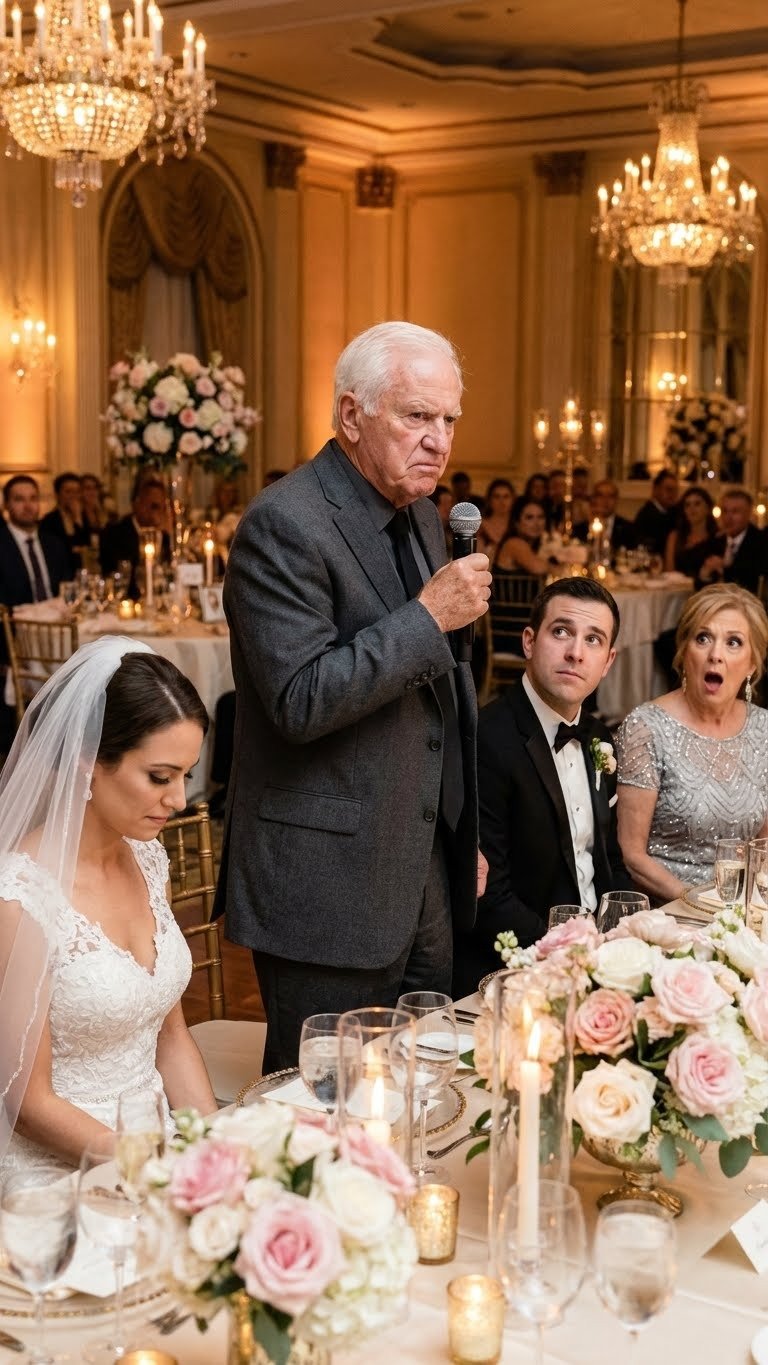
Robert took the microphone. His large hand, roughened by decades of gripping steering wheels and changing tires, closed around the cool metal. He cleared his throat.
“Good evening,” he began. His voice was not loud, but it was deep and resonant. It filled the cavernous room without effort. “I’m probably not as good at making beautiful, flowery toasts as some of the people here tonight. I don’t know much about mergers, and I certainly don’t know much about trusts.”
He paused, letting his eyes sweep over the silent crowd, finally resting on Eleanor.
“I’m a simple man. I’ve spent my life on the road, watching the white lines go by. But I love my daughter. And today, I want to say a few words.”
Eleanor rolled her eyes, checking her nails.
“Since this seems to be an evening for ‘clarifications’,” Robert continued, his voice hardening slightly, “an evening for speaking the brutal truth, then I will speak my truth, too.”
He looked at Anna. His eyes softened, brimming with a love so fierce it made the guests shift in their seats.
“My daughter, Anna, grew up in a simple family. We didn’t have luxury. We didn’t take vacations to the Alps. But she was always surrounded by love. I worked day and night, driving through blizzards and heatwaves, to give her everything I could. And I am proud—damn proud—of the woman she has become. Honest. Kind. Decent. Things that cannot be bought.”
He shifted his gaze to Leo. Leo finally looked up, meeting Robert’s eyes. In the older man’s gaze, Leo saw no judgment, only a challenge.
“Leo,” Robert said. “I’m glad you chose my daughter. I see that you love her. But love isn’t just smiling when things are easy. Love is standing up when things are hard.”
Eleanor scoffed audibly. “Oh, spare us the philosophy lesson.”
Robert ignored her completely. He turned back to the room, his presence growing larger, commanding the space not with money, but with the sheer weight of his integrity.
“Over the last twenty years, I’ve seen it all. Loneliness on the road. Breakdowns in the middle of nowhere. But I always knew they were waiting for me. That I had my Anna. And for her, I would do anything.”
The room was so quiet you could hear the hum of the air conditioning.
“So, here’s what I’m getting at. I haven’t made millions. I haven’t bought any condos in the sky where you look down on people. But I do have something. A house.”
He smiled, a genuine, warm smile that transformed his tired face.
“Not a palace, of course. But a home. My own. I built it with my own two hands. Stone by stone, board by board, on the weekends when I wasn’t driving. It might not have fancy moldings, Anna, and the floors aren’t Italian marble. But it’s warm. It’s cozy. And in that house, people are respected not for their bank account, but for who they are.”
He reached into his pocket and pulled out a set of keys. They were old, brass keys on a faded leather keychain.
“And this house,” he said, his voice ringing with conviction, “I am gifting to Anna and Leo. In its entirety.”
He looked directly at Eleanor.
“With no conditions. No prenups. No ‘trusts’ to hide behind. The deed is already transferred to Anna’s name. Let them live there. Let them love each other. Let them raise their children in a place where kindness matters more than status.”
A collective gasp went through the room, followed by a ripple of spontaneous applause. It started from Anna’s family, but then, surprisingly, the waitstaff joined in. Then the photographer. And finally, even some of Eleanor’s business partners, moved by the raw authenticity of the moment, began to clap.
Eleanor’s face went crimson. Her carefully constructed display of superiority had crumbled. She looked around, realizing she had lost the room. She pressed her lips into a thin, white line and turned away, trying to hide her utter mortification.
Leo walked over to Robert and Anna. He looked at his mother’s furious, red face, then at Robert’s dignified, tear-streaked one. It was as if he were waking from a long, deep sleep. The spell was broken.
He extended his hand to Robert.
“Thank you,” Leo said, his voice thick with emotion but steady. “Thank you for Anna, for the house, and for… for showing me what a real man looks like.”
Robert shook his hand firmly. “You be a real man, too, Leo. Be the master of your own house. Protect her.”
“I will,” Leo nodded. He turned to Anna. “Anna, let’s go.”
She blinked, wiping her tears. “Go where?”
“Home,” Leo replied, a smile breaking across his face—a real smile, free of burden. “To your—to our—home. I’ve had enough of this hypocrisy. I don’t want the condo. I don’t want the strings attached to it.”
A brilliant smile lit up Anna’s face. She grabbed her father’s hand one last time, then took Leo’s.
They walked toward Eleanor’s table. The entire room watched. Eleanor was trembling with rage.
Leo leaned down, his hands resting on the table, invading her personal space for the first time in his life.
“Mom,” he said quietly. “We’re leaving.”
Eleanor looked up, her eyes wet with angry tears. “You walk out that door, Leo, and you turn your back on everything I’ve built for you.”
“No, Mom,” Leo said softly. “I’m walking toward something I’m building for myself.”
He took Anna’s hand, and they turned their backs on the crystal chandeliers, the cold shrimp, and the colder woman. They walked out of the restaurant, leaving the stunned guests and the remnants of a lavish party behind.
The night air outside was cool and fresh. It smelled of rain and freedom. They got into Leo’s car—not the limousine Eleanor had hired, but his own car. As they drove away, the lights of the city faded behind them, replaced by the soft glow of the headlights on the road ahead.
They were heading to a modest house with creaky floorboards and a heart of gold. A house built by love. A home that was their true inheritance.
If you want more stories like this, or if you’d like to share your thoughts about what you would have done in Anna’s situation, I’d love to hear from you. Your perspective helps these stories reach more people, so don’t be shy about commenting or sharing.