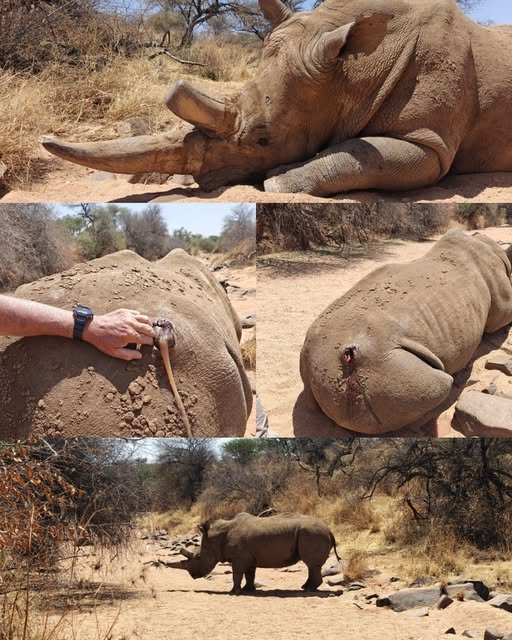
He stood alone on the dusty plain, a massive grey silhouette against the fading sun — an adult rhino bull in all his ancient, quiet power. At a distance, he looked perfect. Unbreakable. Almost carved out of stone. But as he shifted his weight, a strange swelling on his rear flank caught the eye of the monitoring team. A large, rounded lump, too smooth and too swollen to be natural, disturbed the otherwise seamless armor of his hide.
For days, the team watched him. At first, he behaved normally, grazing peacefully, walking steadily, lifting his head only when a breeze carried a new scent. But the lump continued to grow. And a rhino does not show weakness unless something serious is happening beneath the surface.
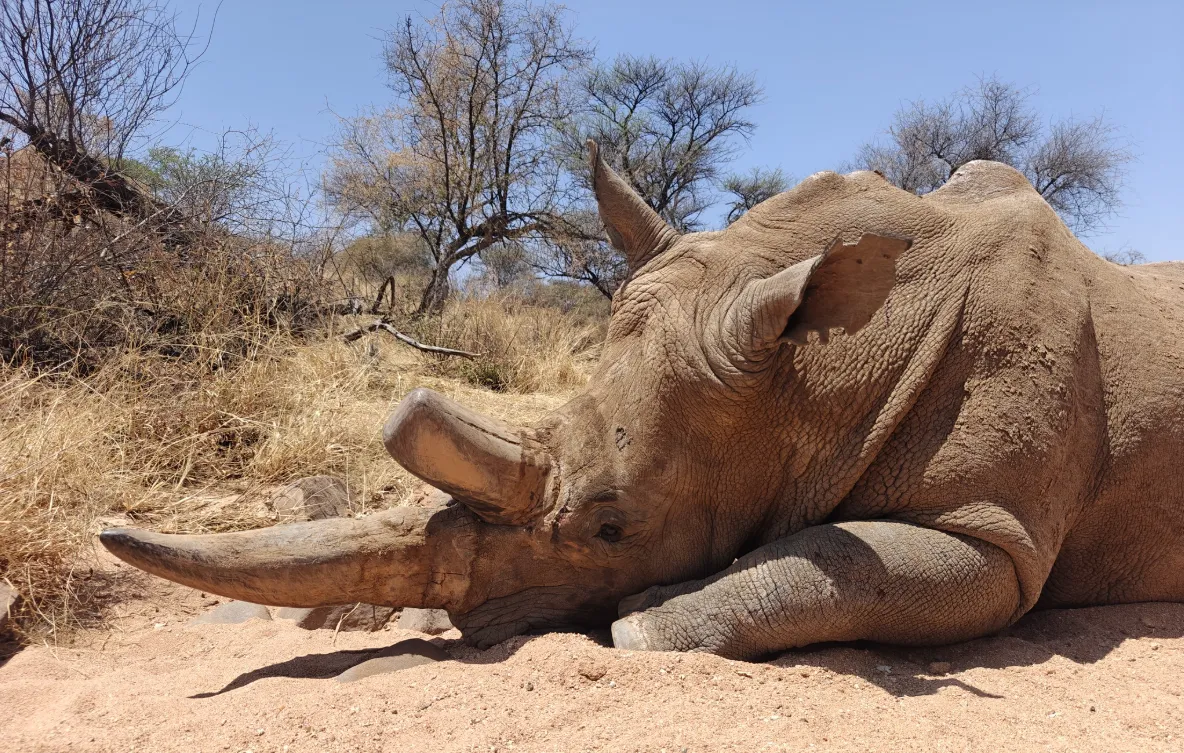
This bull had survived droughts, territorial fights, poachers’ snares, and the harsh laws of the wild. Yet now, silently and without complaint, he was battling something he couldn’t outcharge or outrun — an abscess festering beneath layers of his famously thick skin.
Rhino skin can reach up to five centimeters thick in places — nature’s shield, evolution’s armor, a living fortress meant to protect them from attackers. But that same strength can become a prison for infection. If bacteria slip in through a dart wound, a horn poke, a scratch, or any small injury, the thick skin can seal the infection inside. The body then fights back: white blood cells rush in, tissue breaks down, and a pocket of pus forms deep under the hide.
And that was exactly what was happening to him.
It was time to intervene.
Early the next morning, the veterinary team gathered. The air was still cool, the sun barely cresting the horizon, painting the savanna in gold. Birds called out across the landscape, unaware of the quiet urgency rising among the humans preparing the tranquilizer dart.
The rhino stood grazing peacefully when the helicopter approached. He looked up, ears twitching, but did not run. He had likely experienced darting before — perhaps for vaccination or a routine check — and he recognized the sound. A moment later, the dart struck his flank with a soft
thwip. He flinched but did not panic.
The team kept a respectful distance as the sedative began to take effect. Slowly, his legs softened. His breaths grew deeper, heavier. Finally, with a great exhale, he sank to the ground, guided gently by the team to avoid injury.
Even sedated, he was magnificent — a titan lying in the dust, the weight of his existence filling the air around him.
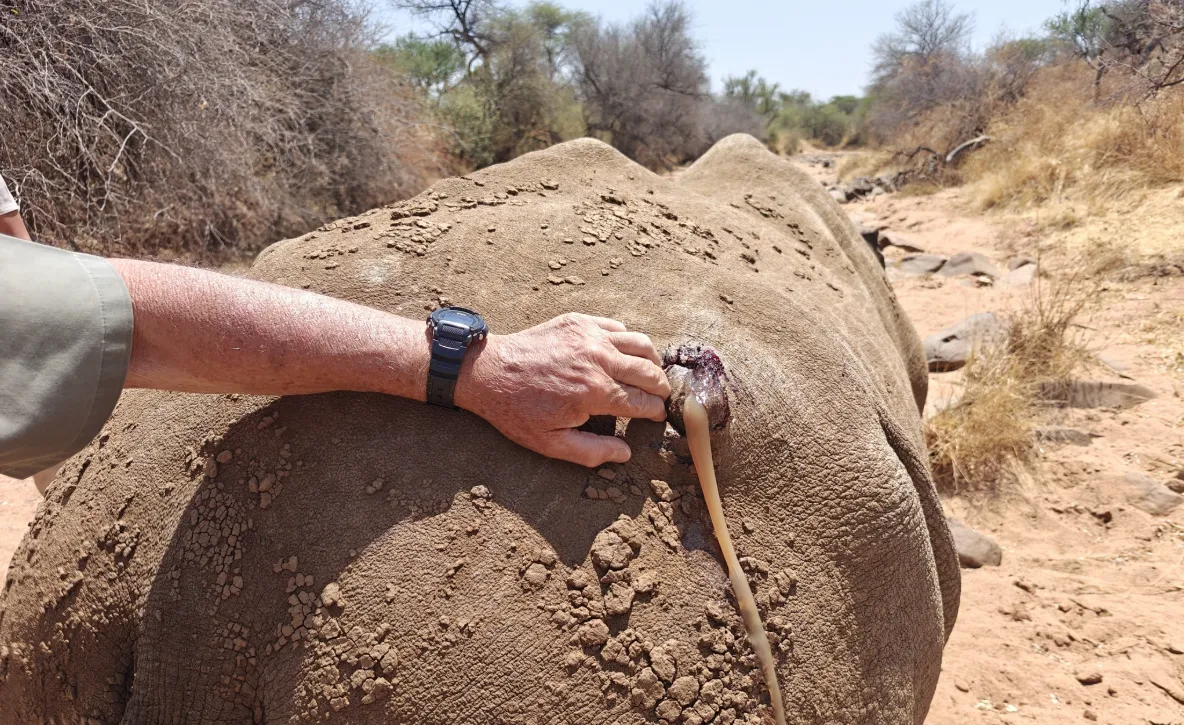
Only then did the team see the lump up close. It was enormous, stretched tight, warm to the touch. Something nasty lived inside it, and it had to come out.
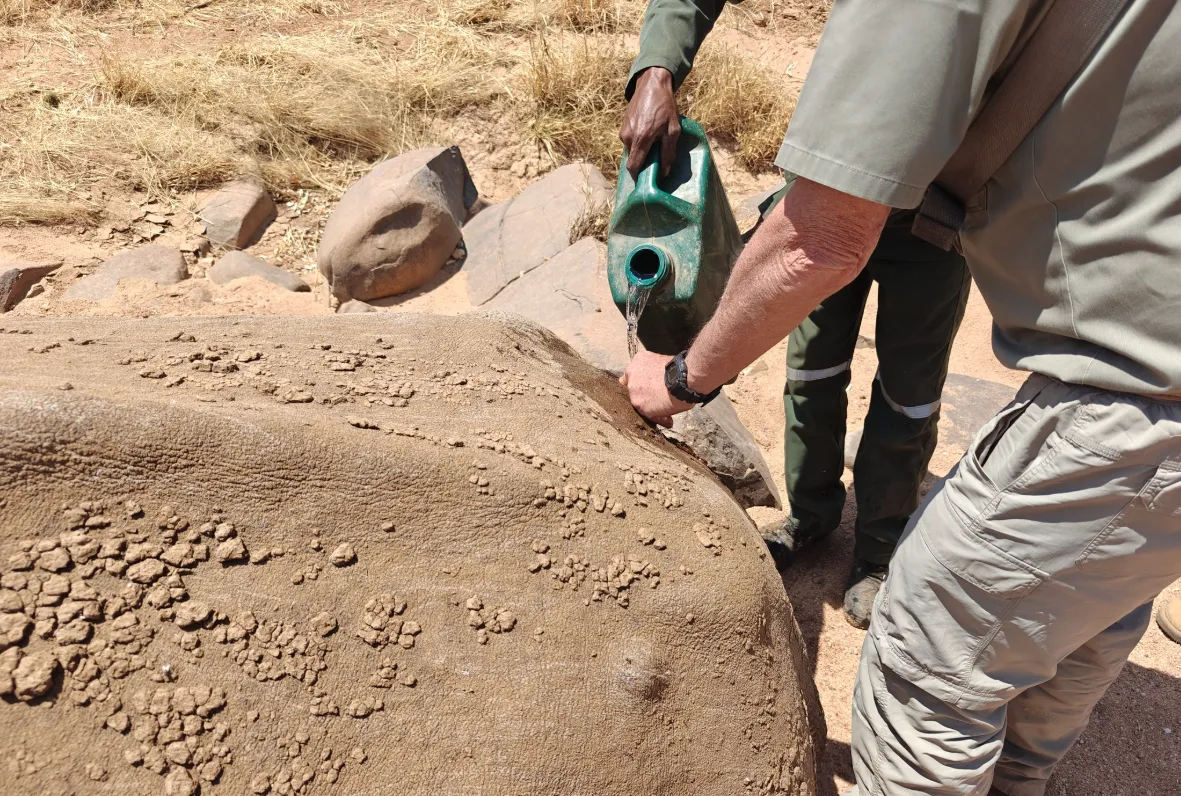
The veterinarian readied the scalpel. Everyone stepped back except the handler and the assisting vet. A single clean incision was made — and instantly, the pressure released.
What came out was thick, foul-smelling, and unmistakably infected: pus. A mix of bacteria, dead cells, fluid, and tissue debris the body had walled off in desperation. It poured out in slow, unpleasant waves, a sign of just how much his body had been carrying, fighting, and protecting itself from.
It was the kind of medical moment that is equal parts dramatic and deeply humbling: to see something so strong brought low by something so small.
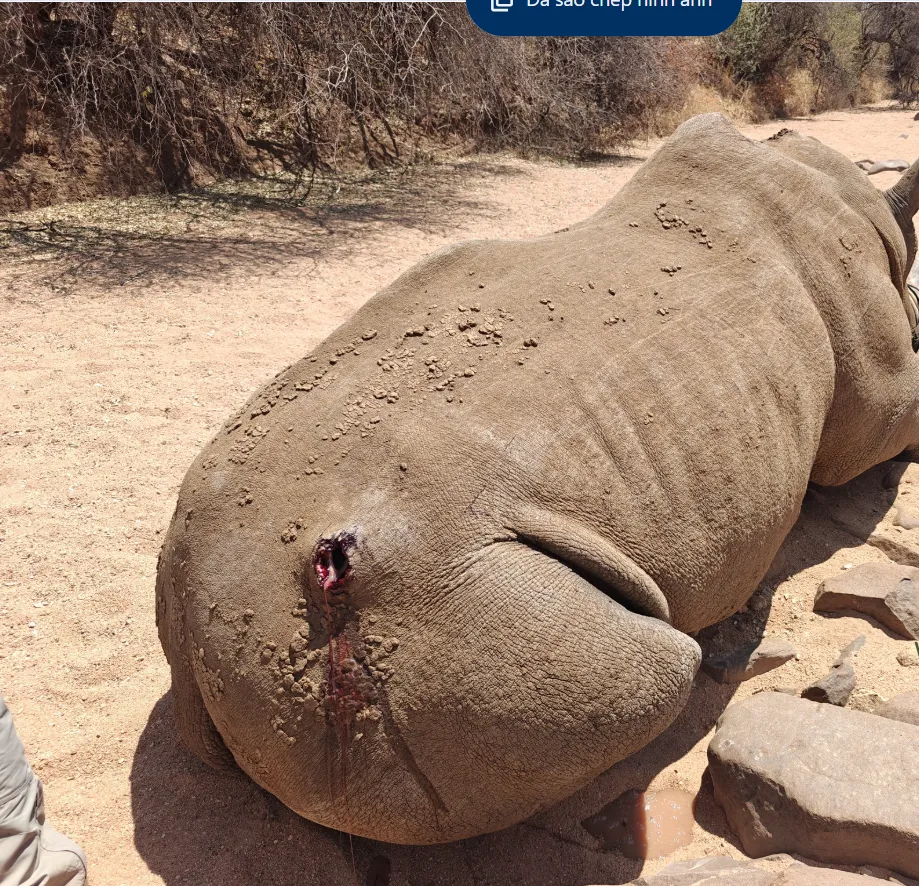
The abscess cavity was deep, deeper than anyone expected. Thick cords of tissue and old hardened pus clung inside, and the vet worked carefully to open, drain, and break loose anything that could continue to harbor infection. Assistants rinsed the wound repeatedly with sterile fluid, flushing out every hidden pocket. The smell was sharp. The sight was intense. But the work was lifesaving.
As the abscess emptied, the swelling finally began to soften. The pressure that had undoubtedly caused him pain, even though he never showed it, was gone.
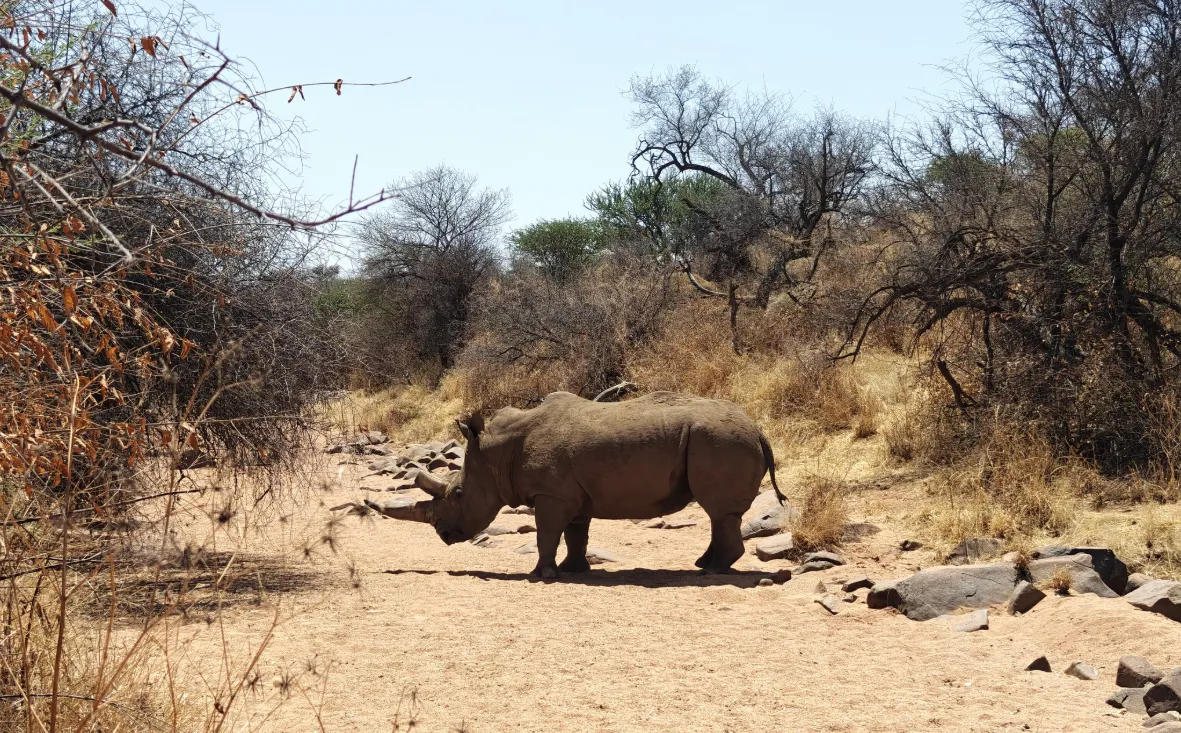
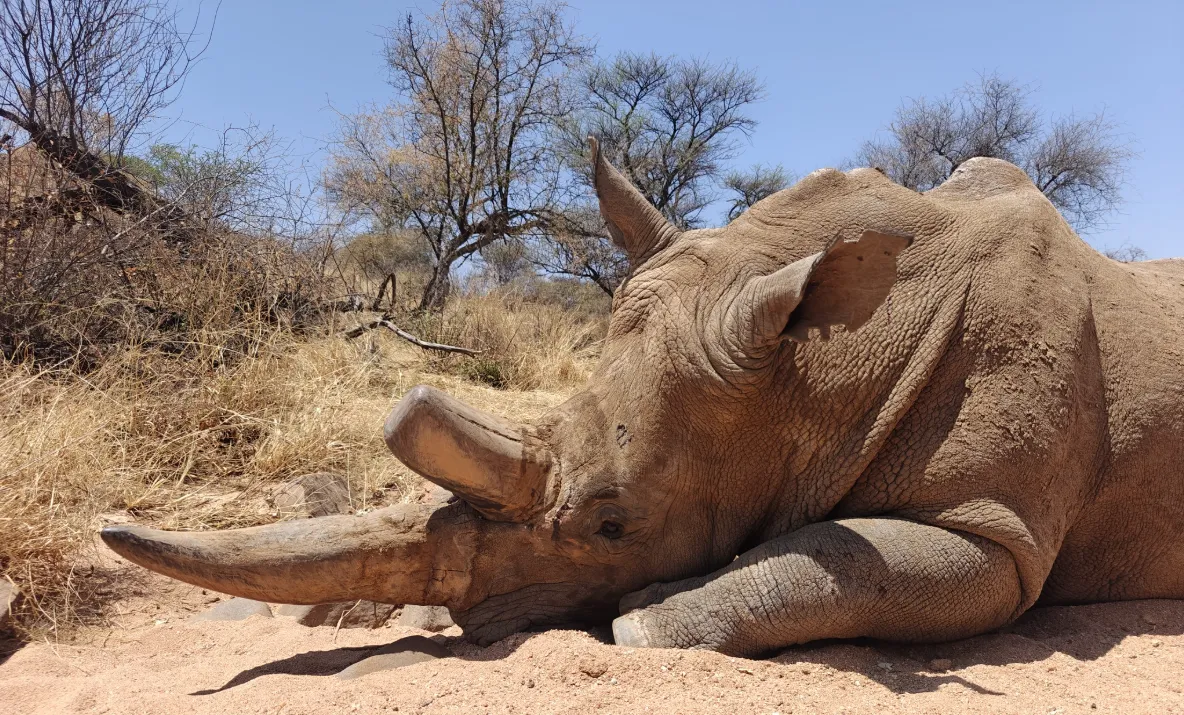
The vet administered long-acting antibiotics — powerful enough to keep fighting whatever bacteria remained. A topical antiseptic was applied. And finally, a protective spray sealed the cleaned wound.
For a long moment, everyone stepped back, simply taking in the sight of him — this massive, vulnerable creature lying peacefully under the care of hands that wanted nothing but to give him another chance at strength.
Rhinos may look invincible, but they are as fragile as any living thing. Their future in the wild depends on the constant, compassionate work of people who refuse to let nature’s giants fade away unnoticed.
The reversal drug was finally administered. Within minutes, his ears twitched. Then his tail flicked. His breaths grew faster as the sedation faded. With a grunt and a surge of sheer muscle, he pushed himself up onto his feet. Dust burst around him as he rose.
For a moment, he stood there, steadying himself, wobbling slightly. And then he took a deep, decisive breath — almost as if acknowledging his own relief — and walked off with the calm, confident stride of a healed titan reclaiming his place in the world.
No anger. No fear. Just quiet dignity.
The team watched him disappear among the acacias, the morning sun catching his silhouette one last time. They knew he would recover well. The worst was behind him.
In the vast African wild, where life is both brutal and breathtaking, this was a small victory — one rhino saved, one powerful life given another chance.
Perhaps he’ll never understand what happened that morning, or why a group of humans gathered around him with needles, rinses, and concern written in their eyes. But the land seemed to understand. The wind carried him forward. And somewhere in that immense, ancient world, a healed rhino bull now walked lighter, stronger, and free from the hidden pain he had carried in silence.
A reminder that even the strongest creatures sometimes need gentle hands — and that saving a life is always worth the effort.
Out of the Shadows: The Stray Who Saved Officer Reyes 217
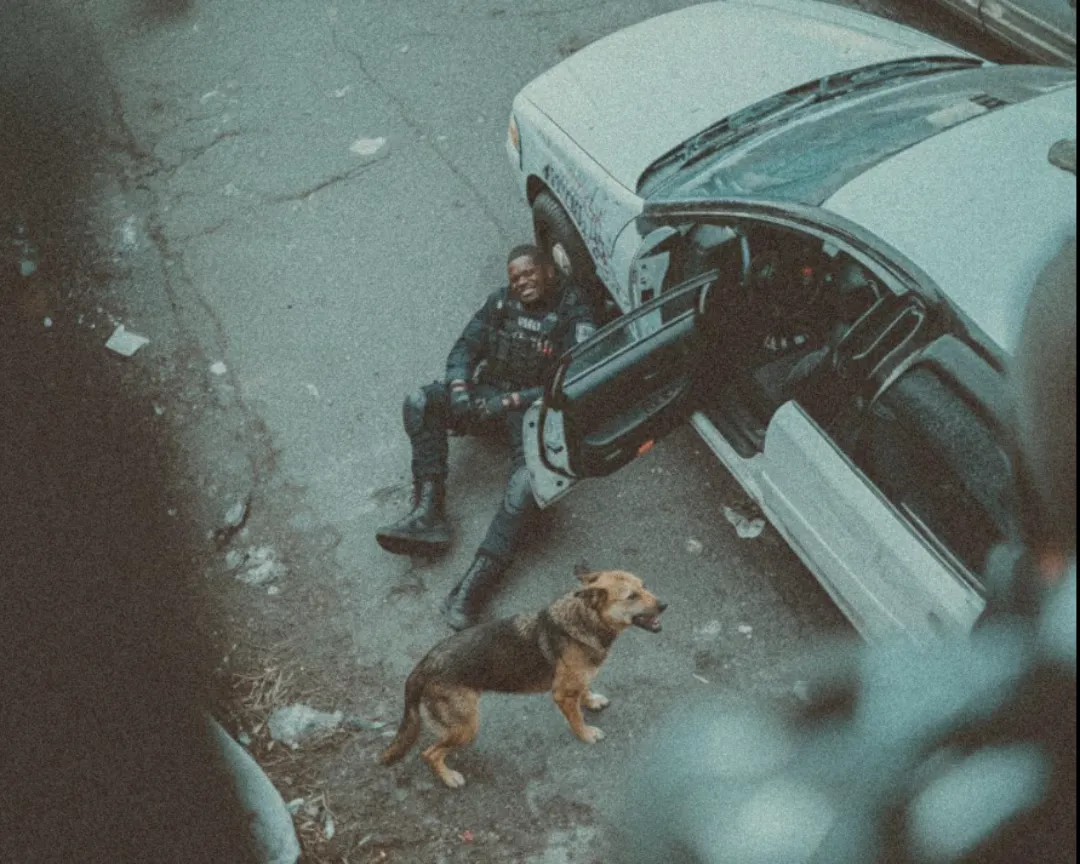
The streets of Monterrey, Mexico, were unusually quiet that evening. The sky hung heavy with the colors of dusk — violet clouds brushed with gold, and the city’s hum beginning to fade beneath the soft call of street vendors and the distant bark of dogs. Officer Daniel Reyes sat behind the wheel of his patrol car, one hand on the steering wheel, the other resting on the worn leather of his holster.
It was supposed to be a calm shift.
For ten years, Reyes had served his city faithfully — through late nights, high-speed chases, and countless moments of danger that blurred together. He’d seen a lot, but something in his gut told him this night would be different. Still, he pressed on, thinking only of his daughter’s laughter waiting for him at home.
When he spotted a dark sedan swerving across the lane, he turned on his lights and pulled the car over near an old apartment building. He parked behind it, stepped out of the cruiser, and called out to the driver. What happened next unfolded in seconds — so fast that even the witnesses later struggled to recall it clearly.
As soon as Reyes approached the vehicle, gunfire exploded into the night.
The first bullet whistled past him, striking the pavement. He ducked, drawing his weapon, but another shot hit him — a hot, burning pain tearing through his shoulder. He fell backward, hitting the ground hard, the world spinning. The air was filled with the acrid scent of gunpowder and the echo of screams from nearby windows.
Blood pooled beneath him. His hand trembled as he tried to reach for his radio. He could hear the shooter’s footsteps approaching — steady, deliberate. The gunman was coming closer, stepping around the front of the cruiser. Reyes tried to move, but his strength was fading.
And then, from the shadows — came a miracle.
A stray dog, thin and scruffy, with patchy brown fur and eyes that told stories of hunger and hardship, appeared from behind a trash bin. No one knew where he had come from. He was one of hundreds of stray dogs that roamed the city, scavenging for scraps and warmth. But in that moment, something in the chaos called to him.
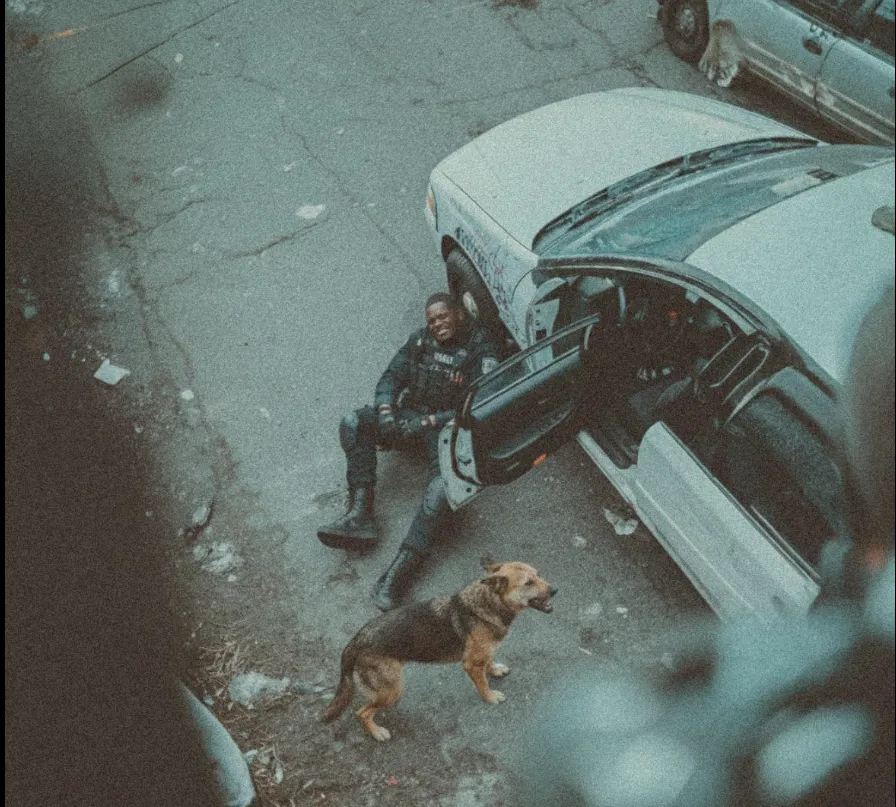
He saw the man on the ground. He saw the other man with a gun. He saw danger — and he didn’t hesitate.
As the gunman rounded the cruiser, raising his weapon to finish the job, the stray lunged. With a snarl that tore through the air, he sank his teeth into the attacker’s arm. The man cried out in shock, stumbling backward as the gun fired once more, the bullet ricocheting harmlessly off the cruiser’s hood. The dog held on with every ounce of strength his frail body could muster, growling, pulling, refusing to let go.
Startled and bleeding, the gunman kicked free and fled down the street, disappearing into the night.
For a moment, all was silent except for the dog’s heavy panting and the faint sound of sirens in the distance. The stray turned toward the fallen officer, sniffed his bloodied hand, and lay down beside him. He didn’t leave. He didn’t run. He simply stayed there, watching over him until help arrived.
By the time backup reached the scene, the suspect was gone, and the stray was still standing guard. When paramedics tried to lift Reyes onto a stretcher, the dog growled, stepping protectively between them. It was only when Reyes weakly whispered, “It’s okay, amigo,” that the dog backed down, tail lowered but eyes still fixed on his human.
Reyes was rushed to the hospital. He spent several days there, recovering from surgery. The bullet had missed his heart by inches. His fellow officers visited often, bringing him updates — and one of them mentioned the dog.
“He’s at the shelter,” one officer said. “Wouldn’t leave your cruiser. We had to carry him out. Poor thing’s covered in scars — looks like he’s been through a lot.”
Reyes closed his eyes. He remembered the moment — the growl, the teeth, the sudden rush of hope when all had seemed lost. He smiled weakly. “He saved my life,” he murmured.
When he was finally discharged, the first place he went wasn’t home — it was the animal shelter. Rows of cages lined the walls, filled with barks and whimpers. But one cage was quiet. Inside, lying on a threadbare blanket, was the same brown dog. His ears perked up the instant he saw Reyes.
The officer knelt. “Hey, buddy,” he said softly. The dog’s tail thumped once, uncertainly. Reyes reached through the bars and stroked his fur. “You were brave out there,” he whispered. “Braver than most men I’ve known.”
The shelter worker smiled. “He’s been waiting for you. Wouldn’t let anyone else near him.”
That day, Reyes signed the adoption papers. He carried the dog out into the sunlight, holding him close despite the stitches still pulling at his shoulder.
“I’m calling you Valor,” he said, running a hand through the dog’s rough fur. “Because that’s what you are — pure courage.”
Months passed. Reyes returned to duty, his story spreading throughout the department and beyond. Newspapers called it “A Miracle on the Streets of Monterrey.” Some said the dog had been heaven-sent; others said it was instinct. But Reyes didn’t care for explanations. Every evening, he came home to the sound of paws on the floor and a wagging tail.
Valor now had a collar, a warm bed, and a badge-shaped tag engraved with his name. He rode with Reyes on some patrols, sitting proudly in the passenger seat, watching the city that had once forgotten him.
Sometimes, when Reyes looked at him, he thought about that night — the cold street, the flash of gunfire, and the moment a stray chose to fight for a stranger.
It reminded him of something he’d always believed but had nearly forgotten:
That courage doesn’t always come from strength.
That heroes aren’t always born — sometimes, they’re found in the unlikeliest places.
And sometimes, they walk on four legs.