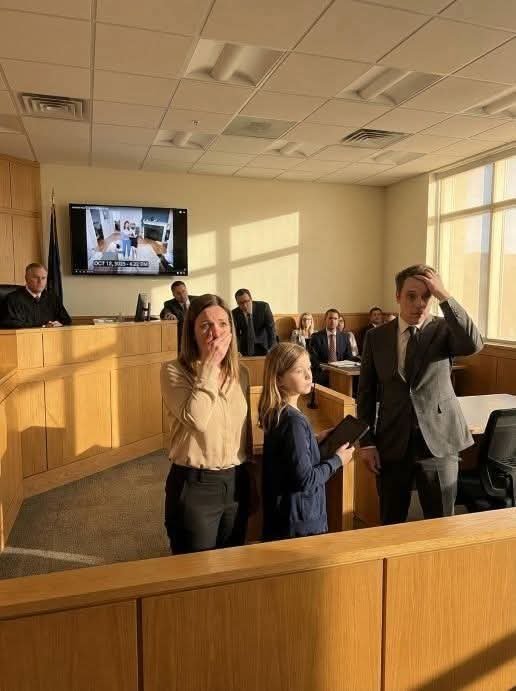
The atmosphere in the family court was thick with a sterile tension, the air smelling of old paper and quiet despair. For months, I had endured a narrative being crafted that painted me as the unstable element, the emotional parent unfit for the primary custody my husband, Caleb, sought. I listened as our life together was reduced to legal arguments, my character dissected in polite, devastating terms. Beside me, our ten-year-old daughter, Harper, was a statue of solemnity, her small frame nearly swallowed by the wooden chair, her eyes fixed on nothing. When the judge offered a final opportunity for statements, I had nothing left to say. But Harper did. She stood, her voice a fragile thread in the heavy quiet, and asked the judge if she could show something I didn’t know about.
The permission was granted, and she handed over a tablet. What unfolded next was not just evidence; it was a window into a hidden world within our home. The video, time-stamped in the dead of night, showed our kitchen. But it was not the peaceful place I remembered. Caleb’s voice, sharp and full of a venom I had never heard directed at her, filled the room. He was berating Harper, silencing her tears, placing the weight of his own frustrations on her small shoulders. The threat was implicit and chilling: don’t tell your mother, or you’ll ruin everything. The video ended with the sound of breaking glass, a punctuation mark to a moment of terror I had slept through. The courtroom’s collective gasp was a physical force.
In that instant, the carefully constructed case Caleb had built shattered as completely as the glass in the video. The judge’s demeanor shifted from procedural neutrality to grave concern. He asked me directly if I had known, and my horrified, tearful denial was its own testament. When he turned to Caleb, there were no more arguments left to make. The truth, raw and undeniable, spoken in our daughter’s frightened whimper and her father’s cold anger, had rendered all other narratives meaningless. The facade of the calm, responsible parent evaporated, leaving a stark reality the court could not ignore.
The final ruling, delivered later, reflected this new understanding. Custody was secured with me, with provisions for Harper’s safety and mandated steps for Caleb. But the real verdict had already been delivered in that silent courtroom. As we left, Harper finally reached for my hand, her voice laced with a guilt she should never have carried. She whispered an apology for not telling me sooner. I knelt on the sun-warmed steps, looked into her eyes, and made sure she understood. Her act was not betrayal; it was an astonishing act of self-preservation. She had documented her truth because she feared even her own memory might fail her.
That day, Harper taught me more about bravery and truth than a lifetime had before. It was a painful lesson that the most profound realities can live in the silence of a child, and that the quest for a perfect family is far less important than the fight for a safe one. Her small voice, trembling but clear, did more than change a legal outcome. It broke a spell of fear and redefined our future, proving that the purest form of courage often speaks in a whisper.