Introduction: The Hidden Theatre of Presidential Handovers
Every four years, the United States partakes in what political scientists fondly call the “peaceful transfer of power.” It is a grand, sweeping phrase meant to evoke images of marble pillars, soaring rhetoric, and a stable democracy. But behind the majestic public facade lies a deeply human, often excruciatingly awkward reality.
Power in Washington D.C. is not just transferred via ballots and oaths; it is handed over in the cramped, armored confines of official limousines.
For decades, the traditional ride down Pennsylvania Avenue from the White House to the United States Capitol has served as a visual truce. Outgoing and incoming leaders—often bitter rivals who spent months trading insults on the campaign trail—are expected to sit shoulder-to-shoulder, smile for the cameras, and make polite small talk for the sake of the republic.
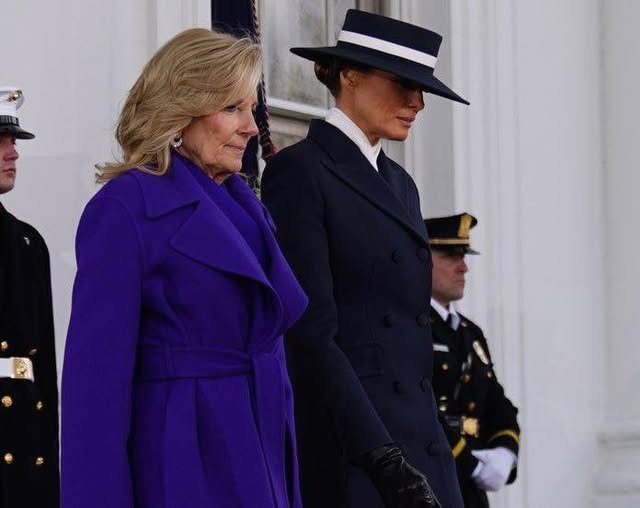
But on Inauguration Day 2025, inside the vehicle carrying the outgoing and incoming First Ladies, the truce didn’t just fracture—it froze over completely.
Thanks to explosive revelations in Jill Biden’s new memoir, “A View from the East Wing,” the public has been granted an unprecedented, fly-on-the-wall look into one of the most painfully tense encounters in modern political history. The ride shared by Jill Biden and Melania Trump was not just a clash of two distinct personalities; it was a microcosm of a deeply polarized nation, where accountability collided head-on with a sense of untouchable entitlement.
1. Anatomy of an Awkward Ride: The Limo That Transformed into an Icebox
The Setup and the Human Buffer
According to Jill Biden’s account, the tension between the two women was so palpable following the traditional pre-inauguration tea at the White House that the inaugural committee panicked. They knew that putting Jill and Melania alone in the back of an armored car would be a recipe for disaster.
To avert a total diplomatic meltdown, organizers recruited an unlikely hero: John Bessler, an attorney and the husband of Minnesota Senator Amy Klobuchar. Placed squarely in the middle seat, Bessler’s job description was simple yet terrifying: Be the human buffer.
The “NYU” Wall of Silence
What followed was a masterclass in passive-aggressive resistance. Bessler, deploying the ultimate Midwestern defense mechanism, attempted to break the ice with gentle, non-partisan small talk. He leaned toward Melania Trump and asked a benign question about how her son, Barron, was adjusting to his studies at New York University (NYU).
The response? Melania didn’t turn her head. She didn’t smile. She simply stared out the bulletproof window at the crowds lining Pennsylvania Avenue and uttered a single, chilly word:
“NYU.”
Every subsequent attempt by Bessler or Jill Biden to pivot to safe, universally accepted topics—the crisp winter weather, the logistics of the upcoming ceremony, the beauty of the historic route—died a swift death in the heavy, silent air of the vehicle. While Joe Biden and Donald Trump were reportedly engaging in conversation in the presidential limousine ahead of them, the First Ladies’ car was an absolute vacuum of civility.
2. The Root of the Rage: The Mar-a-Lago Raid and the Underwear Drawer
To understand why Melania Trump was, as Jill Biden described, “stone-faced” and visibly seething, one must look back at the events that fundamentally altered the Trump family’s relationship with federal law enforcement: the FBI search of their Mar-a-Lago estate.
The Search for National Secrets
In August 2022, federal agents executed a search warrant at Donald Trump’s Florida residence to recover a massive hoard of classified national defense documents—including sensitive materials regarding nuclear capabilities and military vulnerabilities—that had been improperly removed from the White House.
While the media focused on boxes stacked in ballrooms and bathrooms, Melania Trump took the search deeply personally. Her private quarters, including her bedroom and personal closets, were searched by federal agents executing the lawful warrant.
Jill Biden’s Attempted Solidarity
In her memoir, Jill Biden reveals that she actually tried to extend an olive branch during their interactions by tapping into a highly unique shared experience. As First Lady, Jill had also experienced the indignity of having her personal property searched by federal investigators during a separate probe into misplaced documents.
Jill writes that she genuinely understood how distressing it was to have law enforcement officers “rummage through your underwear drawer.” It was an attempt at raw, woman-to-woman empathy—an acknowledgment that regardless of politics, having your sanctuary breached is deeply unsettling.
The Personalization of Law Enforcement
But Melania Trump, according to Jill, completely rejected the gesture. In Melania’s worldview, the search wasn’t the result of a legal process, a grand jury, or her husband’s repeated refusal to return classified government property to the National Archives. Instead, she viewed it as a direct, weaponized hit ordered personally by Joe Biden.
3. A History of Broken Norms: The 2021 vs. 2025 Transitions
The icy limo ride of 2025 was not an isolated incident; rather, it was the culmination of a four-year pattern of shattered traditions and institutional disdain. To truly appreciate the gravity of the situation, we must look at how the transition of power has historically been handled by First Ladies, and how Melania Trump systematically rewrote the rulebook.
The 2021 Snub
When Donald Trump lost the 2020 election, the transition was famously chaotic, culminating in the events of January 6th. Subtly backing her husband’s election-denial narrative, Melania Trump chose to completely skip the traditional White House welcoming tea for Jill Biden. This broke a gracious chain of hospitality that had survived decades of intense political warfare—including the bitter 2000 Bush-Gore recount and the deeply personal 2016 race.
The 2025 Asymmetry
Fast forward four years. When the political tables turned, Jill Biden chose to uphold the dignity of the office. She extended the traditional invitation to Melania Trump, welcoming her back to the East Wing.
Yet, as Jill notes with sharp disappointment in “A View from the East Wing,” the grace was entirely one-sided. Melania accepted the hospitality but refused to offer any reciprocal warmth or assure a smooth cultural transition for the East Wing staff.
Jill Biden Describes ‘Frosty’ Inaugural Limo Ride With Melania Trump
4. The Two Worlds of the East Wing: Contrast in Philosophy
The friction between Jill Biden and Melania Trump highlights a profound ideological divide regarding what the role of the First Lady should be in American civic life.
Jill Biden: The Institutionalist
Jill Biden approached the role through the lens of institutional duty and community service. As a lifelong educator who continued teaching English at a community college while serving as First Lady, Jill viewed the East Wing as a platform for public service, military family support, and cancer research advocacy. To her, the traditions of the White House were sacred threads that held a fragile democracy together. Showing up, even when it was difficult or uncomfortable, was non-negotiable.
Melania Trump: The Enigmatic Outsider
Conversely, Melania Trump viewed the First Lady’s role through a lens of personal privacy, curated branding, and transactional loyalty. Often detached from the day-to-day political machine of Washington, Melania used her platform selectively. When she felt aggrieved—whether by the media or federal investigators—she withdrew completely behind a wall of absolute silence and defiance. For Melania, institutional norms were secondary to personal and familial loyalty. If the system did not favor her family, she felt no obligation to respect its theatrical traditions.
5. Entitlement vs. Accountability: The Broader Political Stakes
Beyond the delicious, high-society gossip of a frozen limousine ride, Jill Biden’s anecdote carries profound implications for the state of American democracy. It exposes the psychological rift over a fundamental American principle: that no one is above the law.
The Echo Chamber of Grievance
For years, Donald Trump has signaled to his base that his legal troubles—including indictments and federal searches—were not the result of his own actions, but were rather a “witch hunt” orchestrated by his political opponents.
What Jill Biden’s memoir beautifully illustrates is that this narrative isn’t just a political talking point used to raise campaign funds; it is an foundational belief system within the Trump household. Melania Trump’s refusal to engage in basic human civility in that limousine shows a deep internalization of this grievance. She wasn’t just angry at an invasion of privacy; she was furious that the shield of presidential immunity and exceptionalism had been breached.
The Contrast of the Underwear Drawer
The contrast Jill Biden draws is masterful. Both women had federal agents go through their private belongings.
Jill Biden accepted it as a painful but necessary consequence of a system designed to ensure accountability at the highest levels of government.
Melania Trump viewed it as a declaration of war.
This collision between accepting accountability and demanding total immunity is the defining struggle of modern American politics.
Conclusion: The Silent Portrait of an Era
Years from now, when historians write the definitive chapters on this tumultuous era of American history, they will look past the dry court filings, the political rallies, and the talking heads on cable news. Instead, they will likely point to the image captured in Jill Biden’s memoir: Two powerful women sitting in the back of an armored limousine, separated by a bewildered Midwestern lawyer and an ocean of ideological silence.
It is a haunting portrait of a divided nation. On one side sits a First Lady desperately trying to keep the fragile gears of democratic tradition turning through basic politeness and empathy. On the other side sits a First Lady staring fixedly out the window, cloaked in an icy silence, entirely convinced that the rules governing ordinary citizens should never apply to her.
Ultimately, the ride down Pennsylvania Avenue ended, the door opened, and the public ceremony commenced. But as “A View from the East Wing” reminds us, the truest indicators of a nation’s health are often found not in the speeches delivered to millions, but in the chilly, unspoken truths whispered—or withheld—in the quiet dark of a moving car.