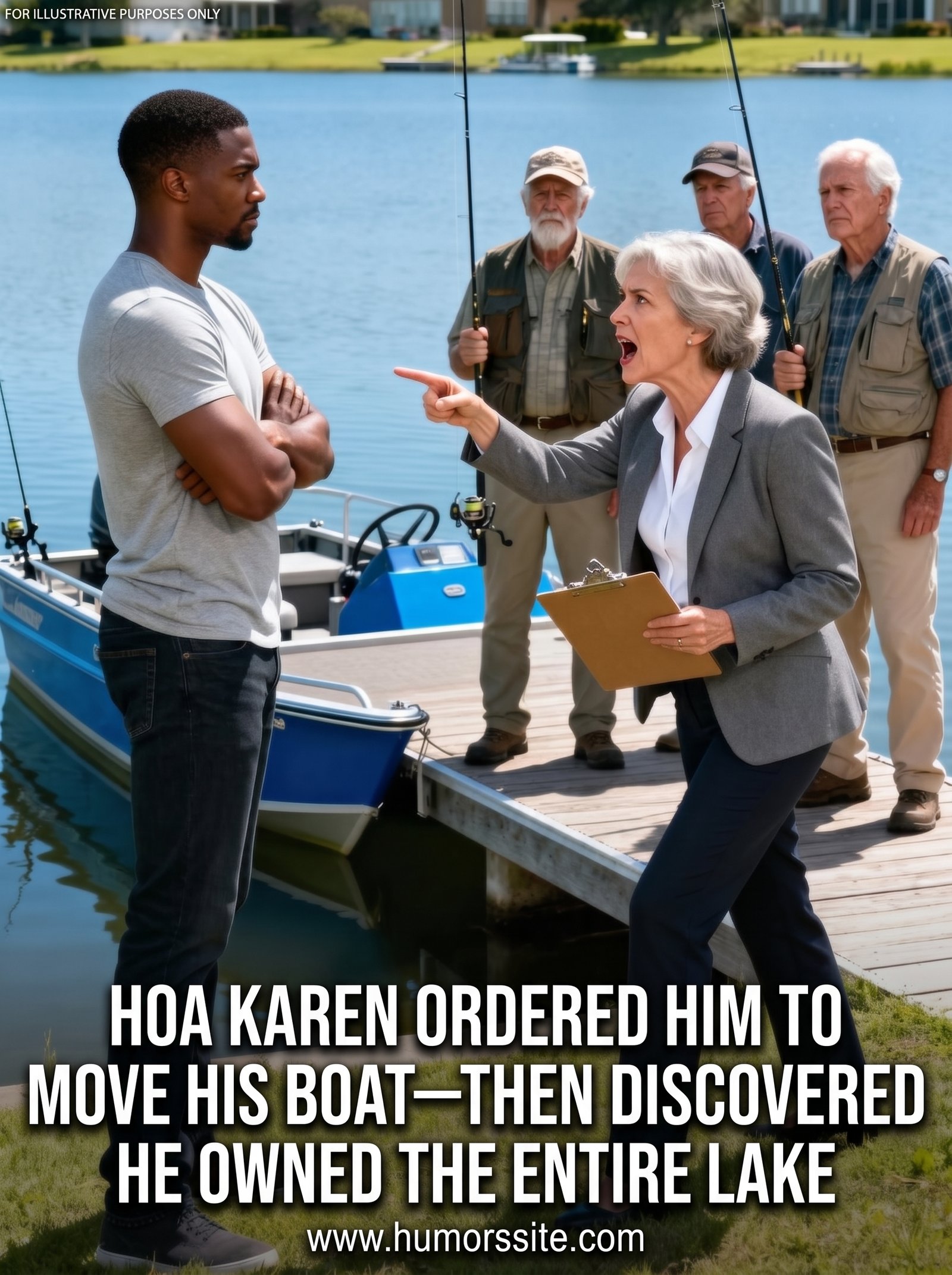
HOA KAREN ORDERED HIM TO MOVE HIS BOAT—THEN DISCOVERED HE OWNED THE ENTIRE LAKE
PART 1 — THE LETTER
Daniel Whitaker had lived in Brookside Estates for less than a year.
He wasn’t the type to attend neighborhood meetings or argue over trash-can placement. He worked from home, kept his circle small, and spent most mornings on the water.
The lake behind his property was his escape.
His twenty-two-foot pontoon boat sat at the dock beside his house, usually stocked with fishing gear, a cooler, and two folding chairs.
Then Carol Jennings arrived.
She was the president of the Brookside Estates Homeowners Association and had developed a reputation for treating the HOA bylaws like federal law.
She stood at Daniel’s front door with a clipboard tucked against her chest.
“Mr. Whitaker, we’ve received several complaints.”
Daniel glanced at the clipboard.
“About?”
“Your boat.”
He looked toward the lake.
“My boat?”
“Yes. It’s visible from several homes.”
Daniel almost smiled.
“It’s a lake.”
Carol didn’t appreciate the joke.
“The community regulations require watercraft to be stored out of sight.”
Daniel folded his arms.
“Who owns the dock?”
“The HOA maintains the waterfront.”
“That’s not what I asked.”
Carol’s expression hardened.
“The association manages the community.”
“That wasn’t my question either.”
She sighed.
“Mr. Whitaker, don’t make this difficult.”
Daniel thanked her and closed the door.
Then he walked into his office and opened a locked drawer.
Inside was a thick folder.
The first page contained the deed.
The second contained a survey.
The third contained something Carol had never bothered to investigate.
Lake Brookside — Private Property
Daniel owned the lake.
Not merely his waterfront lot.
The entire lake.
The fishing rights.
The submerged land.
The docks.
The boat slips.
Even the access easement.
He had purchased the property six months before moving into Brookside Estates from an investment company that had acquired the lake decades earlier.
The developer had sold the houses.
But it had never sold the water.
Daniel knew the truth.
The HOA didn’t.
And he intended to let them keep believing they were in charge.
For now.
PART 2 — THE FISHING CLUB
Three days later, Daniel found six fishing boats on the lake.
He recognized several of the men.
They belonged to the Brookside Estates Fishing Club.
The club had apparently been using the lake for years.
Daniel walked down to the dock.
An elderly man named Frank waved.
“Morning, Daniel! You joining us?”
“No.”
Frank laughed.
“You’re missing the best part. Carol’s got the annual fishing tournament coming up.”
Daniel looked at him.
“Annual?”
“Every summer.”
“Who gives permission?”
Frank pointed toward the clubhouse.
“The HOA.”
Daniel nodded slowly.
“Interesting.”
That afternoon, Daniel contacted his attorney, Melissa Grant.
She arrived the next morning carrying three folders.
“I reviewed everything,” she said.
“And?”
“You’re right.”
Daniel leaned back.
“The HOA has no ownership interest in the lake.”
“None?”
“None.”
“What about their fishing club?”
Melissa opened a folder.
“Even worse.”
She handed him several photographs.
The fishing club had installed unauthorized structures along the shoreline.
Benches.
Storage boxes.
Fishing platforms.
Electrical hookups.
One structure even had a permanent foundation.
Daniel stared at the photographs.
“Did they get permits?”
Melissa shook her head.
“No.”
Then she showed him something else.
An environmental inspection report.
The fishing club had been dumping bait containers and fishing waste into the water.
And there was evidence of fuel leakage near one of the unofficial docks.
Daniel looked toward the lake.
Suddenly, this wasn’t about a boat anymore.
The HOA had spent years treating his property as if it belonged to them.
Worse, they had been damaging it.
“Can I remove everything?”
“Legally, yes.”
Daniel smiled.
“Not yet.”
Melissa raised an eyebrow.
“What are you planning?”
“I’m going to give them one opportunity to leave peacefully.”
That evening, Daniel drafted a letter.
It was polite.
Professional.
And devastating.
He informed the HOA that the lake was privately owned.
He attached a copy of the deed.
He requested that all unauthorized fishing, construction, and commercial activity cease immediately.
He also asked them to remove their structures within fourteen days.
The following morning, Carol called him.
She was furious.
“You cannot do this.”
Daniel calmly replied:
“I already did.”
She threatened legal action.
Daniel thanked her.
Then he hung up.
What Carol didn’t know was that her next meeting was about to become the most embarrassing night in Brookside Estates history.
PART 3 — THE HOA MEETING
The clubhouse was packed.
Nearly seventy residents showed up.
Carol stood at the front beside a projector screen.
“This is an attack on our community,” she announced.
Several residents applauded.
Daniel sat quietly in the back.
Carol pointed toward him.
“Mr. Whitaker claims he owns the lake.”
A man shouted:
“That’s ridiculous!”
Another yelled:
“We’ve been fishing there for twenty years!”
Carol smiled confidently.
“Exactly.”
She turned toward Daniel.
“Would you like to explain yourself?”
Daniel stood.
“I’d rather let the documents explain.”
He connected his laptop to the projector.
The first document appeared.
The deed.
Then the property survey.
Then the original development plans from 1987.
The room became quiet.
Daniel zoomed in on one paragraph.
Lake Brookside and all associated submerged lands shall remain privately held and shall not become part of the homeowners’ association common property.
Someone whispered:
“That’s impossible.”
Daniel continued.
“The developer retained ownership.”
He displayed another document.
A purchase agreement.
His name appeared at the bottom.
“I purchased the lake last year.”
Carol’s face went pale.
“That document could be fake.”
Melissa, Daniel’s attorney, stood.
“It isn’t.”
She placed certified copies on the table.
“These were recorded with the county.”
The room erupted.
One resident shouted:
“Then why did the HOA charge us fishing fees?”
Everyone turned toward Carol.
She froze.
Daniel looked at her.
“That’s a good question.”
Carol tried to explain.
“The money goes toward community activities.”
“How much?”
She said nothing.
Daniel displayed another spreadsheet.
Fishing Club Revenue — $86,400 over five years.
Gasps filled the room.
“Where did that money go?”
Carol looked toward the HOA treasurer.
He suddenly stood.
“I’m done.”
He walked out.
Then another board member followed.
Then another.
Carol was left standing alone.
But Daniel wasn’t finished.
He displayed photographs of the unauthorized docks.
“These were built without permission.”
A resident raised her hand.
“My husband built one of those.”
“Then he built it on my property.”
Silence.
Daniel closed his laptop.
“I’m not interested in humiliating anyone. I want the lake protected.”
Carol glared at him.
“You think you’ve won?”
Daniel smiled.
“No.”
He looked around the room.
“I think we’ve finally started.”
The next morning, Daniel received a certified letter.
It wasn’t from the HOA.
It was from a law firm representing the original developer.
The letter contained a startling claim:
Someone had been trying to sell the lake again.
And they had used Daniel’s property records to do it.
PART 4 — THE REAL SCHEME
Daniel met with Melissa immediately.
“Who tried to sell it?”
“That’s what we’re investigating.”
The answer came two days later.
The HOA’s attorney had secretly formed a company called Brookside Waterfront Holdings LLC.
The company had been created eighteen months earlier.
Before Daniel purchased the lake.
The purpose?
To convince residents that the HOA controlled the waterfront.
Then the company planned to negotiate a private sale to a luxury development group.
The plan was simple.
Build a private marina.
Add expensive waterfront homes.
Charge existing residents for access.
And make millions.
But there was a problem.
They didn’t own the lake.
Daniel did.
The HOA had been trying to sell property that wasn’t theirs.
Daniel took the evidence to the county authorities.
The investigation expanded quickly.
Bank records showed payments between the development company and two former HOA board members.
Then came the biggest discovery.
The original HOA president had known the lake wasn’t community property.
She had hidden that information from residents for nearly a decade.
Carol had inherited the presidency from her.
She had simply continued the arrangement.
When investigators confronted Carol, she insisted she knew nothing about the proposed sale.
But her signature appeared on three documents.
She couldn’t explain them.
Within weeks, the HOA board collapsed.
The fishing club dissolved.
The unauthorized docks were removed.
And the county ordered a complete environmental inspection of the lake.
The inspection found several violations.
Fuel contamination.
Improper waste disposal.
Unapproved electrical wiring.
And damage to the shoreline.
Daniel could have demanded enormous penalties.
Instead, he offered the residents something unexpected.
A compromise.
He created a nonprofit lake association.
Residents could fish.
Families could use the shoreline.
Children could kayak.
But everything would operate under clear rules.
No private construction.
No dumping.
No commercial activity.
No favoritism.
And most importantly:
Nobody would ever again be allowed to pretend they owned what they didn’t.
There was only one person who refused to accept the arrangement.
Carol.
She filed a lawsuit against Daniel.
Her claim was that decades of community use had created an implied right to the lake.
Daniel’s attorney laughed when she read it.
But Daniel didn’t.
He knew exactly what Carol was trying to accomplish.
If she could establish a public right, she could destroy the lake’s private value.
So Daniel agreed to take the case to court.
And on the day of the hearing, something unexpected happened.
An elderly man walked into the courtroom carrying a battered leather briefcase.
He introduced himself as the retired attorney who had represented the original developer.
Then he placed an old document on the judge’s desk.
“I’ve been waiting thirty years for someone to ask for this.”
PART 5 — THE DOCUMENT
The courtroom became silent.
The retired attorney opened his briefcase.
Inside was the original master development agreement.
It was dated 1987.
He pointed to a paragraph.
“The developer deliberately separated the residential property from the lake.”
The judge read the document carefully.
Then looked at Carol’s attorney.
“Did your client know about this?”
The attorney hesitated.
Carol lowered her eyes.
The judge continued reading.
Another clause appeared.
No homeowners’ association shall acquire ownership, control, or exclusive rights to the lake without the written consent of the recorded owner.
Daniel’s attorney looked at him.
They both knew the case was over.
The judge dismissed Carol’s claim.
But there was more.
The court referred the fraudulent sale documents and financial records for further investigation.
Several former HOA officers eventually faced charges related to the attempted property transaction.
Carol resigned.
The fishing club disappeared.
And Brookside Estates changed forever.
Six months later, Daniel stood on his dock one Saturday morning.
The lake was peaceful again.
Children were kayaking near the shoreline.
Two retired neighbors were fishing from a permitted dock.
A family was having lunch beneath the trees.
Daniel’s pontoon boat floated quietly beside him.
Frank, the elderly fisherman who had once unknowingly trespassed onto the lake, walked over.
“You know,” Frank said, smiling, “I thought you were going to kick all of us out.”
Daniel laughed.
“I thought about it.”
Frank grinned.
“Why didn’t you?”
Daniel looked across the water.
“Because the lake was never the problem.”
“What was?”
“People believing ownership meant control over everyone else.”
Frank nodded.
Then he held out a small box.
“What’s this?”
“Your fishing club left it behind.”
Daniel opened it.
Inside was an old brass plaque.
It read:
BROOKSIDE COMMUNITY LAKE — EST. 1987
Daniel turned it over.
On the back, someone had engraved another message.
For everyone who respects the water.
Daniel smiled.
He walked to the shoreline and mounted the plaque on a wooden post.
Then he added one final line underneath:
PRIVATE PROPERTY — PUBLICLY SHARED BY PERMISSION.
That evening, Carol drove past the lake.
She slowed when she saw families enjoying the water.
Nobody was afraid.
Nobody was arguing.
Nobody was checking clipboards.
For the first time in years, the lake belonged exactly where it had always belonged:
With its rightful owner.
Daniel stood on his dock as the sun disappeared behind the trees.
His phone buzzed.
A message from Melissa:
“Congratulations. The final settlement is complete.”
Daniel looked at the lake.
He typed back:
“Good. Now I can finally go fishing.”
He put his phone away, climbed aboard his pontoon, and started the engine.
As the boat moved across the water, he smiled.
Carol had thought she was ordering a homeowner to move his boat.
She had never realized she was challenging the man who owned the entire lake.
And that was the mistake that changed Brookside Estates forever.