I GAVE HIM ONE NIGHT—BY MORNING, HE HAD CHANGED EVERYTHING
PART 1 — THE MAN AT THE BUS STOP
Because my apartment didn’t look like my apartment.
The counters were clean.
The overflowing trash bag I’d been meaning to take downstairs for three days was gone.
The broken cabinet hinge had somehow been repaired.
Even the crooked bathroom door that had refused to close properly for months was hanging straight.
And from the kitchen came the smell of something warm and comforting.
Soup.
Real soup.
Not the instant noodles Mason and I usually ate when money was tight.
I stood in the doorway with my work bag still over my shoulder.
“Ryan?”
There was no answer.
My heart jumped.
For one terrifying second, I wondered if I’d made the worst mistake of my life by bringing a stranger into our home.
Then I heard Mason laughing.
I hurried toward the kitchen.
My eight-year-old son was sitting at the table, swinging his legs beneath the chair.
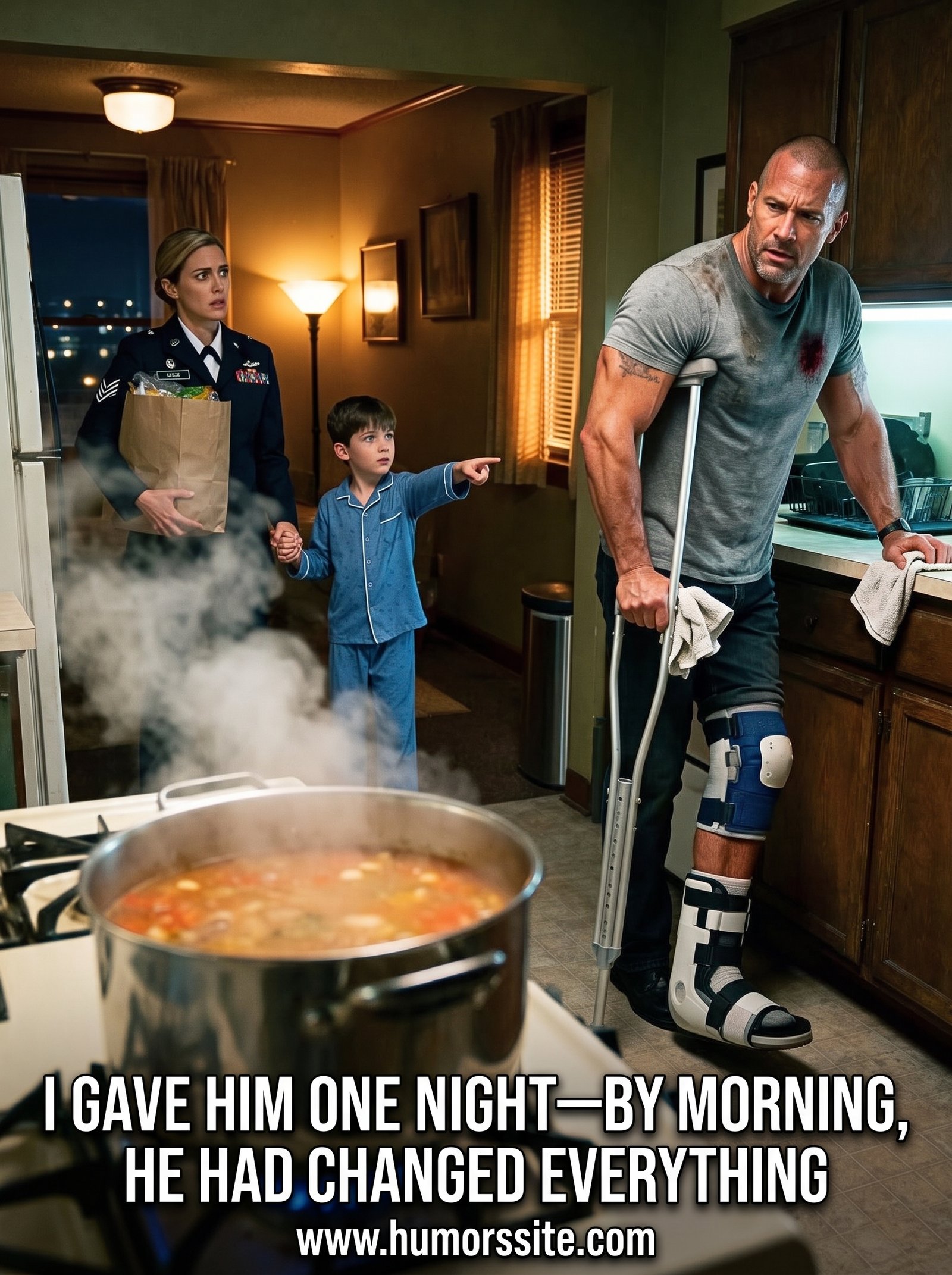
Ryan stood beside the stove.
His injured leg was still locked inside the brace, and one crutch leaned against the counter.
He turned when he heard me.
“You’re home.”
I stared at the kitchen.
“What happened?”
He looked confused.
“I cleaned.”
“I can see that.”
“I hope that’s okay.”
I put my bag down slowly.
“You cooked?”
He nodded.
“There wasn’t much here, but I found some vegetables, chicken, rice, and that half-empty carton of broth.”
I looked at Mason.
“You let him cook?”
Mason shrugged.
“He said he knew how.”
Ryan smiled.
“I worked in kitchens once.”
That sentence caught my attention.
“Once?”
He looked down.
“A long time ago.”
Something about the way he said it told me there was a story behind those two words.
I sat down.
Ryan served Mason a bowl.
Then he served me one.
I took a cautious spoonful.
It was delicious.
Better than anything I’d cooked in months.
“Where did you learn?”
“Different places.”
“What kind of places?”
He hesitated.
“Hotels. Restaurants. A hospital kitchen for a while.”
Mason looked up.
“You were a chef?”
Ryan laughed softly.
“No. I was the guy who made sure the chefs had what they needed.”
He sat across from us.
For a few minutes, nobody spoke.
Then Mason asked the question I’d been avoiding.
“Ryan, why do you sleep outside?”
Ryan’s expression changed.
He looked at my son for a long moment.
“Sometimes life takes more from you than you’re prepared to lose.”
Mason frowned.
“Like what?”
Ryan looked toward the window.
“People.”
That was all he said.
After dinner, I showed him the couch.
He thanked me again.
Before I went to bed, I checked the front door.
The hinge was perfect.
I looked at Ryan.
“You fixed this?”
He nodded.
“Bad hinges can make a door look worse than it is.”
I smiled.
“Goodnight, Ryan.”
“Goodnight.”
I closed my bedroom door.
But I didn’t lock it.
I wasn’t sure why.
Maybe something about him had changed the way I saw him.
He didn’t seem like someone waiting to be rescued.
He seemed like someone who had once spent his life rescuing other people.
And I was about to discover exactly what had happened to him.
PART 2 — THE THINGS HE NEVER ASKED FOR
Ryan stayed another night.
Then another.
Not because I invited him to.
Because every morning, I found him doing something useful.
He fixed the loose railing outside our apartment.
He repaired Mason’s broken bicycle chain.
He organized the disaster beneath my kitchen sink.
He even figured out why the heater in Mason’s bedroom wasn’t working properly.
“You’re an electrician too?” I asked.
“No.”
“A plumber?”
“No.”
“Then what are you?”
Ryan smiled.
“Annoying.”
I laughed for the first time in weeks.
Mason adored him.
But there was something strange about Ryan.
He never asked for money.
Not once.
He wouldn’t let me buy him new shoes.
He refused when I offered to pay for a hotel room.
When I bought groceries, he carried the bags upstairs himself despite his injured leg.
One evening, I found him sitting at the kitchen table staring at an old photograph.
It was a picture of Mason’s father.
My late husband, Daniel.
Ryan quickly turned it face down.
“You knew him?”
His face went pale.
“No.”
The answer came too quickly.
I picked up the photograph.
“You just looked at it like you did.”
Ryan stared at the floor.
“Your husband worked construction, right?”
“Yes.”
“Downtown?”
“Mostly.”
He nodded.
“I knew someone who worked with him.”
“Who?”
He didn’t answer.
I waited.
Finally he said:
“A good man.”
My stomach tightened.
“You knew Daniel.”
Ryan looked at me.
“Yes.”
The room suddenly felt smaller.
“How?”
Ryan took a deep breath.
“Daniel and I worked on the same project.”
“When?”
“About three years before he died.”
I sat down.
“Why didn’t you tell me?”
“Because I didn’t know whether you wanted to hear my name.”
“What does that mean?”
Ryan rubbed his hands together.
“Daniel helped me once.”
“How?”
“I was in trouble. Bad trouble. He gave me money and helped me get into a rehabilitation program.”
I stared at him.
“My husband never told me.”
“He wouldn’t.”
“Why?”
“Because he didn’t do things so people would praise him.”
That sounded exactly like Daniel.
Then Ryan reached into the pocket of his jacket.
He pulled out a small, worn metal key.
“I’ve kept this for six years.”
I looked at it.
“What is it?”
Ryan swallowed.
“Your husband gave it to me.”
My heart started pounding.
“Why?”
Ryan looked toward Mason.
“Because he told me that if anything ever happened to him, I was supposed to find you.”
I couldn’t speak.
Daniel had been dead for almost two years.
Why would he have given a homeless stranger a key and told him to find me?
“What does it open?”
Ryan shook his head.
“I don’t know.”
“Then how do you know it’s important?”
“Because Daniel made me promise.”
I reached for the key.
Ryan placed it in my hand.
There was a number stamped into it.
417.
I recognized it immediately.
“That’s the storage unit.”
Ryan looked at me.
“What storage unit?”
I stared at him.
“Daniel had one.”
I had completely forgotten about it.
We had never emptied it because the paperwork had been tied up after his death.
I had assumed there was nothing important inside.
I suddenly wondered if I had been wrong.
PART 3 — STORAGE UNIT 417
The next morning, Mason stayed with our neighbor while Ryan and I drove to the storage facility.
The manager led us to Unit 417.
I inserted the key.
It worked.
The metal door rolled upward.
Dust filled the air.
Inside were boxes.
Dozens of them.
Old tools.
Files.
Photographs.
A toolbox.
And one wooden chest.
My hands began shaking.
“Why did Daniel never tell me about this?”
Ryan stood beside me.
“Maybe he wanted to protect you.”
I opened the first box.
Inside were financial records.
Bank statements.
Invoices.
Copies of contracts.
Then I saw something that made my blood run cold.
A company name.
Turner Property Management.
Mr. Turner.
The same man who managed my apartment building.
I looked at Ryan.
“That’s impossible.”
Ryan’s expression hardened.
“What’s wrong?”
“My landlord.”
I showed him the documents.
Daniel had been investigating him.
There were records showing illegal rent increases.
Forged maintenance reports.
Payments to contractors for repairs that were never completed.
And then I found something worse.
A letter.
Written by Daniel.
I recognized his handwriting immediately.
If you’re reading this, something went wrong.
My hands trembled.
I discovered that Turner has been forcing elderly and low-income tenants out of their apartments so he can renovate the buildings and triple the rent.
I stopped reading.
Ryan looked over my shoulder.
The letter continued.
I tried to expose him.
Then came the sentence that changed everything.
If I can’t finish this, I need someone I trust to protect my family.
I looked at Ryan.
He lowered his eyes.
“Daniel asked you to protect us.”
He nodded.
“Before he died.”
I felt a chill.
“Did he know he was in danger?”
“I don’t know.”
“Did Turner hurt him?”
“I don’t know.”
“But you suspect it.”
Ryan was silent.
Then he said:
“Daniel’s death wasn’t investigated properly.”
I stared at him.
“What are you saying?”
“I’m saying he was supposed to meet someone the night he died.”
“Who?”
“Turner.”
My knees nearly gave out.
Daniel’s death had been ruled an accident.
A construction accident.
A fall.
I’d spent two years believing that.
Ryan pulled another folder from the chest.
Inside was a photograph.
Daniel was standing beside a group of workers.
One of them was Ryan.
Another was Mr. Turner.
And behind them was a building I recognized.
My apartment building.
Ryan pointed to Turner.
“That man knew Daniel was collecting evidence.”
I looked at the photograph.
Then I noticed a date written on the back.
Three days before Daniel died.
Suddenly, the man I’d allowed into my home wasn’t simply a homeless stranger.
He was the last person my husband had trusted.
And the documents in that storage unit could expose a crime that had been hidden for years.
But there was one problem.
We weren’t alone.
A car was parked across the street.
Someone was watching the storage facility.
Ryan saw it too.
“Don’t look directly at it.”
My heart began racing.
“Who is that?”
“I don’t know.”
Then his phone rang.
Ryan answered.
He listened for five seconds.
His face changed.
He hung up.
“Who was it?”
He looked at me.
“Your landlord.”
PART 4 — THE TRUTH ABOUT RYAN
Mr. Turner wanted the documents.
That much was obvious.
But he made one mistake.
He assumed Ryan was still the helpless man he’d seen sleeping near the bus stop.
He didn’t know Ryan had spent years rebuilding his life.
Or that Daniel had once trusted him with evidence.
Or that Ryan had contacts in places Turner couldn’t reach.
We went to the police.
At first, the detective was skeptical.
Then we showed him the documents.
His attitude changed immediately.
The investigation reopened.
Bank records were subpoenaed.
Old construction reports were examined.
Phone records were retrieved.
And finally, they found the connection.
Turner had paid a contractor to falsify the safety report from the night Daniel died.
The “accident” hadn’t been an accident.
Daniel had discovered the fraud.
He had threatened to expose it.
Turner had confronted him.
Daniel fell.
Then Turner had covered it up.
I sat in the detective’s office listening to the truth I’d spent two years never knowing.
I cried.
Not because I had finally learned what happened.
Because Daniel had known he might not survive.
And he’d still spent his final days trying to protect strangers.
Ryan sat beside me.
“You okay?”
I shook my head.
“No.”
He nodded.
“I know.”
The detective turned toward Ryan.
“You saved her.”
Ryan looked confused.
“I didn’t do anything.”
“You did.”
The detective pointed toward the evidence.
“Without you, none of this would have been found.”
Ryan looked at me.
“I only kept a promise.”
I reached across the table and took his hand.
“You kept it.”
The case moved quickly after that.
Turner was arrested.
Several people involved in the fraudulent scheme were charged.
And the tenants who had been pushed out of their homes were given legal assistance.
But there was still one mystery.
Why had Ryan become homeless?
I finally asked him.
He didn’t answer immediately.
Then he told me.
After Daniel died, Ryan tried to expose Turner himself.
Turner retaliated.
Ryan lost his job.
His apartment.
His savings.
His reputation.
Then, after an injury to his leg, everything collapsed.
He had spent months sleeping wherever he could.
But he’d kept Daniel’s key.
Because Daniel had been the one person who believed he could become something better.
I looked at the man who had cleaned my apartment while I was at work.
The man who had repaired my broken door.
The man who had cooked dinner for my son.
He hadn’t needed charity.
He needed someone to remember that he still had value.
And suddenly I knew what I wanted to do.
PART 5 — THE MAN WHO WAS NEVER REALLY HOMELESS
Six months later, Ryan walked into a small restaurant wearing a clean white shirt.
His leg brace was gone.
He was walking with only a slight limp.
Mason ran across the room and hugged him.
“You came!”
Ryan laughed.
“I said I would.”
I stood behind the counter.
The restaurant belonged to me now.
After Turner was arrested, the building’s ownership was transferred to a community housing organization.
I had used the settlement money from an unrelated legal claim to open a small diner on the first floor.
Ryan managed the kitchen.
Not as a favor.
Not as charity.
As a partner.
The first time I offered him the job, he stared at me.
“You really want me?”
I smiled.
“I don’t want you.”
He looked confused.
“I need you.”
That made him laugh.
Months later, the diner was always full.
Workers came for breakfast.
Families came for dinner.
People who had once been homeless came in knowing they wouldn’t be judged.
And every Tuesday evening, Ryan made the same soup.
The one he’d made on his first night.
Mason called it “Ryan’s miracle soup.”
One evening, after closing, Ryan handed me an envelope.
“What’s this?”
“Something I should have given you months ago.”
Inside was Daniel’s final letter.
I had never seen it.
Ryan had kept it because he hadn’t known when the right time would be.
I opened it.
There were only a few lines.
Evelyn,
If Ryan ever comes to you, don’t judge him by where he sleeps.
Judge him by what he does when nobody is watching.
He’s a good man.
If he needs help, give him work—not pity.
And if Mason ever asks why I trusted him, tell him this:
Because Ryan once had everything taken from him and still chose to help someone else.
I couldn’t finish reading.
I pressed the letter against my chest.
Ryan looked away, giving me privacy.
Mason came running from the kitchen.
“Mom!”
I wiped my eyes.
“What?”
“Ryan says we’re out of bread.”
I laughed.
“Then tomorrow you two are going shopping.”
Mason grinned.
Ryan shook his head.
“You realize he’s going to buy everything except bread.”
“I heard that!” Mason shouted.
The three of us laughed.
Outside, Milwaukee was cold.
The same city.
The same winter.
The same bus stop where I had first seen Ryan sitting beneath a worn blanket.
But Ryan wasn’t there anymore.
He had a home.
A job.
A purpose.
A family who loved him.
And every Tuesday, when the soup simmered on the stove, I remembered the lesson I had learned that first night.
Sometimes the person you think you’re saving is the person who has been quietly saving everyone around him.
I had thought I was giving a homeless man one warm night.
In reality, I had opened my door to a man who had spent years keeping a promise.
And somehow, without either of us realizing it, that one small act of kindness had brought two broken families back to life.