Part 1: The Car That Mattered More Than My Son’s Life
“I am not putting a vomiting child on brand-new leather. When your father gets home, he can decide what to do.”
Those were the words my stepmother, Lorraine, spoke when I begged her to take my nine-year-old son to the hospital. She had owned her new Buick for only eleven days, and apparently, protecting its immaculate interior mattered more than getting Owen emergency medical attention.
Lorraine was sixty-three, and the pearl-white Buick with tan leather upholstery was the first brand-new car she had ever owned. My father had purchased it for $64,000 from a dealership in Salina, and I had genuinely been happy for her.
That Friday in October, my children had the day off from school because of parent-teacher conferences. Since I had a full schedule at the dental office, I had taken thirteen-year-old Tess and nine-year-old Owen to my father’s farm the previous evening.
The property was forty miles from my home in Hays, with the final nine miles consisting entirely of gravel roads. Both children loved visiting their grandfather, who allowed Tess to drive his old blue Ford around the pasture while Owen spent hours playing with his favorite barn cat.
Dad left for the livestock auction at eight that morning. Owen had complained of stomach discomfort and decided to remain at the farmhouse, so Dad asked Lorraine to watch him.
At 12:10 PM, my phone vibrated twice while I was cleaning a patient’s teeth. Recognizing our family’s emergency signal, I immediately removed one glove and answered.
“Mom, something’s wrong with Owen. His stomach is really hard, like a board.”
Although I wasn’t a nurse, my healthcare training had taught me enough to recognize potentially serious symptoms. Tess explained that her brother had been vomiting since ten, had developed a fever of 102 degrees, and was experiencing severe pain in the lower right side of his abdomen.
I asked her to put Lorraine on speakerphone.
“Lorraine, I think Owen might have appendicitis. He needs to get to the hospital immediately.”
“He probably has the flu, Marnie. There’s no reason to panic.”
When I insisted that Owen needed urgent medical attention, she refused, explaining that she didn’t want him vomiting inside her new Buick.
“I’ll pay to have the entire car professionally cleaned. I’ll even replace the seats if necessary. Please, just take him to the hospital.”
“When your father comes home, we’ll decide.”
She walked away from the telephone, leaving me stunned. Even my patient, Dorothy Pfeifer, looked horrified by what she had overheard.
I immediately instructed Kim, our receptionist, to contact emergency services. The dispatcher estimated that an ambulance would need thirty minutes to reach the farmhouse but could arrive at the highway junction in twelve.
My father was unreachable at the livestock auction, and I was forty miles away. The only adult at the farmhouse had deliberately refused to help.
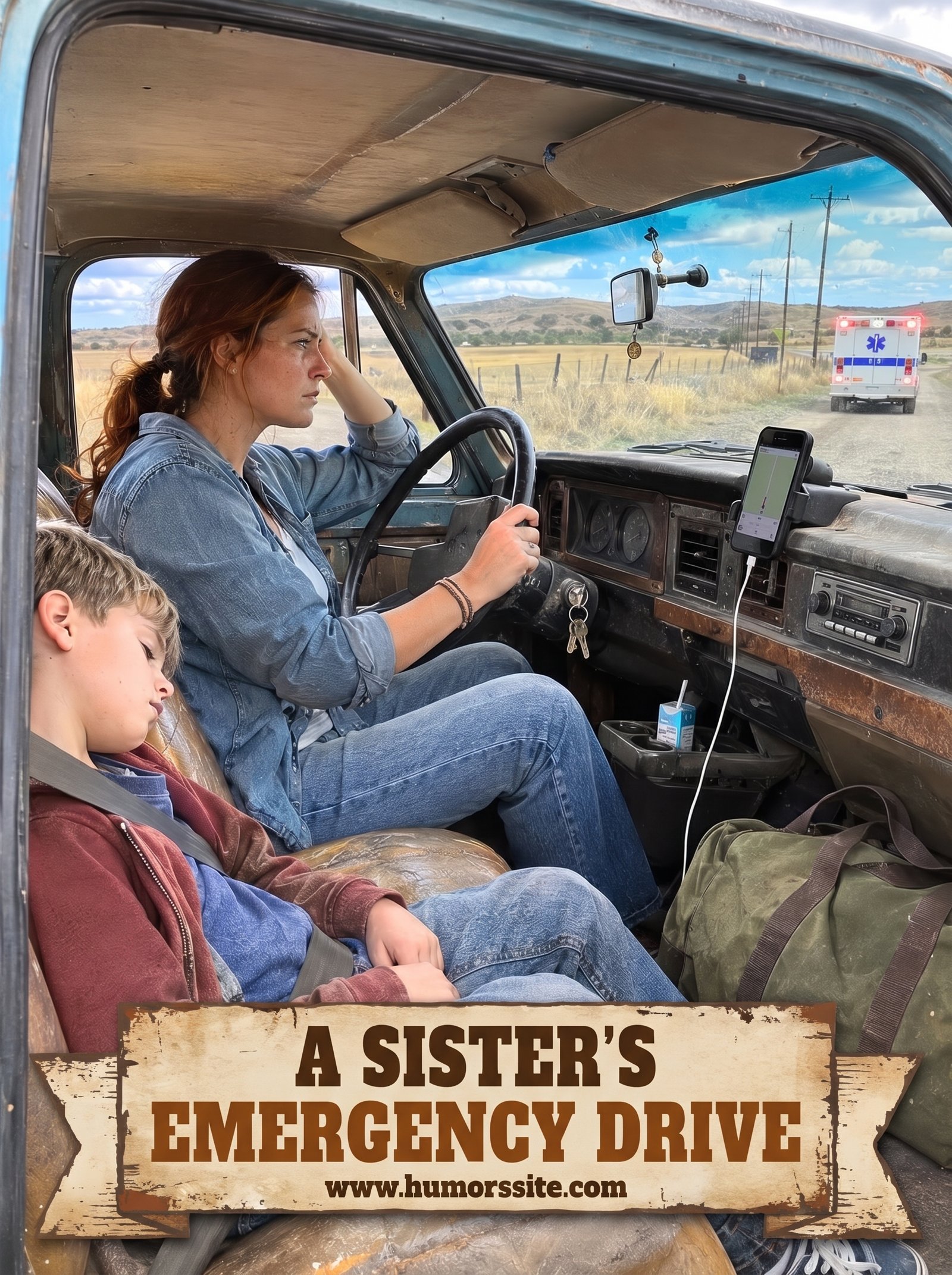
Then I remembered my father’s old 1978 Ford pickup, which Tess had been driving around the farm since she was eleven. She had never driven on a public road, but the dispatcher confirmed that paramedics could meet a vehicle at the highway junction.
“Tessie, sweetheart, are you still there?”
“Yes, Mom.”
I hated what I was about to ask my daughter, but I was terrified of what might happen if Owen didn’t receive medical attention soon.
“Can you get your brother into Grandpa’s truck?”
Without hesitation, my thirteen-year-old daughter answered.
“Yes, ma’am.”
Part 2: Nine Miles of Gravel and a Thirteen-Year-Old Hero
I instructed Tess to gather a blanket and a bucket before carefully helping her brother into the pickup. Through the telephone, I could hear her reassuring Owen as he cried in pain, while Lorraine called after them from the farmhouse.
“Tess, what on earth do you think you’re doing?”
My daughter didn’t answer. Moments later, I heard the familiar sound of my father’s old Ford starting, followed by the crunch of gravel beneath its tires.
Suddenly, a loud impact came through the speaker, followed by a scraping noise. Tess’s voice rose in panic as she realized what had happened.
“Mom! I hit Grandpa’s mailbox! It’s lying in the ditch!”
“Don’t worry about the mailbox, sweetheart. Just concentrate on getting your brother to the ambulance.”
I knew that nine-mile stretch of gravel intimately because my father had taught me to drive on the same road in that very pickup. With the emergency dispatcher coordinating the ambulance’s arrival, I remained on the telephone, doing everything I could to keep my daughter calm.
Kim sat beside me, relaying information from emergency services. The ambulance had already reached the highway junction, where the paramedics were waiting with their emergency lights flashing.
Meanwhile, Dr. Nguyen, the dentist I worked for, postponed his next appointment after discovering what was happening. My patient, Mrs. Pfeifer, remained in the dental chair, silently witnessing the most terrifying experience of my life.
“How’s your brother doing, Tess?”
“He’s leaning against the door with his eyes closed. Mom, he’s not crying anymore.”
His sudden silence frightened me even more than his earlier cries. I desperately needed to hear his voice and reassure myself that he was still conscious.
“Owen, sweetheart, can you hear Mommy?”
For several agonizing seconds, there was no response.
“It hurts, Mama.”
“I know, baby. Your sister’s taking care of you. Tell her about your cat.”
“He caught a mouse.”
His voice was barely audible, but hearing him respond gave me enough strength to continue. Mrs. Pfeifer reached for my free hand, closed her eyes, and quietly began praying.
When Tess reached the narrow creek bridge halfway to the junction, she encountered an approaching farm truck. The driver, a member of the neighboring Urban family, recognized her and subsequently followed the pickup with his hazard lights flashing.
After what felt like an eternity, Tess’s trembling voice came through the telephone.
“Mom! I can see the ambulance!”
The paramedics rushed toward the passenger side as soon as the pickup arrived. Within moments, they were attending to Owen while another emergency worker approached my daughter.
“You can relax now, sweetheart. We’ve got your brother.”
“Mom, I can’t open my hands.”
Tess had been gripping the steering wheel so tightly that she couldn’t bring herself to release it. The paramedic gently placed her hand over my daughter’s fingers and reassured her that the frightening journey was finally over.
Only then did Tess begin sobbing. Standing in the dental office, still wearing my scrubs, I cried alongside her while Mrs. Pfeifer continued holding my hand.
My thirteen-year-old daughter had accomplished what the adult entrusted with her brother’s safety had refused to do. But as the ambulance rushed Owen toward the hospital, I still didn’t know whether we had reached him in time.
Part 3: The Doctor’s Warning That Silenced My Stepmother
Dr. Nguyen told me to leave immediately, promising to finish Mrs. Pfeifer’s dental cleaning himself. Since the hospital was only six minutes from our office, I reached the ambulance entrance before Owen arrived.
My son’s complexion was alarmingly pale, and his hair was damp with perspiration. The paramedics had already inserted an IV, but his first concern wasn’t about his own condition.
“Mom, did Sissy get in trouble?”
Before I could properly reassure him, the medical team wheeled him inside. Tess arrived ten minutes later, accompanied by a sheriff’s deputy named Schmeidler.
The deputy explained that Grandpa’s pickup had been secured near the highway junction and that the neighboring farmer had volunteered to return it. Although he was required to document the incident, he assured me that he had no intention of issuing a citation for Tess’s actions.
“However, I need to understand why an adult wasn’t driving. Your daughter told me someone else was at the farmhouse.”
I explained exactly what had happened, and he carefully recorded my statement. His expression remained professional as he asked me to spell Lorraine’s name.
After examining Owen, Dr. Wasinger determined that emergency surgery could not be postponed. I signed the necessary consent forms with trembling hands, terrified by how rapidly everything had escalated.
At 1:40 PM, my father finally called from the farm.
“Marnie, the pickup is missing, the mailbox is destroyed, and Lorraine won’t explain anything. What happened here?”
I recounted the entire ordeal without exaggerating or withholding a single detail. When I repeated Lorraine’s refusal to risk damaging her new leather seats, Dad became unusually quiet.
“We’re coming to the hospital.”
Owen entered surgery at two that afternoon. Tess sat beside me in the waiting room, her hair dusty, her forearm scraped, and her hands still trembling from the journey.
“Do you think Grandpa will be angry about his mailbox?”
“Your grandfather has plenty of reasons to be upset today, sweetheart, but none of them have anything to do with you.”
She rested her head against my shoulder before revealing something that made my stomach tighten.
“Lorraine watched us leave, Mom. She was standing on the porch.”
Dad and Lorraine arrived shortly before three. Despite being seventy-four and suffering from stiff knees, my father knelt in front of Tess’s chair and wrapped both arms around her.
Lorraine sat nearby without acknowledging my daughter. At one point, she quietly insisted that she had genuinely believed Owen was suffering from the flu, but nobody responded.
At 4:15 PM, Dr. Wasinger finally appeared and sat across from us. He explained that Owen had survived the operation, although his appendix had ruptured shortly before reaching the hospital.
“We cleaned his abdomen and inserted a drain. He’ll need intravenous antibiotics for several days.”
The surgeon glanced toward Tess before returning his attention to me.
“I want to be completely straightforward with you. If he’d arrived an hour later, we might be having a very different conversation.”
My father slowly rose from his chair, clutching his hat between his hands.
“Would you repeat that, Doctor? I want to make sure my wife hears every word.”
The surgeon repeated his explanation while Lorraine stared at the floor. Dad thanked him politely before turning toward his wife.
For the first time that afternoon, Lorraine was about to discover the consequences of choosing her precious new Buick over her grandson’s safety.

Part 4: The Keys She Had to Surrender and the Inheritance She Lost
My father had never been a man who needed to shout to make himself understood. When he confronted Lorraine in the hospital waiting room, his quiet disappointment carried more weight than any angry outburst.
“Eleven days ago, I borrowed $64,000 because I wanted you to have something beautiful for yourself. You’d never owned a new car, and I was happy to give you one.”
Lorraine attempted to interrupt, but Dad continued speaking.
“Today, you had those keys in your pocket while a sick little boy needed help. Instead of driving him to the hospital, you watched a thirteen-year-old girl take him down nine miles of gravel because you were worried about your upholstery.”
“I honestly thought he had the flu, Gene. I swear I did.”
“Perhaps you believed that at first. But what did you think when Tess hit the mailbox? You could have taken over, or you could have followed them. Instead, you sat on the porch.”
Lorraine began crying, admitting that she had spent forty years making do with secondhand vehicles and furniture. She had desperately wanted to keep one valuable possession in perfect condition and hadn’t considered the consequences of her decision.
“I understand everything you’ve gone without,” Dad replied. “But none of that was Owen’s fault.”
He extended his hand, and Lorraine reluctantly retrieved the Buick’s key fob from her purse. Dad placed it inside his shirt pocket and announced that the vehicle would remain unused until he decided what to do with it.
He also insisted that Lorraine acknowledge Tess, whom she had avoided looking at since arriving.
“You drove very well,” Lorraine finally told her.
The words sounded painfully inadequate, and she immediately excused herself. Tess reached for Grandpa’s hand and apologized for destroying his mailbox.
“I’ll replace it, sweetheart. Don’t you ever apologize for what you did today.”
Owen remained hospitalized for five days, gradually recovering from the infection. Tess slept in the recliner beside his bed every night, earning the affectionate nickname “the driver” from the nursing staff.
A hospital social worker subsequently interviewed me after reviewing the deputy’s report. I made it clear that my children would never again remain at the farmhouse unless their grandfather was personally present.
The medical bills arrived in November, including a $1,870 ambulance charge and hospital expenses exceeding $41,000. My insurance covered most of the treatment, leaving me responsible for $4,500.
I arranged a payment plan, but Dad secretly paid the entire outstanding balance after learning about it from Kim. Several weeks later, he visited me and revealed that he had made another significant decision.
Lorraine had spent the previous year persuading him to add her name to the deed of our family farm, part of which had belonged to our relatives since 1906. He had scheduled an appointment with his attorney for October 28 and had nearly agreed to her request.
“I kept the appointment, Marnie. But I changed what I intended to accomplish.”
Instead of transferring ownership to Lorraine, Dad established a trust protecting the family property. She would retain the right to live in the farmhouse for the remainder of her life, with money reserved for her living expenses.
However, ownership of the land would eventually pass to me and subsequently to Tess and Owen.
Dad had ensured that Lorraine understood every provision before signing the documents. When I asked how she had reacted, he quietly shook his head.
“She said she supposed she deserved it.”
Part 5: The Mailbox That Became a Monument to My Daughter’s Courage
During the first week of November, the pearl-white Buick was returned to the dealership in Salina. Surprisingly, Lorraine herself had requested that Dad sell it, admitting that she could no longer bear to sit inside the vehicle.
The dealership purchased it as a used car with only four hundred miles on the odometer, leaving Dad with a loss of approximately $9,000 after settling the loan. Lorraine returned to driving her old Buick with its cracked dashboard.
On the Sunday before Thanksgiving, she appeared unexpectedly at my front door carrying a casserole and an envelope. Inside was a check for $1,870, drawn from the modest savings she had accumulated by selling eggs and altering clothes.
“Lorraine, Dad has already taken care of the ambulance expenses.”
“Then put it away for the children. I don’t want to keep that money.”
She admitted that she had recognized her terrible mistake shortly after watching Tess disappear down the gravel road. Overwhelmed by shame and indecision, she had remained on the porch instead of following them.
“I was wrong, Marnie. I’ve thought about what happened every single night, and I still can’t give you a good explanation.”
I accepted her contribution without pretending that everything had been forgiven. When she asked whether Tess was home, my daughter remained upstairs, listening without coming down.
Lorraine glanced toward the staircase before quietly nodding.
“Please tell her I asked about her.”
We returned to the farm for Thanksgiving because Dad wanted us there and Owen desperately missed his barn cat. Lorraine prepared the entire meal, including a small pumpkin pie especially for Owen.
He happily thanked her, but Tess remained distant throughout the gathering. She was polite whenever Lorraine addressed her, yet she made no effort to initiate conversation, and I respected her decision.
After dinner, Dad invited the children outside to show them something he had been working on. He had replaced the damaged mailbox with a sturdy steel post secured inside a wide concrete foundation.
Before the concrete hardened, he had engraved three things into its surface: TESS, OCTOBER 16, and 9 MI.
My daughter stood quietly beside the mailbox, studying the inscription with her hands tucked inside her coat pockets. Dad remained beside her, allowing the gesture to speak for itself.
“Grandpa, why isn’t my name there?” Owen asked.
“Because you were the cargo, buddy.”
Owen eventually returned to school and proudly showed his two-inch surgical scar to anyone willing to listen. His recovery brought enormous relief to our family, although Tess was still processing everything she had experienced that afternoon.
She hadn’t driven since the emergency. Grandpa’s old blue Ford was back beside the hay shed, its bumper bearing a new dent that Dad had deliberately decided not to repair.
He had twice offered to let Tess drive around the pasture again, but she had told him she wasn’t ready. Nobody pressured her to overcome her fear before she felt comfortable doing so.
Last Sunday, while standing beside Dad’s kitchen window, I noticed Tess sitting alone inside the pickup. The engine was off, the driver’s door was closed, and her hands rested quietly in her lap.
She remained there for approximately twenty minutes before climbing out and returning to the farmhouse. When she came inside, she simply asked what we were having for supper.
I didn’t question her or mention the truck. I knew that whatever she needed to overcome, she deserved the time and patience to do it at her own pace.
My daughter had already demonstrated more courage in those nine miles than many people manage to show in an entire lifetime.