PART 1: SHE HAD NOWHERE ELSE TO GO
“Elora didn’t come to stay with you for the reason she gave you.”
My neighbor Patricia stood on my doorstep holding an old shoebox.
Her hands were trembling.
I looked at the box, then at her face.
“What are you talking about?”
Patricia glanced toward the street.
“She planned the whole thing before she ever called you.”
A strange feeling settled in my stomach.
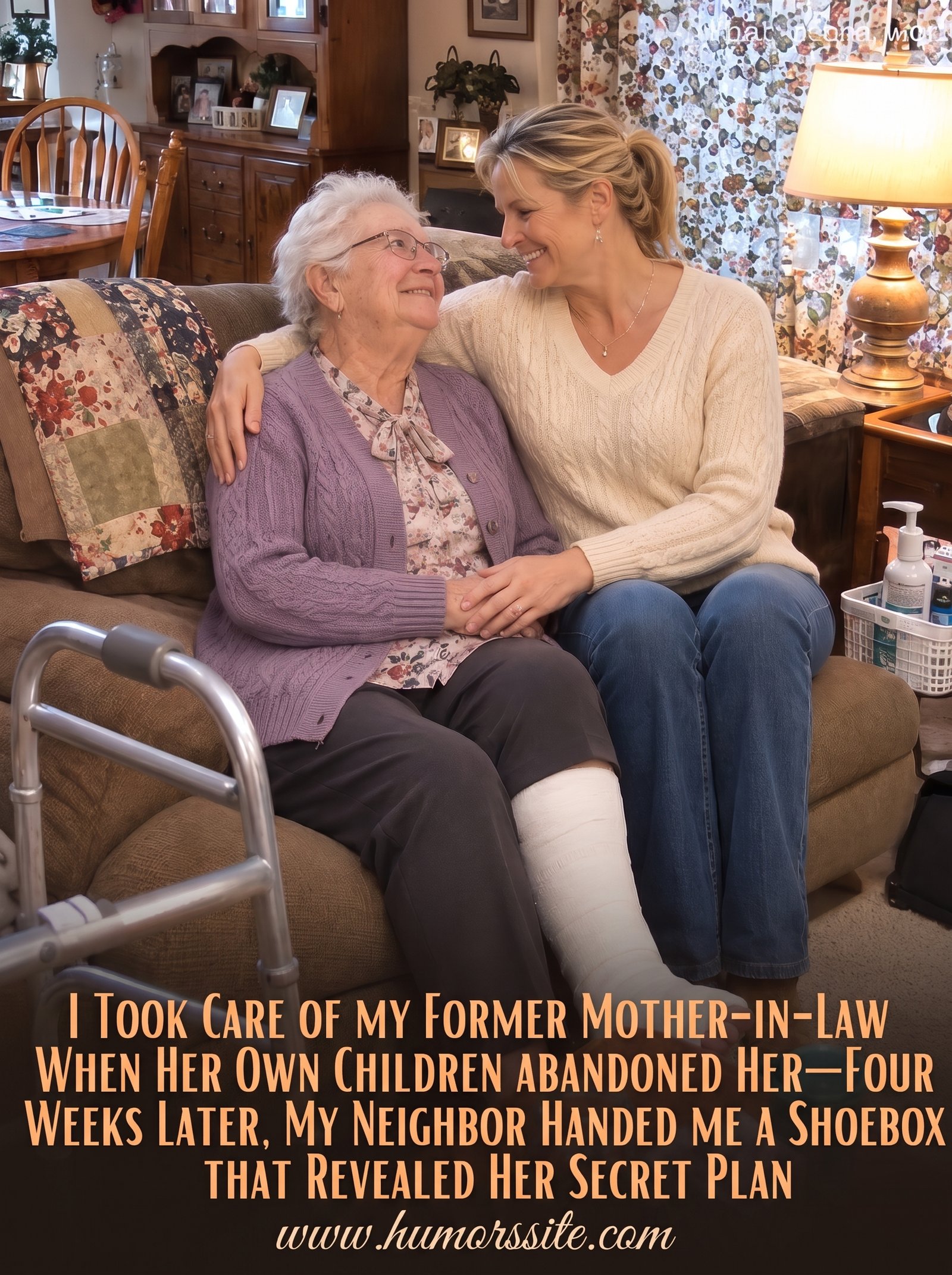
For four weeks, I had welcomed my former mother-in-law into my home.
I had cooked for her, driven her to medical appointments, helped her dress, and sometimes gotten out of bed in the middle of the night when she needed assistance.
I had done everything a daughter would do for her mother.
And now Patricia was telling me that Elora had been hiding something from me the entire time.
Something she had planned from the beginning.
My name is Natalie Bennett.
I’m thirty-nine years old, and five years ago, I divorced the man I thought I would spend the rest of my life with.
His name was Shane.
We had been married for eleven years when I discovered he was having an affair with a woman from his office.
The discovery destroyed me.
I had spent years believing that marriage meant choosing the same person every day, even when life became difficult.
Apparently, Shane had a different understanding of commitment.
When I confronted him, he didn’t immediately apologize.
Instead, he blamed our busy schedules.
He complained that we had grown apart.
He said I had become too predictable.
Then he told me something I would never forget.
“Sometimes people outgrow each other, Natalie.”
I stared at him.
“Is that what you’re calling betrayal now?”
He looked away.
Our marriage ended several months later.
I moved into a modest three-bedroom house on a quiet residential street.
I continued working as an administrative coordinator at a dental practice.
I rebuilt my life slowly.
Some days were easier than others.
There were mornings when I woke up feeling relieved.
There were evenings when I cried while eating dinner alone.
But eventually, the pain became less overwhelming.
And through everything, one unexpected person remained in my life.
Shane’s mother, Elora.
She was seventy-two years old, with silver hair, warm brown eyes, and a habit of calling everyone she loved sweetheart.
From the moment Shane introduced us, she had treated me like family.
She taught me how to make her famous apple pie.
She remembered my birthday.
She sat beside me at the hospital when I underwent surgery.
When my own mother died, Elora arrived at my house carrying enough food to feed an entire neighborhood.
She didn’t ask what I needed.
She simply stayed.
So when she discovered Shane had been unfaithful, her disappointment was unmistakable.
“I can’t believe my own son treated you that way,” she told me.
“You deserved a husband who respected you.”
I remember crying when she said those words.
I had expected her to defend him.
Most mothers would have tried to explain their son’s behavior.
Elora didn’t.
Naturally, she still loved Shane.
He was her child.
But she refused to excuse what he had done.
After the divorce, we continued speaking occasionally.
Sometimes she called to check on me.
Other times, we met for coffee.
She sent me Christmas cards.
I brought her flowers on Mother’s Day.
There was only one rule.
“I don’t want to hear anything about Shane,” I told her.
Elora understood.
And for five years, she respected that boundary.
Then one afternoon in early March, my telephone rang.
It was Elora.
“Hello, sweetheart.”
Her voice sounded weak.
“Elora? Are you all right?”
She began crying.
“I’m sorry to trouble you.”
“What’s wrong?”
“I broke my leg last week.”
I immediately sat down.
“What?”
“I slipped on the back steps. The doctors say it’ll take some time before I can manage properly.”
“Why didn’t you call me sooner?”
She sighed.
“I didn’t want to bother you.”
“Where are your children?”
There was a long silence.
Elora had three children.
Shane was the oldest.
His younger sister, Meredith, lived approximately forty minutes away.
Their youngest brother, Colin, lived in the same town as Elora.
Surely one of them could help.
“I asked all three,” she finally admitted.
“Shane says he’s busy with work.”
“Meredith says her house is too crowded.”
“Colin says he can’t take time away from his business.”
I felt anger rising.
“Not one of them can stay with you?”
“No.”
Her voice broke.
“I suppose everybody has their own life.”
My heart ached.
Elora had spent decades raising those children.
She had worked extra shifts when money was tight.
She had helped them purchase their first cars.
She had contributed toward their weddings.
She had watched their children whenever they needed assistance.
And now, when she couldn’t safely prepare her own meals, nobody had room for her.
“Come stay with me,” I said.
She immediately protested.
“Oh, honey, I couldn’t impose on you like that.”
“You’re not imposing. I’m inviting you.”
“But you work.”
“I can manage.”
“You have your own life.”
“And you’re part of it.”
She became quiet.
Then she began crying again.
“Are you sure?”
“Absolutely.”
The following morning, I collected her from her house.
She had packed two suitcases, a handbag, and a small collection of personal belongings.
I helped her settle into my spare bedroom.
I placed fresh flowers beside the window.
I bought groceries she liked.
I rearranged the furniture so she could move around more safely.
For the next four weeks, my routine changed completely.
I woke earlier to prepare breakfast.
I organized her appointments.
I made sure she had everything she needed within reach.
After work, I cooked dinner and helped with household tasks.
Some evenings, we watched old movies together.
Other evenings, we sat at the kitchen table talking about memories that had nothing to do with Shane.
For the first time in years, my house felt less empty.
Elora often apologized.
“You shouldn’t have to do all this.”
I always gave her the same answer.
“You would do it for me.”
She would smile.
Sometimes, her eyes filled with tears.
Around the middle of her stay, however, I began noticing peculiar behavior.
Elora frequently asked about my schedule.
“What time are you leaving tomorrow?”
“Will you be working late?”
“Are you coming home for lunch?”
At first, I assumed she simply wanted to know when she would be alone.
But then she started asking more specific questions.
“Does your office ever close early on Fridays?”
“Do you usually visit the grocery store after work?”
“How long does your lunch break last?”
One afternoon, I returned home unexpectedly because a patient had canceled several appointments.
When I opened the front door, I heard Elora speaking on the telephone.
“She’s home already,” she whispered.
Then she immediately ended the call.
I entered the living room.
“Everything okay?”
She smiled too quickly.
“Of course, sweetheart.”
“Who were you talking to?”
“Just an old friend.”
I didn’t question her further.
Another evening, I noticed Patricia leaving through my back gate.
Patricia was sixty-seven and had lived next door since I purchased the house.
She occasionally brought me vegetables from her garden.
We were friendly, although we weren’t particularly close.
“Patricia stopped by?” I asked Elora.
“Yes. She brought me some magazines.”
I nodded.
But there were no magazines anywhere in the living room.
A few days later, I found several scraps of paper on the kitchen table.
They contained numbers, dates, and what appeared to be calculations.
When Elora noticed me looking, she gathered them quickly.
“Just some household paperwork.”
I told myself she probably wanted privacy.
Perhaps she was worried about medical expenses.
Perhaps she felt embarrassed about depending on me.
I didn’t want to make her uncomfortable.
So I continued caring for her as before.
Eventually, her doctor determined that she had recovered enough to return home with appropriate support.
On the morning she left, I helped her pack.
She stood near the front door and wrapped her arms around me.
She held me for so long that I began laughing.
“Elora, you’re going to make me cry.”
She whispered:
“You’ll never understand how much you’ve done for me.”
I smiled.
“I’m just glad you’re feeling better.”
She pulled away and touched my cheek.
“You deserve more happiness than you’ve been given.”
I assumed she was simply grateful.
Nothing more.
I drove her home, made sure she was comfortable, and returned to my house.
A few hours later, Patricia knocked on my front door.
She looked nervous.
In her hands was an old brown shoebox.
“Can I speak with you?”
“Of course.”
“It’s about Elora.”
My smile disappeared.
“Is something wrong?”
Patricia glanced behind her.
“I’ve been trying to decide whether I should tell you this.”
She held out the box.
“But I think you deserve to see what’s inside.”
I took it slowly.
“What are you talking about?”
Patricia lowered her voice.
“Elora didn’t come to stay with you for the reason she gave you.”
I stared at her.
Then she added:
“She planned the whole thing before she ever called you.”
I felt suddenly cold.
“Planned what?”
Patricia stepped inside.
“Open the box, Natalie.”
I placed it on my kitchen table.
My hands trembled as I lifted the lid.
Inside were photographs, envelopes, bank documents, a small notebook, and a folded piece of paper bearing my full name.
But the first thing I noticed was a photograph lying on top.
It showed Shane standing outside my house.
The date printed beneath the image was only three weeks earlier.
I stared at Patricia.
“Why was my ex-husband here?”
She took a deep breath.
“That’s exactly what Elora was trying to find out.”
PART 2: YOUR EX-HUSBAND NEVER TOLD YOU THE WHOLE TRUTH
I picked up the photograph.
Shane stood beside his vehicle near my driveway.
He was wearing a dark jacket and holding a folder.
The image had clearly been taken from Patricia’s property.
I looked at the date again.
It was a Tuesday.
I remembered that day.
I had worked until six because one of my colleagues was absent.
Elora had asked me twice that morning whether I would be coming home for lunch.
“Was Shane inside my house?” I asked.
Patricia nodded slowly.
“Elora let him in.”
I felt betrayed.
“She promised me she wouldn’t involve him in my life.”
“I know.”
“Then why?”
Patricia pulled out a chair.
“There’s more.”
I sat opposite her.
She removed another photograph.
This one showed Meredith standing near my front door.
Another showed Colin carrying a large envelope.
All three of Elora’s children had visited my house while I was at work.
Without my knowledge.
Without my permission.
I felt anger rising.
“They said they were too busy to take care of her.”
Patricia nodded.
“Apparently, they weren’t too busy to come here.”
I looked down at the photographs.
“What were they doing?”
Patricia hesitated.
“Arguing about money.”
I stared at her.
“What money?”
“Elora’s money. And something that belonged to you.”
I immediately thought about my house.
My savings.
The modest retirement account I had built since the divorce.
Had Shane discovered something about my finances?
Was Elora helping him?
The possibility made me feel physically sick.
Patricia reached into the shoebox and removed a small notebook.
The cover was faded blue.
I recognized it immediately.
Elora had carried that notebook for years.
She used it to record grocery lists, birthdays, appointments, and household expenses.
Patricia opened it to a marked page.
At the top, Elora had written:
NATALIE.
Beneath my name were several dates.
The earliest was from five years ago.
Shortly before my divorce became final.
There were references to a family business, a property sale, and several financial transfers.
I recognized the name of Shane’s father.
Arthur Bennett.
Arthur had died seven years earlier.
He had owned a small commercial landscaping company that Shane helped manage.
During our marriage, I had assisted with the company’s paperwork.
I had spent evenings organizing invoices.
I had helped prepare payroll records.
I had answered telephone calls when the office manager was unavailable.
I had never received a regular salary for that work.
Shane always said we were building something together.
When Arthur died, Shane told me the company was struggling.
He claimed that debts and operating expenses had consumed most of its value.
During our divorce, he provided financial documents suggesting that his interest in the company was worth very little.
I had accepted a modest settlement.
I hadn’t wanted a prolonged legal battle.
I simply wanted to leave.
Patricia removed an envelope.
“Elora found these several months ago.”
Inside were copies of financial records.
I didn’t understand every detail.
But I understood the numbers.
One document showed proceeds from a commercial property transaction.
Another referred to distributions from the landscaping company.
A third contained a payment schedule connected to a separate business entity.
The amounts were considerably larger than anything Shane had disclosed during our divorce.
I looked up.
“What is this?”
Patricia sighed.
“Elora believes Shane hid money from you.”
I stared at her.
For five years, I had believed I had walked away with what was legally and fairly mine.
I had rented a small apartment before saving enough for my house.
I had worked overtime.
I had postponed vacations.
I had rebuilt my savings from almost nothing.
Meanwhile, Shane had purchased a luxury vehicle less than a year after our divorce.
He had moved into a larger house with the woman he had cheated with.
I remembered wondering how he could afford those things.
He had told mutual friends that his business had improved.
I had believed him.
Now I wasn’t so certain.
“How did Elora discover this?”
Patricia opened the notebook again.
“She was organizing Arthur’s old records. She found documents that didn’t match what Shane had told her.”
“Why didn’t she call me?”
“She wanted to understand everything first.”
I looked at the photographs.
“That doesn’t explain why she brought him into my house.”
Patricia lowered her eyes.
“Elora knew her children wouldn’t discuss certain things openly if they thought you were listening.”
My anger returned.
“So she used my house to arrange secret meetings?”
“Yes.”
“While I was taking care of her?”
Patricia nodded.
I stood and walked toward the window.
I couldn’t believe it.
The woman I trusted had been inviting my former husband into my home behind my back.
Even if her intentions were good, she had violated the one boundary I had established.
“Was her leg really broken?”
“Absolutely.”
“Did her children really refuse to help her?”
“Yes.”
I turned around.
“Then what did she plan?”
Patricia looked toward the shoebox.
“She planned to use the time away from her own house to investigate what her children had been doing.”
I sat down again.
“Why my house?”
“Because she trusted you.”
I laughed bitterly.
“That’s an interesting way to demonstrate trust.”
Patricia didn’t argue.
Instead, she removed a sealed envelope.
My name was written across the front.
“She gave me this yesterday.”
I took it.
“Why didn’t she give it to me herself?”
“She was afraid you would think she’d stayed with you only because she wanted something.”
I looked at the envelope.
“Didn’t she?”
Patricia shook her head.
“Not exactly.”
I opened the letter.
Natalie, sweetheart,
If you’re reading this, Patricia has decided that you deserve to know everything.
She’s right.
I should have told you myself.
But I was ashamed.
Not because of anything you did.
Because of what my children have become.
When Arthur died, I believed I could trust Shane to manage the family business honestly.
I believed Meredith and Colin would help protect what their father had built.
Instead, I have discovered things that have made me question decisions I made years ago.
I believe Shane concealed assets during your divorce.
I also believe my other children knew more than they admitted.
I needed somewhere safe to organize the records.
When I broke my leg and my children refused to care for me, I realized something painful.
The person I trusted most was no longer legally part of my family.
It was you.
I knew you would offer to help.
And I knew that if I told you everything immediately, you would be hurt.
So I made a terrible decision.
I kept it from you.
Please understand that I never intended to take advantage of your kindness.
But I understand if that’s exactly how you feel.
There is one more thing you need to know.
Arthur left instructions concerning you.
Shane never told you about them.
Find the white envelope at the bottom of the box.
Please speak with Margaret Ellis before contacting any of my children.
I love you, Natalie.
Whatever happens next, that will never change.
Elora.
I read the letter twice.
Then I reached into the bottom of the shoebox.
There was a white envelope.
Inside was a photograph of Arthur standing beside me at the landscaping company’s tenth anniversary celebration.
On the back, he had written:
Natalie, this business would not be what it is without you.
Beneath the photograph was a document bearing the name of an attorney.
Margaret Ellis.
I unfolded it.
My eyes moved across the first page.
Then I stopped breathing for a moment.
The document referred to an agreement Arthur had signed before his death.
An agreement recognizing my contributions to the company.
And beneath my name was a figure I had never seen before.
Fifteen percent.
I looked at Patricia.
“What does this mean?”
She shook her head.
“I think you need to ask the lawyer.”
I stared at the document.
For eleven years, Shane had told me I was helping build our future.
But what if I had actually helped build a business that partly belonged to me?
And what if he had spent five years making sure I never discovered it?
PART 3: YOU WERE NEVER SUPPOSED TO WALK AWAY WITH NOTHING
I barely slept that night.
The shoebox remained on my kitchen table.
Every time I walked past it, I felt a mixture of anger, confusion, and sadness.
I wasn’t only thinking about Shane.
I was thinking about Elora.
The woman who had held my hand when my marriage ended.
The woman who had called me sweetheart for nearly twenty years.
Why had she decided I couldn’t handle the truth?
Why had she allowed Shane into my home?
Why had she made me part of a plan I had never agreed to?
The following morning, I called Margaret Ellis.
Her receptionist arranged an appointment for that afternoon.
Margaret was a woman in her early sixties with silver hair and rectangular glasses.
When I entered her office, she looked at me with immediate recognition.
“Natalie Bennett?”
“Yes.”
She stood.
“I remember you.”
I sat opposite her and placed the documents on her desk.
“Elora told me to contact you.”
Margaret examined the papers.
Then she removed her glasses.
“I wondered when you might come.”
I frowned.
“You knew about this?”
“I knew about Arthur’s original intentions. I didn’t know everything that happened afterward.”
She retrieved archived records from her office.
Then she began explaining.
Years earlier, Arthur had become concerned about the amount of unpaid work I performed for the company.
He knew I handled administrative responsibilities outside my regular employment.
He knew I had helped the business survive a difficult period.
He also knew Shane frequently described my contributions as simply helping the family.
“Arthur didn’t see it that way,” Margaret explained.
“He considered your work valuable.”
I looked at the old photograph.
“He never told me.”
“He intended to.”
She explained that Arthur had executed an agreement providing for a financial benefit connected to the company, subject to specific conditions and implementation through his estate arrangements.
It wasn’t as simple as discovering that I automatically owned fifteen percent of everything.
The business structure had changed.
Additional documents needed examination.
But there was enough evidence to justify a serious legal review.
“Did Shane know?” I asked.
Margaret looked through the records.
“There are indications that he was informed about the arrangement.”
I felt my throat tighten.
“Before our divorce?”
“Yes.”
I stared at the wall.
During our marriage, Shane had repeatedly told me the company couldn’t afford to pay me.
He had said that everything we were building would eventually benefit both of us.
Then, when our marriage ended, he insisted the business was practically worthless.
Had he known all along that Arthur intended to recognize my contributions separately?
Margaret continued.
“Elora contacted me approximately three months ago.”
“Before she broke her leg?”
“Yes.”
“She brought several documents and asked whether the financial disclosures from your divorce could have been incomplete.”
I leaned forward.
“What did you tell her?”
“That we needed an independent review. I also advised her not to confront anybody until she understood the records.”
I shook my head.
“She confronted all three of her children in my house.”
Margaret looked surprised.
“I wasn’t aware of that.”
I explained Patricia’s photographs.
The secret visits.
The questions about my schedule.
The telephone calls.
Margaret sighed.
“Elora should have told you.”
“Everybody keeps saying that.”
“I understand why you’re upset.”
I looked down at my hands.
“I thought she was different from Shane.”
Margaret remained quiet for a moment.
“People can love us and still make decisions that hurt us.”
I nodded.
Then she showed me another document.
It concerned a commercial property owned through an entity associated with the family business.
The property had been sold shortly after my divorce.
The transaction had generated substantial proceeds.
Some financial arrangements relating to the sale appeared to have existed before the divorce was finalized.
“Depending on the circumstances, these records may be relevant to your previous settlement,” Margaret explained.
“We need to establish what was disclosed, what was omitted, and whether there are available legal remedies.”
I looked at the numbers.
“How much money are we talking about?”
“The overall transaction exceeded two million dollars.”
I felt dizzy.
“Two million?”
She nodded.
“That doesn’t mean you are entitled to that entire amount, or any particular percentage without further review.”
I understood.
But the possibility that Shane had concealed substantial assets was enough to make my stomach turn.
Margaret recommended that I retain independent counsel experienced in post-divorce financial disputes.
She also suggested an independent forensic accountant.
I agreed.
Before leaving, I asked her one final question.
“Why were Meredith and Colin involved?”
Margaret opened another folder.
“Because Elora believes the three of them have been pressuring her to transfer control of her remaining assets.”
I stared at her.
“What assets?”
“Her house, investment accounts, and interests associated with Arthur’s estate.”
I remembered Elora’s tears when she told me none of her children could care for her.
I remembered the exhaustion in her voice.
Had they been pressuring her while she was injured?
Margaret continued.
“Elora had begun reconsidering certain financial arrangements. Her children were not pleased.”
I thought about the photographs again.
They hadn’t visited my house because they suddenly cared about their mother.
They had come because they were worried about what she knew.
And what she intended to do with that knowledge.
I drove directly to Elora’s house.
She answered the door using her walking aid.
When she saw me, her face changed.
“Natalie.”
I held up the letter.
“Patricia gave me the box.”
Elora closed her eyes.
“I thought she might.”
“Why didn’t you tell me?”
She stepped aside.
“Come in, sweetheart.”
I entered.
She guided me toward the living room.
I remained standing.
“Shane was in my house.”
She nodded.
“Meredith and Colin too.”
“Yes.”
“You asked about my schedule so you could arrange meetings while I was gone.”
Her eyes filled with tears.
“Yes.”
I felt anger rise.
“How could you do that?”
“I’m sorry.”
“You knew how difficult it was for me to establish boundaries after the divorce.”
“I know.”
“You knew I didn’t want Shane anywhere near my life.”
She lowered her head.
“I know.”
“Then why did you decide those boundaries didn’t matter?”
Elora began crying.
“I thought I was protecting you.”
I shook my head.
“That’s what people always say when they make decisions for somebody else.”
She looked at me.
I continued.
“You could have told me what you discovered. You could have asked permission to use my house. You could have met them somewhere else.”
“I should have.”
“Instead, you lied to me while I was taking care of you.”
She covered her face.
“I’m so sorry.”
I sat down.
For several minutes, neither of us spoke.
Finally, Elora whispered:
“I was afraid.”
“Of what?”
“Of losing you.”
I stared at her.
“That doesn’t make sense.”
She wiped her eyes.
“When I found Arthur’s documents, I realized my son might have betrayed you in ways I hadn’t understood.”
Her voice broke.
“I thought you might blame me for trusting him.”
I remained silent.
She continued.
“And when I broke my leg, I discovered that none of my children wanted to help me unless I agreed to certain things.”
“What things?”
Elora reached toward a folder beside her chair.
She handed me several documents.
One proposed giving Shane broad authority over her financial affairs.
Another concerned a possible transfer of her house.
There were additional papers relating to her investments.
“Shane told me it would make everything easier,” she explained.
“Meredith said I was becoming too old to manage my affairs.”
“Colin said the family needed access to money.”
I looked at her.
“Did you sign anything?”
“No.”
I released a breath.
“Good.”
She began crying again.
“They were furious.”
I thought about the woman who had spent her life helping her children.
Now those same children were treating her independence as an inconvenience.
Elora looked at me.
“I wanted to understand whether Shane had hidden money from you before I made any further decisions about my own finances.”
She swallowed.
“And I wanted him to admit it.”
“Did he?”
Elora became quiet.
Then she reached into her handbag and removed a folded piece of paper.
“He didn’t admit everything.”
She handed it to me.
“But he sent me this message after our last conversation.”
I unfolded the paper.
It was a printed message from Shane.
Mom, stop digging into the divorce. Natalie signed the settlement. She agreed to walk away. Nobody forced her. If you keep bringing up Dad’s old agreement, you’re going to create problems for all of us.
I read it again.
Then I looked at Elora.
“He knew.”
She nodded.
“I believe he did.”
My hands trembled.
Five years earlier, Shane had watched me leave our marriage believing I had received everything I was entitled to.
And now he was more concerned about the consequences of being discovered than the damage he had caused.
Elora reached toward my hand.
“There’s something else.”
I looked up.
“What?”
“All three of them are coming here on Sunday.”
“Why?”
She took a deep breath.
“They want me to sign the financial documents.”
I stared at her.
“And what are you going to do?”
For the first time that afternoon, Elora’s expression became firm.
“I’m going to tell them no.”
PART 4: YOU ONLY REMEMBER I’M YOUR MOTHER WHEN YOU NEED MY MONEY
Sunday arrived with cold rain and gray skies.
Elora had asked me to attend the family meeting.
Initially, I refused.
“I don’t want to be involved in another confrontation with Shane.”
“I understand.”
She hesitated.
“But I want you there because part of this concerns you.”
I agreed on two conditions.
There would be an independent attorney present.
And nobody would pressure me to discuss my divorce beyond what was necessary.
Elora accepted immediately.
By two o’clock, we were seated in her living room.
Margaret attended as Elora’s attorney.
My own attorney, Rebecca Morgan, was also present.
Patricia had offered to help Elora prepare refreshments, but she left before the meeting began.
At approximately two-fifteen, Shane arrived.
He entered wearing an expensive coat and carrying a leather folder.
When he saw me, he stopped.
“Natalie?”
I remained seated.
“Hello, Shane.”
He looked toward his mother.
“What’s she doing here?”
Elora answered calmly.
“I invited her.”
Shane frowned.
“This is a family matter.”
Elora looked directly at him.
“That’s exactly why she’s here.”
Meredith arrived several minutes later.
Colin followed.
Neither appeared pleased to see me.
Meredith removed her coat.
“Mom, why are there lawyers here?”
Elora folded her hands.
“Because I’m tired of having conversations that everyone remembers differently afterward.”
Colin sighed.
“Can we make this quick?”
Elora looked at him.
“Of course. I wouldn’t want to interfere with your busy schedule.”
He shifted uncomfortably.
Shane placed his folder on the coffee table.
“Mom, we’ve already discussed this. You need help managing your finances.”
“I needed help when I broke my leg.”
He frowned.
“That’s different.”
“How?”
Nobody answered.
Elora continued.
“I called all three of you.”
She looked at Meredith.
“You told me your guest bedroom was full.”
Meredith lowered her eyes.
She turned toward Colin.
“You said your business couldn’t operate without you.”
Then she looked at Shane.
“You told me you couldn’t possibly rearrange your schedule.”
Shane sighed.
“Mom, we all have responsibilities.”
Elora nodded.
“Yes.”
She looked at me.
“So does Natalie.”
The room became quiet.
“She works full-time. She has bills. She has a house to maintain. She has no legal obligation to take care of me.”
Her voice trembled.
“Yet she didn’t hesitate.”
Meredith crossed her arms.
“Are we supposed to feel guilty?”
Elora stared at her.
“I was hoping you might feel something.”
Nobody spoke.
Then Shane opened his folder.
“Can we discuss the actual reason we’re here?”
Elora nodded.
“Certainly.”
He removed the proposed financial documents.
“We’re trying to simplify things.”
Margaret leaned forward.
“Mrs. Bennett has reviewed these documents with me. She will not be signing them.”
Shane looked irritated.
“Why not?”
“Because she does not wish to grant the proposed authority or transfer her property.”
Colin shook his head.
“Mom, you’re seventy-two.”
Elora raised an eyebrow.
“I’m aware of my age.”
“You can’t manage everything forever.”
“Then I’ll arrange appropriate independent assistance when I need it.”
Meredith looked toward me.
“Did Natalie convince you to do this?”
I opened my mouth, but Elora answered first.
“No.”
She sat straighter.
“I am perfectly capable of making my own decisions.”
Shane began tapping his fingers against the table.
“This is ridiculous.”
Elora reached toward another folder.
“Then perhaps we should discuss something less ridiculous.”
She placed copies of Arthur’s old documents in front of him.
Shane stopped tapping.
I watched his face.
The change was immediate.
“Where did you get those?”
Elora looked at him.
“From your father’s records.”
He picked up the first page.
“These are outdated.”
Rebecca spoke calmly.
“That is one of the matters requiring independent review.”
Shane looked at her.
“And who are you?”
“Natalie’s attorney.”
His expression hardened.
He turned toward me.
“You’re seriously doing this?”
I looked directly at him.
“I’m trying to understand what happened.”
“Our divorce was finalized five years ago.”
“I remember.”
“You signed the settlement.”
“I also relied on the financial information you provided.”
He looked away.
Elora pointed toward the documents.
“Your father intended Natalie to receive recognition for her work.”
Shane laughed nervously.
“Dad said a lot of things.”
Margaret answered.
“These are executed documents, not merely remembered conversations.”
Meredith looked toward her brother.
“Shane?”
He ignored her.
Colin leaned forward.
“How much does she think she’s owed?”
I stared at him.
“I haven’t made any demand.”
He shook his head.
“This is going to ruin everything.”
Elora turned toward him.
“What exactly will it ruin?”
Colin didn’t answer.
Rebecca explained that a preliminary review had identified substantial discrepancies between certain historical financial records and the disclosures associated with my divorce.
Further investigation was necessary.
Shane became angry.
“Natalie, you wanted out of the marriage!”
I looked at him.
“Because you were sleeping with somebody else.”
Meredith stared at the floor.
Shane continued.
“You said you didn’t want anything from me.”
“I said I didn’t want to spend years fighting with you.”
“That’s the same thing.”
“No.”
I felt my voice becoming stronger.
“It isn’t.”
I thought about the nights I had worked on company paperwork.
The weekends I had spent organizing invoices.
The personal savings I had used during difficult periods in our marriage.
“You knew how much I contributed,” I said.
“You knew what your father intended.”
Shane looked toward the attorneys.
Then he said:
“The business would have suffered if I’d paid her what Dad wanted.”
The room became completely silent.
Elora stared at him.
“What did you just say?”
Shane realized his mistake.
“I mean, the arrangement wasn’t practical.”
Rebecca made a note.
I felt tears rising.
“You knew about it.”
Shane rubbed his forehead.
“Natalie, it’s complicated.”
“No. It’s finally becoming very simple.”
I looked at him.
“You let me believe the company was worth almost nothing.”
He didn’t answer.
“You let me leave without knowing what your father had arranged.”
He remained silent.
“And afterward, you built a new life using money I didn’t even know existed.”
Shane stood.
“I’m not discussing this anymore.”
Elora spoke sharply.
“Sit down.”
He stared at her.
She repeated:
“Sit down, Shane.”
Slowly, he returned to his chair.
Elora’s eyes filled with tears.
“Your father worked his entire life to build that business honestly.”
Shane shook his head.
“You don’t understand how business works.”
Elora leaned forward.
“I understand how honesty works.”
Meredith began crying.
“Mom, please. We don’t need to destroy the family.”
Elora looked at her.
“Then why didn’t anybody protect the family when Natalie was being deceived?”
Meredith wiped her eyes.
“I didn’t know everything.”
“Did you know anything?”
She hesitated.
Then she nodded.
“Shane told me Dad had made an arrangement for Natalie.”
I stared at her.
“And you never told me?”
She lowered her head.
“He said it wasn’t my business.”
I felt a fresh wave of betrayal.
Colin admitted that he had also heard about Arthur’s arrangement.
He claimed he hadn’t understood its legal significance.
But he acknowledged receiving financial assistance from Shane after the property transaction.
Elora looked at all three of them.
“I raised you to help one another.”
Her voice broke.
“Not to help one another hide the truth.”
Nobody spoke.
Then she reached toward Margaret.
“I want you to explain the next document.”
Margaret removed a written notice.
She explained that Elora had revoked certain existing informal financial permissions and established independent arrangements for managing her affairs.
Her estate plans were also under review.
Her children would no longer be involved in decisions without her informed authorization.
Shane looked horrified.
“You’re cutting us out?”
Elora shook her head.
“I’m protecting myself.”
Colin stood.
“After everything we’ve done for you?”
Elora looked at him.
“Tell me what you did for me when I couldn’t get from my bedroom to my kitchen.”
He opened his mouth.
Nothing came out.
She continued.
“Tell me which one of you brought me dinner.”
Silence.
“Which one drove me to the doctor?”
Nobody answered.
“Which one offered me a bed?”
Her eyes moved toward me.
“Natalie did.”
Meredith began sobbing.
Elora wiped her own tears.
“You only remember I’m your mother when you need my money.”
Shane looked furious.
“This is because of her.”
He pointed at me.
“She’s turning you against your own children.”
I stood.
“I didn’t ask for any of this.”
He laughed bitterly.
“Of course you didn’t.”
Elora immediately interrupted him.
“Enough.”
Her voice was stronger than I had ever heard it.
“Natalie took care of me for four weeks without asking for a single thing.”
She looked at her children.
“Not one dollar.”
“Not one promise.”
“Not one favor.”
“She helped me because she loved me.”
Then she looked directly at Shane.
“And you had the privilege of being loved by that woman for eleven years.”
Her voice broke.
“You threw it away.”
Shane stared at her.
Elora continued.
“Don’t blame her because you are finally being asked to answer for your own choices.”
The meeting ended shortly afterward.
The attorneys arranged for relevant records to be preserved and reviewed.
Shane left without saying goodbye.
Meredith cried as she collected her coat.
Colin followed her outside.
When the front door closed, Elora leaned back against her chair.
She looked exhausted.
I sat beside her.
For a moment, neither of us spoke.
Then she reached toward my hand.
“Are you angry with me?”
I looked at her.
“Yes.”
Her eyes filled with tears.
I continued.
“But I’m also worried about you.”
She nodded.
“I’m sorry, sweetheart.”
I squeezed her hand.
“I need you to understand something.”
“What?”
“You don’t have to manipulate circumstances to make me help you.”
She began crying.
“You could have trusted me with the truth.”
She nodded again.
“I should have.”
I looked toward the documents scattered across the table.
“From now on, no more secrets.”
Elora squeezed my fingers.
“No more secrets.”
PART 5: I WAS NOT ASKING FOR REVENGE
The following months were difficult.
I had believed my divorce was behind me.
Instead, I found myself reviewing documents connected to a marriage I had spent years trying to forget.
My attorney obtained relevant financial records through appropriate legal procedures.
An independent forensic accountant examined the historical business transactions.
The process was slow.
There were complicated ownership arrangements.
Changes in business structure.
Property transactions.
Payments to family members.
And financial information that had not been clearly disclosed during the divorce.
The independent review eventually established that significant information had been omitted.
There was also evidence supporting a separate financial claim connected to Arthur’s agreement.
Shane disputed several findings.
His attorney argued that some assets had been incorrectly characterized.
He claimed certain transactions occurred after our marriage ended.
But the records showed that relevant arrangements and financial interests existed earlier than he had originally disclosed.
For the first time, I understood how much I had not known when I signed the settlement.
One afternoon, Rebecca called me.
“Natalie, Shane’s attorney wants to discuss a possible resolution.”
I sat down.
“What kind of resolution?”
“He appears willing to negotiate rather than continue the proceedings.”
I thought about the years I had spent rebuilding my life.
“What does he want?”
“Financial certainty. An end to the dispute.”
I laughed softly.
“That’s what I wanted five years ago.”
Rebecca understood.
We agreed to consider a settlement only after the financial review was sufficiently complete.
I wasn’t interested in punishing Shane beyond what the evidence justified.
I wasn’t interested in taking property that belonged to somebody else.
I wanted what I should have been able to negotiate honestly the first time.
Several weeks later, Shane asked to speak with me privately.
I initially refused.
Then I agreed to meet him in a public coffee shop.
When I arrived, he was already sitting near the window.
He looked older.
Not dramatically different.
Just tired.
He stood when he saw me.
“Thanks for coming.”
I sat opposite him.
“What do you want?”
He looked uncomfortable.
“I wanted to talk without lawyers.”
I nodded.
“Then talk.”
He took a deep breath.
“I made mistakes during the divorce.”
I waited.
He continued.
“I was worried about the business.”
I looked at him.
“You were worried about yourself.”
He lowered his eyes.
“Maybe.”
I remained silent.
Then he said:
“I thought you’d be okay.”
I stared at him.
“What?”
“You had a job. You were independent. You’ve always been good at taking care of yourself.”
I felt anger rising.
“So you decided I didn’t need what was rightfully mine?”
He shook his head.
“That’s not what I meant.”
“Then what did you mean?”
He struggled to answer.
I continued.
“You cheated on me. You blamed me for the problems in our marriage. And when I finally left, you withheld information that could have affected my financial future.”
He looked toward the window.
“I know.”
“Do you?”
He nodded slowly.
Then he whispered:
“I was selfish.”
For the first time, he didn’t blame the business.
He didn’t blame our marriage.
He didn’t blame my independence.
He simply acknowledged his behavior.
I took a breath.
“Why did you come to my house while Elora was staying with me?”
He looked surprised.
“She asked me to.”
“And you didn’t think I deserved to know?”
He lowered his head.
“No.”
I shook my head.
“That’s exactly the problem, Shane.”
He looked up.
“You keep making decisions that affect me without considering whether I have a right to participate.”
He remained silent.
Then he said something unexpected.
“Mom hasn’t been speaking to me much.”
I nodded.
“That’s between you and her.”
“She listens to you.”
“She’s an adult.”
“Maybe you could tell her I’m sorry.”
I looked at him.
“Tell her yourself.”
He swallowed.
“She won’t forgive me.”
I picked up my handbag.
“Then give her a reason to believe you’re changing.”
He looked at me.
I continued.
“Not because you’re afraid of losing money. Not because you want something from her.”
I stood.
“Because she’s your mother.”
Several months later, the legal dispute was resolved through a negotiated agreement.
The final amount payable to me was $412,000, reflecting the financial claims established through the review and the compromises reached by the parties.
It was not a gift.
It was not an inheritance from Elora.
It was not money I had obtained because I cared for her.
It was a resolution of financial matters that should have been addressed honestly years earlier.
When Rebecca called to confirm the agreement, I sat quietly at my kitchen table.
For a long time, I didn’t know how to feel.
I had imagined that receiving justice would make me happy.
Instead, I thought about the woman I had been five years earlier.
The woman who cried in a rented apartment.
The woman who counted every dollar before buying groceries.
The woman who believed she had lost everything because her marriage had failed.
I wished I could sit beside her.
I wished I could tell her that she had been stronger than she realized.
And that somebody else’s dishonesty had never diminished her worth.
I used part of the money to reduce my mortgage.
I strengthened my retirement savings.
I created an emergency fund.
And for the first time in years, I booked a vacation without feeling guilty about spending money on myself.
Meanwhile, Elora continued recovering.
She arranged professional assistance for tasks she couldn’t manage safely.
She established independent financial oversight.
She began attending a community exercise program after her doctor approved it.
She also made changes to her estate plans.
One afternoon, she asked whether I would accompany her to Margaret’s office.
I agreed.
When we arrived, Margaret explained that Elora wanted to discuss a proposed gift and certain future estate arrangements.
I immediately looked at Elora.
“What are you doing?”
She smiled.
“Something I should have done years ago.”
I shook my head.
“You don’t owe me anything.”
“I know.”
“I didn’t take care of you because I wanted money.”
“I know that too.”
Margaret explained that Elora had independently considered her financial needs, future care expenses, and the people and organizations she wished to benefit.
She wanted to recognize my place in her life.
But I felt uncomfortable.
“Elora, I don’t want your children thinking I did this to receive an inheritance.”
She reached for my hand.
“Natalie, they can think whatever they want.”
I sighed.
“That doesn’t make it easier.”
She nodded.
“Then tell me what would make you comfortable.”
After a lengthy conversation, we agreed that her financial security should remain the priority.
She would make her own estate decisions independently.
I would not accept control over her accounts.
I would not become involved in managing her property.
And any gift or future benefit would be considered separately, with appropriate legal advice and without pressure from me.
Elora smiled.
“You really don’t want anything, do you?”
I looked at her.
“I want you to be safe.”
Her eyes filled with tears.
“And I want you to stop thinking you have to give people something to make them love you.”
She began crying.
Margaret quietly handed her a tissue.
On the drive home, Elora stared out the passenger window.
Then she said:
“I think I’ve spent my entire life trying to make myself useful.”
I looked at her.
“What do you mean?”
“When my children were young, they needed me.”
She smiled sadly.
“I cooked. I cleaned. I worked. I helped with homework. I paid bills.”
She paused.
“Then they grew up, and I kept finding ways to help them.”
I listened.
“I gave them money. I watched their children. I solved their problems.”
Her voice became quiet.
“I suppose I was afraid that if they stopped needing me, they might stop loving me.”
My heart broke.
“Elora.”
She wiped her eyes.
“When I broke my leg, I couldn’t do anything for anybody.”
She looked at me.
“And suddenly, nobody had time for me.”
I reached toward her hand when we stopped at a traffic light.
“You don’t have to earn your place in somebody’s life.”
She began crying again.
I continued.
“You can be loved when you’re tired.”
“When you’re sick.”
“When you need help.”
“When you have absolutely nothing to offer.”
She squeezed my hand.
“That’s what you showed me.”
I smiled.
“And that’s what I need you to remember.”
PART 6: YOU WERE NEVER JUST MY DAUGHTER-IN-LAW
A year passed.
Elora’s leg healed.
She became more independent.
She started growing tomatoes in her backyard again.
She joined a book club.
She even began taking short trips with Patricia and several other women from the neighborhood.
Our relationship recovered too.
But it didn’t happen immediately.
For a while, I struggled whenever Elora asked about my schedule.
She noticed.
One morning, she called and asked what time I would be home.
Then she immediately added:
“I’m asking because I want to bring you some pie. Nothing mysterious.”
I laughed.
“Good.”
She laughed too.
We gradually rebuilt the trust that had been damaged.
She apologized more than once for inviting her children into my home without permission.
She never tried to justify it again.
And I appreciated that.
Because the truth was that her intentions had not erased the hurt she caused.
I loved her.
But I also needed her to respect my boundaries.
She learned to do both.
As for her children, their relationships with her changed in different ways.
Meredith was the first to make a genuine effort.
She visited one afternoon carrying groceries.
Elora looked surprised.
“What’s all this?”
Meredith smiled awkwardly.
“I thought you might need a few things.”
Elora invited her inside.
They talked for nearly three hours.
Later, Elora told me that Meredith had apologized for refusing to help when she broke her leg.
She admitted that she had become accustomed to her mother always being available.
She had never stopped to consider how lonely Elora might feel.
Their relationship didn’t immediately return to normal.
But Meredith began visiting regularly.
Sometimes she helped with errands.
Sometimes she simply stayed for coffee.
Colin took longer.
For several months, he barely contacted his mother.
He remained angry about losing access to financial assistance.
Eventually, he called because his business was experiencing difficulties.
Elora listened.
Then she told him she would not provide money.
He became upset.
“You’re my mother.”
She answered:
“Yes. And I love you.”
There was a pause.
“But loving you doesn’t mean financing every decision you make.”
He ended the conversation abruptly.
Several weeks later, he called again.
This time, he didn’t ask for money.
He asked how she was feeling.
Elora told me about the call with tears in her eyes.
“It was the first time in years he asked about me without asking for something afterward.”
I hugged her.
“That’s a beginning.”
Shane remained distant for much of the following year.
The financial settlement had forced him to reconsider several business and personal arrangements.
His lifestyle became less extravagant.
He sold one of his vehicles.
He reduced certain expenses.
But I didn’t follow the details closely.
I had spent enough of my life thinking about Shane Bennett.
I wanted to concentrate on my own future.
Then, one afternoon in November, Elora invited me to her house.
When I arrived, Shane’s car was parked outside.
I immediately stopped.
Elora opened the front door.
“Sweetheart, I’m sorry. I should have called.”
I looked toward the vehicle.
“Is he staying?”
“No. He was just leaving.”
Shane appeared behind her.
He looked at me.
“Hello, Natalie.”
“Hello.”
There was an awkward silence.
Then he turned toward his mother.
“I’ll call you next week.”
Elora nodded.
“All right.”
He looked at me again.
“I hope you’re doing well.”
“I am.”
He smiled slightly.
“Good.”
Then he left.
I watched his vehicle disappear.
Elora looked worried.
“Are you upset?”
I shook my head.
“No.”
And I realized I meant it.
Seeing Shane no longer made my stomach tighten.
I no longer wanted explanations.
I no longer wanted him to understand how much he had hurt me.
I had reached a point where his opinion of me didn’t matter.
Elora invited me inside.
She had prepared tea and apple pie.
We sat at the kitchen table.
“Shane apologized today,” she said.
I looked at her.
“Really?”
She nodded.
“He told me he was ashamed of the way he treated both of us.”
I listened quietly.
“He didn’t ask for anything.”
“That’s good.”
Elora smiled.
“I think he’s beginning to understand.”
I nodded.
“I hope so.”
She looked at me carefully.
“Do you ever wish things had turned out differently?”
I thought about the question.
“Sometimes I wish he had been honest.”
She nodded.
“Of course.”
“But I don’t wish I were still married to him.”
She squeezed my hand.
“I understand.”
I smiled.
“Some things ended because they needed to.”
Elora looked down.
Then she whispered:
“I’m glad you didn’t leave me too.”
My eyes filled with tears.
I reached across the table.
“You weren’t the person who broke our marriage.”
She began crying.
“And you were never responsible for fixing it.”
She held my hand tightly.
That Christmas, Elora asked whether I would spend the holiday with her.
I agreed.
She arranged separate celebrations with her children so nobody would feel pressured into an uncomfortable gathering.
Patricia joined us.
So did my sister, Caroline.
We prepared a modest dinner.
Elora made apple pie.
Patricia brought homemade rolls.
I cooked a roast.
There were no expensive decorations.
No extravagant presents.
No arguments about money.
Just laughter, stories, and people who genuinely wanted to be together.
After dinner, Elora disappeared into her bedroom.
She returned carrying a familiar brown shoebox.
I stared at it.
“Please tell me there’s nothing terrible inside that.”
Patricia burst out laughing.
Elora smiled.
“No secrets this time.”
She handed it to me.
I lifted the lid.
The old financial documents were gone.
Inside were photographs.
Dozens of them.
There was a photograph of me on my wedding day.
Another showed Elora and me standing in her kitchen covered in flour.
There were photographs from birthdays, family dinners, and vacations.
There was a picture of my mother sitting beside Elora at a Christmas celebration many years earlier.
I picked it up.
“I haven’t seen this in years.”
Elora smiled.
“Your mother gave me a copy.”
My eyes filled with tears.
At the bottom of the box was a small velvet pouch.
I opened it.
Inside was a delicate silver bracelet.
A tiny charm hung from it.
It was shaped like a heart.
On one side, the word DAUGHTER had been engraved.
I stared at it.
“Elora.”
She took my hand.
“I bought that before you married Shane.”
I looked up.
“What?”
“I was going to give it to you on your wedding day.”
She laughed softly.
“But I misplaced it during the preparations. I found it years later.”
Her eyes became wet.
“After the divorce, I thought you might not want it anymore.”
I held the bracelet.
She continued.
“But I finally realized something.”
“What?”
“You didn’t become my daughter because you married my son.”
Her voice broke.
“You became my daughter because of the person you were.”
I began crying.
“And that didn’t change when your marriage ended.”
I stood and hugged her.
She held me tightly.
Patricia wiped her eyes.
Caroline smiled through her tears.
For several minutes, nobody said anything.
Then Elora whispered:
“Thank you for taking care of me.”
I pulled away.
“Thank you for loving me.”
She smiled.
“Always.”
The following spring, I decided to renovate my spare bedroom.
I painted the walls a soft yellow.
I bought new curtains.
I replaced the old mattress.
And I placed a framed photograph of Elora and me beside the window.
When she visited, she looked around.
“It’s beautiful.”
I smiled.
“I thought you might like it.”
She frowned.
“What do you mean?”
“It’s still your room whenever you need it.”
Her eyes immediately filled with tears.
“Natalie, I have my own house.”
“I know.”
“And I can take care of myself.”
“I know that too.”
I took her hand.
“But if you ever need somewhere to stay, you don’t have to wonder whether you’re welcome.”
She hugged me.
Then she laughed.
“I promise not to arrange any secret family meetings.”
I laughed too.
“That’s probably a good idea.”
Two years after Patricia arrived with the shoebox, Elora celebrated her seventy-fourth birthday.
We organized a small gathering in her garden.
Meredith attended.
Colin came with flowers.
Shane stopped by earlier in the day to help prepare the tables.
Everyone respected the arrangements Elora had made.
There were no discussions about inheritance.
Nobody brought financial documents.
Nobody asked her to sign anything.
For once, her children were simply there because it was her birthday.
Later that afternoon, Elora sat beside me beneath a large umbrella.
She watched her grandchildren playing in the garden.
Then she looked at me.
“Do you know what the best thing about breaking my leg was?”
I laughed.
“There’s a best thing?”
She nodded.
“It taught me who I was when I couldn’t do anything for anybody.”
I smiled.
“And who was that?”
She looked around the garden.
“Somebody who still deserved to be loved.”
I squeezed her hand.
“Exactly.”
She rested her head against my shoulder.
We sat together quietly.
I thought about the telephone call that had started everything.
The woman crying because her children refused to help.
The four weeks we spent under the same roof.
The strange questions about my schedule.
The secret meetings.
The photographs.
The documents that exposed Shane’s dishonesty.
And the old shoebox that had changed my life.
For a while, I had believed Elora’s secret meant her love for me had never been genuine.
But the truth was more complicated.
She had made mistakes.
She had allowed fear and guilt to influence her decisions.
She had violated my trust while believing she was protecting me.
And she had needed to take responsibility for that.
But she had also refused to remain silent about what her own children had done.
She had chosen honesty when silence would have been easier.
She had accepted that loving her children did not require protecting them from the consequences of their behavior.
And she had learned that she didn’t need to purchase anybody’s affection.
As for me, I had learned something equally important.
Kindness did not require me to ignore my boundaries.
Forgiveness did not require me to forget what happened.
And family was not always defined by marriage certificates, blood relationships, or shared surnames.
Sometimes, family was the person who called when you were lonely.
The person who brought you dinner when you couldn’t cook.
The person who admitted they had hurt you and worked to regain your trust.
The person who stayed because they wanted to, not because they expected something in return.
That evening, after everyone left, Elora handed me a small container of leftover birthday cake.
“Take this home, sweetheart.”
I laughed.
“You’re still trying to feed me.”
“Some habits never change.”
I hugged her.
“Happy birthday.”
She kissed my cheek.
“Drive safely, my daughter.”
I smiled.
“I will, Mom.”
It was the first time I had called her that since my divorce.
Elora froze.
Then her eyes filled with tears.
She hugged me again.
Neither of us spoke.
We didn’t need to.
Five years of legal separation had never erased the affection between us.
A painful secret had nearly destroyed our trust.
But honesty, accountability, and time had allowed us to build something stronger.
When I returned home, I placed the leftover cake in the refrigerator.
Then I walked into my spare bedroom.
The yellow walls glowed beneath the bedside lamp.
On the dresser sat the old shoebox.
I opened it and looked through the photographs.
The financial documents were safely stored elsewhere.
The box no longer represented betrayal.
It represented everything that had survived it.
I picked up the photograph of Elora and my mother.
Two women who had loved me in different ways.
Then I looked at the silver bracelet around my wrist.
DAUGHTER.
I smiled.
When Elora broke her leg, I thought I was simply helping an elderly woman who had nowhere else to go.
I never imagined that those four weeks would expose the truth about my marriage, restore financial security I had been unfairly denied, and force an entire family to reconsider what love really meant.
But the greatest thing I gained was not money.
It was the certainty that I could remain kind without allowing myself to be used.
That I could demand honesty without becoming cruel.
And that the end of a marriage did not have to mean the end of every meaningful relationship it had brought into my life.
Shane was no longer my husband.
Elora was no longer legally my mother-in-law.
But whenever she called me sweetheart, I knew exactly who she was.
She was the woman who had chosen to love me even after her son stopped.
The woman who had made mistakes, admitted them, and learned from them.
The woman whose place in my life could not be explained by a legal document.
And the woman I would always welcome into my home.
Not because I owed her anything.
Not because she owed me anything.
But because somewhere along the way, we had become something more meaningful than relatives through marriage.
We had become family by choice.
And that was something no divorce, no inheritance, and no amount of money could ever take away from us.
THE END.