PART 1: THE PROMISE PEARL MADE ME KEEP
“If you receive even one dollar from my mother’s inheritance, I will ruin your life.”
My mother whispered the threat while gripping my wrist inside the attorney’s office. To everyone else, Miranda Sterling looked perfectly composed in her elegant black dress, greeting relatives with a polite smile, but I knew her too well to mistake that expression for calm.
My mother never threatened anyone impulsively. When Miranda warned you about something, she had already thought through exactly what she intended to do.
My name is Jade Sterling. I was twenty-eight years old and taught second grade at a public school in Charleston, but to understand why my mother was threatening me before my grandmother’s will had even been read, I had to go back six months.
It began with the last phone call I ever received from Grandma Pearl.
I was sitting at my classroom desk on a Tuesday afternoon in September, grading spelling notebooks beside a cup of coffee that had gone cold, when my phone rang. Pearl’s voice sounded weaker than I had ever heard it.
“Jade, listen to me carefully. Whatever happens, I’ve already taken care of it. Promise me you’ll remember that.”
I promised, but before I could ask what she meant, she gently changed the subject. Within seconds, she was asking about my students and teasing me about surviving on sweet bread whenever work became too busy for me to cook.
That was Pearl. She had spent my childhood turning frightening moments into something manageable, and she was the person who picked me up from school whenever my mother had somewhere more important to be.
She taught me to bake without measuring ingredients and repeated the same advice whenever I felt intimidated.
“Never let anyone make you feel small.”
Miranda had always resented how close we were. The morning after Pearl’s strange phone call, I tried calling again, but my mother answered.
“My mother is resting. You are not to call again.”
She hung up before I could respond.
I called eleven more times that week, but every attempt ended with voicemail or Miranda disconnecting the call. After eight days, I drove to Pearl’s house in Charleston’s historic district and found the curtains closed and the porch dark.
Travis, my mother’s husband, opened the door only far enough to block the entrance.
“Your mother said she cannot have any visitors right now.”
“She’s my grandmother. I only want five minutes.”
“Don’t add any more stress to her condition.”
He shut the door.
I stood on the porch listening to the deadbolt slide into place while a faint light glowed from Pearl’s bedroom upstairs. That was the moment I understood Miranda was not protecting my grandmother from visitors.
She was protecting everyone else from whatever Pearl might say.
Weeks became months. Every Sunday, I mailed Pearl a handwritten card describing ordinary pieces of my life, hoping that somehow at least one would reach her.
During that entire time, Miranda called me only once.
“Pearl is changing her estate. You should focus on your little job.”
I wanted to fight her, but I had no proof and no money for the kind of legal battle I feared might be coming. Then, one evening in November, an unknown number sent me a message saying Pearl had been transferred to palliative care.
I drove to the facility in Beaufort immediately.
The receptionist checked the visitor list.
My name was not on it.
My mother had personally decided who could see Pearl, and I was not among them.
Two weeks later, Miranda called at seven in the morning.
“Pearl passed away. The funeral is Thursday.”
At the funeral, I spent every prayer wondering whether Grandma had died believing I abandoned her. Then, as people were leaving the cemetery, one of Pearl’s nurses approached me quietly.
“Your grandmother talked about you every single day.”
Those words broke something open inside me. Pearl had never believed I stopped loving her.
Someone had simply made sure we could not reach each other.
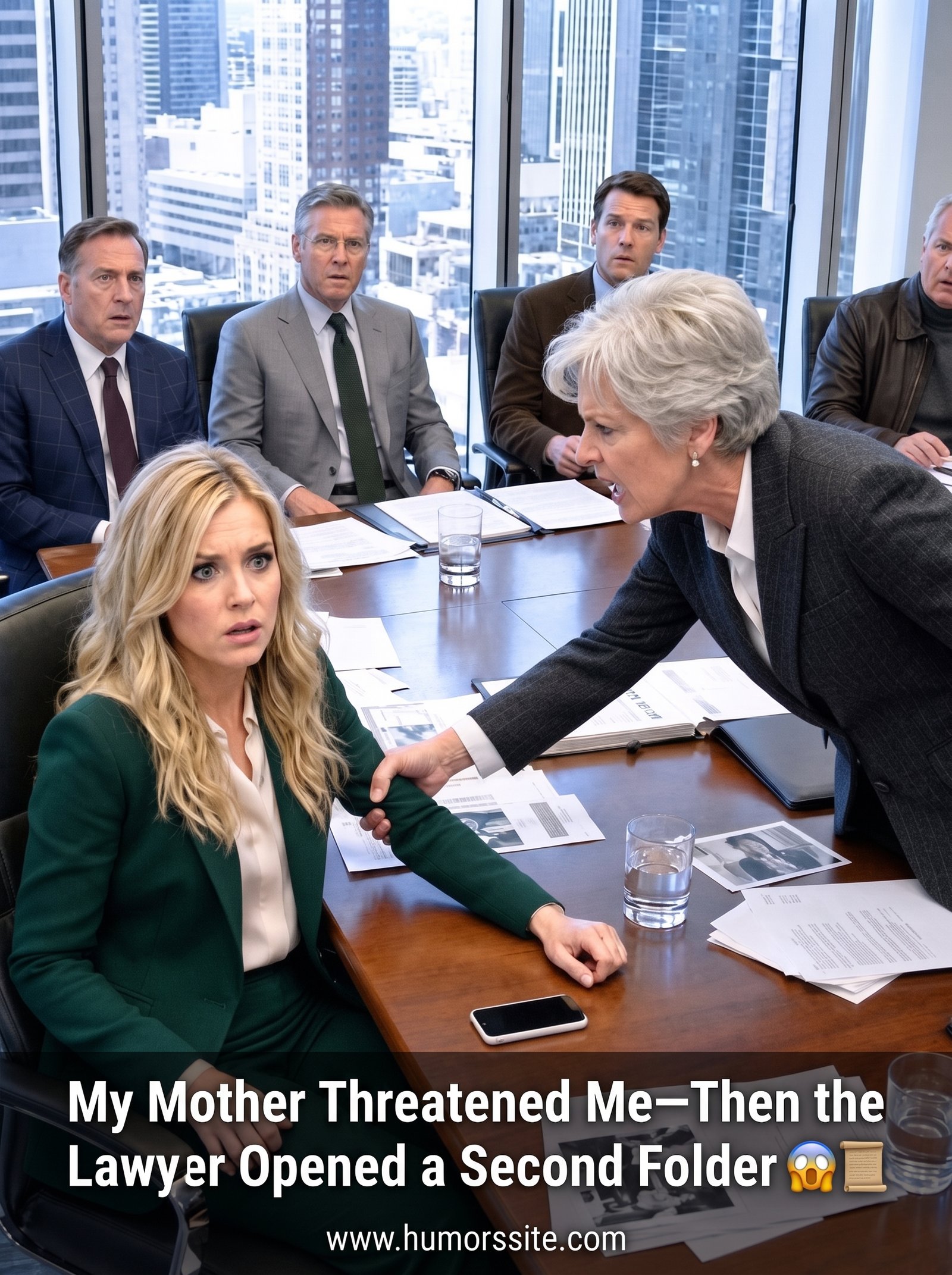
A week later, I entered attorney Silas Thorne’s office for the reading of Pearl’s will. Before anyone sat down, Miranda leaned close and tightened her fingers around my wrist.
“If you get a single cent, I will destroy you.”
For the first time since Pearl died, I looked directly into my mother’s eyes.
I had no idea which one of us was about to lose everything.
PART 2: THE WILL MY MOTHER NEVER EXPECTED
Attorney Silas Thorne’s office occupied the second floor of an old brick building downtown. When I entered the conference room, my mother was already seated beside him wearing Grandma Pearl’s earrings even though the will had not yet been opened, and the sight of them made my stomach tighten immediately.
As everyone settled into their seats, Miranda leaned toward me and pressed her fingernails into my wrist.
“If you get a single cent, I will destroy you.”
Then she sat back as though nothing had happened.
Attorney Thorne began reading Pearl’s original will in a calm, professional voice. According to that document, the house, savings, jewelry, furniture, books, and nearly everything else Grandma owned had been left to my mother, who would decide how the remaining belongings were distributed.
Miranda turned toward me with a small smile.
“See? My mother knew who was really there for her at the end.”
Then she stood and began speaking to the room as though she were delivering a heartfelt tribute instead of celebrating a victory. She talked about everything she had supposedly sacrificed during Pearl’s final months and painted herself as the devoted daughter who had stayed beside her until the end.
“Jade didn’t even visit her once in three months. My mother died wondering why she had been abandoned.”
Every word landed painfully because Miranda had spent those same months preventing me from seeing Pearl. Now she was using the isolation she created as proof that I had never cared.
For one terrible moment, I questioned myself. I wondered whether I should have borrowed money for a lawyer, pushed harder against Travis, or found some way to force myself into Pearl’s room despite everything Miranda had done to keep me away.
Then I noticed something strange.
Attorney Thorne had not closed the file.
Beneath the first stack of papers sat another folder secured with a bright red clip. The moment Miranda noticed it too, the confidence in her expression began to fade.
“Is there anything else?”
“There is.”
Attorney Thorne opened the second folder and arranged several documents across the table.
“This office also received an amendment signed three days before Pearl Sterling’s death, along with an irrevocable trust.”
The word trust seemed to drain the color from my mother’s face.
Attorney Thorne lowered his eyes to the document and continued.
“The trust names Jade Elena Sterling as the sole beneficiary of all savings and the property.”
Hearing my full name stunned me. Elena had been Pearl’s middle name, and in that moment it felt as though my grandmother had reached across the room one final time to remind me that she had never forgotten who I was.
Miranda shot to her feet so quickly that her chair scraped across the floor.
“That’s impossible! My mother was sedated. She couldn’t have signed anything.”
Attorney Thorne remained completely calm.
“The signature was witnessed by a certified nurse and validated by a licensed mobile notary.”
Then he looked toward the conference room door.
A woman stepped quietly inside and took the empty chair beside him.
I recognized her immediately.
She was the nurse who had approached me after Pearl’s funeral.
“My name is Megan. Pearl knew exactly what she was signing, and she specifically asked me to tell the truth if anyone questioned her wishes.”
The room fell completely silent.
For the first time that morning, Miranda had nothing to say. She was not simply losing an argument anymore.
She was watching the story she had spent months constructing begin to collapse in front of everyone.
PART 3: THE TRUTH PEARL PROTECTED
Megan introduced herself to everyone in the room and then looked directly at my mother. Her voice was steady as she explained that Miranda had taken Pearl’s phone, restricted my visits, and pressured her to sign documents when she was too weak to defend herself properly.
Miranda immediately denied everything, but the atmosphere had already changed. No one interrupted Megan, and no one rushed to defend my mother, which meant that for the first time in months, Miranda could not control the only version of events anyone was allowed to hear.
Attorney Thorne reached into the second folder and removed a photocopy of one of Pearl’s final diary pages.
“This is an excerpt from Pearl Sterling’s journal.”
Then he began reading.
“Miranda hasn’t let Jade visit me for more than two months, and she took my phone while I was sleeping.”
Hearing those words felt like hearing Grandma speak from across the room. She wrote that she still loved her daughter, but she would not allow Miranda to erase me from her life or inherit everything through manipulation.
Attorney Thorne continued.
“My granddaughter is the only person who has loved me without expecting anything in return.”
My mother’s posture changed almost immediately. Only minutes earlier, Miranda had looked completely certain of herself, but now her confidence was disappearing with every page that was read aloud.
The final entry was written directly to me.
Because Pearl had not been allowed to say goodbye in person, she had written the farewell instead. She explained that she had prepared everything in advance because she hoped the truth would protect me after she was gone, especially if Miranda tried to rewrite what had happened.
By the time Attorney Thorne finished, the story my mother had spent months constructing had collapsed in front of everyone. Miranda suddenly pointed at me with shaking hands.
“You manipulated her.”
I met her eyes without raising my voice.
“I didn’t speak to her for three months because you made sure I couldn’t, Mom.”
No one challenged me.
There was nothing left to argue about.
The diary, the trust, Megan’s testimony, the witnesses, and the notary had already answered every question that mattered.
I slowly stood from my chair.
“I’m not going to fight you. Grandma already made her decision. The only voice that matters in this room is hers, and I intend to honor her wishes.”
Then I turned toward Attorney Thorne.
“I accept the trust. I also want the locks on the house changed as soon as possible.”
He nodded.
“We’ll begin immediately.”
I walked out of the office without saying another word. For the first time in months, breathing felt easy again.
The truth spread through town much faster than I expected. People who had attended the reading began talking, and within days, the version Miranda had told everyone about me started falling apart.
A longtime family friend called to apologize.
“Pearl kept every Sunday card you mailed. She stored them in a basket beside her bed.”
I sat down on my living room floor and cried harder than I had at the funeral.
She had received them.
She knew I never stopped trying to reach her.
Travis quietly disappeared from Miranda’s side once he realized there was no inheritance left for him to defend. Before long, even members of our church knew what had happened, and my mother began sending emails asking whether we could somehow start over.
I never answered.
Some apologies do not repair trust.
They simply reopen the wound.
PART 4: THE HOUSE THAT STILL REMEMBERED ME
After the will reading, the consequences for Miranda unfolded quietly rather than dramatically. Travis gradually disappeared from her side once it became clear there was no inheritance left for him to defend, and people who had believed her version of events began reconsidering everything they had been told.
My mother sent several emails asking whether we could start over. I read each one, but I never answered because I had finally learned that an apology did not automatically rebuild trust, especially when the person apologizing had spent months controlling access, manipulating the truth, and using grief as leverage.
Some apologies do not repair what was broken.
Sometimes they simply reopen the wound.
The first time I returned to Grandma Pearl’s house alone, I stood outside for several minutes before unlocking the door. The place smelled exactly as I remembered, a mixture of old books, polished wood, and the quiet warmth that had always made her home feel safer than anywhere else.
Walking through those rooms brought back pieces of my childhood I had almost forgotten. I could picture Pearl moving through the kitchen, hear her voice correcting me when I used too much flour, and remember all the afternoons when she made me feel important simply by listening.
Then I entered her bedroom.
Inside one of the cabinets, I found fourteen handwritten diaries stacked neatly together. They covered years of Pearl’s life, and I sat on the edge of her bed before opening the final notebook.
On the last page, she had written something directly to me.
“Jade, if you’re reading this, my plan worked, so don’t be sad. And never let anyone make you feel small again.”
I pressed the diary against my chest and cried until there was nothing left to hold back.
For months, I had been haunted by the idea that Pearl died believing I had abandoned her. Now I knew she had understood what was happening, received my cards, protected the truth, and prepared a way for her wishes to survive even after Miranda tried to erase me from her final months.
Eventually, I moved into the house.
It was not because I wanted to claim some victory over my mother. I moved there because the house still felt like Pearl, and for the first time since her death, being inside those rooms made me feel connected to her instead of separated from her.
Most afternoons, I sat on the porch swing with one of her journals in my lap while the trees moved in the wind. Page by page, I began learning more about the woman Pearl had been beyond simply being my grandmother.
I also began changing the way I understood myself.
I no longer saw mys
elf as the granddaughter who had been kept away.
I saw myself as the granddaughter who had never stopped trying to come home.
PART 5: THE VOICE I FINALLY CHOSE TO KEEP
Over time, the house stopped feeling like a place where something terrible had happened and became home again. I spent long afternoons on Pearl’s porch swing reading through her journals, slowly replacing the version of my grandmother Miranda had tried to control with Pearl’s own words.
I learned about worries Pearl had never shared with me, moments from her younger years, and the quiet ways she had prepared for the possibility that my mother might try to isolate her completely. The more I read, the more I understood that the trust and amended will had not been impulsive acts made during her final days.
They had been protection.
Pearl knew Miranda better than I ever had, and she had prepared carefully enough that even after her death, her intentions could not easily be rewritten. The witnesses, the notary, the diaries, and the legal documents all existed because she understood that truth sometimes needed more than memory to survive.
My mother continued trying to reach me for a while. Some messages were apologetic, while others blamed Travis, the attorney, Megan, or even me for allowing the situation to become public.
I stopped trying to decide whether one version of Miranda was more genuine than another.
I also stopped waiting for her to become the mother I had always hoped she might eventually choose to be. That realization did not make me hate her, but it finally allowed me to stop measuring my peace by whether she approved of my choices.
There was grief in that acceptance, but there was freedom too.
For years, Miranda had been able to make me feel small with a single comment about my career, my finances, or my relationship with Pearl. I had spent too much of my life defending myself against accusations that were designed to keep me uncertain.
Pearl had spent just as many years teaching me the opposite.
“Never let anyone make you feel small.”
Those words had followed me through childhood, but I had never fully understood them until after her death. Pearl had not been telling me that other people would always treat me fairly; she had been teaching me that their judgment did not get to define my value.
When I thought about her final months, I no longer pictured myself standing helplessly outside a locked door. I remembered the Sunday cards I kept sending, the phone calls I refused to stop making, and the drive to Beaufort when I learned she had entered palliative care.
I had not abandoned her.
I had kept trying to reach her until there was no time left.
One evening, I sat alone on the porch swing with Pearl’s final diary resting on my lap. The old trees moved gently in the wind, and the house behind me was quiet.
I opened the notebook to the last page again.
“Jade, if you’re reading this, my plan worked, so don’t be sad. And never let anyone make you feel small again.”
This time, I did not cry.
I closed the journal and looked out across the porch, finally understanding that Pearl had given me more than property or an inheritance. She had left me proof that I had been loved, believed, and remembered even when someone else tried to convince me otherwise.
When I think about those months now, I no longer remember myself as the granddaughter who was kept away. I remember the granddaughter who never stopped trying to come home.
And whenever Pearl’s words return to me, they no longer sound like a warning.
They sound like permission.
“Never let anyone make you feel small.”
This time, I finally listened.