My Grandma’s “Worthless” Savings Book Called the Police 📖🚨

PART 1: THE BOOKLET THEY THREW INTO THE GRAVE

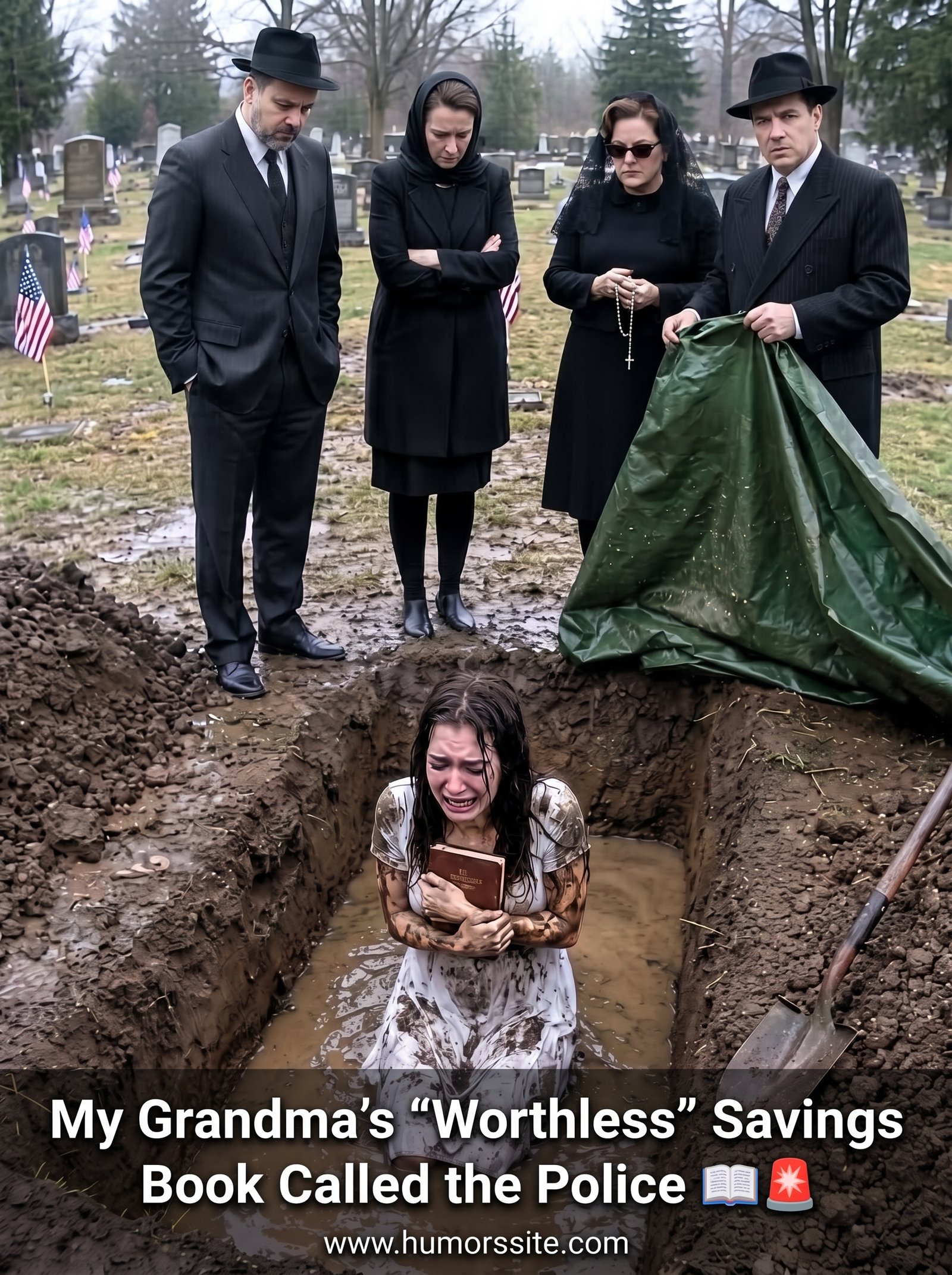
My father waited until Grandma Lupita’s funeral was nearly finished before tossing her small blue savings booklet onto the open coffin. Rain had turned the cemetery into mud, and everyone under the funeral tent watched silently as it landed beside the woman who had raised me.

“That booklet is worthless. Let it rot with the old woman.”

Not one of my uncles, cousins, or even the priest challenged him. They stared at the booklet as though it were trash instead of the one thing Doña Guadalupe had specifically named as my inheritance.

I was twenty-seven, wearing a borrowed black dress and standing in rain so cold my fingers had gone numb. My father, Víctor Salazar, adjusted his gloves and gave me the familiar dismissive smile he had used throughout my childhood whenever he wanted me to believe I was overreacting.

“There’s your inheritance, Mariana. An old booklet. No house, no land, no money. Your grandmother always loved being mysterious.”

My stepmother Patricia laughed quietly behind her sunglasses, while my half-brother Diego joked that if there were fifty pesos inside, I owed him tacos. Several relatives laughed with them, but I kept thinking about the words our family notary had read only twenty minutes earlier.

“To my granddaughter Mariana Salazar, I leave my savings booklet and all rights connected to it.”

Grandma had left my father nothing, which explained the anger he was trying to disguise. She had raised me after my mother died in a car accident when I was five, teaching me how to cook, manage bills, read documents carefully, and never allow intimidation to make decisions for me.

One week before she died, Grandma had squeezed my hand inside her hospital room and given me one final instruction.

“When they laugh, let them. Then go to the bank.”

At the time, I had not understood what she meant. Standing beside her grave and looking at the muddy booklet on her coffin, I suddenly remembered every word.

I stepped forward, but Dad grabbed my arm.

“Don’t you dare.”

I looked directly at him.

“Let go of me.”

His grip tightened.

“Don’t humiliate yourself in front of everyone, Mariana.”

“You already did that for me.”

I carefully stepped toward the coffin, picked up the booklet, and brushed away the worst of the mud before pressing it against my chest. Dad moved closer, the smell of tequila heavy on his breath.

“Your grandmother couldn’t even save her own house. You really think she saved you?”

Instead of humiliating me, those words made something click into place. Grandma had known exactly how he would react.

“It was hers. Now it’s mine.”

I placed the booklet inside my bag and headed toward the cemetery gate. When Diego blocked my path and asked where I thought I was going, I looked past him toward the rain-covered street.

“To the bank.”

Everyone laughed as I walked away, with Dad laughing louder than anyone. Only Licenciado Arriaga remained serious, watching me leave with an expression that made me wonder whether he already knew what I was about to discover.

An hour later, I entered a Banco del Bajío branch in downtown Querétaro with my dress still damp from the cemetery. I handed the booklet to a teller named Maribel and explained that it had belonged to my grandmother.

She opened it and began checking the information.

Then she read my full name.

The color drained from her face.

Maribel looked at me, then back at the booklet, and reached for the telephone with trembling hands.

“Call the police. Lock the door. The young woman cannot leave.”

My stomach dropped.

“Why are you calling the police? Did I do something wrong?”

She hurried around the counter and lowered her voice.

“No, Miss Mariana. This account has had special instructions for many years.”

The branch manager, Carmen Rivas, escorted me into a private office and carefully placed Grandma’s booklet on the desk. She explained that my grandmother had created instructions requiring the bank to verify my identity, notify authorities, and protect the related documents if I ever arrived carrying the original booklet.

“Protect them from whom?”

Carmen lowered her eyes.

I already knew.

“From my father.”

Her silence confirmed it.

Then she told me something that changed my understanding of my childhood.

Víctor had tried to close the account three times.

The first time, I had been thirteen years old.

He had presented the bank with my death certificate.

A fake one.

Before I could fully process that, two investigators arrived and assured me I was not under arrest. Then Licenciado Arriaga entered carrying a yellow envelope Grandma had instructed him to give me only if I reached the bank by my own choice.

Inside was a small key and a handwritten letter.

“My girl, if you are reading this, it is because you were braver than they believed. That booklet is not money. It is a door.”

The rest of the letter said my father had stolen what my mother left me, taken Grandma’s house and important documents, and spent years trying to convince me none of it had ever belonged to me.

I read the letter twice through tears.

The booklet my father had thrown into Grandma’s grave was not the inheritance.

It was the key to everything he had tried to bury.


PART 2: THE VAULT MY FATHER TRIED TO ERASE

The branch manager, Carmen Rivas, kept Grandma Lupita’s muddy blue booklet on the desk between us as though it were evidence rather than an old savings record. She explained that the bank had been instructed years earlier to protect anything connected to the account if I ever appeared in person with the original booklet.

Then she told me what my father had done.

Víctor had tried to close the account three separate times. The first attempt came when I was thirteen, when he submitted a fake death certificate carrying my full legal name.

“That’s impossible. I was alive.”

“You were thirteen. Your grandmother brought you here the next day and demanded that nothing ever be released unless the bank saw you in person.”

The memory returned slowly. I remembered sitting beside Grandma in a bank lobby, a teller handing me tamarind candy, and Grandma crying on the bus ride home while insisting her eyes were irritated by allergies.

At thirteen, I believed her.

At twenty-seven, I understood that my own father had tried to convince a bank I was dead.

Two investigators arrived soon afterward, and Commander Valeria Montes immediately assured me that I was not under arrest. The bank’s alert had existed for years specifically to protect me if I ever appeared carrying the original booklet.

Then Licenciado Arriaga came inside, soaked from the rain and carrying the yellow envelope Grandma had left for me. Inside were the small key and the letter explaining that the booklet was not the inheritance itself, but the doorway to everything Víctor had tried to hide.

Carmen led us into the bank vault.
The key from Grandma’s envelope opened safe-deposit box 117 together with the bank’s matching key. There was no jewelry or stack of cash inside, only several carefully organized envelopes filled with documents.

The first envelope was labeled:

FOR MARIANA — MONEY

Inside were old investment certificates, insurance records, bank statements, and financial documents reaching back years. At the bottom was a balance so large that I assumed I had misread it.

23,480,000 pesos.

“That can’t be right.”

Carmen shook her head.

“Yes, it can. Your mother had insurance, investments, and property. Your grandmother protected everything through financial instruments and lived modestly so your father would never suspect how much remained.”

I thought about Grandma wearing the same patched sweater year after year and stretching groceries farther than anyone should have needed to. She had made poverty look convincing because appearing to have nothing had been the safest way to protect what belonged to me.

Then I opened the second envelope.

THE HOUSE

Inside was the deed to the white house in Colonia Álamos, the place surrounded by bougainvilleas where some of my earliest memories of my mother still lived. Dad had sold it when I was thirteen and told me Grandma could no longer afford to keep it.

The deed proved something completely different.

The house had never belonged to Grandma.

It belonged to me.

My mother had placed it in trust before she died.

“Then how did he sell it?”

Licenciado Arriaga’s expression hardened.

“Forged documents. False powers of attorney, fabricated signatures, and a company connected to Patricia’s brother.”

I could barely process what he was telling me. My father had not merely hidden an inheritance, he had apparently constructed an entire system of false paperwork around money and property that legally belonged to his daughter.

Then someone began pounding against the bank’s locked front doors.

“Open up! My daughter is stealing family documents!”

I moved toward the blinds and saw Víctor outside in the rain with Patricia beside him and Diego recording everything on his phone. Dad spotted me through the glass and silently formed one word with his mouth.

“Mine.”

Commander Montes walked toward the entrance with two officers.

“Víctor Salazar, come with us.”

Dad immediately protested.

“This is a family matter.”

Commander Montes did not hesitate.

“No. This is evidence now.”

Patricia tried to retreat toward the parking lot, but another officer stopped her. Diego slowly lowered his phone, finally beginning to understand that whatever his father had expected to control was no longer staying inside the family.

There was still one envelope left inside Grandma’s safe-deposit box.

Its label made my stomach tighten.

FOR THE POLICE — ABOUT LIDIA

Lidia was my mother.

Commander Montes put on gloves before opening it. Inside were photographs of the car in which my mother had died, receipts from a mechanic, and a USB drive Grandma had preserved for more than twenty years.

The commander studied the contents before looking directly at me.

“Mariana, this may change everything you believe about your mother’s death.”

Outside, my father began shouting my name from the patrol car.

For twenty-two years, I had believed my mother died in a tragic accident on a wet road.

Grandma Lupita had spent those same twenty-two years protecting evidence that suggested otherwise.


PART 3: THE TRUTH MY GRANDMOTHER REFUSED TO LET DIE

The USB drive contained recordings Grandma Lupita had secretly preserved over the years. In the first one, I heard her confronting my father about the accounts he had tried to seize and the false death certificate he once submitted using my name.

“I know about the accounts, Víctor. I know you tried to declare Mariana dead.”

“You can’t prove anything, old woman.”

Grandma’s voice remained steady.

“I also know Lidia wanted to leave you.”

For several seconds, the recording contained nothing but silence. Then my father answered in a voice so cold that my stomach tightened.

“Some women learn too late what happens when they want to leave.”

Those words changed everything I had believed about my mother’s death. For twenty-two years, I had been told Lidia died in a tragic accident on a rain-soaked road, but Grandma’s evidence suggested the weather had not been the only reason she never came home.

Investigators reopened the case and began examining records that had remained buried for decades. They found payments Víctor had made to a mechanic shortly before the crash, photographs showing damage to the brake line that never appeared in the original investigation, and indications that parts of the old case file had been altered.

The mechanic was elderly and seriously ill by then, but he eventually admitted that my father had paid him to interfere with the car. According to him, Víctor wanted to frighten Lidia into abandoning her plan to leave with me and the house, not cause her death, but heavy rain turned his intimidation into something irreversible.

When Commander Montes explained what the evidence showed, I did not cry. I sat silently with Grandma’s muddy blue booklet in front of me and thought about how casually my father had thrown it into her coffin, believing he was discarding something worthless.

Justice moved slowly after that. Months passed through interviews, hearings, legal filings, and arguments from relatives who insisted that family problems belonged inside the family, but Grandma had spent years preserving evidence precisely because she knew silence would protect Víctor more than it protected us.

The bank confirmed his repeated attempts to take control of my accounts, while Licenciado Arriaga established that the sale of my house had relied on forged documents. Investigators also found evidence on Patricia’s computer connecting her to attempts to access accounts after deaths, challenge inheritances through claims of incapacity, and eliminate old savings records.

Even Diego eventually testified.

“My dad hated Mariana because she looked like Lidia.”

Hearing that hurt more than I expected because years of cruelty suddenly made a terrible kind of sense. Every time my father looked at me, he had apparently seen the woman who once tried to escape him.

The jury eventually heard another recording Grandma had preserved.

“Tell me why, Víctor.”

“Because she was going to take what was mine.”

“Lidia was not yours.”

“My daughter wasn’t going to be hers either.”

Grandma pressed him further.

“Did you cut the brakes?”

A long silence followed.

“She chose to drive.”

The courtroom went completely still.

For decades, my father had hidden behind forged papers, intimidation, and the expectation that family loyalty would keep everyone quiet. Grandma had defeated that strategy by making sure his own words survived long enough to be heard.

Víctor was ultimately convicted of fraud, forgery, financial exploitation of an elderly adult, and homicide. Patricia also received a prison sentence for conspiracy, while her brother became implicated through the fraudulent property transaction.

At my father’s sentencing, I stood before the judge holding the same blue booklet he had once thrown into Grandma Lupita’s grave.

“My father called this worthless. But it carried my grandmother’s courage, my mother’s protection, and the truth he tried to bury.”

I tightened my fingers around the stained cover.

“He just didn’t bury it deep enough.”

PART 4: THE HOUSE THAT CAME BACK TO ME

Several months after the trial, the house in Colonia Álamos was legally returned to me. Years of neglect had left the paint peeling and the bougainvilleas growing wildly around the property, but the moment I stepped through the front door, I felt as though a forgotten piece of my childhood had been waiting patiently for me to come back.

The rooms were smaller than I remembered, and the walls carried the faded marks of time. In the kitchen, however, one detail remained exactly where Grandma Lupita had left it.

There were pencil lines on the wall measuring my height.

“Mariana, 4 years old.”

A little higher was another.

“Mariana, 5 years old.”

Then I saw a faded line above both of them.

“Lidia, first key, 19 years old.”

That was when I finally cried.

Not because of the money my father had tried to steal, and not because of the years I had spent believing his version of the past. I cried because something I had assumed was gone forever had found its way back to me.

The inheritance was eventually restored as well, including the money Grandma had protected so carefully. But by then, twenty-three million pesos no longer felt like the most important thing she had saved.

She had protected proof.

She had protected choices.

Most of all, she had protected my ability to decide what happened next.

I used part of the recovered inheritance to establish a foundation in the names of Guadalupe and Lidia. Its purpose was simple: to help women and children trying to escape violence and financial exploitation inside their own families.

The first woman who came through our doors was named Ana. She carried a sleeping baby against her chest and kept adjusting her makeup as though she were trying to conceal a bruise beneath it.

“Sorry to bother you.”

I placed a folder containing information about housing, legal assistance, and financial support in front of her.

“You don’t have to apologize here.”

As soon as I said it, I understood what Grandma Lupita had actually left me.

The inheritance was not just property, money, or a restored house. It was the ability to turn something she had protected for me into protection for someone else.

Eventually, I framed the blue savings booklet and hung it near the entrance of the restored house. I deliberately left one stain of cemetery mud on the cover because I no longer saw it as something ugly.

It was evidence of what the booklet had survived.

Beneath the frame, I had Grandma’s final instruction engraved.

“When they laugh, let them. Then go to the bank.”

Visitors sometimes asked why I displayed something so important instead of locking it away. My answer was always the same: that booklet had already spent enough years hidden in fear.

Grandma had never protected it so I could spend the rest of my life terrified of losing it.

She had protected it so I would finally understand that something does not become worthless simply because someone powerful says it is.

And for the first time in my life, I understood that sharing blood with someone never gave them the right to take what belonged to me.


PART 5: WHAT GRANDMA HAD REALLY SAVED

For years, my family had hidden terrible things behind familiar phrases about respect, loyalty, and keeping private matters inside the home. I had grown up hearing that good daughters did not question their fathers and that family problems should never be exposed to strangers, but I finally understood how easily those ideas could be used to protect control instead of love.

My father had depended on that silence. He believed that being my parent gave him authority over my money, my inheritance, my memories, and even the story of what had happened to my mother.

Grandma Lupita had believed something very different.

She had known that truth sometimes needed time, documents, witnesses, and patience. That was why she saved the bank records, protected the house papers, preserved the recordings, and made sure the blue booklet would eventually lead me to all of it.

Looking back, I realized that almost every lesson she taught me as a child had prepared me for that moment. When she told me never to sign something I had not read, to keep copies of important papers, and to look people in the eye when they tried to frighten me, I thought she was simply teaching me how to be careful.

She was teaching me how to survive my own family.

The restored house slowly became more than a piece of property I had recovered through the courts. I repaired the walls, cleared the overgrown garden, and kept the old pencil markings in the kitchen exactly as they were because they connected three generations of women who had once lived beneath that roof.

The foundation grew there as well. Women arrived carrying folders, children, unpaid bills, court notices, and stories they had spent years being told were too embarrassing to speak aloud.

Every time someone apologized for needing help, I remembered Ana.

“You don’t have to apologize here.”

Those words became something of a rule inside the building.

We helped women recover identification papers, understand accounts opened in their names, find temporary housing, and speak with lawyers when family members had used money or paperwork to control them. Each case was different, but many began with the same belief I had once carried: that resisting a relative somehow made you disloyal.

I knew better now.

One afternoon, I stood near the entrance and looked at Grandma’s framed savings booklet. The cemetery mud was still visible on one corner, exactly where I had chosen to leave it.

Beneath it were her words.

“When they laugh, let them. Then go to the bank.”

People occasionally asked why I kept such an important object in public instead of placing it inside a safe. I told them that the booklet had spent enough years hidden and that Grandma had not protected it so I could remain afraid forever.

She had protected it so I would understand what my father never did.

Value does not disappear because someone powerful declares something worthless.

Ownership does not disappear because someone related to you decides they deserve what is yours.

And truth does not disappear simply because a family agrees not to speak about it.

My father threw that booklet into Grandma Lupita’s grave believing he was burying the final threat to everything he had built on lies. Instead, he handed me the exact object that led me back to my mother, my inheritance, my home, and the truth.

What he never understood was that Grandma had spent decades preparing for that moment.

A truth can remain hidden for years.

But once someone finally has the courage to uncover it, no family name, money, intimidation, or carefully constructed lie can force it underground again.

Related Posts

Leave a Reply

Your email address will not be published. Required fields are marked *