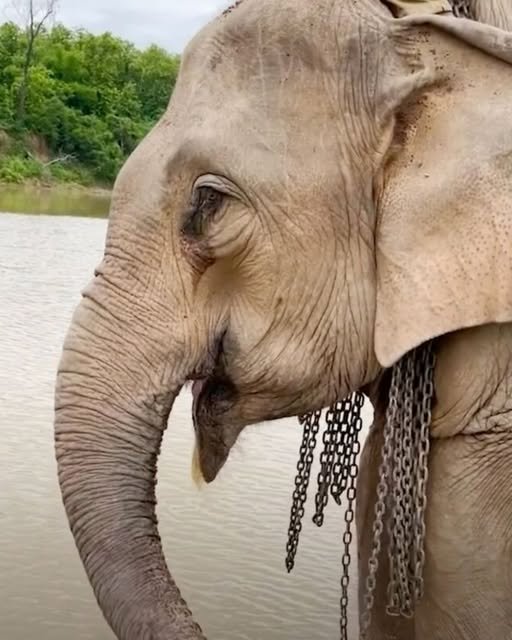
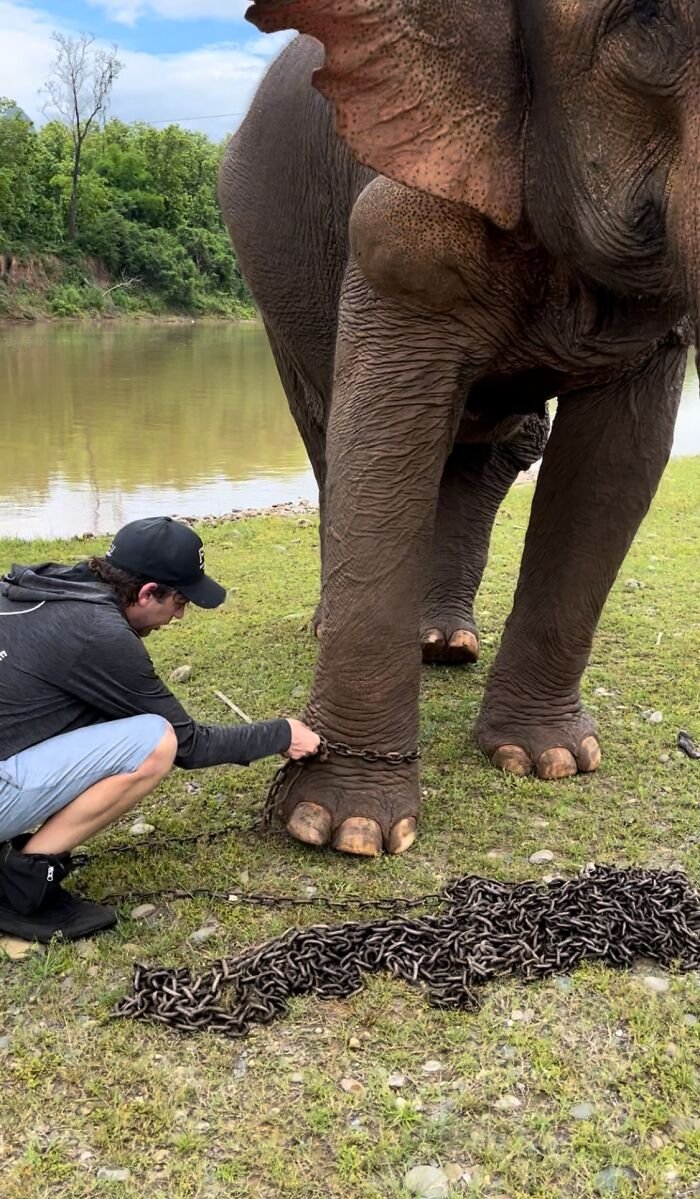
For 41 long years, Mare Noi knew nothing but the weight of chains. She had never felt the cool mud beneath her feet or the warmth of the sun without restraint. Her days were spent in servitude — first as a logging elephant, then as a breeding animal — her legs bound, her spirit fading beneath the clinking sound of metal that became the rhythm of her life.
But that sound is gone now.
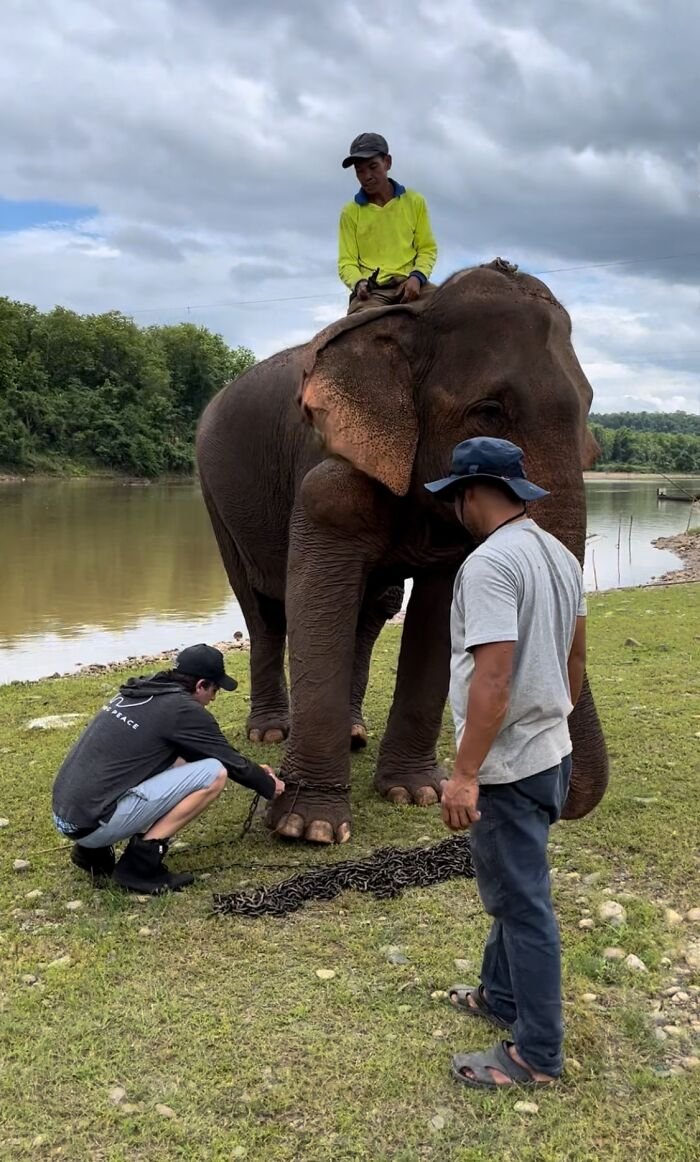
In a video that has since melted hearts across the world, Mare Noi — a gentle Asian elephant rescued in Thailand — takes her first free steps. Each movement is hesitant at first, almost disbelieving, as though her body cannot comprehend that it is finally allowed to move without pain. Then, slowly, her steps grow stronger, more confident. The chains that once marked her existence are gone, replaced by the sound of leaves underfoot, wind in the trees, and a freedom she had waited over four decades to feel.
“You are looking at the newest free elephant in the world,” says Aaron Jackson, founder of Planting Peace, the nonprofit organization that rescued Mare Noi. “This is her first time walking free.”
The short clip, filmed in Thailand, quickly went viral — viewed by millions, shared across continents, and accompanied by an outpouring of emotion from people who could hardly believe what they were witnessing. Tears and comments flooded in:
“I’ve never cried so hard over an elephant before,” one viewer wrote. “You can see the relief in her body — she finally understands she’s safe.”
The Chains of Exploitation
Thailand, known globally for its breathtaking beauty, tropical beaches, and rich culture, hides a darker reality behind the postcard-perfect scenes. It is also home to one of the world’s largest populations of captive elephants — between 3,000 and 4,000 of them — used in tourism, logging, and entertainment.
With fewer than 50,000 Asian elephants left in the wild, many of these gentle giants spend their lives in captivity, enduring harsh conditions, cruel training, and years of isolation. For some, like Mare Noi, their captivity stretches over generations.
“She was enslaved as a riding elephant,” Aaron Jackson wrote on his Facebook page. “Her feet were in chains for roughly 30 years before Planting Peace took them off for good.”
Mare Noi’s rescue is just one of many undertaken by Planting Peace, a U.S.-based humanitarian organization founded in 2004 by Aaron Jackson and Haitian humanitarian John Louis Dieubon. Their mission — “to spread peace in a hurting world” — spans from global equality campaigns to wildlife protection efforts like this one.
But among their many acts of compassion, Mare Noi’s story stands apart — because her first steps to freedom represent the silent liberation of thousands of other elephants still waiting for the same chance.
A Symbol of Redemption
The rescue was not simple. It took months of negotiation, logistics, and financial resources to secure Mare Noi’s release from her former owners. Once freed, she was transported to a protected sanctuary, where she could live safely among other elephants, free from human exploitation.
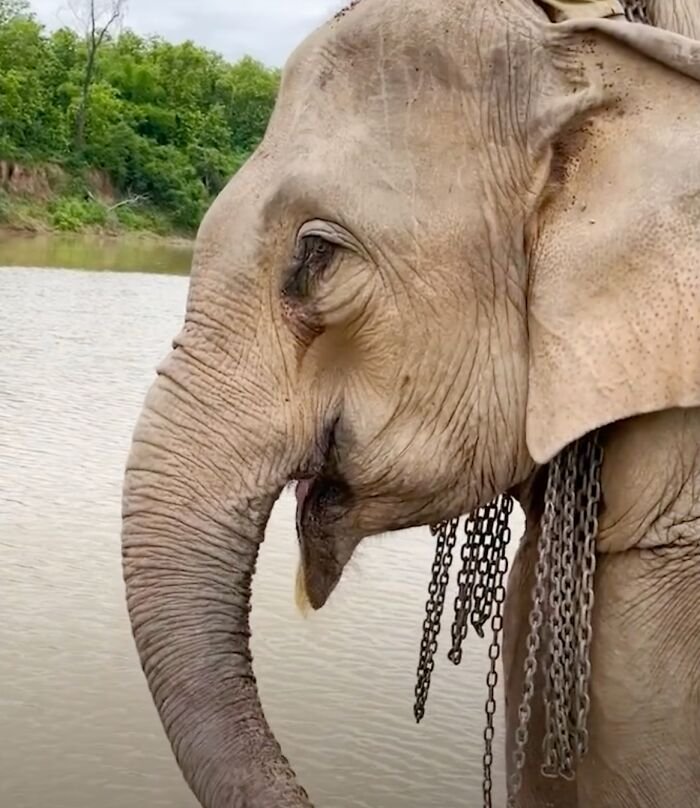
When the final chain was lifted from her legs, witnesses say she paused, as if unsure what to do. Then she took a step — one deliberate, trembling step — and the world seemed to exhale with her.
“It’s like watching someone breathe for the first time,” Jackson said. “You realize how unnatural captivity is when you see what freedom looks like.”
Not an Isolated Story — The Plight of Jong
Planting Peace’s work didn’t end with Mare Noi. Another elephant, Jong, was found chained to a tree at an abandoned elephant riding camp that had closed during the COVID-19 pandemic. When rescuers found her, she was starving.
“Elephants won’t eat where they use the bathroom,” Aaron explained. “Being chained to a tree with no one moving her is why she is 50 percent underweight.”
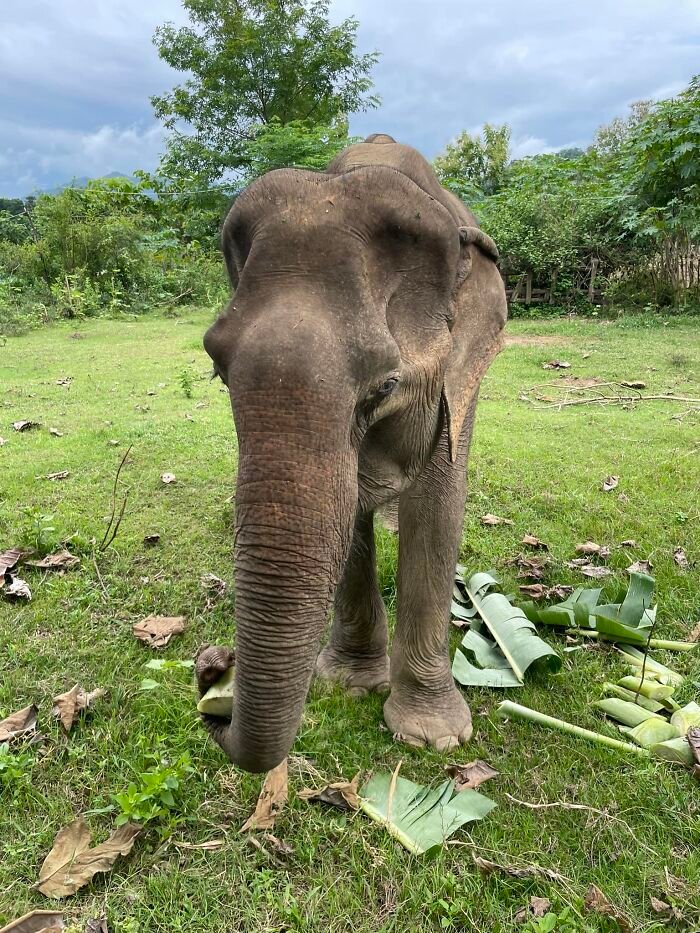
Jong’s frail frame told her story — ribs visible, her skull sunken from malnutrition, and one eye blind from an old wound. She had been struck by her caretaker with a metal chain during an abusive episode, leaving her permanently scarred.
Her suffering ended only when a compassionate donor provided the funds to purchase her freedom. After 50 years in chains, Jong was finally released to the same sanctuary that had welcomed Mare Noi. There, she began to heal — physically and emotionally — surrounded by trees, open sky, and kindness for the first time in her life.
The Long Road to Healing
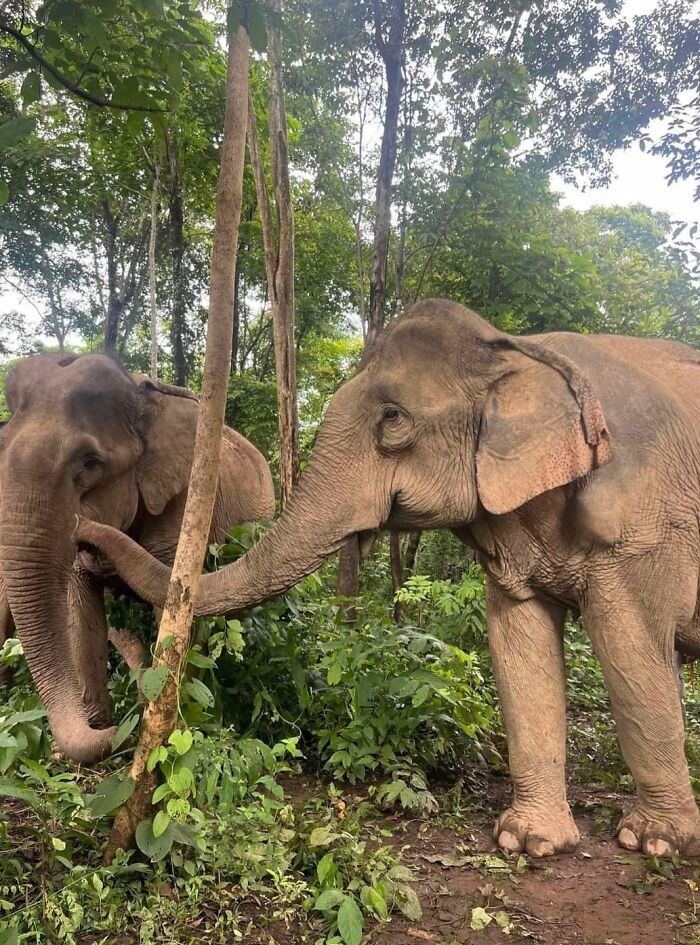
Both Mare Noi and Jong symbolize more than just rescue; they represent the enduring hope of all captive elephants still waiting for liberation. Rehabilitation is a slow process. For elephants that have spent decades in chains, freedom itself can feel foreign.
In sanctuaries, caregivers often note that newly rescued elephants take time to relearn how to walk properly, to trust humans, and even to sleep lying down — something they often forget to do in captivity because of constant fear.
“They’ve lived their whole lives thinking pain is normal,” one caregiver said. “So when the pain stops, they don’t quite know what to do with it.”
For Mare Noi, her days now begin with gentle sunshine and the company of other elephants — animals who, like her, have endured years of exploitation and emerged into freedom. She roams the open fields, dusts herself with red earth, and splashes water over her body, behaviors she had been denied for decades.
Her keepers describe her as calm and curious, often standing by the fence line to watch other elephants graze. “Every time she takes a step, it’s a reminder that patience and compassion can undo even 40 years of cruelty,” Jackson said.
A Movement of Compassion
The video of Mare Noi’s first steps did more than capture hearts; it reignited a global conversation about ethical tourism and animal welfare in Thailand. Many tourists visiting the region are unaware that popular elephant rides and performances often come at the cost of immense suffering.
Animal rights groups have long campaigned to shift tourism toward sanctuaries that promote observation rather than exploitation — allowing elephants to live naturally and interact safely without forced labor or human entertainment.

Planting Peace and other organizations like Save Elephant Foundation and Elephant Nature Park continue to work tirelessly to rescue and rehabilitate elephants trapped in abusive conditions, relying on donations and awareness campaigns to fund their missions.
Each rescue is costly, each rehabilitation long and complex — but the outcome, as Mare Noi’s story shows, is priceless.
A New Beginning
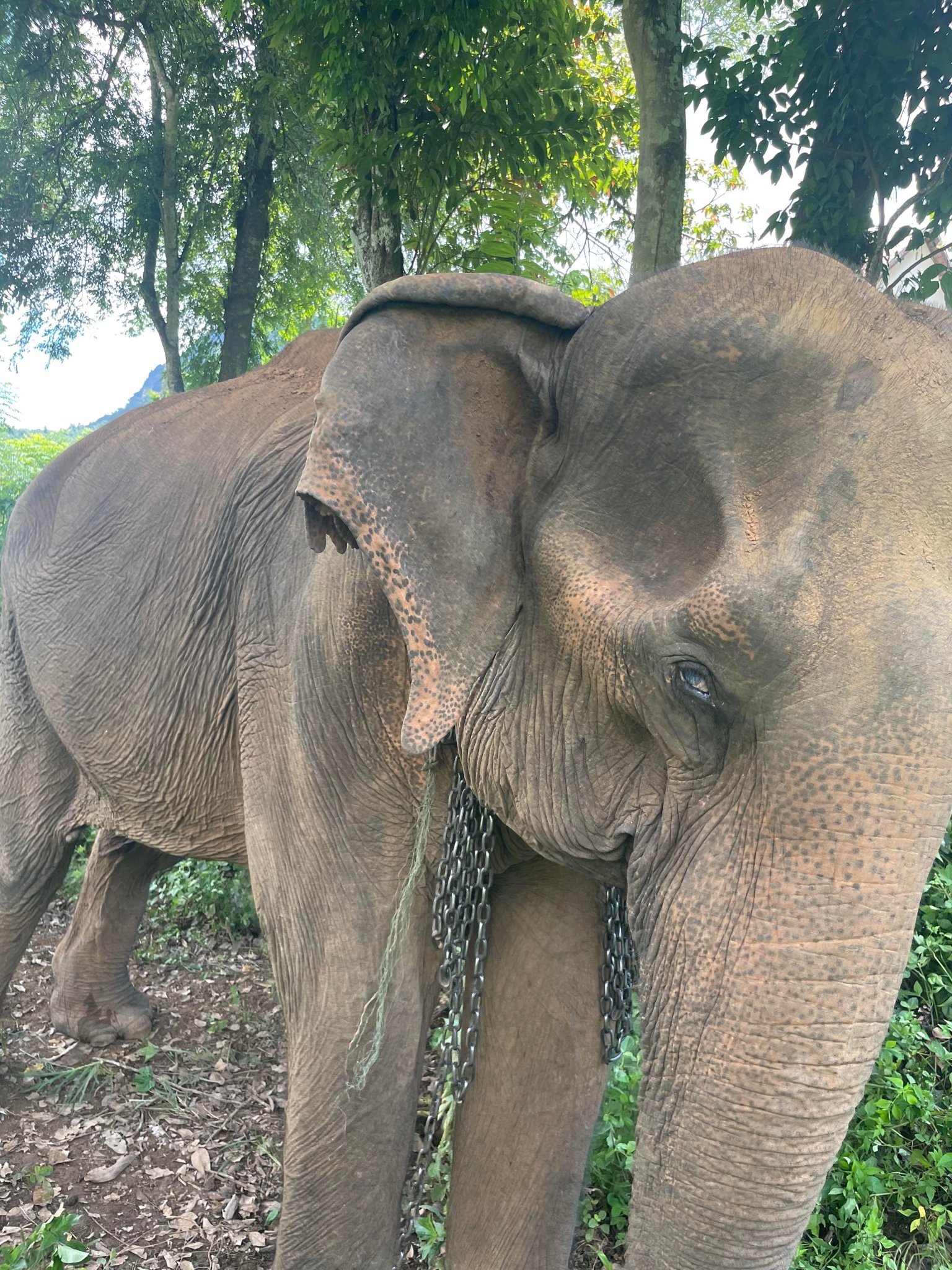
As dusk settles over her sanctuary in northern Thailand, Mare Noi now stands surrounded by trees rather than chains. She grazes slowly, her trunk swaying gently in the breeze. In the background, another elephant calls — a sound that once might have been drowned by human noise, but now echoes freely through the open air.
Her story, captured in that single viral video, has become a global testament to endurance, empathy, and the belief that no creature is beyond saving.
“She walked for the first time without chains,” Aaron Jackson said. “And in doing so, she taught us what freedom really means.”
In a world too often defined by cruelty and indifference, the sight of an old elephant taking her first free steps reminds us of something profoundly simple yet powerful — that freedom, once given, heals everything.
And as millions watched Mare Noi walk, each step seemed to say what words could not: after 41 years in chains, the world still has room for miracles.
“Born Perfectly Different: A Mother’s Love Story for Baby Mia” – 644
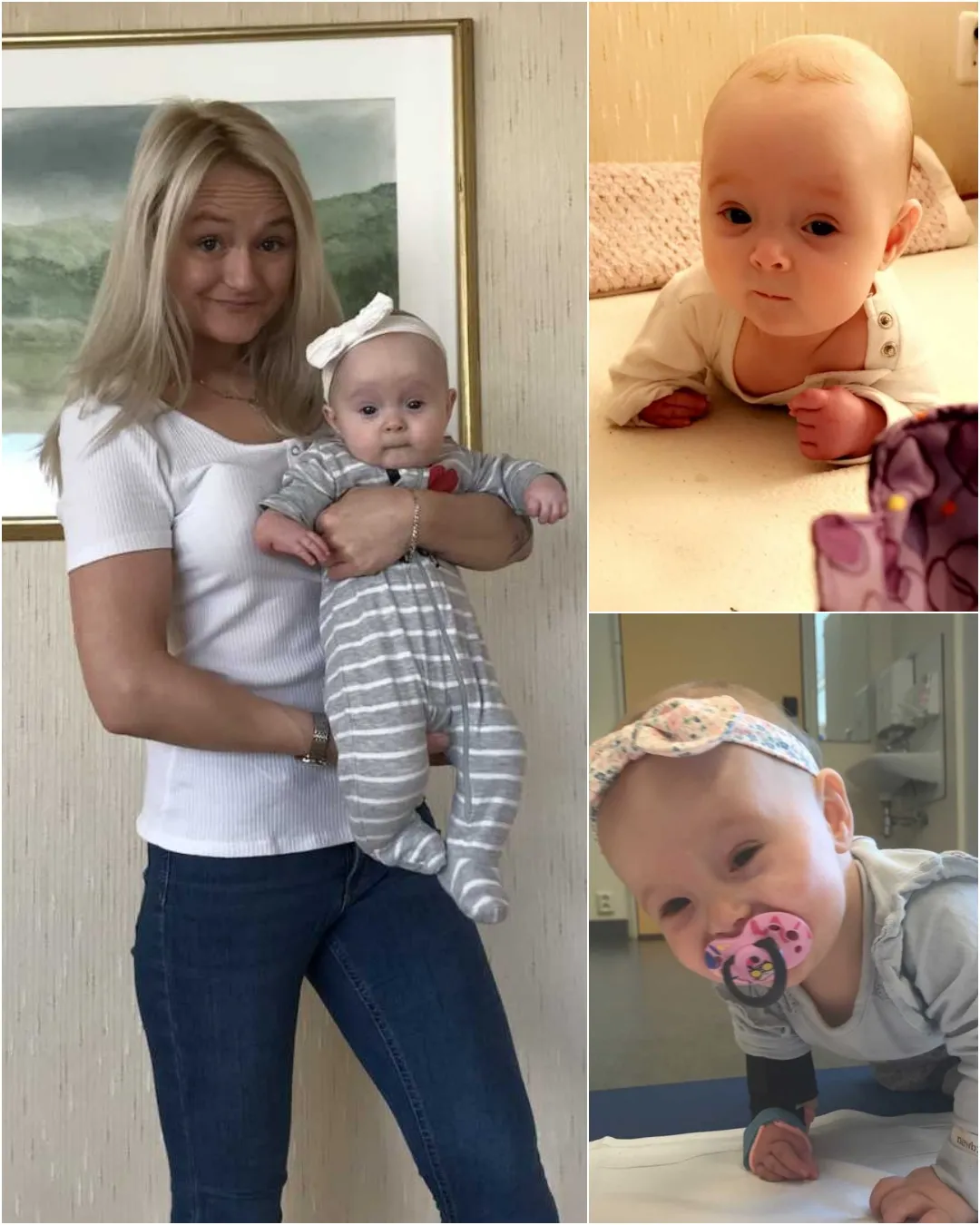
When the nurse placed the tiny newborn on her mother’s chest, time seemed to stop.
For one breathtaking moment, all that existed was love — until the room fell quiet.
“They put Mia on my stomach,” her mother recalls softly. “We saw her hand and her foot were different before they took her away. It was the longest hour of my life.”
That single hour — filled with uncertainty, fear, and aching silence — would become the beginning of a lifelong story about courage, acceptance, and the beauty of difference.
A Norwegian Heart Meets an Irish Soul
The story begins not in a hospital, but under the warm sun of southern Spain.
A young Norwegian woman from Hordaland, restless and full of life, met a man from Dublin who would soon become her home. She was 26, he was 32. She describes him as her “best friend,” and from the first moment, their laughter came easy.
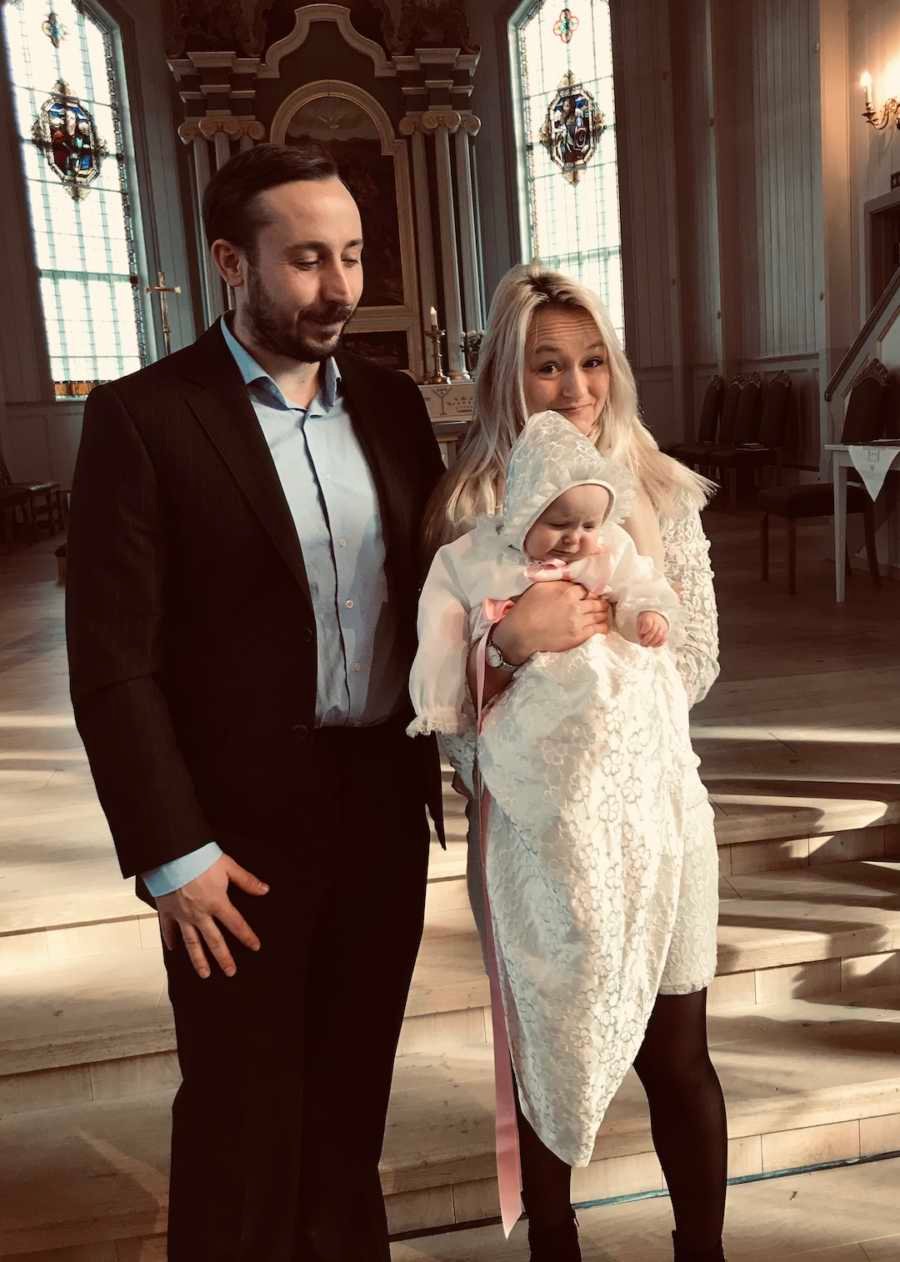
They built a life together in Fuengirola, a coastal town where the sea sparkled and dreams felt possible. But beneath the sunshine and spontaneity, something deeper grew — the desire to settle down, to start a family.
“I had traveled enough,” she says. “I had done everything I wanted to do before becoming responsible for somebody else. I was ready to live the quiet family life.”
So when the pregnancy test turned positive, the world shifted. Two people from opposite ends of Europe suddenly shared one small, growing heartbeat.
A Dream Pregnancy
Pregnancy came easily, almost blissfully.
“I didn’t have any issues or morning sickness,” she remembers. “Just 20 extra kilos, a big belly, and some lovely kicks that made me grateful every day.”
She calls it “a dream pregnancy.”
There were no warning signs — no medical alerts, no strange scans. Every check-up said “perfect.” Every heartbeat sounded steady. Every ultrasound picture painted the same promise: a healthy baby girl.
They named her Mia.
And together, the couple faced their next decision — where to raise her.
With family ties stretching between Norway and Ireland, they weighed their options carefully. Eventually, they chose Norway. “We thought it would be best for a start,” she explains. “And since Mia came a little different than expected, we are so happy we did. Norway has an amazing health care system.”
An Unexpected Labor
Two months before her due date, back pain woke her in the middle of the night.
“It just felt like I had gone to the gym the day before,” she laughs. “I never thought it was labor.”
Still, she decided to go for a check-up — “just to be sure.” Within minutes of arriving, the doctors realized she was in active labor. Her baby was coming early.
Since the local hospital wasn’t equipped for premature deliveries, she was rushed to a larger facility with an intensive care unit for newborns.
“They tried to stop the labor,” she says. “But after some hours, they realized they needed to let it happen because Mia’s heartbeat was slowing down.”
The doctor looked at her calmly and said, “You will have your daughter very soon.”
She didn’t believe him.
“I was in no pain at all. Even when he told me to start pushing, I couldn’t believe it.”
She smiles as she adds, “After giving birth, I like to say that for me, it was less painful than stepping on a Lego.”
The Longest Hour
Mia arrived — tiny, pink, and perfect in her parents’ eyes.
But almost immediately, the doctors noticed something unusual.
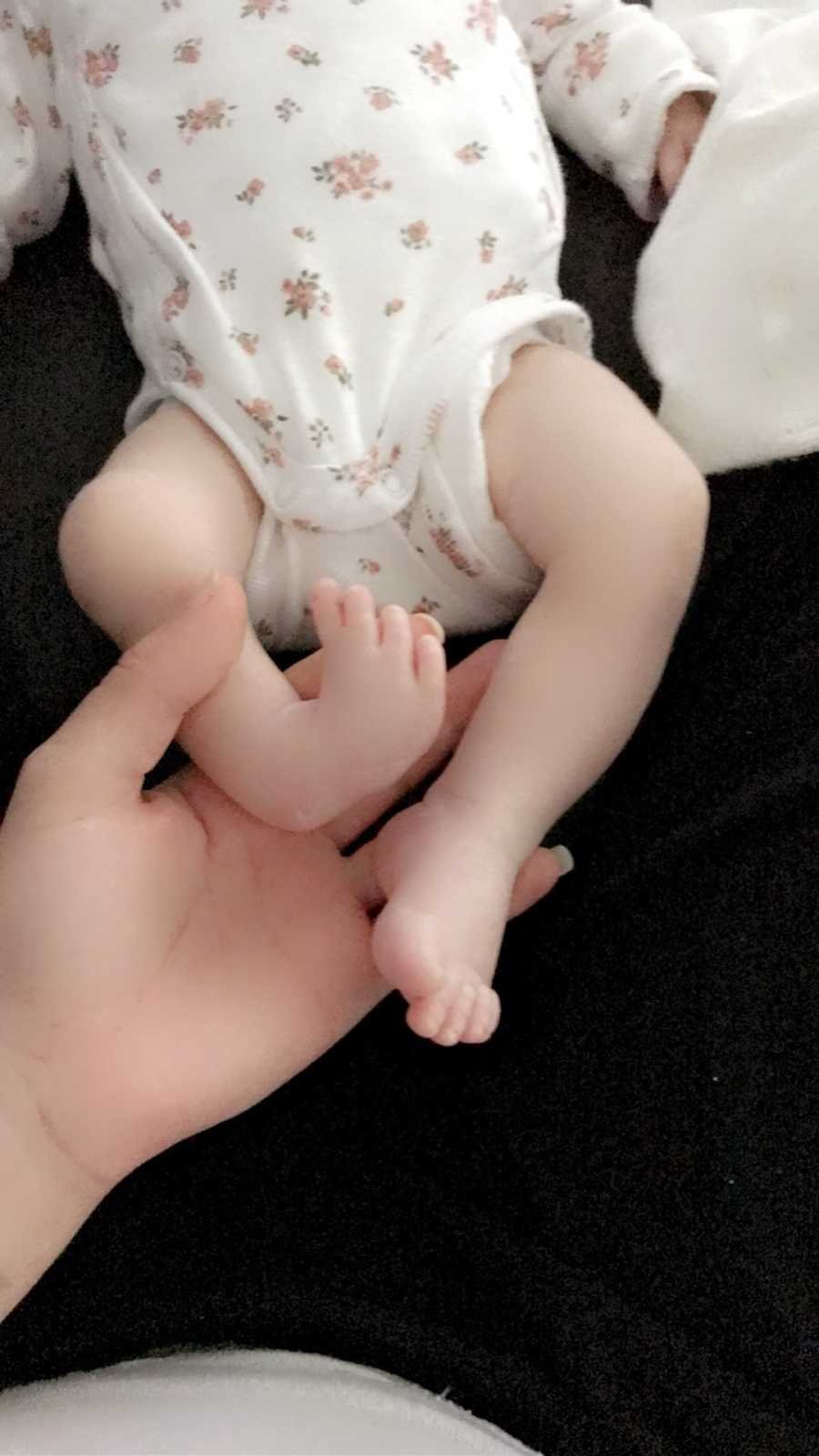
“They put her on my stomach, and we saw that her hand and foot were different,” her mother recalls. “Then they took her away to check her, since she was early.”
The next hour, alone in the delivery room, felt endless.
“I just lay there waiting, not knowing anything about my daughter. It was the longest hour in my life.”
When she was finally allowed to see Mia again, she found her hooked up to small wires and surrounded by caring hands in the neonatal intensive care unit.
And though her daughter’s body was different, her spirit was perfect.
Understanding Mia’s Condition
Mia was diagnosed with congenital limb difference — a rare condition that occurs when arms or legs don’t fully form in the womb.
“It can happen for many reasons,” her mother explains. “Sometimes it’s linked to a syndrome. In Mia’s case, it was completely by coincidence. She has no other health issues.”
Mia was missing two bones — one in her right arm and one in her leg.
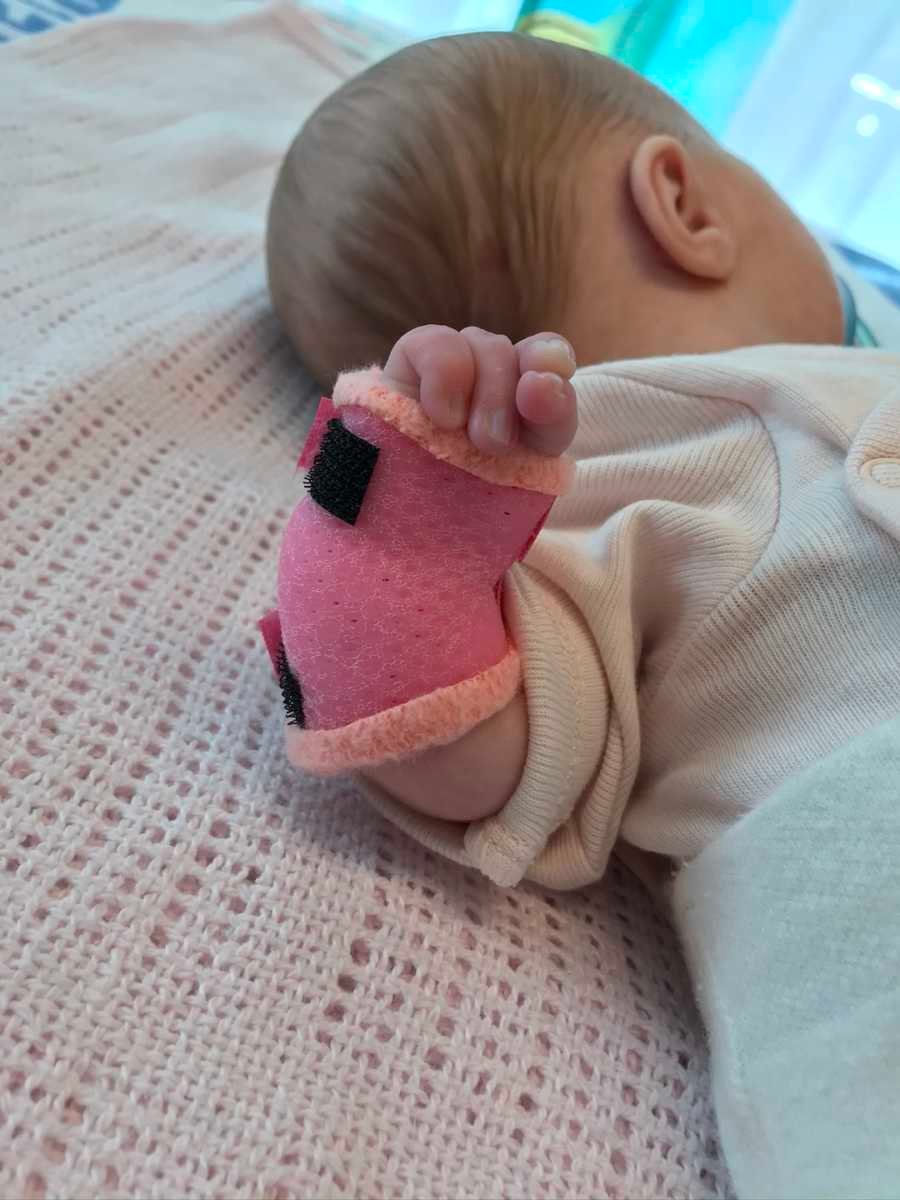
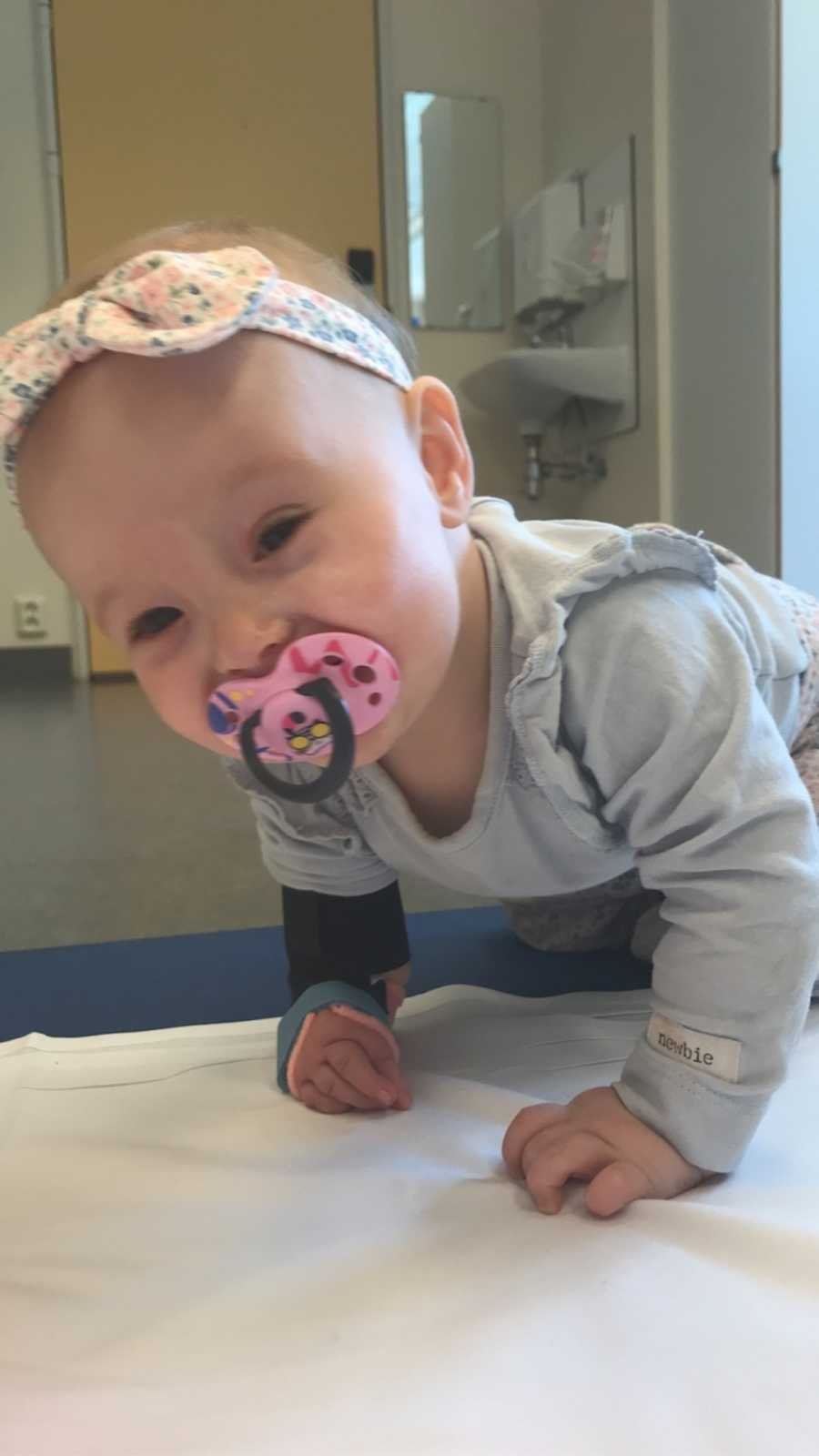
“In her arm, she’s missing the radius bone,” her mother says. “That’s the one on the thumb side, so she doesn’t have a thumb. Her hand stays bent at a 90-degree angle instead of straight.”
To help stretch and align her hand, Mia now wears a small cast while she sleeps. Eventually, surgeons will perform a delicate operation to reposition her hand and create a thumb using one of her other fingers.

“She’ll have normal function,” her mother says proudly. “Even though she’s missing a bone, she can already use her hand with no problem. For her, it’s just normal.”
Her leg, however, presents a bigger challenge. Mia is missing her tibia, the main bone connecting the knee to the ankle. That means her foot can’t bear weight in the usual way.
“She’ll never be able to walk on that foot,” her mother explains gently. “So the doctors will amputate it from the knee. With a prosthetic, she’ll walk and run just like other children.”
They aren’t afraid of that day. In fact, they welcome it.
“We’re actually looking forward to it,” she says. “Right now, her leg is just dead weight. After the surgery, she’ll finally be free to move.”
Strength Wrapped in Calm
From the very beginning, Mia’s parents handled the news with a kind of quiet grace.
“When we got the message about her condition, we didn’t take it hard,” her mother says. “We just told each other — she’s born the way she’s supposed to be.”
There were no tears of pity, no desperate questions of “Why us?”
“Why she was born with fewer bones is something we don’t have an answer for,” she continues. “And we don’t need one. She’s who she’s meant to be, and we wouldn’t change a thing.”
Doctors reassured them that Mia wasn’t in any pain. That was all that mattered.
“The moment we heard she wasn’t hurting, everything else was good news.”
Not a Sick Child — Just a Unique One
In the first weeks after her birth, the couple received a question that cut deep:
“What is it like to have a sick daughter?”
Her mother still remembers how angry that made her.
“She’s not sick,” she says firmly. “She’s a healthy little girl who happens to be missing a few bones. That doesn’t make her ill — it makes her unique.”
She pauses, then adds, “Unique is what every baby is when they come into the world.”
“You’re So Strong” — The Words She Hates to Hear
Another phrase she hears often: “You’re such strong parents.”
She smiles politely when people say it — but inside, she disagrees.
“Every parent is strong,” she insists. “Being a parent can be hard in so many different ways. We just happen to go to more hospital appointments. That’s all.”
Mia, she says, has made parenting easy.
“She’s been a dream baby since birth — sleeping through the night, smiling every day. She’s such a happy soul. For us, parenting isn’t hard at all.”
Letting Mia Just Be Mia
One of the most remarkable parts of this story is how naturally Mia adapts.
Despite being born with one leg and a differently formed hand, she’s learning to do everything other toddlers do — crawl, stand, play, and explore the world around her.
“She’s developing just like any other little girl her age,” her mother says proudly. “We don’t train her to do things a certain way. We just let her be a baby. It all comes naturally.”
Mia doesn’t see herself as different — and that’s exactly how her parents want it.
“She doesn’t know anything else. This is normal for her.”
A Future Full of Possibility
Medical technology today gives Mia endless opportunities.
With modern prosthetics, physical therapy, and reconstructive surgery, her differences will never hold her back. She’ll walk, play, swim, dance — maybe even climb mountains one day.
“She’ll be capable of anything she puts her mind to,” her mother says confidently.
And with each step she takes — whether it’s on her prosthetic leg or with her uniquely formed hand — she’ll be rewriting what it means to be whole.
A Lesson in Acceptance
Through Mia, her parents have learned a truth that many spend a lifetime discovering: perfection isn’t about symmetry or conformity — it’s about love.
“When I look at her,” her mother says, “I don’t see what’s missing. I see everything she is.”
The couple no longer fears the unknown. Their daughter has shown them that beauty exists in difference, that resilience can begin at birth, and that acceptance starts at home.
“She came into this world exactly as she was meant to,” her mother says softly. “And I wouldn’t have her any other way.”
The Courage to Celebrate Difference
Mia’s story has already touched hearts far beyond Norway’s borders.
In a world that often defines worth by perfection, her tiny fingers and soft smile remind us of something bigger — that difference is not defect, and uniqueness is not limitation.
Children like Mia challenge society to look deeper — to celebrate every shape, every ability, every miracle that arrives in its own design.
Her mother hopes that by sharing their journey, others will feel less afraid when life brings unexpected turns.
“I want parents to know that it’s okay,” she says. “That their child will be okay. That love doesn’t shrink to fit normal — it expands to embrace what’s real.”
Mia’s Light
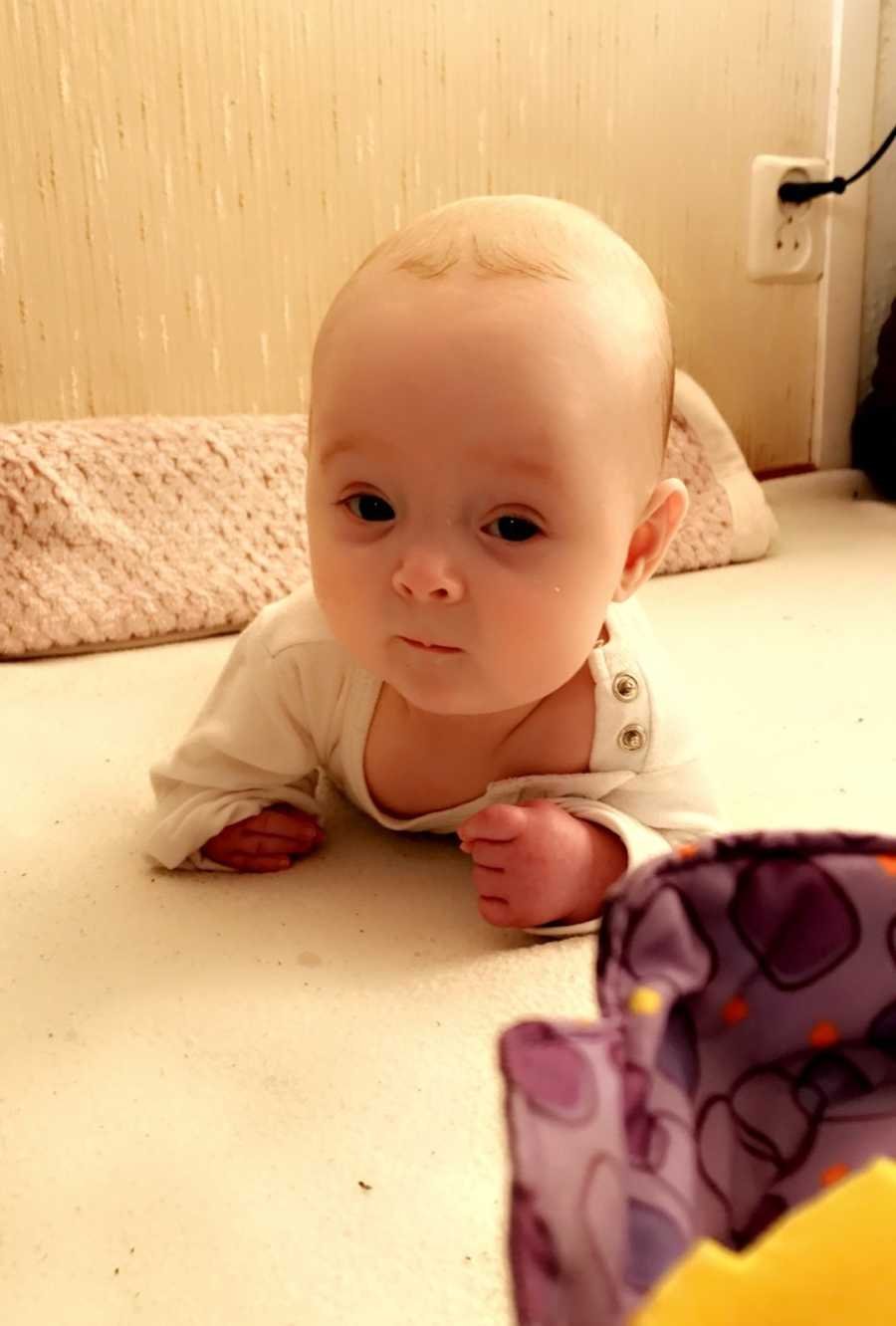
Today, Mia is a thriving, giggling little girl with a mischievous sparkle in her eyes. She waves her tiny hand proudly, crawls faster than her parents can keep up, and charms everyone she meets.
To her, the world isn’t something to adapt to — it’s something to explore in her own way.
“She teaches us every day,” her mother says. “She shows us what strength really looks like — and it’s wrapped in joy.”
The Power of Unconditional Love
In the quiet moments at night, when the world slows down, Mia’s mother sometimes replays that first hour after birth — the hour of waiting, of fear, of silence.
But now, that memory doesn’t hurt. It reminds her how far they’ve come.
From uncertainty to gratitude.
From difference to pride.
From a single heartbeat in Spain to a life filled with laughter in Norway.
“She was born a little different,” her mother says, smiling. “But she was born perfectly.”